American Disconnect

The tragic events in Boston have brought to bear many uncomfortable reminders of the 9/11 horror, but none more all consuming than the need to try to understand the incomprehensible, in the form of the simple question, why? The use of brutal violence against innocents was repeated with the conversion of weapon of choice from plane to pressure cooker, but the intent was the same…to reek havoc, to maim and kill as many as possible.  The application of violence is not unique for such goals.  It happens everyday somewhere on the globe – on the streets of Damascus in Syria, the markets of Kabul, on the subway in London, the transit train in Madrid, the night club in Indonesia, the center city  of Mumbai, India.  The point of such violence is its inherent pointlessness, its anarchistic rage, against those that are seen as insufficiently aware of the bomber’s cause.  What is somewhat new with the Boston tragedy may be seeds of a new reality that America assumed itself to be immune from because of the particular openness of this society, home grown terrorism. On September 11th, 2012, Dzhokhar Tsarnaev took an other declaring his fidelity to American values and became an American citizen.  Seven  months later, he declared his complete disavowal of those ideals, in wanton slaughter of his fellow citizens.

It will be along time if ever that we understand the process that converts individuals like Dzhokhar from being an engaged high school athlete earning a scholarship to higher education to a radicalized cold blooded killer in just a few short years.  The strands of two formative impulses are increasingly apparent, though,  the radicalization of a religion, Islam, into promoting the anarchistic impulses of a whole generation of disaffected youths, and the progressive disconnect of American society from the value set of what it means to be an American.  The power of these dark forces to provide the spark to the internal explosive instability in the Tsarnaev brothers is a discussion we need to face.

The use of Islam as a front for radical anarchy has been in front of us now for several decades.  The civil, modern  world has been slow to the recognition of the marriage between institutional Islam and anarchy, but to continue to deny it is ludicrous.  Billions of dollars poured into the celebration of death and martyrdom, the hate spewed from the mouths of mullahs expressing racial superiority, subservience of women, and holy war, the fueling of internet sites linking violence and the means to achieve it, have radicalized a generation of young people who feel no personal connection with their life and need to express their rage and evict their powerlessness. There is no sense any longer arguing about this being a fringe of the religion – it is deeply embedded in its institution.  The President of Egypt, a leader in the Muslim Brotherhood, refers to Jews not as people he disagrees with, but pigs.  The President of Iran, looks forward to the day when he can lead the annihilation of an entire nation state, Israel.  The Supreme Leader of Iran, promotes a fatwa demanding the death of an author Salman Rushdie, for the crime of expressing a dream sequence about the prophet Mohammad. A member of the Saudi elite family Bin Laden, promotes a caliphate of 11th century ideals through a network of anarchists murdering thousands of people for two decades.  Until the religion of Islam achieves its own Reformation and enters the modern world, it will continue to use the potent weapons of the 21st century, to attempt to achieve the rejectionist dogma of the 7th century.  The civil world owes it to itself to finally come to grips with this clarity.  The Tsarnaev brothers were rudderless in their hate, until institutional Islam helped weaponize it.

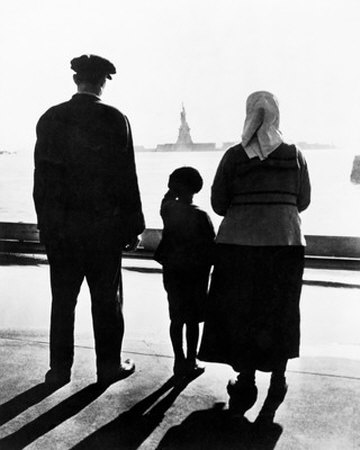
The second thread is a uniquely American one.  The photo above movingly expresses what used to be the immigrant dream – to come to America, to become American meant to leave the rigidity and constraints of a previous life behind, and be accepted as an individual with the limitless possibilities offered in a free society.  It was understood by every immigrant that entered Ellis Island that the sacrifices and struggles  were not behind them, but the societal restraints were.  They would have to learn the language, work long hours, struggle to achieve, but for the generations to follow all would be possible.  The power of a free society was that whatever your roots, the constitutional rights assured you your place in the American dream, because being an American was not where one was born, but what one believed.  It has been assumed that this remains a force today and has kept America free of the disconnected  and disaffected that have plagued other societies. Unfortunately that is a myth we know must additionally face up to.  The Tsarnaev brothers lived the immigrant dream.  From a youth crushed by the extreme prejudice and intense violence of being Chechnyan in the world of Kyrgyzstan and Dagestan, to living in Boston and achieving university status and athletic success, one would assume the juxtaposition would be a positive.  It becomes increasingly evident that with the success of the brothers the isolation and sense of disconnection became increasingly intense.  The older brother previously expressed, ” I have no American friends”.  The younger, superficially expressing the importance of American ideals by bothering to become a citizen, increasingly followed his older brothers fidelity to the superiority claptrap of radicalized Islam, and rejected his potential role in an American free society.  The immigrant process of celebrating your roots while venerating your American conversion was entirely lost on the brothers.  We will probably find out if disconnect switch was Islam, and that we may need to face up to as well.


My literary hero, Mark Steyn, reflects on the American disconnect and our role in it through the vagaries of “coexistence” with a religion that teaches that coexistence is an intolerable state.  We have extended our positive desire to accept all cultures for what they are with the damaging idea that all cultures are equal.  A culture that infuses a hatred of others, proclaims religious and racial superiority, declares the female half of the human race subservient and supports their mutilation, seeks the annihilation of nations, and demands our acceptance of such dogma is not an equal culture to modern society.  Our “co-existence” should include a rational and vigorous defense of our society’s freedom, and the disavowal of any thread of acceptance of such culture and such attitudes.  There is no real way to ever eliminate every individual who feels an internal hate for society who ends up acting out that hatred, but we can stop pretending that being American and living in a free society is something to apologize for.  Multi-culturalism should be the drive to incorporate the best principles of a culture, not accept the flaws and flagellation of a broken one.

My heart and prayers go out to the Boston victims.



People We Should Know #23 – Martin Cooper

      The 2013 Marconi Award for contributions to information technology and communications science was awarded on April 5th, 2013 to a 20th century giant of the information revolution and its a reasonable certainty that you have never heard of him.  Martin Cooper, a Chicago born Illinois Institute of Technology trained engineer, however, probably did more to affect the way you live today than you can possibly imagine.  Martin Cooper will receive the Marconi Prize in October in Bologna, Italy for his critical vision and work in inventing and developing an indispensable modern tool, the mobile cell phone, and like his award benefactor Guglielmo Marconi, inventor of the radio transmission, forever changed the way information could be shared  and propagated, to the everlasting benefit of humanity. For devising a practical tool  that has brought the world to any individual wherever they may be, Martin Cooper readily deserves to be Ramparts’ People We Should Know #23.

Imagine a world without your cell phone and the bounty of links to the world it provides. The phone allows you the power of a computer, the access of a communicator through phone and voice mail, the precise awareness of your location in the world around you through GPS, the networking capability of texting and e-mail, all provided in a device that fits into a shirt pocket.  Martin Cooper visualized it when the world of communication tethered you to a phone number linked by wire to a location and limited to the capacity of the wire to transmit sound or information, but not both simultaneously.  This was the world of 1973, when Mr. Cooper,an engineer for the Motorola Corporation, proved that phone communications could be transmitted in wireless fashion through a portable device powered by its own battery.

The Motorola Corporation was a great exemplar of the power of private capitalism to innovate, something that has been lost in this modern time of government overbearance with shepherding new technologies with companies  such as Solyndra.  It is estimated that Motorola invested over a hundred million dollars in 1970s currency value in Mr. Cooper’s team of visionaries from 1965 until 1993 when the first dollar of profit was finally realized in Cooper’s creation, without a hint that the technology would actually take hold.  Mr. Cooper’s team worked to convert ideas into practical devices.  He stated a large part of his inspiration was the entirely fictional device known as the hand held communicator, a device conceived out of fantasy by Gene Roddenberry, the producer of the Star Trek television show, to allow its fictional characters to communicate with each other and with their ship effortlessly.

The challenge was immense. What passed for the zenith of mobile communication was the car phone, a device that needed engine power and over thirty pounds of installed equipment to work, not exactly the kind of technology that would appeal to the individual walking about. Cooper’s first device was a behemoth, weighing 2.5 pounds, 10 inches long, with a charge lasting twenty minutes and requiring a ten hour recharge, and was indecorously referred to as the “box” or “shoe” phone. But in the fateful year of 1973, Mr. Cooper walked the streets of New York in a public demonstration of his phone, wirelessly called and wirelessly received a phone call, and personal communication was changed forever. From the first practical application of Motorola’s first successful models in the late 1980’s, morphing into the spectacularly successful “flip phone” of the 1990’s, to the incredible power of the iPhone today, dramatic advances in battery capacity, solid state, broadband capacity, and miniaturization were required. But in the space of thirty years, Martin Cooper converted the world to the idea that all information could follow an individual wherever they were, and to the immeasurable benefit of their personal freedom.

Want to know the effect of  Martin Cooper’s vision on our way of life?  The International Telecommunication Union estimated by 2012 that there were 6 billion mobile subscriptions in the world and that the developed world had achieved the saturation point  of over one mobile subscription per person.  87% of the world now has mobile communication capacity and over 73% of what was once referred to as the developing world.  Martin Cooper’s vision  has helped make mobile communications indispensable, practical, and affordable to almost every person on earth that desires it.  It looks like that 100 million spent by Motorola on Martin Cooper was a very good bet indeed.

One can never fail to be amazed at how humans create reality out of fantasy through the simple but magnificent force of their will and intellect.  Martin Cooper, Ramparts People We Should Know #23, proves again that solutions to overwhelming problems are best served by getting out of the way of the incredible capacity of the marketplace to invest in and vet ideas, without the bias of governments that seek to politically control the process.  Despite the billions and billions of tax dollars spent to “invent” a cure to fossil fuels, the likely solution will come from some unknown, obscure thinker, who was inspired by ideas entirely of their own creation, and driven entirely by their own intellectual need to solve the problem.  Somewhere out there, the next Martin Cooper will change the way we live forever.

A Distant Mirror Into the Genius of Thatcher

Can we ever be sufficiently thankful for the magnificence that is the internet? After yesterday’s Ramparts eulogy reviewing the supernova that was Margaret Thatcher, the perfect record of the young and vibrant Thatcher describing with passion and wonderful intellect the basis for conservative political thought was posted by the Weekly Standard today, and it is a wonder to behold. Can we imagine our current political class engaging in such a thoughtful principle driven discussion of the fundamentals of human action and reaction?  Take a minute and revel- its this snapshot of Thatcher before she won the Prime Ministership that made grown men pause in awe, and drop their pretense that a woman could not lead men, breaking the glass ceiling forever:


Iron Lady

     When I was a little boy, it was interestingly my mother who first connected me to my love of history and the storied greatness of certain of its participants.  She was in the kitchen making a meal, when I wandered in to see if I could catch some early hint of dinner to come.  Normally it would have been a certainty I would get a taste of what was to be created without much effort, but this time she seemed to be in a very serious mood.  “Do you know who died today?” she asked.  Being very young I had no clue; but she pressed onward.  “A very great man”, she said, “Winston Churchill.”  She showed me the newspaper- the entire front page was devoted to him; a large photograph of a smiling man with a cigar flashing a victory sign dominated the front fold.  I was hooked – it seemed the whole world knew this man and saluted his memory.  It was my first contact with greatness universally recognized and it would never leave me.

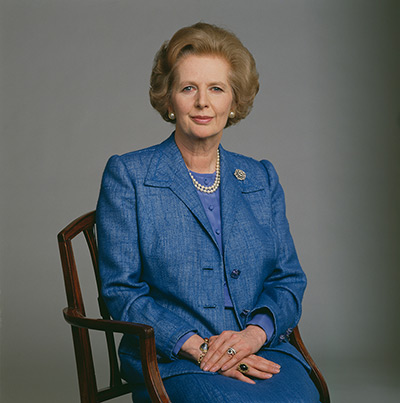
Historical greatness belonged to another British Prime Minister of the 20th century, and she, Margaret Thatcher, in many ways laid a similar stamp of recognition of greatness from all who knew her, or lived in her time on the stage. She was a warrior for the individual and liberty, a true defender of the Ramparts of Civilization that is the guts and basis for this blog.  Today she passed on, and as it was with Churchill, the recognition of greatness cloaked her memory, and reminded the world of the power of those who back up their intellectual prowess with the power of their principles and the will of their conviction.  At a time when all the world trembled before the darkness of fascism’s power, Churchill radiated the confidence in the eventual victory of a free people.  Some three decades later, when Britain once again had become a shadow of its former self, she resurrected the concept of the power of freedom and individual aspiration, and brought that great nation and much of the free world back out of its self absorbed decline.

For those who believe all things are possible in a free society if you work hard and maintain focus, Margaret Thatcher was the poster child.  Born of absolutely middle class values and capacities, she belied the perceived notion that only the elites of society could have sufficient perspective understanding of societal needs and obligations. She was a bedrock supporter of the idea of individual as owning the ultimate definition of their own existence and fate.  She disdained the idiocy that stereotyped a woman who raised a family and cared for her husband as unable to compete on the stage of egos and intellect, frankly crushing her opposition time and time again in the battle of ideas and the arena of victories with nary a hair out of place on her coiffed hair or a discernible wrinkle in her immaculate dress.   She was a feminist in the truest sense, leading her party and nation through turmoil and victory, not always assuming that her very presence should be proof enough of her capability (unlike a certain American female politician that has spent twenty years being available, and performing poorly when called).

Most importantly, Margaret Thatcher was a person of principles that put her actions where her principles lay.  Like Ronald Reagan, and even more so, she was fully committed to standing on principles at risk of her defeat.  She was a warrior for real conservatism- the concept that freedom and free will best dictate progress, and that progress is the natural evolutionary state of all streams of creativity in the arena of ideas.  She was a chemist, a scientist and a barrister, and recognized that creative streams would need guidance but not correction.  She knew why liberal society failed, and that its failure was the product of expectation not reality.  As Milton Friedman said, and she believed so firmly, “One of the great mistakes is to judge policies and programs by their intentions, rather than their results.”  She was not interested in what felt good, only what worked, and she was particularly derisive of the softcoats in her own party that attempted to undertake shallow copies of their opponents programs in hopes of “appeasing” the voters.  As she strongly projected at the wobbly Conservative Party congress of 1980, ” You turn if you want to.  The lady’s not for turning.” 

She believed conservative, limited government worked, and she stood proudly for it, in the face of vicious attacks on her character.  When they attempted to paint her as infeminant, calling her Iron Lady, as if her forcefulness was somehow “bitchy”, a typical weapon of liberal assassination, she overwhelmed them by grasping the moniker and making it her own.  She withstood the further verbal grapeshot of the left, “racist”, ” snob”, and “hater” and put forth a conservative agenda of privatization, personal aspiration, and firm support for the law to transform the cowering Great Britain of the 1970’s crippled by strikes, moral decay, international withdrawal, and overwhelming socialist regulatory economic stagnation into an economic and independent juggernaut of the 1980’s and 1990’s.  So powerful was her sway, that when the Liberal party under Tony Blair returned to power in the mid 1990’s, no effort was made to return the economic structure away from private development. The lady, it turned out, was not for turning.

The moment of great conviction and return of international influence was  through her steadfast and very public defiance in the face of the twin challenges of Soviet aggression and Argentine invasion of the Falkland Islands.  On one front she bolstered the new American President Reagan in his heretical calling out of the Soviet empire as “evil” and stating it would “end up like all totalitarian regimes on the trash heap of history”.  To the other in the face of American indecisiveness, she put Great Britain squarely in the position of defending its territories in recognition of a free people, the Falkland Islanders, selecting their own determination to stay British.  The once great power of Great Britain  again projected halfway across the globe and achieved a victory in a way that most thought impossible without American support.  Thatcher was not about to lose the British capacity to choose its own destiny, as reserved to all free people, even when her best ally could not see a shared interest, other than the philosophic one.

Like all great people, Margaret Thatcher was eventually pulled down by her implacable will, when the furtherance of that will exhausted those who continued to be held by her high standards.  She was thrown out not by her people, but by her party, who made the recurrent failed argument  that a continued rigorous governance on principle had exhausted the population and could no longer be supported.  Once again, the pale copy of ideal over performance led to the defeat of the conservatives, by the liberals led by Tony Blair who recognized the fatal mistake and campaigned as the True Hybrid of Thatcherism and Humanism.  In her later years, as she led a quiet family existence, the chance to forget her successes and rewrite history proved tempting to a media no longer afraid of her brilliance and energy for defense of ideas.  To be great is to eventually be destroyed by those who could not cotton to her greatness.  This proved no different for Thatcher then for her predecessor Churchill or her compatriot Reagan.

Yet death re-writes all history, and the immense imprint of a life overwhelms all superficial efforts to distort it.  The call of contemporary Prime Ministers in her shadow make it clear she is a once in a lifetime figure – no perspectives on Heath, Wilson, Callaghan, Major, Blair, Brown, or Cameron are likely to echo through the centuries as will the Lady Thatcher in the hallowed halls of British Parliamentary history.  She was a leader of people who happened to be a woman, a deliverer of a country who happened to be a commoner, and an intellectual giant of economic governance who happened to be the grocer’s daughter. None of these stereotyped categorizations turned out to matter in the least.   Let them try to knock her down.  She is a force of nature that withstands all slings and arrows.   Margaret Thatcher, a true defender of the Ramparts,  died today at 87, but you will never see extinguished the blazing light  of her effervescent star.

 Be not afraid of greatness.

Some are born great, some achieve greatness, and others have greatness thrust upon them.

Twelfth Night   W. Shakespeare


A Crossroads of Western Civilization

My recent neglect of my duty at the Ramparts has been driven by  time constraints, not by the lack of living in interesting times.  I thought I would get ‘back in the saddle’ with a good old fashioned immersion in the complex ribbons of history that have formed our perception of ourselves, our western ideals and way of thinking.  The stimulus is the visit of one of my Swiss relatives who harken from the venerable city of St Gallen, at the Eastern edge of Switzerland, but at the epicenter of many of the fascinating formative influences of modern Europe.

The glory of St Gallen is not in its epic leaders, warrior kings or trading routes.  The little city of St Gallen instead claims its heritage as the home of people who preserved the knowledge of the world when it was considered the least valuable possession of a violent and harsh time of autocracy in Europe.  The center of knowledge of St Gallen was its Benedictine abbey, and the epicenter its magnificent library, a world heritage site.  How so many great books came to populate this library, preserved from the 9th century onward, is the story of knowledge and its battle with  darker forces,  and in the history of its shelves the story of the path to a modern Europe.The creation of a center of knowledge in the central European continental wilderness of the alpinian foothills near Lake Constance is wonder of man’s striving for something more than just existing, and starts in of all places, Ireland.  Christianity had a powerful evangelical influence on Gaelic culture and the concept of knowledge and piety as intertwined concepts made Ireland an oasis of education at one of the truly dark times in history.  The collapse of the Roman Empire in the fourth century led to a multi-century period of tribal control on the continent with war and conflict a constant.  At a time when a man’s life often depended on his ability to stay within the confines of his feudal lord’s domain, Irish monastic evangelism boldly traveled far from home, spread the word of Christ and the process of education that the training entailed.  First across the Irish sea to the western shores of Albion (England and Scotland) and from there to the far environs of the continent, the Irish Evangelists brought not only the word but the idea of knowledge and study with them.  Saint Columbanus with twelve fellow Irish disciples spread across the continent around 610 AD and brought their concepts and evangelistic fervor to the wilderness tribes at the periphery of civilization’s reach.  Gallus, one of Columbanus’s disciples traveled with him down the Rhine, but due to illness, found himself unable to continue with Columbanus’s journey to Italy and was left to fend for himself in the wilderness around Lake Constance. Here he developed a hermitic existence  in the forests proselytizing to the locals.  Upon his death, a little church was established, but it took other events to shape the eventual importance of St Gall.

Elsewhere in Europe other forces were coming to bear.  The monastic tradition of desert isolation so much a part of the early church was being changed by the experiences of the Irish monks and others. Monastic life began to evolve into the fabric of the surrounding populous rather than be completely separated from them, despite the isolation suggested by monasticism.  St Benedict would define rules of monastic life that would provide a bridge between individual isolation and zealotry and the realistic necessities of community life with like minded individuals. The central focus would be service to God, but it began to extend into behaviors with others and  focuses of communal life that suggested the value to this service of activities such as work and education.  This lead to a closer positioning of the monastery to the population, and the monastery as a source of education for the secular class, bonding the religious tradition in a safe embrace with those who would rule the population, and ultimately protect, the monastery.  With the development of large imperial empires on the continent through the resources of the Carolingian kings such as Charlemagne and the later eastern competitors under the Habsburgs. Kings, recognizing the importance of the organized monastery in elevating the capacity of the empire, began to “assist”the placing of abbots who would adhere to Benedict’s rules of order.

Under the auspices of the Carolingian kings, St. Othmar would be the actual developer of the monastery at what was eventually to become the abbey at St Gallen, and the site of the little church that marked the hermitage of Gallus, was converted to Benedictine rules, and became the site of great Benedictine abbey of St Gallen.  The focus of Benedictine monks on introspection and study required the presence of a scriptorium, a place where concepts of religious thought and learning could be secured by monks permanently onto paper, for others to study, and eventually the development of a repository, or library, for the accumulated scripts of the community.  The abbey at St Gallen became acknowledged over time as one of the great repositories of knowledge in Europe, and St Gallen became a prized location for various factions who felt the city belonged in their sphere of influence.  The city became a center for education and eventually industry, with its skill in textiles particularly valued.

St Gallen had made itself valued through its abbey, but the progressive prosperity of the city increased the strains between the abbey and the burgeoning middle class that wanted to control their own destiny separate from the princely power of the abbot. This led to a period of great instability in the fifteenth century, in which the town and its guilds rebelled against the abbey’s administration and the abbot threatened to move to the town Rorschach on Lake Constance.  The city would have none of it and the result was a tumultuous time of conflict that eventually led to the spread of the conflict to the surrounding cantons and the intervention of the Hapsburg Emperor Maximilian. The Hapsburg Empire, thoroughly galled by the ongoing autonomy of the Swiss confederation cantons was not interested in seeing this border city or others like it act independently, particularly when it came to valued assets and progressively the cantons and the empire slid towards war. The Swiss, however, were not amateurs to conflict, having become known as front line troops in the conflicts of the Holy Roman Empire, and Maximilian proved rapidly in over his head, absorbing a humiliating defeat to the Swiss confederation in the battle of Dornach in 1499, ending the set of conflicts known as the Swabian War, and securing the independence of the city state of St Gallen and the other Swiss Cantons until a brief conquest in 1798 by Napoleon.

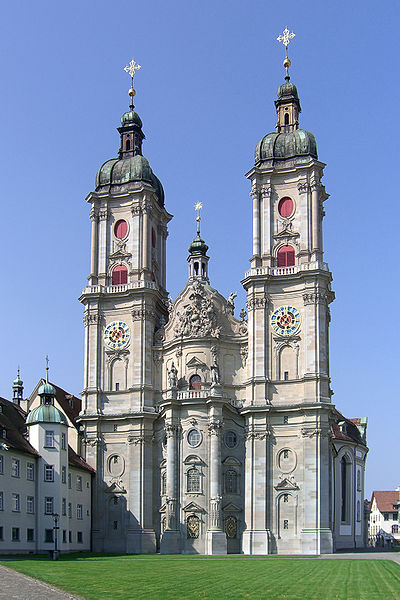
The abbey was not quite as lucky given the outcome of the Swabian War.  It lost its connection to imperial protection, and with it became vulnerable to the rigid hold it had on its properties.  When the Protestant reformation swept through St Gallen as it did much of northern Europe, the Catholic abbey lost its influence, and in 1803, its existence as a monastery, with only the surviving segments of the functioning monastery, the baroque inspired cathedral and the library.

Though pummeled by forces of history and at various times losing portions of its magnificent collection, the library remains a window into thirteen hundred years of European history, with the particular gemstone of its collection over 2100 hand scribed manuscripts from the Middle Ages, and over 400 preserved manuscripts more than a thousand years old.  Reaching back into the time when the only secure connection of man’s intellect with history was preserved by the isolated monk accepting as a  concept of service to God the hard work of scribing for posterity human thought,  the library stands as a rampart of civilization that has come to us ennobled by time. In the little town of St Gallen there stands some of the brighter embers of man’s capacity for greatness.


Rand Paul and the Rise of the Principlitarians

This week we saw something rare in modern political discourse. The junior Senator from Kentucky, Rand Paul, invoked one of those archaic legislative tools from the nation’s past, the filibuster,  to awaken the world to the reality that he was going to have a say about the nation’s future.

The venerable filibuster, the action by which a Senate action can be delayed, adjusted, or withdrawn on the basis of a single individual’s action, has been under attack by the controlling interests in Washington, who have been embarrassed by its quirky nature to upset carefully laid plans for culmination of the elites’ agendas. Elite dominance of the legislative process is nothing new, nor is the concept of filibuster.  Cato the Younger, zealotrous defender of the idea of Rome as a republic, formally initiated the concept to foil Julius Caesar’s manipulation of the Senate by devising long winded speeches that would delay any action on Caesar’s requests until nightfall, where , by edict, the Senate had to adjourn. The United States Senate has been the stage of a filibuster over the many years since its founding, for good or ill, but in inevitably as a device to assure an overwhelming majority of support is present for an action, as it takes 60 votes out of 100 Senators to obtain cloture on the filibuster.

Recently, both Republican and Democrat leaders have considered the elimination of the filibuster, for in a closely divided nation, the ability to push things through the Senate has become considerably more perilous.  The filibuster, evoking the rights of the individual against the weight of the majority, has in reality on many occasions been a delay tactic without structure or inherent value.  It has often looked silly with debate being artificially extended with reading into the Senate record baseball statistics, or names and numbers in the phone book.  Rand Paul took the concept and wrenched it back into its deeper reason for existence, “talking back” Senate action on the basis of principle.  In a carefully crafted recitation on the principle of the rights of the individual and the concept of limited governmental powers,  Paul exploded the idea that elemental ideas that founded the nation were from and for another era, and were immaterial to the way the government currently views itself.

Paul invoked intense discussion on whether the government that currently viewed itself as having an ultimate right to view an American citizen overseas as an enemy combatant and thereby attack him without due process, had the same right to deny an American citizen due process on American soil. The war against terrorism over the last decade has progressively placed American military action on the side of decisiveness rather than discretion, and Paul was having none of it.  Paul’s  almost thirteen hour filibuster to delay a vote on John Brennan, the Obama Administration’s nominee to take over the CIA, on the lack of Brennan and Attorney General Holder’s response to one question, whether the United States government felt it had the right to perform a drone strike on an American citizen on American soil without due process, was a wonder of the concept of principle, logic, and philosophical depth.  This was no reading of the phonebook.  In the end, the Obama administration got their vote on Brennan, but not before Paul stunned Washington by gaining the acquiescence of the administration in formal letter response, that it did not have a constitutional right to such action.

Rand Paul and a new group of citizen legislators are filling a need that a jaded Washington has been too long without, the idea that principle matters, and that the country has not entirely succombed to the concept of having their priniciples bought off.  Dismissed as a “a tea party generated son of a kook” by establishment types when the kentuckian Paul first won  the Senate seat in 2010, Rand has instead projected himself into a modern version of  palatable libertarianism, and with measured, intelligent defenses of the most basic rights endowed in the Constitution, a formidalble opponent to the usual Republican”to win we must be more like them” strategy. The idea has intense appeal among people who feel that government and rights are philosophically constructed, and based on principles, not laws that can be changed on a whim to prevailing winds.  The people that Paul appeals to see the Bill of Rights as a critically  secured set of principles independent of time, read the Federalist Papers to understand the Constitution, conceive the framework of the constitution as the living protector of the basis of why an America exists, and find modern disdain for carefully crafted principles disdainful in and of itself.  Paul is not alone, as Senators such as Rubio, Lee, Cruz, and Johnson are of like seriousness and internal mettle.  The concept of “kookdom” is becoming more and more absurd when the “kooks” are arguing individual rights, state rights, budget discipline, right to life, sanctity of the concept of marriage, and reduced American adventurism, while the modern establishment in the form of progressivism is arguing enforced restrictions on speech, ignoring border stability, global warming, alternative lifestyles, abortion on demand, budgetary obliviousness at the expense of future generations, and drone strikes on American soil.

Whether Rand Paul and his fellow Principlitarians can create a new consensus in the country that a serious discussion of ideas and future actions start with a foundation of principles, not desires, formative policy, not reactionary indulgence, is certainly unclear.  The forces represented by President Obama, that use demagoguery and bribes to convince the voter, has always been powerful, and the fuel of trillions of dollars of persuasion is a devastating weapon against the desire for identifying and promoting  personal responsibility and a freedom in life’s choices.  It appears however in the personage of Rand Paul and Ted Cruz, principles to live by will not go quietly into that good night.


Miracle On Ice

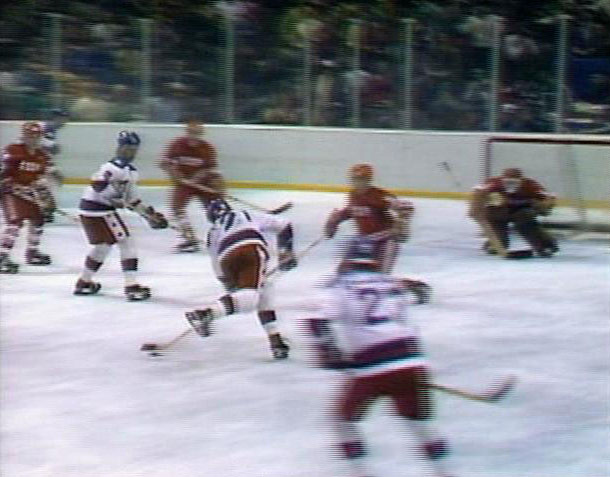
To see it as a television projection is ultimately the most appropriate way.  The memory after all, for all but the 8500 people in the stands of the Lake Placid hockey arena on February 22, 1980 is a gift of the medium of television.  Mike Eruzione, a college player from Boston University, is caught at the moment of release of a shot that had incredible repercussions in sport, national relations, and history. Its impact continues to this day as a defining event of the later half of the 20th century and indirectly affected the lives of tens of millions of people through memory and inspiration.  Instead of epic, sacred, or profound, it occurred, of all things, in a hockey game.

33 years later, the anniversary of one of sports and history’s epic events was brought to the forefront by an auction.  Eruzione, whose life has been molded by the Game, determined to get value out of his jersey and hockey stick from the event, for the purposes of value to himself and his charity.  The jersey sold for 657,250 dollars, the hockey stick for 262,900 – the memory obviously for everyone who experienced the moment, priceless.

The funny thing is, almost nobody out of the arena saw the event live.  Television wasn’t the superconnected force it is in today’s society.  The Olympic hockey game between the United States and the Soviet Union occurred in the afternoon prior to prime time television and the game was broadcast on tape delay.  I was a college student at the University of Wisconsin and went to a bar on a snowy, cold night with two friends to watch(drinking age was 18 years of age then, but that is another story) as none of us had a TV, and all of us had interest in hockey, particularly with the local connection to Wisconsin players in the game such as Mark Johnson and Bob Suter.  It is hard to imagine in today’s world of instant Internet informational access, that nobody outside of Lake Placid had any idea what had transpired.  We watched the game with complete innocence, and progressive, utter disbelief.

The game itself had ridiculous connotations beyond what a hockey game, or frankly, any sporting event deserved.  The United States in the late winter of 1980, was in a world of psychological hurt. the previous decade had seen ignominious defeat in Vietnam, the devastating effect to the concept of moral leadership of Watergate, the economic blow of the rise of OPEC and resultant oil embargo and rationing, the national paralysis over the impudent Iranian takeover of the US Embassy in Tehran, and the rise of Soviet aggression in Afghanistan.  President Jimmy Carter, an ineffective , righteous micro-manager, appeared helpless in the face of such forces, and determined to take out his anger with the Soviet Union through sport, having threatened through his Secretary of State Cyrus Vance, just before the Winter Olympics in Lake Placid to boycott the Summer Olympics in Moscow later that year, summarily in protest for the incursion into Afghanistan.  The United States as an international force for stability and good, was felt to be a hollow shell of its former capacities, and the world was moving onward toward progressive volatility without it.

The game was positioned to be as David vs Goliath as any sporting event in history. The United States team was filled with obscure amateurs from a country in which the best athletes participated in sports such as basketball and football.  Most Americans watching hockey for the first time were likely unaware that US colleges even  fielded hockey teams, as  so few universities actually supported such a minor sport.  The Soviet Union, on the other hand, had a team of professional players practicing year round with financial support and state of the art facilities sponsored by its military superstructure, making the team a propaganda arm of Soviet might.  The Soviet team was deeply comprised of hall of fame quality depth, that made a practice of devastating other professional teams from Europe and the National Hockey League.  It was without doubt, the finest professional team currently playing, and the idea that upstart college players from a minor hockey country like the US could compete in a match was considered fantasy, the proof of the pudding a nasty 10-3 spanking the Soviets applied to the US team just ten days before.  Having already “proved” parity in the international basketball arena by defeating the US in a controversial upset at the 1972 Olympics, the Soviet team was not about to make room for the upstarts in the sport they owned.

The amazing thing about sport is, of course, the incredible power of carrying a chip on your shoulder.  The American team underwent blast-furnace coaching by Herb Brooks, determined to use the psychology of “shocking the world”  in preparing his team.  The game in his mind was to break fine crystal; in other words wreak havoc on the precision of the Soviets through contesting every minute as a physical contest of wills.  The Soviets, convinced of their overwhelming superiority, expected the Americans like every other team,  to  wilt under the continuous pressure of superior talent and precision play.  Brooks was more interested in the game becoming a survival of the fittest contest.

The Soviets ended up helping the Americans every chance they could.  They allowed the game to unfold exactly as Brooks hoped for, with the unease all on the Russian side.  An early goal by the Russians was answered with an American goal, but the pressure was all Soviet on the beleaguered American defense and its goalie Jim Craig, the Russians peppering him with numerous blasts and taking a 2-1 lead,, until the inconceivable happened that changed the game, and history.  With seconds to go in the first period almost empty of any US offensive plays,  a long, loose slap shot by the Americans on the Soviet goal was poorly handled by the indisputably best goalie in the world, Vladislav Tretiak, allowing the rebound to inadvertently end on the stick of Wisconsin’s own Mark Johnson, who calmly slapped it by the stunned Tretiak with a second to go.  The game, expected to be a blowout was now tied, 2-2.  The Soviet coach Viktor Tikhonov then did the unthinkable – he apparently determined to “punish” Tretiak by pulling him from the game and inserting his backup goalie Vladimir Myshkin.  In the hallowed halls of impetuously stupid coaching maneuvers, this was took the cake, giving the Americans a win on the game’s strategic chessboard they had no reason to expect.

The second period was all Soviet, scoring a goal, and out-shooting the Americans 12 to a pathetic 2 shots on goal and taking a 3-2 lead.  The game was nowhere near as close as that, as Soviet bombardment continued on goalie Craig unabated, with shots deflected by the netpipes and by Craig with near equal occurrence.  Then suddenly Mark Johnson, as those of us who had seen him play so often with the University of Wisconsin team, took advantage of opportunity as only a true scorer does, making the most of a rare American power play man advantage, scoring on Myshkin with just over 8 minutes left, tying the game again at 3-3.  I can still remember my friends and my shared excitement at the idea that at this late stage in game, the upstarts were in a position to do the unthinkable, and potentially actually WIN.  Many camera angles began to capture two amazing sights.  The first was the ‘carnivore tensing for the kill’ expressed in Coach Herb Brooks face as he realized how close the team was to achieving the greatest upset since David slung the rock at Goliath; the second was the incomprehensibly worried looks on the Soviet players as they felt destiny pressing against them with overwhelming force.

With exactly ten minutes left, destiny called Mike Eruzione, and he answered, with a slapshot just inside the right faceoff past Myshkin into the net.  The greatest team in hockey, the pride of the Soviet Army, the unstoppable force of collectivist organization, was now trailing the collection of college hobbyists from the United States on the world stage.  The pressures from this point onward, the gritty defense of the United States against the greatest offensive players in the world, the goalie Craig who was summoning from nowhere one of the greatest displays in goalie play ever witnessed, the power of intense humiliation staring the Soviet professionals in the face, the incredible tsunami wave of emotion pouring forth from the disbelieving crowd, made the last ten minutes hockey an epic of memory never to be forgotten.  Shot after shot, wave after wave of Soviet drives against the ramparts of the American will to persevere defined every succeeding second, until ABC’s TV announcer Al Michaels made his career in broadcasting by framing the final seconds in immortality:

 11 seconds, you’ve got 10 seconds, the countdown going on right now! Morrow, up to Silk. Five seconds left in the game. Do you believe in miracles?! YES!

The impact of what had just happened (actually what had happened several hours before due to the TV delay) was indescribable. My friends and I were stunned by our own emotional exhaustion, and I remember few words were expressed.  The overwhelming emotion was elation, at its purest derivative.  It describes the sensation, however indirectly, of having participated in something you know is life affirming, and unique in your exposure to it.  It brought to the world possible, out of all that was felt impossible, and I suspect for the next decade drove a resurgence in can do spirit for which the 1980’s became known for.  It is  possible that such elation in its highest form fueled the spark of Solidarity, that out of the factories of Gdansk, took on and eventually dismantled the Soviet omniscient hegemony. It may have brought the can do spirit that caused the American economy to roar back under President Reagan, when framed in prism of what an individual is capable of. It may have powered the return of American creativeness and individual will to succeed that created the Information Revolution and ascendancy of American invention and entrepreneurship.

All that from a hockey game? Maybe, maybe not.  Mike Eruzione is smart enough to understand the power of the symbols of that game to everyone and auctioned some material items off for monetary gain.  He is also smart enough to know, however, that the ultimate prize from the game is the crack in time that is fused forever in the television frame above, where his destiny, and the history of humanity, was briefly fused in undeniable joy.  Such memories are unauctionable; his, mine, and for millions who saw it – ours forever.


The 3 AM Phone Call Standard

The  story that continues to be unfolded regarding the September 11, 2012 terrorist assault on the American Consulate in Benghazi, Libya that resulted in the deaths of Ambassador Chris Stevens and three other Americans, is a progressively more sordid one.  The image of a hands-on commander in chief and supporting national security team competently managing a crisis in defense of critical American interests appears to have been as far removed from reality as a snowstorm in the Sahara.  The growing conclusion that the American administration led by our current President was unprepared for the moment despite recurrent warnings, and when faced with the crisis, determined to do nothing but look away, is becoming more and more apparent.

The standard of the ever vigilant watchman over American interests propagated by every Presidential candidate is one that was ruminated upon by the very protagonists in this story long before Benghazi.  In 2008, then Presidential candidate Hillary Clinton, facing an increasing threat from the left as to her democratic nomination for the Presidency by upstart Illinois Senator Barrack Obama, framed for the voter the key question of experienced competence they should consider when selecting a President – who is best prepared to deal with the unexpected crisis? Put simply, who do you want to answer that call at 3 AM?

According now to confirmations of  White House phone logs from the night of September 11, 2012 there were no phone calls between the President and his National Security team regarding the unfolding crisis at 3 AM…. Nor were there any at 1 AM, or 11PM, or 8PM.  In fact, the White House under pressure from Senator Lindsey Graham to release the status of interactions from that night revealed there were NO communications that night  between the President and his Secretary of State Clinton, between the President and his Secretary of Defense Panetta, or between the President and his Joint Chief of Staff General Martin Dempsey over the entire 7 to 8 hours of the progressive assault on the consulate and the annex.

In the eternity of hell that was occurring in Benghazi over an 8 hour period it appears now that nobody held the vaunted 3AM standard presidential candidate Clinton felt was so telling about the qualities of leadership paramount in representing America. Secretary of Defense Panetta and Joint Chief Dempsey stated they ignored repeated calls for backup and assistance by the beleaguered soldiers defending the annex because the State Department under Hillary Clinton never requested it, and because there wasn’t enough time.  Secretary of State Clinton, the originator of the 3AM standard of leadership amazingly testified that she had no interaction that night with events, and was unaware of the threats repeatedly cabled to her by her Ambassador Stevens because ‘no one could possibly be aware of all the millions of cable transmissions that cross her desk.’  Fundamentally, she did not feel the need to understand the event further, because, as she snarled back at Senator Ron Johnson, to his question as to from whom the ongoing instructions came to UN representative Rice to continue to obfuscate on national television four days later about a supposed video inciting a peaceful rally to the destructive attack in Benghazi that night, “What difference does it make, why four people are dead ?”

Not to distract from our discussion, but please tell me what exactly is the attraction of this nation to Hillary Clinton’s skill set? With the millions of talented women out there with similar education and presentation skills, is this truly the best we can do? She has wobbled from disastrous attempts to become wealthy by means such as the Whitewater real estate fiasco and cattle futures, botched the coordination of comprehensive health care under her husband’s watch, delayed and likely obstructed federal investigations by hiding key documentation from her Rose Law firm days, accused the country of a right conspiracy attempting to destroy her husband when it was his own behavior that put him at such peril for impeachment, got run over by candidate Obama who frankly ran rings around her in electoral planning and competence, and finally, has sat at the State Department through the deterioration of relationships with Israel, Russia, China, and ongoing diplomatic flops with Arab Spring, Iran and North Korea.  And now the inventor of the 3AM phone call standard is nowhere to be found during the catastrophic attack on her own ambassador and consulate, and a no show in the presentation of the Administration’s position in the aftermath.  Really…Presidential material?….please people; let’s be serious.

And finally, the President himself. What kind of leader hides under a rock during an active assault on United States territory and representatives, then allows the false message to be repetitively delivered for days  that the attack was a reaction to a nonsensical video, knowing all long that a coordinated attack by al Qaeda took place on the anniversary of 9/11 upon United States interests resulting in the deaths of four Americans?  What kind of man feigns outrage at a debate that he would never stand by knowingly when American forces were under assault, when the record shows now he did exactly that – communicating with no one, directing no action, accepting no responsibility, and discerning no followup reaction?

We know now that President Obama was notified of at least two previous coordinated attacks on the consulate in April and June, 2012, including one that breached the wall of the consulate, preparing for the eventual assault on September 11th, but took no action to fortify the consulate’s defenses.  We now know that Ambassador Stevens himself summarized the attacks and the progressive danger in an August 16th memo, and no action was taken to fortify or protect the mission by the State Department led by Ms. Clinton.  We now know that the President did not discuss with the government of Libya the events until the night of September 12th, long after any local response could have been formulated or combatants apprehended.  We now know it was known by multiple levels of government, that on the night of September 11th, 2012, over a hundred fifty militants, heavily armed with assault rifles, rocket powered grenades, and gun truck mounted artillery initiated a coordinated attack on the consulate killing the ambassador and staff, and hours later, on the CIA annex, killing two military defenders, likely using materials provided by the US to promote the overthrow of the Libyan strong man Gaddafi instead to be used in an attack against the US.  We know now that the President barricaded his re-election on the falsehood that an obscure video by a disgruntled Egyptian Coptic was responsible for an event that was instead a spectacular indictment of months of missteps and lousy followup that have become the trademark of a foreign policy that “leads from behind”.

The record of what happened that night and the events leading to it continue to evolve, but it is a process of evidence that would likely have clamped  any other President in a vice, under a blizzard of withering questions, and yet will leave this particular President unscathed.  We should ask ourselves why that is, and how healthy that is, in maintaining the defense of this country and the principles upon which it supposedly stands.  What is the future of the country where the 3 AM call goes unheeded, and nobody cares.  With the Benghazi incident, we now know, you don’t just get a busy signal, you get no tone at all.

Pictures At An Exhibition

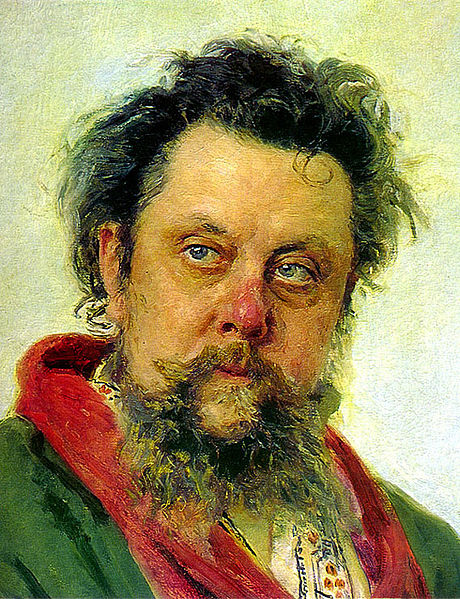
     By 1874, Modest Mussorgsky was experiencing a decline all too common to the Russian story.  Once considered an icon of Russian musical compositional expression, the dual stresses of age pummeled by an all encompassing allegiance to alcohol (so vividly expressed in the ruborous proboscis highlighted in Repkin’s telling portrait of Mussorgsky) had brought progressive detachment and eventual separation from his governmental subsidy as a national composer, and the inevitable slide into obscurity.  Mussorgsky had once been secure as a member of the “Big Five”, along with Borodin, Rimsky-Korsakov, Cui, and Balakirev, a group of Russian composers who determined to express musically a Russian nationalist identity cloaked in Russian history linked to musical  impressionism and based on classic conservatory rules of composition. But genius is not always successfully muzzled by personal neglect, and 1874 produced a very special jewel of  Mussorgsky’s soaring creativity in the Piano suite, Pictures At An Exhibition that has outlasted many of his fellow compatriots compositions in the esteem of the musical public and the performers who bring it to life again and again.

Pictures At An Exhibition  was created by Mussorgsky as an inspired interpretation of his experiences viewing a St. Petersberg exhibition of paintings  by his friend, artist Viktor Hartmann, who had died suddenly from an aneurysm in 1873.  Both artist and composer were devout adherents to the concept of a Russian identity in art, and Hoffman’s death effected Mussorgsky deeply.  The musical concept came to Mussorgsky rapidly, the idea of a ‘promenade’ of musical motifs reflecting the viewer’s walk down a promenade of paintings, rising and falling in a perfect blending of colors and mood, as the viewer left one painting and came upon another.

The suite lent itself to a number of interpretations, but came to maximum fruition when it came upon another musical genius 50 years later, Maurice Ravel, who determined to bring his gifts of orchestral scoring to Mussorgsky’s masterpiece.   Ravel, a master of orchestral color, blew out the limitations of the piano to inflect nuances, shades, spectacle and ominous emotional power to each painting, with the orchestra becoming the vibrant color and expression of each scene and painting character.

Pictures At An Exhibition is as a result very much a work of art that allows musical artists to bring the elements of creation of art to the forefront, and our collective  awe as an audience to what music is capable of stimulating within our brains.  The best expression of this phenomena, is what is created when a genius composition is interpreted by a master colorist, and performed by a master conductor and orchestra at the height of their powers.  From the early 1970’s to Sir George Solti’s death in 1997, the Chicago Symphony Orchestra was felt to be the world champion of musical virtuosity and blunt orchestral power, led by Solti’s intense and dazzling vision of what was meant by being known as the greatest assembled group in classical music.  A very special gift is available to us on the the internet that ties this all together, in a Chicago Symphony performance of Pictures in which the incredible preparation of the orchestra and Solti are lovingly reproduced, followed by the dazzling performance. Worth every second of viewing, it is the perfect vehicle into the artist’s mind, and the magnificent creative impulses that humans are capable of, in creating greatness for which we all are immeasurably benefited.

This Week in History: Opening Pandora’s Box

The origin of man’s frailties and flaws are set forth in multiple cultures, through allegory, in the story of the first woman.  In the Bible’s book of Genesis, God’s creation of Man in the idyll of the Garden of Eden is thrown asunder by the temptation of Adam by God’s following creation, Eve, introducing Original Sin and the subsequent darker forces that would bedevil mankind.  In Greek mythology, the supreme god Zeus orders Hephaestus, the god of craftsmanship, to create the first woman on earth, Pandora.  Hephaestus secures for Pandora sublime gifts of beauty and fertility, but additionally, curiosity, and with it the elements for the Greek version of fall from grace.  Zeus gifts Pandora a mysterious but non-descript box and forbids her to open it.  Her curiosity, however, overwhelms her dutiful allegiance to Zeus’s instructions,  and she opens the box. The box, containing all the evils of creation, rapidly empties, and Pandora is helpless to re-apply the lid and contain the damage.  The allegory of Pandora’s box, the connection of a seemingly innocuous events with profound later consequences, is appropriate for the event thirty four years ago occurring at the Tehran airport in the first week of February,1979.

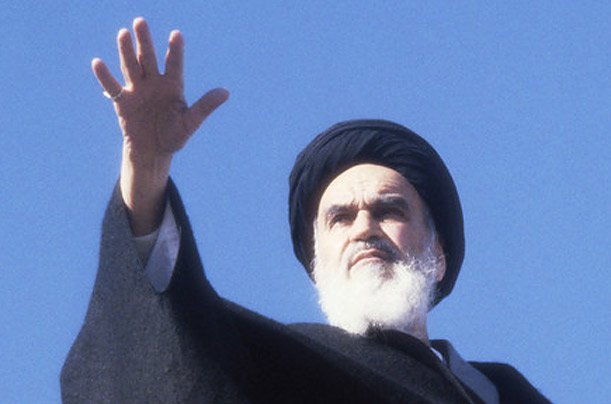
On February 1st, 1979, an elderly man gingerly stepped down the exit ramp of an airplane onto the tarmac of the airport in Tehran, Iran, and with his foot contacting Iranian soil, Pandora’s box was opened.  77 year old Ruhollah Khomeini, a Shia ayatollah, 15 years in exile in Paris for opposition to the longstanding rule of Iran’s Shah Mohammad Reza Pahlavi, was returning on the invitation of the Shah’s Prime Minister Shapour Bakhtiar.  The Shah, who had abdicated his monarchical position of omnipotent ruler of Iran at the end of 1978 in response to severe public unrest, sharing power with a parliamentary government led by Bakhtiar, had determined to leave Iran just two weeks earlier.  Bakhtiar, like many naive liberal revolutionaries before and after him, envisioned being able to control Khomeini by enveloping him in the arms of the revolution, as one of many voices that would formulate the new Iran.

The tumult of revolution we associate with the modern concept of ‘Arab Spring’ had convulsed its Persian forebears in 1978, resulting in the abdication of the Shah and dismantling of his vaunted security apparatus.  Khomeini was the spiritual leader of millions of Iran’s Shia followers but as with the Arab Spring only one of several arms of the revolution.  His revolutionary zeal, however, was never pointed toward the goals of liberal democratic consensus.  His was a hardened religious totalitarianism, linked to the fundamentalist dogma of sharia law and supreme societal rule by clerics.  Khomeini may have superficially agreed to form an “Islamic Vatican” in the city of Qom, the spiritual home of Shia religious thought in order to return from exile, but cooperating with a secular leader to progressively reform Iran was the farthest thing from his mind. Ruling Iran through cleric supremacy and formulating a larger Islamic fundamentalist revolution was at the core of his being.

Liberals tend to be attracted to the purity of totalitarian rhetoric and disdainful of the dirty compromises and character flaws of secular leaders who must deal with the reality of their circumstances.  The  message of societal efficiencies propagated by  the “democratically elected” Hitler and Mussolini, the pursuit of socialist perfection by the communists under Stalin, the purity of sacrifice of the individual to the great societal good of the pure communist state put forth by Mao Tse Tung and Pol Pot, all with goal of elimination of the “elites” and leveling of the societal playing field, has proved attractive intellectually to liberals, who are thereby willing to sacrifice individual liberties for the greater purity of societal equality.

Khomeini was in the mold of these epic totalitarians, yet was lavished with praise by the intellectual liberal elites and press in Europe and the United States, for his life long opposition to what they saw as the greater evil, the Shah of Iran. To the elites, the Shah was evil incarnate for his secret police, prisons, and harsh rule over those who would seek to water down his omnipotent rule.  Khomeini, however, was no advocate of expanded freedom for Iranians. He was in exile in Paris since 1963 instead for his oppositional rage to the Shah’s initiation of the “White Revolution” – the Shah’s six point revolution to modernize Iran – land reform, nationalization of forests, the sale of state owned enterprises to private interests, the enfranchising of women and nonIslamic minorities  to educational equality and the right to vote and hold office,  a national literacy campaign, and initiation of profit sharing to industry.  To Khomeini and his religious followers, the Shah’s drive toward a Westernized more liberal Iran was the ultimate crime against the core tenet of fundamentalist Islam, that demanded complete submission to the message and laws of the Koran as interpreted by Khomeini and other fundamentalists.  Completing the Shah’s journey to ultimate sin against Islam was his willingness to have diplomatic relations with the state of Israel and his good graces with the Great Satan, the United States.

The elderly man who stepped off the tarmac in Tehran in February, 1979, may have been physically enfeebled by age, but carried the great energy and fire fed by hatred and zealotry.  Prime Minister Bakhtiar had unknowingly transmitted Pandora’s Box from Paris and opened it, releasing what has become the great storm of Islamic fundamentalist rage and retribution of the last 34 years and making the epicenter of the fury the Islamic Republic of Iran.  Khomeini quickly brushed aside Bakhtiar and his  liberalist tendencies and by the end of the year brought the totalitarian cleansing he had dreamed of in those years in exile in Paris.  Gone were the open role of women in education and society.  Gone were the concepts of minority rights and  freedoms.  The Shah’s prison abuses soon paled to the kangaroo courts and  brutal torture chambers Islamic fundamentalist justice with tens of thousands of free thinkers and religious minorities imprisoned and executed.  The concept of jihad proved an ominous Khomeini tool to control events beyond his immediate borders, intimidating liberal Islamic thinkers like Salman Rushdie through the declaration of fatwas, and revolutionizing the youth of Iran. much like Mao. into defense of the faith as Revolutionary Guards. He directed his followers to dismantle the concept of diplomatic immunity and national sovereignty by encouraging and orchestrating the hostage takeover of the U.S. Embassy in Tehran for the sheer joy of humiliating the Great Satan.   He soaked his country in the blood of totalitarian war, driving a half a million zealots to their death against the equally murderous totalitarian Saddam Hussein and Iraq.  He turned the democratic concept on its head, forming the concept of Supreme Leader, placing in the hands of a cleric levers of power that even the Shah could not approach.  His final goal was the bringing of jihad against the Great Satans, Israel and the United States, and his surrogates continue to aim for the destruction of each through strikes of terror and Iran’s singled minded drive to develop the atomic bomb.

Pandora was horrified of what she had done in giving in to her curiosity and releasing the contents of the Box.  Our Western apologists unfortunately make no bones of the great damage done to the concepts of individual freedom, separation of church and state, and extension of the concepts of liberty and entrepreneurialism emitted by opening the Box 34 years ago in Tehran.  To them, their cartoonishly negative view of flawed individuals like the Shah prevent them from ever assessing the balance of the good and bad these type of leaders occasion for their people. The Iran of today may be free of the Shah, but managed to trade him in for a darker more ominous totalitarian, and the world is definitely not a safe or freer place as a result.  One wonders how many more of Pandora’s boxes were opened by the encouraging of the process of the Arab Spring.  Unlike Zeus, we can not simply retreat to Olympus, but as human beings, will have to face and bear the untoward consequences.