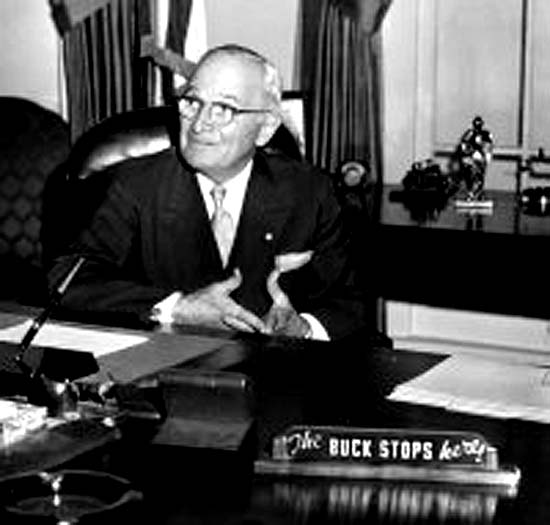
President Harry S. Truman was proud of his sign displayed prominently on the Oval Office desk – “The Buck Stops Here”. No other principle was as important to him. He understood that the occupant of the office of the President held ultimate authority and ultimate responsibility for the events and actions that occurred during his watch. The weight of the responsibility was clear to him from the very first moment he took the oath:
“I felt as if the moon, the stars, and all the planets had fallen on me. I got the most terribly responsible job a man ever had.”
There was additional little doubt in Truman’s mind the process of politics created the critical energy and vetting needed to achieve real change, but it never occurred to him that anybody else could inevitably to be seen as the fulcrum of all credit and blame under a President’s watch. He had no time for whiners.
Our current President has made an art of being the anti-Truman. Wherever the responsibility for our current mess resides, he wants everyone to know it doesn’t reside with him. For the umpteenth time in a recent interview, he looks at the economic chaos and stagnation before him, and nearly three years into his watch sees where the buck of responsibility clearly rests – George W. Bush. A clever device of the Democrat party in undercutting the previous President, candidate Obama brought the device to a fever pitchand, like a one trick pony, can not seem to divest himself of the role the SuperBush has played in preventing Obama from achieving sustained recovery. The mantra of Democrats in regards to the supernatural capacities of our supposedly mentally enfeebled former president to continue to reek economic havoc, nearly three years after he released control, is a wonder to behold. President George W. Bush, singularly responsible for .Com recession, 9/11, the lack of WMD, Abu Griab, the Iraqi debacle, global warming, Hurricane Katrina, the collapse of the housing bubble and Mortgagegeddon, World hatred of the United States, and the Banking collapse, apparently continues to wage nefarious control over our current President’s success.
Obviously the blame game can only go so far. The farther one gets from BushHitler the harder it gets to connect the dots that link the barbarian to our current mess. In fact, the current stagnation in recovery and apparent drift toward a second recession is progressively being recognized as a pillar of President Obama’s time at the tiller, and the President may be the last to recognize it. Unlike Truman, who was politically able to rail against the “do nothing” republican Congress of 1947-48, President Obama’s Democrat party has been in control since 2007 and the opposition has had to mostly sit back and accept the massive increases in government size and regulation, stimulus spending, and the progressively creepy and destructive Obamacare.
The crux of the matter for Obama is, the American public can tolerate a blowhard, barely tolerate a fabricator, but can not tolerate a whiner. Kind of unbecoming. Maybe somebody ought to get the President a copy of Truman’s sign.
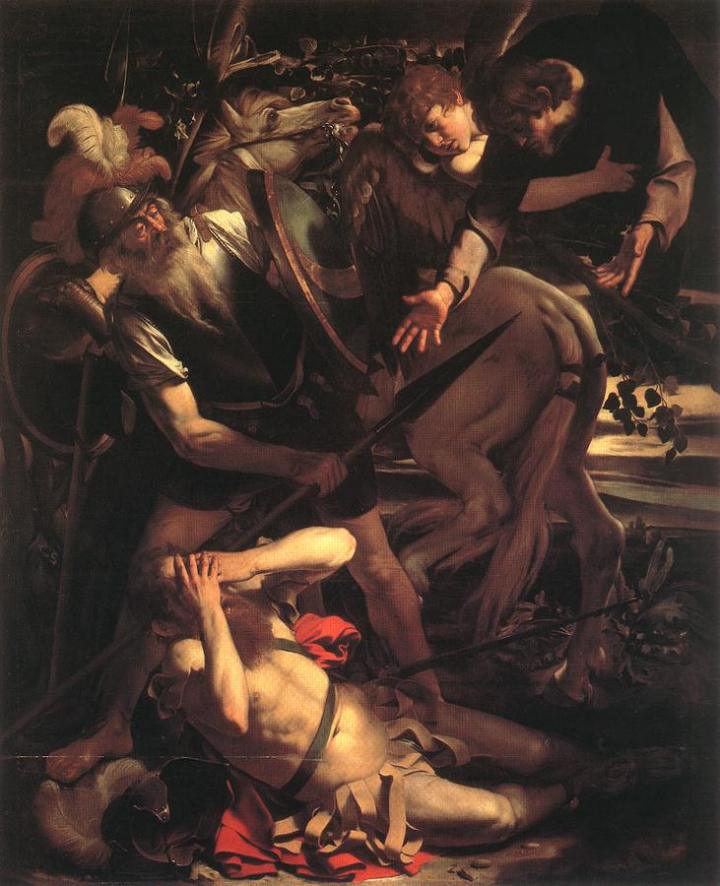
Over 1900 years ago, a battalion of soldiers lead by Saul the Pharisee road on the road to the already ancient city of Damascus to rout out a major threat to the ruling hierarchy at that time, the cult of religious extremists known as Christians. Well educated and convinced of the righteousness of his task, Saul determined to deal firmly and resoundingly with the upstarts in a conclusive fashion. Just short of the gates of the city in the presence of his soldiers, Saul was struck from his horse by an unseen force and held paralytic to the ground while a voice heard by all spoke to Saul and revealed to him the error of his mission and proposed the path to his true calling. On the road to Damascus, Saul the Pharisee, destroyer of the breath of life, came to from his interaction with the Supreme Being, blinded but now clearly seeing, converted to his new life, as Paul the Apostle.
No such moment has occurred yet on the modern road to Damascus to another educated man convinced of his own righteousness to violent action, the president of Syria, Bashar al- Assad. Unfortunately the opthamologist from London has rapidly taken on the worst instincts of a base tribal instinct to dominate and destroy other that has brought horrific destruction to a country that has seen too large a share of domination over the ages from many invaders. The city of Damascus may be the oldest continuously inhabited city in the world, extending as an identified destination back to before 6000 BC. Mentioned in Genesis, the city has seen the rule of Assyrians, Hittites, Canaanites, Arameans, Persians, Greeks, Romans, Byzantines, and Islamic Caliphates. The most recent period of independence has occurred since 1946 with withdrawal of French overseers, and the country has been left to its own devices since, with tribal fault lines suppressed under a nationalist Baathist civilian structure ruthlessly maintained by the army. Since 1970, the government and army have been dominated by the minority Alawites with the Presidential power first in the hands of father Hafez, and now son, Bashar. The overriding theme of Baathist “progress” in Syria has been the ruthless domination of all other political structures in Syria and the external focus of a belligerent permanent state of war with Israel. The father Hafez laid the template for the dealing with internal opposition with the essential leveling of the uncooperative city of Hama in 1982 with an estimated 25,000 casualties. The son Bashar, the western trained physician, has now set an altogether different standard, sending troops, tanks, and internal security thugs nationwide to destroy the nidus of a unified opposition movement. This is not the Muslim Brotherhood insurrection of the 1980’s. The tenets of the Arab Spring are seen in the demographic of the modern Syrian opposition, and al-Assad’s carefully developed western face as a “reformer” has been exposed as a farce.
The only residual support the increasingly butcher like Bashar has been able to maintain is the traditional Syrian ethnic and religious minority fear of the majority Sunni Islamic population. Christians, Druze, and Shia alike see the religiously nebulous Baathists as their best protection against the other culturally insensitive Sunni tradition. This has allowed Assad thus far to crush the increasingly aggressive opposition with impunity, but the greater Arab world is noticing the effect of his actions potentially on their on restive populations and are no mood to see the Assad “example” grow as a rallying cry.
The role of the United States as a supporter of individual human rights has come to an untenable position in Syria. President Obama’s stated policy of middle Eastern non-interference has been exposed as hypocritical in Lybia, and rudderless everywhere else. The current adminstration’s desire to “lead from behind” has left the door open for other countries to fill the vacumn. Turkey, former home of the Ottoman Empire, and Iran, keeper of the fundamentalist Shia flame find themselves on opposite sides of the Syrian conflict and raise the possibility that the Syrian civil war could expand into a greater conflict. President Obama, who appears progressively tired of the demands of the office, has made no visible moves to stop the Syrian government’s vicious actions, define a position, or engage a plan for the various potential dangerous outgrowths of the Syrian violence. We may be in the midst of the most anti-philosophical foreign policy in American history, who has determined their only weapon of policy or diplomacy is the drone strike or Tomahawk cruise missle.
The suffering people of Syria populating one of the most epic pieces of land in the human story, may unfortunately be the set pieces of a building tragedy that has no answer except pitiless individual demolition. It is sad to relate, that the only potential salvation of the people is the whisper of a chance of a modern miracle occuring on the road to Damascus, this time to the butcher of his own people, Bashar al-Assad.
A late announcement today from Apple Corporation managed to drop the after market price and relative value of one of the hottest stock properties in the world more than 7 percent. The message wasn’t so much a what, but a who – legendary Apple CEO Steven Jobs announced he was relinquishing the position of leader of a corporation that had made one of the greatest comeback stories in American business history on the strength of his vision and leadership. The story of Steven Jobs is every bit an American success story, and a primary example of why we can never let government rather than the market dictate what is or will be a leading technology.
Steven Jobs didn’t go to an Ivy league school, write a crucial paper on nanotechnology, invent hedge funds, or succeed at everything he put his mind to. He was instead the ideal of the American Dream that has powered the American economy to the dominant position in the world. Nobody predestined this adopted son of California parents to change the world as he did. He grew up non-descript and struggled to even attend college at all, dropping out after several months and essentially “phoning” in his effort. He liked technological things but did not initially show commitment to anything that looked like a job. A fortuitous acquaintance with computer geek Steven Wozniak lead Jobs to consider the crazy idea of starting a computer company out of his garage in 1976. At a time when IBM was a company of business machines and the sole purveyor of “computers”, Jobs and Wozniak had the impulse to personalize the computer when no one knew what that meant. It was horribly unclear what a person would actually do with a personal computer, but Jobs and Wozniak came up with the concept of tying the computer to desktop publishing and devised a graphics interface to make it palatable to the non-computer geek. Apple I, Apple II, and finally Macintosh was born, and the world was never the same. Though Microsoft Windows eventually took over the world of computer interface, it has always been a pale second to the genius of the Macintosh Operating System, that was the first to use icons for computer instructions, graphics, and mouse click, drag and drop. Wozniak made the computer guts work but it was the particular genius of Jobs that formulated the personal look and feel of an Apple product that instantly defined it as something different, and somehow better and leading edge cool.
Like all visionaries, Job had his difficult egocentric side, and in the 1980’s his demand for total control proved too much for the company he founded to bear, and he was essentially released. The path of failure was only one of many paths of Jobs visionary journey. He founded NeXt technologies and bought a little known computer aninmation company he renamed PIXAR entertainment, and within ten years it was Apple that was begging him to come back to the fold. Apple purchased NeXT for 430 million dollars and more importantly put Jobs back int the vision seat of the company that had tumbled to less than three percent of the personal computer market.
The rest is history. In a ten year period that would be the envy of Thomas Edison, Jobs helped Apple create the Macintosh OS X operating system that made the world of Apple possible with the iMAC personal computer, revolutionized how we listened and collected music with the iPOD, took over the music industry with iTUNES and iTUNES Store, changed personal communication forever with the iPHONE, and invented a new computer interface known as iPAD that will convert the world of personal computing more profoundly than the original Apple. The genius of Jobs was his ability to inject entirely new interfaces for the public to digest that would cause them to leave completely their comfort zone with proven technology and accept Job’s vision of the future.
Jobs has known brilliant success and personal rejection, spot on analysis and woeful misdirection, business stagnation and unbounded business growth. What he has known more than anything is that the American story is not how it begins or ends, but how the journey can be your own if you only accept the primary principle, you are limited only by your effort and imagination. He has given his country a gift more precious then the magnifient inventions that have change our lives or the jobs and fortunes he has created for tens of thousands of individuals. He has given us the beautiful example that in this wonderful experiment known as America, all things are possible.
It appears illness will finally defeat Jobs where competition, turmoil, and limited understanding could not. We all are indebted to Steven Jobs for bringing his indominable will to his perceived vision in the perfect marrage of both in Apple. At a time where the country founders on the rocks of entitlement and repression of personal incentive, we need only look Mr Jobs as to what happens when the world gets out of the way – and lets a thousand flowers bloom.
I doubt I will ever experience anything as central to my observation of man’s struggle for personal liberty close to the wonder I felt watching the events of 1989 to 1991. The heroes that wrestled totalitarianism to the ground were so brave and numerous, so intelligent and strategic as to create awe. Walesa in Poland, Havel in Czechoslovakia, Pope John Paul II, and so many others had worked tirelessly to create the inescapable pressures and circumstances that made the move of all Eastern Europe to freedom, and even more miraculously, in predominantly non-violent fashion. Every month seemed to bring an amazing story of triumph to bear, as sclerotic, bully like authoritarian governments were forced to admit their systemic failure and accede to the wishes of the people to be free of their oppression. The irrepressible wave eventually caught up to collosus of totalitarianism, the Soviet Union, and its collapse in 1991, and unsteady evolution into a new world, is still being felt today.
This weekend is the twentieth anniversary of the highpoint of the August Revolution, in which the people of Russia fought off an attempt of the old guard to put the liberty genie back into the bottle. Occurring in late summer, it was nevertheless the Russian version of the current Arab Spring, with bravery shown by countless common citizens, ruthlessness by entrenched autocrats, savvy leadership from unexpected bureaucrats, and uncertainty in the clarity of the outcome. The Russian people twenty years later are still finding their way through the historical strains of the death of one version of history and the birth of another alternate universe.
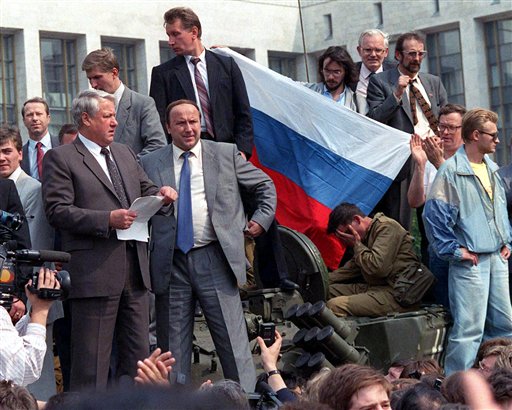
By 1991, the strains created by Mikhail Gorbachev’s attempted ‘reform’ of communism were reaching intolerable levels. Gorbachev’s two 1980’s reform processes, Glasnost (Opening) and Perestroika (Restructuring), designed to improve the transparency of government action and provide some market style reforms, had inadvertantly exposed the structural rot that had permeated the top down communist system and led to open revolt by the oppressed population for not reform, but renewal. Unwilling to fully deconstruct the only system he knew and the one that had brought him to power, but recognizing the inherent failure of the system to evolve, Gorbachev, still supreme leader of the government and party, found himself nearly paralyzed between the progressive will of the country to join the freedom process birthed in eastern Europe and the conservative Soviet hierarchy that saw the seventy year empire of Soviet communist dominance at perilous risk. The pressure keg finally blew open on August 1991 when the Soviet Vice President, Defense Minister, and KGB chief attempted a coup d’etat, house arresting President Gorbachev and threatening his life. The tipping point was the expected signing of a New Union Treaty on August 20 that would effectively turn the Soviet Union into a federation of independent states with a common president, foreign policy, and military. This breaching of Soviet sovereignty was too much for the old guard and after confining Gorbachev they moved to secure the base of the presumed largest state of the new federation, that of Russia itself. Their focus was the Russian parliament, which had become an unwanted counter balance to the Kremlin, and the recently elected bureaucrat of the Russian federation, Boris Yeltsin. Yeltsin, a long standing communist apparatchik had been lately mouthing ominous sounds of independence, and the threat to the Supreme Soviet institutional dominance was clear. The coup leaders rapidly closed newspapers and silenced political activity, moving troops and tanks to the White House, the parliament building that housed Russian Federation leaders and Yeltsin himself, surrounding it and threatening its destruction if Yeltsin did not accede to arrest.
This was a different Russia then the coup leaders had expected to find. Rather than cowed by the intimidation of tanks, tens of thousands of Russians took to the streets around the White House and surrounded the tanks, daring them to attempt violent action. As if undergoing an evangelic conversion, Yeltsin the bureaucrat suddenly became Yeltsin the freedom revolutionary, and in a pivotal moment, took to the steps of the White House with a bullhorn, rallying the massed people to defend their parliament and their new found freedoms. Yeltsin proved to be much more the modern politician than anyone had any right to expect, sagely predicting both the public’s response to his call, and the effect of his call for Russian patriotism to the troops. The reaction was truly revolutionary. The troops refused orders to take over the building and the people swept up in the furor rallied them to their side. The seventy year history of ruthless, ironfisted Soviet dominance of the Russian people crumpled overnight, and by August 21, 1991, the three day coup collapsed. Gorbachev was released and assumed a Soviet presidency that had no residual power base, as neither soviet nor russian governments wanted any residual connection to him. Yeltsin through grasping his historical moment became the true leader of a Russian Federation, and with the official dissolution of the Soviet Union in December 25, 1991 and Gorbachev’s resignation, the leader of Russia itself.
The fairy tale story of common people manning the Ramparts of freedom and achieving victory for liberty and human rights was the daily drama of those years of 1989 through 1991, stretching from eastern Europe through Russia and even China in a spectacular storyline. Its earthquake tremors are felt today through the Arab Spring cataclysms that began in Tunisia and are still broiling in Libya and Syria today. Like all unfolding great historical sagas, the Russian chapter is yet to be fully told. Yeltsin attempted a crash course in capitalism and democratization in Russia leaving only a few winners and untold losers that resulted in a partial authoritarian retrenchment in the form of Vladimir Putin and the loss of many of the hard fought individual freedoms of the revolution. The Russian experiment has additionally been saddled with a contracting native Russian population and a devastatingly violent imbroglio with Chechen separatists that took the period of self determination too literally for the residual Russian federation to tolerate. The loss of briefly held freedoms such as opposition parties and newspapers, equal economic opportunity, and tolerance for dissent has left a stain on the accomplishments of that fateful few days in Moscow twenty years ago.
It is up to the people of Russia themselves to determine if it all was worth it, and to desire a future that celebrates the individual over the state. A great people locked in history’s embrace will perhaps some day realize the ultimate triumph.
President Obama took some chances this past week to stem what has been a progressive crumbling of support for his chances for re-election in 2012. He embarked on a bus tour through the midwest to mingle with the people and try to stem the tide of bad karma. At one of the stops he stated:
“We had reversed the recession, avoided a depression, got the economy moving again. But over the last six months we’ve had a run of bad luck.”
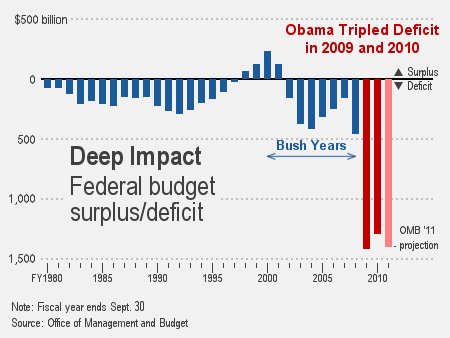
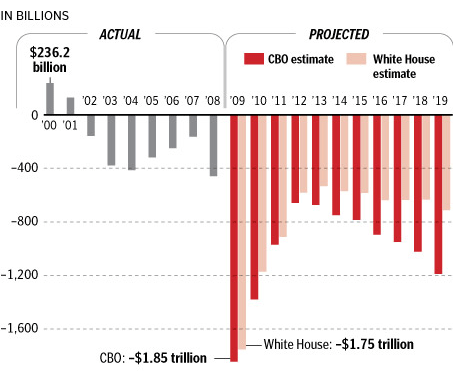
Putting aside the President’s rather than generous opinion of his role in “reversing the recession and avoiding a depression”, the line that has seized the attention of commentators has been President Obama’s comment regarding the defining of his fate by “bad luck”. Charles Krauthammer dissects the President’s record and responses to the economic conditions he was presented with upon election and sees the outcome more as bad excuses rather than bad luck. The sympathetic good vibes that surrounded this President with ascension to the presidency at a difficult time have dissolved with the recognition of his inflexible and ideological instincts in favor of a command economy. Wielding a top down stimulus approach, the President has poured over 4 trillion dollars of deficit spending, selective industry protections and investments formed on ideology not productivity, and overbearing regulation in the space of three short years, and the result has been “bad luck” – persistent unemployment at over 9% (twice his predecessor), sluggish economic indicators despite the cheapest credit available in history, and a world wide sense of a second economic contraction.
It is an unfortunate reality of modern politics that the last two presidents “of the people”, Presidents’ Clinton and Obama, have both been among our most narcissistic and self absorbed personalities. In President Clinton’s case, his enormous political skills saved him from his worst traits of assuming he was always the smartest one in the fight and was always right. He could recognize when he had a “two fisted death grip on a loser” and adjust his bombastic tendencies accordingly, moving away from strangulating universal health care and permanent welfare as a right, and working with the congress to achieve welfare reform. He was rewarded with a second term, despite his visible personal foibles. President Obama has no such selective antenna, no personal work experience to balance his “smartest man in the room” self absorption. He continues to plow ahead with policies that have come up flatter than a pancake in responding to the economic stagnation. Classic for narcissism, both presidents have been quoted as saying that, “no president has ever faced more difficult circumstances”, but in President Obama’s case, the lack of acknowledging failure has taken the natural response of a capitalist economy to retrench and recover out of play, and cemented those “difficult circumstances”. There is every indication that because he is sure he knows better, he is going to push ahead to create the ideal world he has envisioned for us, whether we like it or not, and will struggle to tell the man he sees in the mirror to recognize the answer lies in gettting out of the way.
Bad luck has its way of forming as a response to bad policy. Industries that are not “chosen” are unlikely to risk growth when such growth is sure to be punished. Enemies that are told no longer to fear American reactions to their bad behavior are likely to behave badly. Friends who have been told they can no longer count on America are likely to look to others for friendship. Countries that recognize that your word is no longer your bond are unlikely to have the faith to invest in your future. Your countrymen who have seen your disdain for their hard work, incentive, and risk taking are unlikely to see you as their standard-bearer.
It comes down to the fundamental principle of time immemorial. In problem solving, doing what doesn’t work and hasn’t worked and will never work, is unlikely to work. Mr. President, what it comes down to is – in this life, you make your own luck.
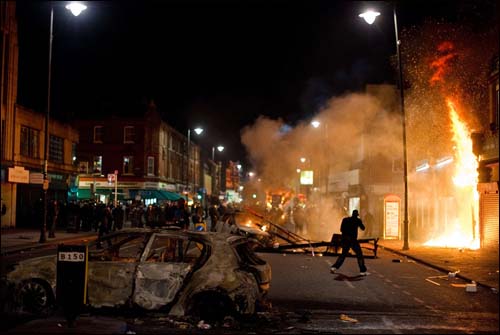
Great Britain is slowly regaining its breath after a week of ferocious riots that collapsed the civilized veneer of London and several other large British cities. The presence of willful anti-social behavior is nothing new in western society, but the scale and scope of these riots was something Brits and other Europeans had always associated with the more uncouth United States. No more. A particularly rabid form of animal behavior surged over British cities and it was led by a concoction of races, ages, and crime behaviors. The physical damage was in the hundreds of millions and the psychological damage to British society staggeringly more. A completely uncontrolled youth Clockwork Orange-like thuggery met up with a completely unprepared police “service”, and the outcome was predictable – arson, looting, beatings, and worse on a countrywide remorseless scale.
The British stiff upper lip is now stiff from a self induced beating. The underlying causes of such acts are being hashed out. Mark Steyn is quite sure he knows what happened. His new book has a chapter on the elements causing collapse of British cultural stability and prophetically predates the violence, but predicts it as inevitable. His National Review Online article points to a concerted effort by British governments to remove responsibility and risk from British life, with cradle to grave support regardless of personal contribution or effort. A generation whose central meaning for existence is pure unadulterated want has been created, and Steyn traces the rapidness of the conversion from the generation that tolerated insufferable hardship in World War II fighting off the Nazi menace to a generation in whom tolerance for any hardship is insufferable. He suggests that the lesson learned is a society that has forgotten its identity, discipline and culture has no capacity to defend itself against its own destruction. Great Britain practically invented the rights and principles of due process, international trade, the industrial revolution, the universality of education, and taking time for tea but can not seem to discern the destructive virus of lives without meaning and purpose. The portrait of a broken society is sharply brought into view every week on Prime Minister’s questions when one of the great deliberative legislative bodies in history spend the greater portion of their time excoriating each other as to their inability to micro-manage the quality of sanitation at local hospitals, or the length of their waiting lists. No one bothers to ask as to why such conditions exist and why their efforts continue to be so ineffective. Like everything else in a crumbling society, the argument is how to drag everyone to mediocrity for fear of exposing any one individual into a personal decision of responsibility. The government wastes its time trying to keep every citizen from feeling stress in any way, only to create a citizen that can barely feel anything.
The obvious corollary of a Great Britain that has lost its way with an America that is heading down the same path is unavoidable. The elite in America see as terrorists a grassroots movement that has asked the country to live within its means, promote personal responsibility, and conform to the principles that are outlined in its own Constitution. Pretty radical stuff, no? Its radical of course only because those that would see in the British social experiment a course to emulate rather than a course to avoid are the principle tea party name callers. The resistance of a mature society to these invectives is the measure of its energy, resilience, and progress. Great Britain may have lost its soul but its not too late for us, if we recognize in time the format of destruction. To those in great Britain and greater Europe I say:
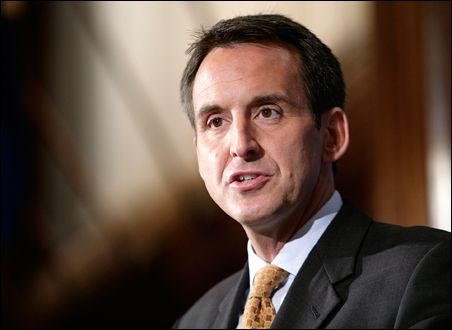
Running for President of the United States takes a lot of things. It takes a thick skin. It takes a pretty big ego. But more than anything it takes a lot of money. A lot. The pointed juxtaposition of ego and money came to the surface in the Republican field of candidates this weekend with the announcement of former Minnesota governor Tim Pawlenty that he was dropping out of the race for President and that current Governor Rick Perry of Texas was getting in.
The tired fact of American politics is that a candidacy for President can end before there has been a single registered vote determining the candidate’s value. Pawlenty dropped out 15 months before the actual election for the Presidency after losing the “straw vote” in Ames, Iowa this weekend. Former winners of this sage event have included Pat Robertson and Phil Gramm. Other than the true political junkie like me, nobody remembers Pat Robertson and Phil Gramm because the country as a whole does not measure the content of the character of the nation’s future president on an informal poll in the Hawkeye state over a year before the real election. It may turn out that nobody will remember Michelle Bachmann, the winner of this year’s straw poll. What was clear to Pawlenty that there are two things needed to become President, outsized ego and outsized access to money, and both he was woefully short on. The money he had, he spent on some very expensive television commercials prior to the poll that tried to nationalize the Pawlenty persona, but he was smaller than his commercials, unable to stimulate loyalty or passion in the state adjacent to Minnesota, whereas Bachmann his fellow Minnesotan could. Finishing third, Pawlenty knew the donor money would rapidly dry up and would soon compete with his ego for inadequacy for the challenge. It appears the country has vetted Pawlenty, a good man and a good governor with governing talent, as not big enough for the bigger job.
That brings us to Rick Perry. That wooshing sound Tim Pawlenty’s money coffers heard this week was the sound of money donors rushing to underwrite the governor of Texas. Rick Perry brings outsized Texas ego and big time financial resources to the presidential mix and has immediately positioned himself as the purer conservative answer to Mitt Romney, the establishment candidate and front runner. Perry brings the Texas success story of booming economy and jobs creation to a country starving for both, but it is unclear as to whether there is sufficient trust out there to elect another Texan with an outsized ego and a cowboy accent to the position of chief executive of the country.
Pawlenty staked his entire candidacy on the Ames straw poll and Perry avoided it like the plague for the same reason – political ego. Pawlenty knew only a win could bring heft to his paper thin political persona and Perry knew that real egos don’t expose themselves to peripheral popularity surveys as it would only risk their diminishment. The bottom line effect is a pulling to the right of the political field and the resources needed to fund it. Only time will tell if this is the last significant shift in the political tectonic plates before the real “bullets” start flying in January 2012. To win in 2012, a candidate is going to need a lot of ego and a lot of money to take on the undisputed current world champion of both, Barack Obama.
Powerline is an excellent blog of broad scope and terrific writing that serves an additional fundamental service to the readers and thinkers of the blogosphere. It is the home of the unedited versions of Uncommon Knowledge with Peter Robinson of the Hoover Institution who provides truly uncommon in-depth interviews with real experts and thinkers. Of particular note is the discussion Peter has with Fouad Ajami, Johns Hopkins Professor of Middle East Studies and a senior Fellow of the Hoover Institute, and Charles Hill, Diplomat in Residence and lecture in Leadership studies at Yale University. This fascinating discussion looks at Iraq, Afghanistan, philosophic tenets of Islamism, and the Arab Spring through the perspective of both intellectual study and the Arab street. It is an essential discussion as we as supporters of the ideal of personal liberty, self determination, and quantitative freedom review the forces at work over the last ten years and what the future may bring in terms of challenge and opportunity. Courtesy of Powerline, a must listen from end to end.
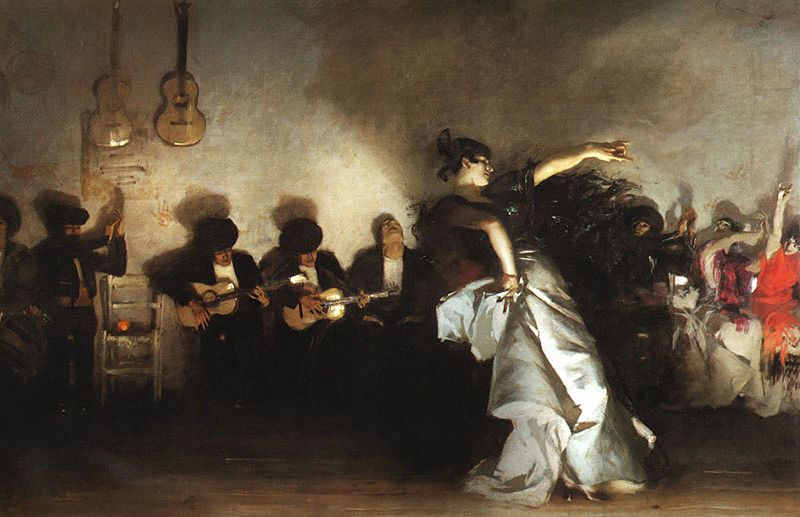
Unlike film, portrait painting and painting in general, must create an emotional reaction from the viewer perceiving a single fused projection of a moment in time. Its necessary immobility creates a vague sense of passiveness as the emotions created do not build into complex directions that create tension with the original impulse. It is the great painter that creates tension in the viewer, the desire to know more of the subject, to want to know what happened to the subject before and after the fixed moment in time. It is the great painter that succeeds in injecting the spark of life into the inanimate canvas and layers of paint that make the viewer feel more than see the painting. John Singer Sargent was that kind of painter.
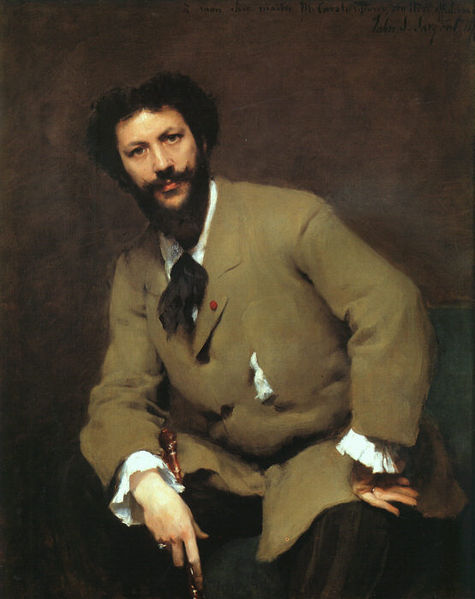
John Singer Sargent (1856-1925) was an anachronism. He was an American painter through and through , but was born in Italy and spent the better part of his working life in Paris and London. David McCullough’s excellent new book The Greater Journey : Americans in Paris relates the story of many American artists who came to Paris in the 19th century to hone their craft or become recognized as “trained” by the French school of artists when they returned home. John Singer Sargent was different in that he did not discover Paris; Paris discovered him. From his first classes with eminent French portrait painter Carolus-Duran, it was clear this teenager was a throwback to the greats, in that he had an epic talent that needed only to be unsheathed, not developed. He burst upon the public consciousness with a portrait of his teacher Carolus that was not a likeness, but instead a capture of a soul of the painter. Carolus is staring directly at the viewer, intense and confident, his body at a jaunty angle, his clothes modern and dandyish, a contained flamboyance of an artist. The hands are languid and flexible and speak to their occupation. Most dramatic are the signature Sargent creation, the eyes. The eyes have what time and time again would project from a Sargent portrait, the radiating energy of a living being, not a memory. This powerful Sargent characteristic was an irresistible draw for wealthy and powerful individuals who wished to be preserved through time with their youth, beauty, and power intact, and Sargent gave them their wish as no other artist of his time.
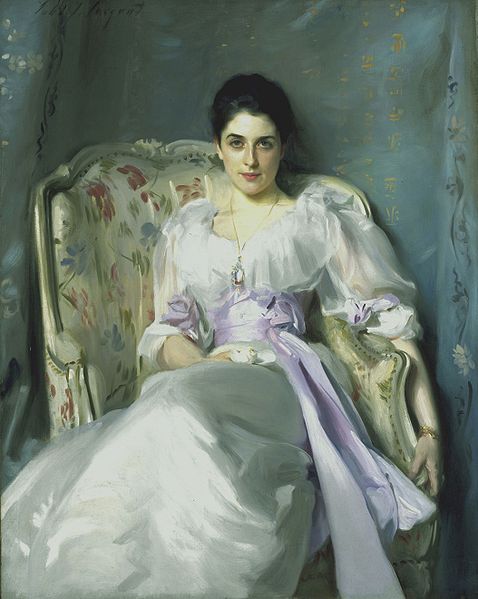
A particularly favorite portrait of mine, and there are so many, was Singer Sargent’s 1893 portrait of Lady Agnew of Lochnaw. The colors are cool and restrained, as befits a British lady of the Victorian era. She is relaxed, refined, assured of her place and time, and closed to the momentary emotional impulses that would effect a woman of lesser stature. But Sargent as he did time and time again let the viewer know she is all woman, fully aware of her beauty and her effect on those who would gaze upon her. Again Sargent brings the eyes to bear – a cool blue grey that dares you to look away, and know you can not. Once again, though rigidly positioned in the clothes and culture of her time, she is as alive as a breathing being that could easily walk out of the painting and across the room, if she so desired.
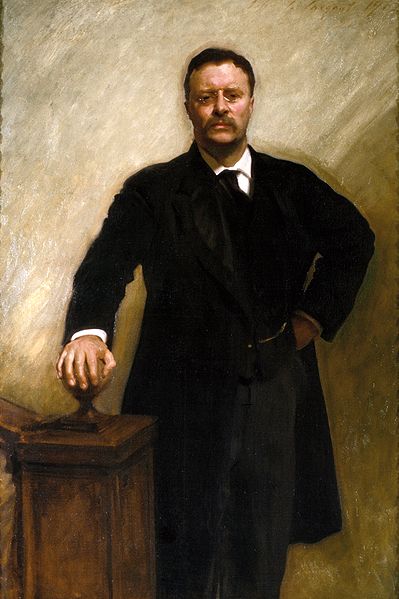
This intense realism was in juxtaposition to the trends of of painting in the late 19th century that became dominant and “modern”, the winning out of tone and color known as Impressionism, over true reproduction. But Sargent wasn’t about the immediate truth of a subject, more of the eternal truth that reflected more of their soul and life force. It is seen again in his visions of the powerful – take the portrait of President Theodore Roosevelt. In Sargent’s view, Roosevelt is every bit the world statesman, but Roosevelt’s nervous, inextinguishable energy shines through. He is a coiled spring and at the height of his personal physicality and power. His confident hand rests on the stairwell, but it might as well as well be the globe of the world given his posture. It was no wonder Sargent never struggled to find subjects for his portraits, as he never failed to pull out the most humanity from whatever unique source they had to give.
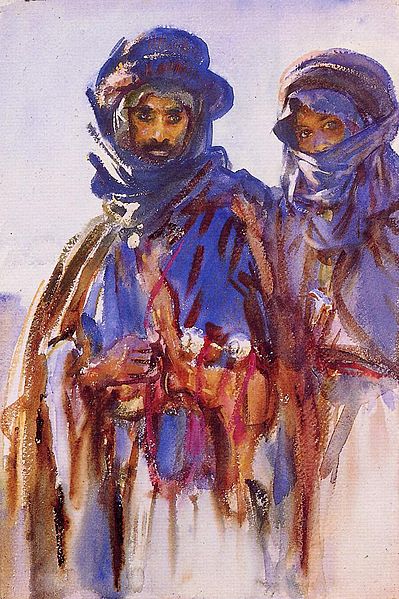
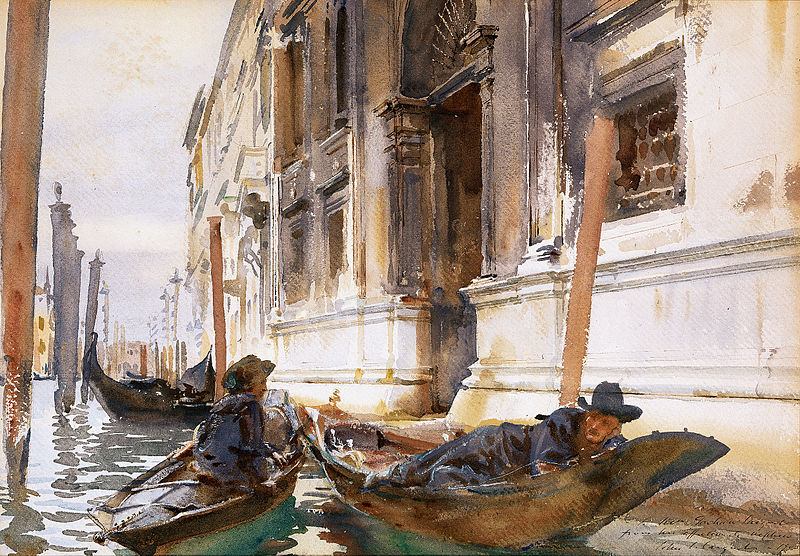
John Singer Sargent was no less gifted in a media that has never held the respect that magnificent oil paintings do, but can be equally complex and illuminating, that of the watercolor. The media of watercolor requires a innate understanding of each color’s interaction and each color’s effect on the painting’s light as the process of watercolor painting is similar to plein-air oil in its immediacy, but also permanent and mistaken impressions irretrievable. Sargent somehow manage to bring the same nervous tension to the watercolor that he did to the oil painting. In the watercolor Bedouins, Sargent once again uses the eyes to fuel in both the male and female subjects their pride and vitality, despite the pastel nature of the color. In the landscape Gondolier’s Siesta,Sargent inflects a dream-like state that brings motion to the water and impressive depth to the rough charactertures of the gondoliers.
Over a lifetime of prodigious work, John Singer Sargent created over 900 oil paintings and over 2000 watercolors and has become an American giant in the world of art. At the end of his life he seemed hopelessly old fashioned, tied more to Titian and Velazquez than Van Gogh and Picasso. The school of Realism, denigrated for almost a hundred years as art turned to more and more abstract interpretations of the world in which we live, has seen a comeback of late and an increased respect for the creativity and talent required to open the human eye to more complexity than its already complex view of the world records. John Singer Sargent was a realist but recognized that people at their core were a special form of energy, that held all of life’s pain and exuberance, introspection and vitality, in equal measure. Sargent was recorder of the Spark of Life, and will provide for anyone who gazes upon his masterpieces far flung across the world, a small surge of understanding of what it means to be human, and to have lived life to its fullest.
The greatest short essayist in my lifetime comes out with another book on August 8, 2011 that is bound to be a blockbuster in sales and penetrating thought. Mark Steyn, an international columnist and thought provocateur previously identified as Ramparts People We Should Know #3 has made a career over the last two decades writing thousands of insightful essays on culture, entertainment, government, religion, liberties, and western ideals that are prodigious in number and unrivaled in clever phrasing, analysis, and introspection. Readers of National Review, Macleans, the Jerusalem Post, Atlantic Monthly and Orange County Register among others have had the constant pleasure of reading sentences and paragraphs from this terrific writer that express clarity, satire, punch, intelligence and comedy in equal measure.
Now 51 years old, Steyn has been an enfant terrible for decades, skewering the pompous, self-important, and dictatorial, eloquently speaking up for freedom of speech and personal liberties. His take no prisoners approach to writing has led to direct confrontation with political correctness and governmental censorship and has made him a hero to millions and a threat those who demand a righteous view of culture and events.
In 2008, Steyn wrote the international best seller America Alonein which he identified the deterioration in European cultural identity, collapsing judeo-christian values, and declining native birthrates, challenged by burgeoning islamic immigrant populations and the unwillingness of those immigrants to assimilate into a western cultural identity. He noted the unique position of America as a country that still had a muscular economy based on entrepeneurism, a constitution preserving personal freedom, and a healthy birthrate of individuals that shared the goals of freedom and economic independence. His fear expressed in the book was that the loss of European cultural identity would leave America dangerously isolated and at risk to succumbing to the progressive growth of reactionary societies and lack of shared history.
A few years later, with the stunning acceptance by the American public of bank and automobile company bailouts, a pathway to personal health servitude relying upon government whim, calamitous spending habits, and governmental acceptance of unfunded debt at inconceivable levels has left Steyn considerably more pessimistic about America’s survival and therefore the survival of the western ideal. The speed at which this turnabout in America’s fortunes and her society’s desire to resist the ebbing of her position as the world leader in progress and freedom has been simply at the level of a freefall. I would suggest readers of the Ramparts would consider Mr. Steyn’s new book After America required reading and hopefully a sufficient prophecy of warning to help us all stop those who would continue to send us hurdling over a cliff. The video below, courtesy of the blog American Power, is extensive but captures Steyn’s passion and intellect on the Canadian television show Sources. Enjoy the discourse. Buy the book. Expand your mind. Enjoy a great writer.