Miracle On Ice

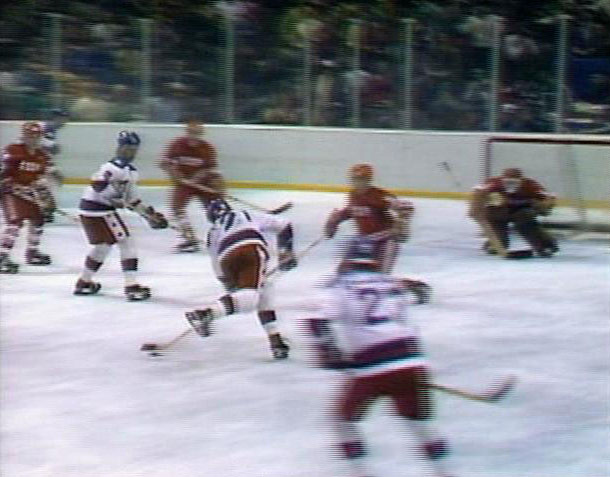
To see it as a television projection is ultimately the most appropriate way.  The memory after all, for all but the 8500 people in the stands of the Lake Placid hockey arena on February 22, 1980 is a gift of the medium of television.  Mike Eruzione, a college player from Boston University, is caught at the moment of release of a shot that had incredible repercussions in sport, national relations, and history. Its impact continues to this day as a defining event of the later half of the 20th century and indirectly affected the lives of tens of millions of people through memory and inspiration.  Instead of epic, sacred, or profound, it occurred, of all things, in a hockey game.

33 years later, the anniversary of one of sports and history’s epic events was brought to the forefront by an auction.  Eruzione, whose life has been molded by the Game, determined to get value out of his jersey and hockey stick from the event, for the purposes of value to himself and his charity.  The jersey sold for 657,250 dollars, the hockey stick for 262,900 – the memory obviously for everyone who experienced the moment, priceless.

The funny thing is, almost nobody out of the arena saw the event live.  Television wasn’t the superconnected force it is in today’s society.  The Olympic hockey game between the United States and the Soviet Union occurred in the afternoon prior to prime time television and the game was broadcast on tape delay.  I was a college student at the University of Wisconsin and went to a bar on a snowy, cold night with two friends to watch(drinking age was 18 years of age then, but that is another story) as none of us had a TV, and all of us had interest in hockey, particularly with the local connection to Wisconsin players in the game such as Mark Johnson and Bob Suter.  It is hard to imagine in today’s world of instant Internet informational access, that nobody outside of Lake Placid had any idea what had transpired.  We watched the game with complete innocence, and progressive, utter disbelief.

The game itself had ridiculous connotations beyond what a hockey game, or frankly, any sporting event deserved.  The United States in the late winter of 1980, was in a world of psychological hurt. the previous decade had seen ignominious defeat in Vietnam, the devastating effect to the concept of moral leadership of Watergate, the economic blow of the rise of OPEC and resultant oil embargo and rationing, the national paralysis over the impudent Iranian takeover of the US Embassy in Tehran, and the rise of Soviet aggression in Afghanistan.  President Jimmy Carter, an ineffective , righteous micro-manager, appeared helpless in the face of such forces, and determined to take out his anger with the Soviet Union through sport, having threatened through his Secretary of State Cyrus Vance, just before the Winter Olympics in Lake Placid to boycott the Summer Olympics in Moscow later that year, summarily in protest for the incursion into Afghanistan.  The United States as an international force for stability and good, was felt to be a hollow shell of its former capacities, and the world was moving onward toward progressive volatility without it.

The game was positioned to be as David vs Goliath as any sporting event in history. The United States team was filled with obscure amateurs from a country in which the best athletes participated in sports such as basketball and football.  Most Americans watching hockey for the first time were likely unaware that US colleges even  fielded hockey teams, as  so few universities actually supported such a minor sport.  The Soviet Union, on the other hand, had a team of professional players practicing year round with financial support and state of the art facilities sponsored by its military superstructure, making the team a propaganda arm of Soviet might.  The Soviet team was deeply comprised of hall of fame quality depth, that made a practice of devastating other professional teams from Europe and the National Hockey League.  It was without doubt, the finest professional team currently playing, and the idea that upstart college players from a minor hockey country like the US could compete in a match was considered fantasy, the proof of the pudding a nasty 10-3 spanking the Soviets applied to the US team just ten days before.  Having already “proved” parity in the international basketball arena by defeating the US in a controversial upset at the 1972 Olympics, the Soviet team was not about to make room for the upstarts in the sport they owned.

The amazing thing about sport is, of course, the incredible power of carrying a chip on your shoulder.  The American team underwent blast-furnace coaching by Herb Brooks, determined to use the psychology of “shocking the world”  in preparing his team.  The game in his mind was to break fine crystal; in other words wreak havoc on the precision of the Soviets through contesting every minute as a physical contest of wills.  The Soviets, convinced of their overwhelming superiority, expected the Americans like every other team,  to  wilt under the continuous pressure of superior talent and precision play.  Brooks was more interested in the game becoming a survival of the fittest contest.

The Soviets ended up helping the Americans every chance they could.  They allowed the game to unfold exactly as Brooks hoped for, with the unease all on the Russian side.  An early goal by the Russians was answered with an American goal, but the pressure was all Soviet on the beleaguered American defense and its goalie Jim Craig, the Russians peppering him with numerous blasts and taking a 2-1 lead,, until the inconceivable happened that changed the game, and history.  With seconds to go in the first period almost empty of any US offensive plays,  a long, loose slap shot by the Americans on the Soviet goal was poorly handled by the indisputably best goalie in the world, Vladislav Tretiak, allowing the rebound to inadvertently end on the stick of Wisconsin’s own Mark Johnson, who calmly slapped it by the stunned Tretiak with a second to go.  The game, expected to be a blowout was now tied, 2-2.  The Soviet coach Viktor Tikhonov then did the unthinkable – he apparently determined to “punish” Tretiak by pulling him from the game and inserting his backup goalie Vladimir Myshkin.  In the hallowed halls of impetuously stupid coaching maneuvers, this was took the cake, giving the Americans a win on the game’s strategic chessboard they had no reason to expect.

The second period was all Soviet, scoring a goal, and out-shooting the Americans 12 to a pathetic 2 shots on goal and taking a 3-2 lead.  The game was nowhere near as close as that, as Soviet bombardment continued on goalie Craig unabated, with shots deflected by the netpipes and by Craig with near equal occurrence.  Then suddenly Mark Johnson, as those of us who had seen him play so often with the University of Wisconsin team, took advantage of opportunity as only a true scorer does, making the most of a rare American power play man advantage, scoring on Myshkin with just over 8 minutes left, tying the game again at 3-3.  I can still remember my friends and my shared excitement at the idea that at this late stage in game, the upstarts were in a position to do the unthinkable, and potentially actually WIN.  Many camera angles began to capture two amazing sights.  The first was the ‘carnivore tensing for the kill’ expressed in Coach Herb Brooks face as he realized how close the team was to achieving the greatest upset since David slung the rock at Goliath; the second was the incomprehensibly worried looks on the Soviet players as they felt destiny pressing against them with overwhelming force.

With exactly ten minutes left, destiny called Mike Eruzione, and he answered, with a slapshot just inside the right faceoff past Myshkin into the net.  The greatest team in hockey, the pride of the Soviet Army, the unstoppable force of collectivist organization, was now trailing the collection of college hobbyists from the United States on the world stage.  The pressures from this point onward, the gritty defense of the United States against the greatest offensive players in the world, the goalie Craig who was summoning from nowhere one of the greatest displays in goalie play ever witnessed, the power of intense humiliation staring the Soviet professionals in the face, the incredible tsunami wave of emotion pouring forth from the disbelieving crowd, made the last ten minutes hockey an epic of memory never to be forgotten.  Shot after shot, wave after wave of Soviet drives against the ramparts of the American will to persevere defined every succeeding second, until ABC’s TV announcer Al Michaels made his career in broadcasting by framing the final seconds in immortality:

 11 seconds, you’ve got 10 seconds, the countdown going on right now! Morrow, up to Silk. Five seconds left in the game. Do you believe in miracles?! YES!

The impact of what had just happened (actually what had happened several hours before due to the TV delay) was indescribable. My friends and I were stunned by our own emotional exhaustion, and I remember few words were expressed.  The overwhelming emotion was elation, at its purest derivative.  It describes the sensation, however indirectly, of having participated in something you know is life affirming, and unique in your exposure to it.  It brought to the world possible, out of all that was felt impossible, and I suspect for the next decade drove a resurgence in can do spirit for which the 1980’s became known for.  It is  possible that such elation in its highest form fueled the spark of Solidarity, that out of the factories of Gdansk, took on and eventually dismantled the Soviet omniscient hegemony. It may have brought the can do spirit that caused the American economy to roar back under President Reagan, when framed in prism of what an individual is capable of. It may have powered the return of American creativeness and individual will to succeed that created the Information Revolution and ascendancy of American invention and entrepreneurship.

All that from a hockey game? Maybe, maybe not.  Mike Eruzione is smart enough to understand the power of the symbols of that game to everyone and auctioned some material items off for monetary gain.  He is also smart enough to know, however, that the ultimate prize from the game is the crack in time that is fused forever in the television frame above, where his destiny, and the history of humanity, was briefly fused in undeniable joy.  Such memories are unauctionable; his, mine, and for millions who saw it – ours forever.



The 3 AM Phone Call Standard

The  story that continues to be unfolded regarding the September 11, 2012 terrorist assault on the American Consulate in Benghazi, Libya that resulted in the deaths of Ambassador Chris Stevens and three other Americans, is a progressively more sordid one.  The image of a hands-on commander in chief and supporting national security team competently managing a crisis in defense of critical American interests appears to have been as far removed from reality as a snowstorm in the Sahara.  The growing conclusion that the American administration led by our current President was unprepared for the moment despite recurrent warnings, and when faced with the crisis, determined to do nothing but look away, is becoming more and more apparent.

The standard of the ever vigilant watchman over American interests propagated by every Presidential candidate is one that was ruminated upon by the very protagonists in this story long before Benghazi.  In 2008, then Presidential candidate Hillary Clinton, facing an increasing threat from the left as to her democratic nomination for the Presidency by upstart Illinois Senator Barrack Obama, framed for the voter the key question of experienced competence they should consider when selecting a President – who is best prepared to deal with the unexpected crisis? Put simply, who do you want to answer that call at 3 AM?

According now to confirmations of  White House phone logs from the night of September 11, 2012 there were no phone calls between the President and his National Security team regarding the unfolding crisis at 3 AM…. Nor were there any at 1 AM, or 11PM, or 8PM.  In fact, the White House under pressure from Senator Lindsey Graham to release the status of interactions from that night revealed there were NO communications that night  between the President and his Secretary of State Clinton, between the President and his Secretary of Defense Panetta, or between the President and his Joint Chief of Staff General Martin Dempsey over the entire 7 to 8 hours of the progressive assault on the consulate and the annex.

In the eternity of hell that was occurring in Benghazi over an 8 hour period it appears now that nobody held the vaunted 3AM standard presidential candidate Clinton felt was so telling about the qualities of leadership paramount in representing America. Secretary of Defense Panetta and Joint Chief Dempsey stated they ignored repeated calls for backup and assistance by the beleaguered soldiers defending the annex because the State Department under Hillary Clinton never requested it, and because there wasn’t enough time.  Secretary of State Clinton, the originator of the 3AM standard of leadership amazingly testified that she had no interaction that night with events, and was unaware of the threats repeatedly cabled to her by her Ambassador Stevens because ‘no one could possibly be aware of all the millions of cable transmissions that cross her desk.’  Fundamentally, she did not feel the need to understand the event further, because, as she snarled back at Senator Ron Johnson, to his question as to from whom the ongoing instructions came to UN representative Rice to continue to obfuscate on national television four days later about a supposed video inciting a peaceful rally to the destructive attack in Benghazi that night, “What difference does it make, why four people are dead ?”

Not to distract from our discussion, but please tell me what exactly is the attraction of this nation to Hillary Clinton’s skill set? With the millions of talented women out there with similar education and presentation skills, is this truly the best we can do? She has wobbled from disastrous attempts to become wealthy by means such as the Whitewater real estate fiasco and cattle futures, botched the coordination of comprehensive health care under her husband’s watch, delayed and likely obstructed federal investigations by hiding key documentation from her Rose Law firm days, accused the country of a right conspiracy attempting to destroy her husband when it was his own behavior that put him at such peril for impeachment, got run over by candidate Obama who frankly ran rings around her in electoral planning and competence, and finally, has sat at the State Department through the deterioration of relationships with Israel, Russia, China, and ongoing diplomatic flops with Arab Spring, Iran and North Korea.  And now the inventor of the 3AM phone call standard is nowhere to be found during the catastrophic attack on her own ambassador and consulate, and a no show in the presentation of the Administration’s position in the aftermath.  Really…Presidential material?….please people; let’s be serious.

And finally, the President himself. What kind of leader hides under a rock during an active assault on United States territory and representatives, then allows the false message to be repetitively delivered for days  that the attack was a reaction to a nonsensical video, knowing all long that a coordinated attack by al Qaeda took place on the anniversary of 9/11 upon United States interests resulting in the deaths of four Americans?  What kind of man feigns outrage at a debate that he would never stand by knowingly when American forces were under assault, when the record shows now he did exactly that – communicating with no one, directing no action, accepting no responsibility, and discerning no followup reaction?

We know now that President Obama was notified of at least two previous coordinated attacks on the consulate in April and June, 2012, including one that breached the wall of the consulate, preparing for the eventual assault on September 11th, but took no action to fortify the consulate’s defenses.  We now know that Ambassador Stevens himself summarized the attacks and the progressive danger in an August 16th memo, and no action was taken to fortify or protect the mission by the State Department led by Ms. Clinton.  We now know that the President did not discuss with the government of Libya the events until the night of September 12th, long after any local response could have been formulated or combatants apprehended.  We now know it was known by multiple levels of government, that on the night of September 11th, 2012, over a hundred fifty militants, heavily armed with assault rifles, rocket powered grenades, and gun truck mounted artillery initiated a coordinated attack on the consulate killing the ambassador and staff, and hours later, on the CIA annex, killing two military defenders, likely using materials provided by the US to promote the overthrow of the Libyan strong man Gaddafi instead to be used in an attack against the US.  We know now that the President barricaded his re-election on the falsehood that an obscure video by a disgruntled Egyptian Coptic was responsible for an event that was instead a spectacular indictment of months of missteps and lousy followup that have become the trademark of a foreign policy that “leads from behind”.

The record of what happened that night and the events leading to it continue to evolve, but it is a process of evidence that would likely have clamped  any other President in a vice, under a blizzard of withering questions, and yet will leave this particular President unscathed.  We should ask ourselves why that is, and how healthy that is, in maintaining the defense of this country and the principles upon which it supposedly stands.  What is the future of the country where the 3 AM call goes unheeded, and nobody cares.  With the Benghazi incident, we now know, you don’t just get a busy signal, you get no tone at all.

Pictures At An Exhibition

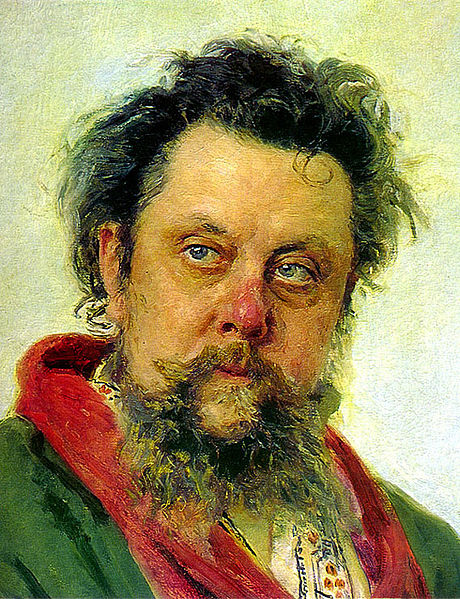
     By 1874, Modest Mussorgsky was experiencing a decline all too common to the Russian story.  Once considered an icon of Russian musical compositional expression, the dual stresses of age pummeled by an all encompassing allegiance to alcohol (so vividly expressed in the ruborous proboscis highlighted in Repkin’s telling portrait of Mussorgsky) had brought progressive detachment and eventual separation from his governmental subsidy as a national composer, and the inevitable slide into obscurity.  Mussorgsky had once been secure as a member of the “Big Five”, along with Borodin, Rimsky-Korsakov, Cui, and Balakirev, a group of Russian composers who determined to express musically a Russian nationalist identity cloaked in Russian history linked to musical  impressionism and based on classic conservatory rules of composition. But genius is not always successfully muzzled by personal neglect, and 1874 produced a very special jewel of  Mussorgsky’s soaring creativity in the Piano suite, Pictures At An Exhibition that has outlasted many of his fellow compatriots compositions in the esteem of the musical public and the performers who bring it to life again and again.

Pictures At An Exhibition  was created by Mussorgsky as an inspired interpretation of his experiences viewing a St. Petersberg exhibition of paintings  by his friend, artist Viktor Hartmann, who had died suddenly from an aneurysm in 1873.  Both artist and composer were devout adherents to the concept of a Russian identity in art, and Hoffman’s death effected Mussorgsky deeply.  The musical concept came to Mussorgsky rapidly, the idea of a ‘promenade’ of musical motifs reflecting the viewer’s walk down a promenade of paintings, rising and falling in a perfect blending of colors and mood, as the viewer left one painting and came upon another.

The suite lent itself to a number of interpretations, but came to maximum fruition when it came upon another musical genius 50 years later, Maurice Ravel, who determined to bring his gifts of orchestral scoring to Mussorgsky’s masterpiece.   Ravel, a master of orchestral color, blew out the limitations of the piano to inflect nuances, shades, spectacle and ominous emotional power to each painting, with the orchestra becoming the vibrant color and expression of each scene and painting character.

Pictures At An Exhibition is as a result very much a work of art that allows musical artists to bring the elements of creation of art to the forefront, and our collective  awe as an audience to what music is capable of stimulating within our brains.  The best expression of this phenomena, is what is created when a genius composition is interpreted by a master colorist, and performed by a master conductor and orchestra at the height of their powers.  From the early 1970’s to Sir George Solti’s death in 1997, the Chicago Symphony Orchestra was felt to be the world champion of musical virtuosity and blunt orchestral power, led by Solti’s intense and dazzling vision of what was meant by being known as the greatest assembled group in classical music.  A very special gift is available to us on the the internet that ties this all together, in a Chicago Symphony performance of Pictures in which the incredible preparation of the orchestra and Solti are lovingly reproduced, followed by the dazzling performance. Worth every second of viewing, it is the perfect vehicle into the artist’s mind, and the magnificent creative impulses that humans are capable of, in creating greatness for which we all are immeasurably benefited.

This Week in History: Opening Pandora’s Box

The origin of man’s frailties and flaws are set forth in multiple cultures, through allegory, in the story of the first woman.  In the Bible’s book of Genesis, God’s creation of Man in the idyll of the Garden of Eden is thrown asunder by the temptation of Adam by God’s following creation, Eve, introducing Original Sin and the subsequent darker forces that would bedevil mankind.  In Greek mythology, the supreme god Zeus orders Hephaestus, the god of craftsmanship, to create the first woman on earth, Pandora.  Hephaestus secures for Pandora sublime gifts of beauty and fertility, but additionally, curiosity, and with it the elements for the Greek version of fall from grace.  Zeus gifts Pandora a mysterious but non-descript box and forbids her to open it.  Her curiosity, however, overwhelms her dutiful allegiance to Zeus’s instructions,  and she opens the box. The box, containing all the evils of creation, rapidly empties, and Pandora is helpless to re-apply the lid and contain the damage.  The allegory of Pandora’s box, the connection of a seemingly innocuous events with profound later consequences, is appropriate for the event thirty four years ago occurring at the Tehran airport in the first week of February,1979.

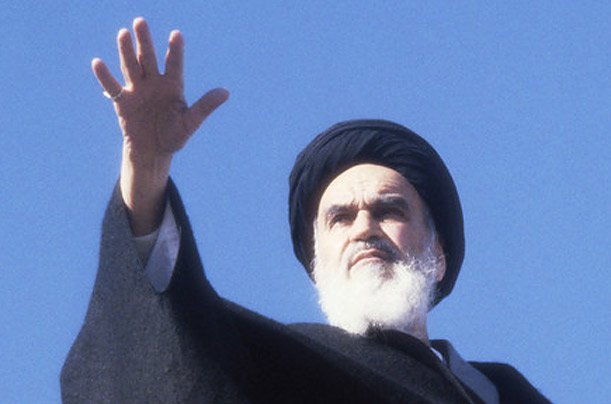
On February 1st, 1979, an elderly man gingerly stepped down the exit ramp of an airplane onto the tarmac of the airport in Tehran, Iran, and with his foot contacting Iranian soil, Pandora’s box was opened.  77 year old Ruhollah Khomeini, a Shia ayatollah, 15 years in exile in Paris for opposition to the longstanding rule of Iran’s Shah Mohammad Reza Pahlavi, was returning on the invitation of the Shah’s Prime Minister Shapour Bakhtiar.  The Shah, who had abdicated his monarchical position of omnipotent ruler of Iran at the end of 1978 in response to severe public unrest, sharing power with a parliamentary government led by Bakhtiar, had determined to leave Iran just two weeks earlier.  Bakhtiar, like many naive liberal revolutionaries before and after him, envisioned being able to control Khomeini by enveloping him in the arms of the revolution, as one of many voices that would formulate the new Iran.

The tumult of revolution we associate with the modern concept of ‘Arab Spring’ had convulsed its Persian forebears in 1978, resulting in the abdication of the Shah and dismantling of his vaunted security apparatus.  Khomeini was the spiritual leader of millions of Iran’s Shia followers but as with the Arab Spring only one of several arms of the revolution.  His revolutionary zeal, however, was never pointed toward the goals of liberal democratic consensus.  His was a hardened religious totalitarianism, linked to the fundamentalist dogma of sharia law and supreme societal rule by clerics.  Khomeini may have superficially agreed to form an “Islamic Vatican” in the city of Qom, the spiritual home of Shia religious thought in order to return from exile, but cooperating with a secular leader to progressively reform Iran was the farthest thing from his mind. Ruling Iran through cleric supremacy and formulating a larger Islamic fundamentalist revolution was at the core of his being.

Liberals tend to be attracted to the purity of totalitarian rhetoric and disdainful of the dirty compromises and character flaws of secular leaders who must deal with the reality of their circumstances.  The  message of societal efficiencies propagated by  the “democratically elected” Hitler and Mussolini, the pursuit of socialist perfection by the communists under Stalin, the purity of sacrifice of the individual to the great societal good of the pure communist state put forth by Mao Tse Tung and Pol Pot, all with goal of elimination of the “elites” and leveling of the societal playing field, has proved attractive intellectually to liberals, who are thereby willing to sacrifice individual liberties for the greater purity of societal equality.

Khomeini was in the mold of these epic totalitarians, yet was lavished with praise by the intellectual liberal elites and press in Europe and the United States, for his life long opposition to what they saw as the greater evil, the Shah of Iran. To the elites, the Shah was evil incarnate for his secret police, prisons, and harsh rule over those who would seek to water down his omnipotent rule.  Khomeini, however, was no advocate of expanded freedom for Iranians. He was in exile in Paris since 1963 instead for his oppositional rage to the Shah’s initiation of the “White Revolution” – the Shah’s six point revolution to modernize Iran – land reform, nationalization of forests, the sale of state owned enterprises to private interests, the enfranchising of women and nonIslamic minorities  to educational equality and the right to vote and hold office,  a national literacy campaign, and initiation of profit sharing to industry.  To Khomeini and his religious followers, the Shah’s drive toward a Westernized more liberal Iran was the ultimate crime against the core tenet of fundamentalist Islam, that demanded complete submission to the message and laws of the Koran as interpreted by Khomeini and other fundamentalists.  Completing the Shah’s journey to ultimate sin against Islam was his willingness to have diplomatic relations with the state of Israel and his good graces with the Great Satan, the United States.

The elderly man who stepped off the tarmac in Tehran in February, 1979, may have been physically enfeebled by age, but carried the great energy and fire fed by hatred and zealotry.  Prime Minister Bakhtiar had unknowingly transmitted Pandora’s Box from Paris and opened it, releasing what has become the great storm of Islamic fundamentalist rage and retribution of the last 34 years and making the epicenter of the fury the Islamic Republic of Iran.  Khomeini quickly brushed aside Bakhtiar and his  liberalist tendencies and by the end of the year brought the totalitarian cleansing he had dreamed of in those years in exile in Paris.  Gone were the open role of women in education and society.  Gone were the concepts of minority rights and  freedoms.  The Shah’s prison abuses soon paled to the kangaroo courts and  brutal torture chambers Islamic fundamentalist justice with tens of thousands of free thinkers and religious minorities imprisoned and executed.  The concept of jihad proved an ominous Khomeini tool to control events beyond his immediate borders, intimidating liberal Islamic thinkers like Salman Rushdie through the declaration of fatwas, and revolutionizing the youth of Iran. much like Mao. into defense of the faith as Revolutionary Guards. He directed his followers to dismantle the concept of diplomatic immunity and national sovereignty by encouraging and orchestrating the hostage takeover of the U.S. Embassy in Tehran for the sheer joy of humiliating the Great Satan.   He soaked his country in the blood of totalitarian war, driving a half a million zealots to their death against the equally murderous totalitarian Saddam Hussein and Iraq.  He turned the democratic concept on its head, forming the concept of Supreme Leader, placing in the hands of a cleric levers of power that even the Shah could not approach.  His final goal was the bringing of jihad against the Great Satans, Israel and the United States, and his surrogates continue to aim for the destruction of each through strikes of terror and Iran’s singled minded drive to develop the atomic bomb.

Pandora was horrified of what she had done in giving in to her curiosity and releasing the contents of the Box.  Our Western apologists unfortunately make no bones of the great damage done to the concepts of individual freedom, separation of church and state, and extension of the concepts of liberty and entrepreneurialism emitted by opening the Box 34 years ago in Tehran.  To them, their cartoonishly negative view of flawed individuals like the Shah prevent them from ever assessing the balance of the good and bad these type of leaders occasion for their people. The Iran of today may be free of the Shah, but managed to trade him in for a darker more ominous totalitarian, and the world is definitely not a safe or freer place as a result.  One wonders how many more of Pandora’s boxes were opened by the encouraging of the process of the Arab Spring.  Unlike Zeus, we can not simply retreat to Olympus, but as human beings, will have to face and bear the untoward consequences.