
Miracle at Dunkirk: Re-Imagining History in the Post History Age

One of the “Little Boats” used at Dunkirk – Imperial War Museum

I recently had the occasion to see Director Christopher Nolan’s cinematic epic “Dunkirk”.  We have been through a period in cinema , depicting heroism relegated to the contrived world of comic super heroes and steroid injected Ubermen,  where courage is universal because personal risk is essentially eliminated.  The real world is altogether different, where courage is usually selfless, with the recognition of one’s mortal being and the randomness and cruelty of destructive fate is ever present.  Nolan has attempted to revert back to old fashioned cinematic concepts of relating historical events, more in line with the effect upon individuals of sweeping and inexorable waves of history.  “Dunkirk” is told in perspective style, in which time is warped to view a simultaneous event from the perception of those on land, on water, and in the air.  Nolan tells everyone’s story on the Dunkirk beach by concentrating on no one’s particular story, instead, relaying a visual masterpiece of surreal beauty, claustrophobic terror, and harrowing visual and audial tension. It is heroism on a human scale, with self preservation in conflict with duty, small gestures raised to epic scope, and helplessness at war with determination.  It is a war epic in classic mode, leaving the seeds of conflict for others to tell, focusing on the innate  human quality of somehow rising to the occasion, forming the mythic foundations of the human story.

Nolan’s epic, though entertaining in both its visual scope and its technical virtuosity, is strangely absent in the critical ingredient needed to attain great cinematic art, the art of telling a mythic event as an engrossing story.  Nolan’s screenplay relates in intimate detail of the overwhelming sense of entrapment and helplessness of the hundreds of thousands of men clinging to the beaches of Dunkirk, but little of the story as to the reasons for their predicament, or of the heroic and determined effort of those who put them there, to get them out.  It is the obvious trap of having to tell a complex story that extends over a week, in the two hours that the movie can relate, that resulted in Nolan determining to leave the tension and heroism in, and the history out.  The result is, despite the brilliance on the screen, one leaves the theater with the story of the “miracle of Dunkirk” seeming vaguely flat and unsatisfying as an epic event.  It is unfortunately the burden of attempting to tell history to a post historical audience, in which the assumption of knowledge of the event and consideration of its importance to our current comfort and security meets  a mostly empty vessel of recognition.  Without presenting the background of the event to the modern audience, now immersed in a world of casual, politically corrected  facts and  extremely limited awareness of history, Nolan has made “Dunkirk” into an entertaining, but at its essence,  simple “disaster” movie, ultimately no more impactful than a characterless Poseidon Adventure.

Dunkirk holds more than enough epic stories to fill a serial movie treatment.  The extent of the looming disaster to western civilization cannot be underestimated.  The relative security and interlude of the ‘Phony War’ of the winter of 1940 came to a sudden and violent end with the Nazi war machine invading Belgium and ultimately France on May 10th, 1940.  Displaying “Blitzkrieg”, the innovative and overwhelming strategy of rapid ground advancement spearheaded with tanks accompanied by devastating air support, the German Wehrmacht achieved in weeks what they could not in 4 brutal years of trench fighting  in WWI, the encirclement of the entire British Expeditionary Force in Europe, along with the residual of the French army, in a small enclave in northwest France.  The only means of escape were the ports, and with the rapid loss of Boulogne and Calais, there was  left only a small salient around Dunkirk, ten miles from the Belgian border.  Over 400,000 British and French forces were bottled up against the coast with diminishing supplies and overwhelming opposition pinching from the flanks.    A near total loss of the critically trained foundation of the British Army was imminent. The developing catastrophe had caused the prime ministership of Neville Chamberlain to fall, with the massive responsibility and enormous consequences of failure now assigned to his replacement, Winston Churchill.  Loss of the expeditionary army of 300,000 men and equipment would likely leave the British homeland prostrate before the multi-faceted superiority of the German war machine.  The future survival of recognizable western civilization lay in the balance.

Pushed against the ocean in Dunkirk, the thousands of men lay inexorably trapped against the artillery from the surrounding enemy and the vicious strafing from the Luftwaffe from above.  The small silver lining was the curious decision of the German forces at the end of May to halt tank advancement against the Dunkirk enclave, believing the surroundings not conducive to tanks due to marshes,  and rely upon the air force to prevent extraction from the sea and devastate the residual force from the air.  This provided a small amount of breathing space for a complex and coordinated heroic attempt to hold off the Germans long enough to evacuate as many as could be evacuated by sea.
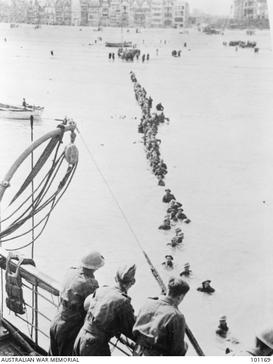
Troop evacuations off the beaches at Dunkirk June 1940 – wikipedia

Nicknamed Operation Dynamo, the plan consisted of a  barricade of predominantly French troops to prevent German ground forces from entering Dunkirk while coordinated landings of the bulk of the British fleet at the Dunkirk  port would remove soldiers under the relative security of British air cover.  The evacuations started on the 25th of May, and the onset of the plan was fully realized on the 26th.  The ominous goal of perhaps removing at most,  10% of the trapped troops, 40,000 men, was the hope of Churchill and his planning team.

The difficulty of the plan, both in scope and in diminishing available time, rapidly increased the chaos at the beaches.  Incoming boats with drafts too deep for the shallow waters of the harbor proved inadequate and slow for the process, and were vulnerable to both air attack and u-boat packs, with brutal losses of ships and men.  The inner harbor was soon abandoned  for the outer breakers, or moles, where men could more efficiently organize and board, though no less vulnerable to strafing attack, as harrowingly visualized in the movie. The mythic part of the evacuation was the participation of many British citizen sailors manning hundreds of small craft, known as the “little boats”, including the motorized life boat pictured at the top of this essay.  This motley armada braved seas, minefields, u-boats and strafing aircraft to pick up and deliver home tens of thousands of additional soldiers.
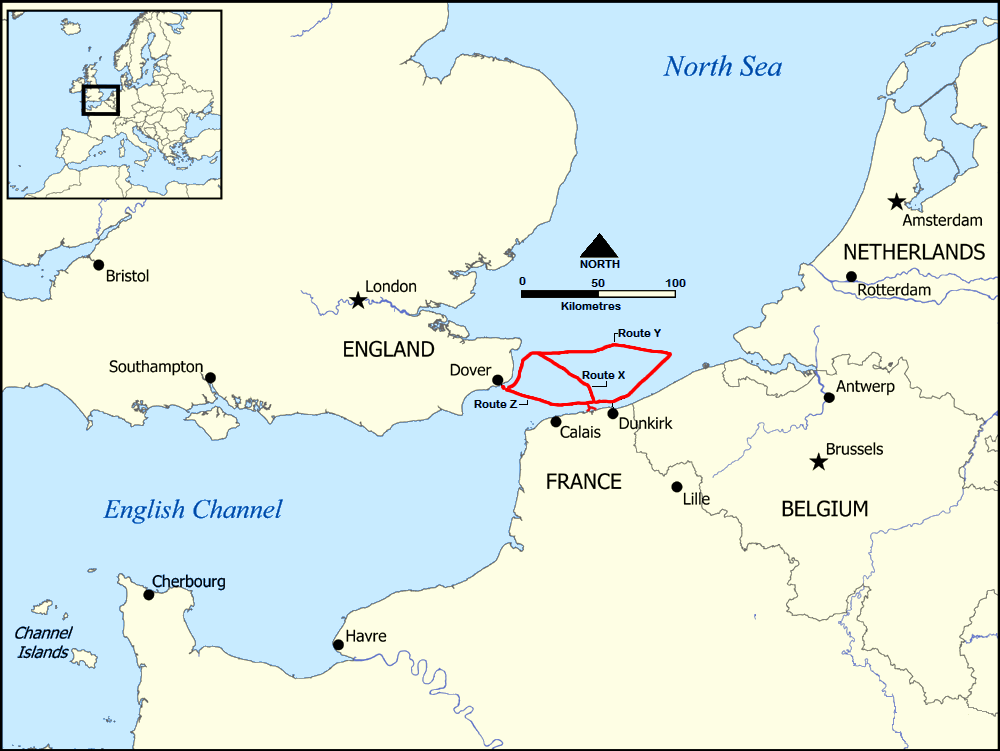
The evacuation routes from Dover to Dunkirk and back –  Route X was laced with minefields and Y with u-boats, but the shortest distance Z was abandoned due to its proximity to German land based artillery. – map by wikipedia

The tremulous dribble of troops out of Dunkirk soon turned into a flood, with at its height as many as 2500 troops an hour evacuated.  By June 4th, in stunning fashion,  over 338,200 British and French soldiers had been rescued and returned to the homeland, to be positioned to help defend the homeland and, maybe one day, reverse the tide against the Germans.

The losses to achieve the ‘miracle at Dunkirk’ were immense. Losses of thousands of defender’s lives, over 100 airplanes and crew, and 226 of 693 participating ships were sacrificed to accomplish the stunning feat. The collapse of the residual French army and the established hegemony over the mass of the European continent by the Nazi dictator was soon achieved.   Churchill recognized the reality in his comments to the House of Commons on June 4th, 1940,  regarding the Dunkirk evacuation:

What has happened is a miracle of deliverance, but we must be very careful not to assign this deliverance the attributes of victory.  Wars are not won by evacuations.”

A movie like Christopher Nolan’s “Dunkirk” provides a ‘you are there’ realism that can be achieved by no other medium.  The movie pulls at your fears and elevates your senses to bring the immediacy of an event alive and current.  What the movie does not do is frame the “how and why” of history, bringing  meaning to sacrifice and perspective as to the outcome.  The immense scope of the endeavor and a nation’s gritty and determined effort to succeed against all odds,  from its leadership on down to the most common of men, is the real survival story of Dunkirk.  The participation of the whole and the sacrifice of blood, sweat and tears for principles that define events such as Dunkirk in the stirring tale of history.  Our post – historical world can only emotionally experience the tragedy of individual loss, too superficially cognizant in their civilization’s history to acknowledge the bounty of human achievement preserved for future generations in such moments.  Our current willingness to be ignorant of history makes us susceptible to emotionally resign to a life of  personal security for the greater intellectual demands of a life of meaning.  Dunkirk reminds us that giving in when there is hope is giving up our humanity.  Across the ocean lies a better future, if we are willing to dream.

 

Daniel Gerhartz: Reflecting Beauty, Seeking the Sublime

Detail from: To Cherish
Daniel Gerhartz 2017

When  you are good friends with someone with immense talent, your perspective on their accomplishments is sometimes akin, like Icarus,  to flying too close to the sun.  Attracted by the brilliance, you can become blinded to the risk of loss of reflection on what is transpiring.  My friend Daniel Gerhartz, like Daedalus, has carefully treaded the path between craftsmanship and inspiration to develop a prolific body of fine art.  It has been balanced between classical technique and a spiritual core that, as quoted by Waaijman, “aims to recover the original shape of man.”  The art world has already appreciated this careful balance, with awards, museum recognition, and popular acceptance. For the premier artist as craftsman, this is a very comfortable place to be. For an artist who is juxtaposed spiritually to the possibilities of the sublime, a parabola oriented toward the sun beckons.  The evolution of good artists to greatness, to permanence, lies in the eerie tension created in risking the comfortable world,  in search of the transcendent .  The art of Daniel Gerhartz is on path towards recognition of the sublime.

Equally proficient in the art forms of landscape, still life, and portrait, the unifying thread of Gerhartz’s work is Beauty, and he is nonpareil in the human form.  One of the great treatises on the concept of beauty is by Umberto Eco.  He identifies the persistent need to extol beauty in all its forms as a distinctly western concept, and reflects as to how art particularly has recorded the changing view of what is deemed beautiful over the centuries.  In his introduction Eco develops the close but distinct relationship between what is the Good and the Beautiful. Good is defined not only what we like, but what we should like to have for ourselves, as possession, that which stimulates our desire.  Beauty permits us to appreciate it for what it is, immaterial of our capability to possess it.  The Sublime lives in a plane of almost infinite beauty, creating as Schiller stated, a duality where the beauty is recognized as a component of a harmony experienced in the world of reason, but a corresponding negative tension  felt by a pull toward the infinite that exists beyond sensible perception, creating a distinct emotion somewhere between a shudder and  untrammeled rapture.  It is in the Sublime that great representational artists congregate.    Over time, Dan has recognized this historical theme, and learned to weave the various expressions of beauty into an ever more arresting and elevated body of work.

A Gerhartz artistic vision  that is evolving  is the juxtaposition of past representations of beauty as part of a mystical, dream like background relief of a classical still life.  Beautifully rendered in “The Best of June”, the exquisite June blooms of peonies frame a distinct but reflected past  expression of sublime beauty in the painting of Sir Frederic Leighton, “Flaming June” an arresting figure in repose existing in the world between languor and dreams.

The Best of June
Daniel Gerhartz 2016

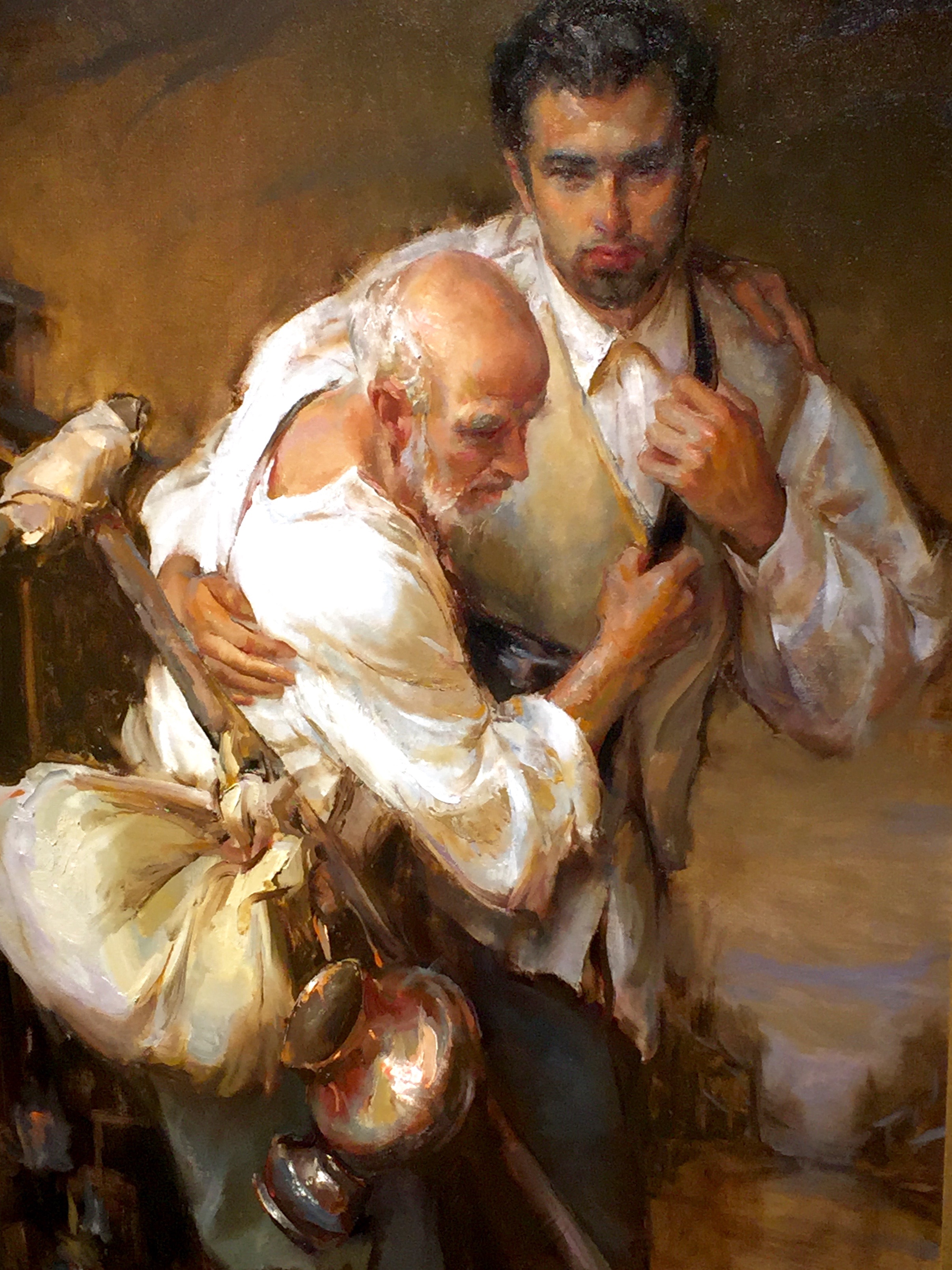
Following his spiritual bent toward the mystical, inhabited in the earliest of Christian monasticism, the Desert Fathers of the 4th century, the parable of Abba Agathon is brought to life in a modern representation of timeless beauty found in selfless human action. The portrait of strength and spiritual clarity in the young man, the age and frailty of the reliant, old and crippled figure are expressively the technique of an engaged master of painting.

Least of These
Daniel Gerhartz 2016

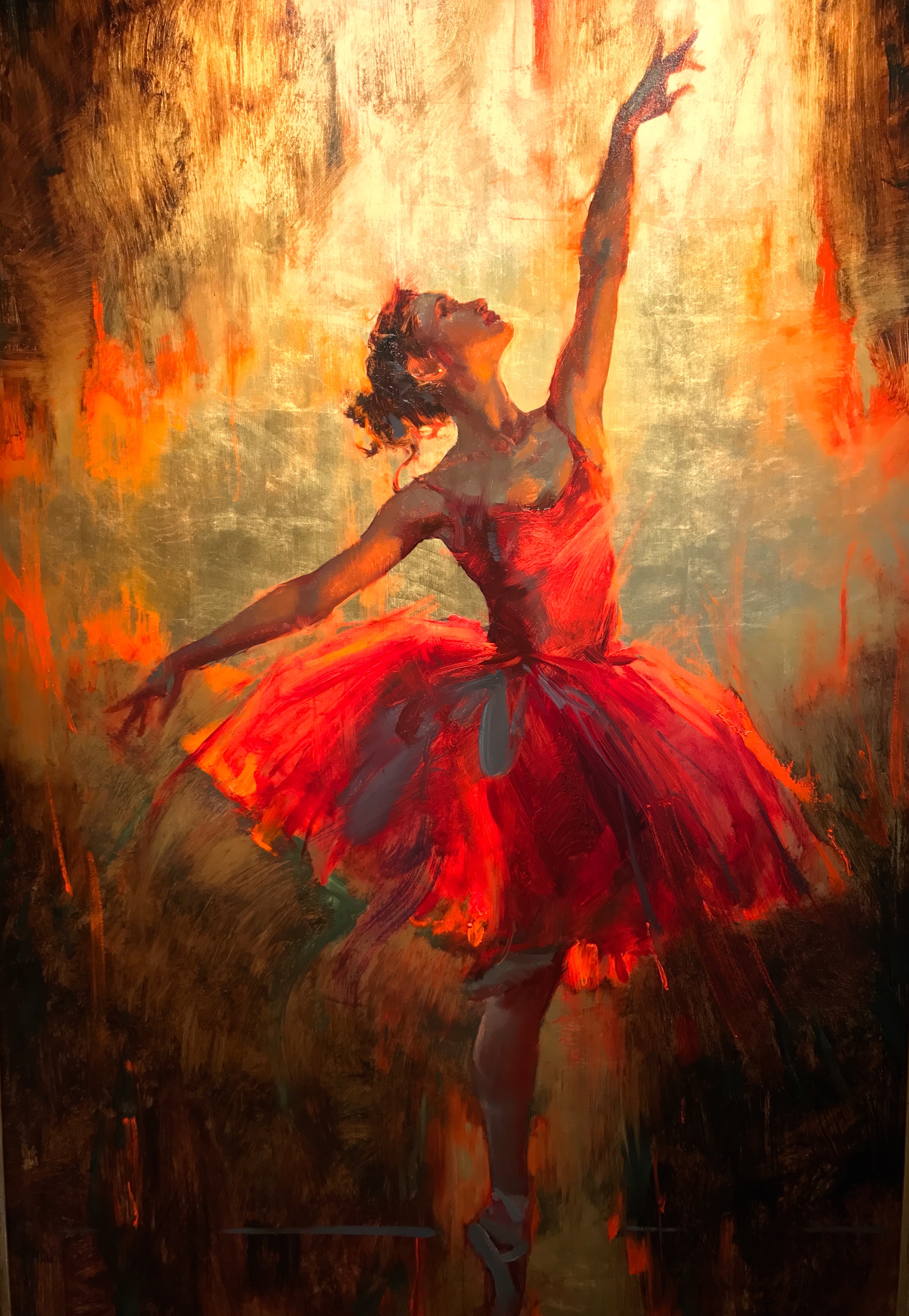
Experimenting with classical portrait on the iconic medium of gold leaf, the echoes of Degas are reverently expressed in a minimalist style backlighting a beautiful, very classical and very Gerhartz, elegantly realized ballet figure.

Gilded Scarlet
Daniel Gerhartz 2017

The silent and intimate evocation of human love of one sister for another, in portraiture almost as perfect in its tone, proportion, and immediate warmth as can be represented by oil paint, is  expressed in Dan’s “To Cherish”.  Strains of Mary Cassatt in coloration and composition remain modern and arresting — uniquely Gerhartz

To Cherish
Daniel Gerhartz 2017

With several decades of painting behind him, this painter is hitting a creative stride that even those like me, close to him for years, can see coming to full realization of his boundless talent.  Modern representational painting has the enormous responsibility to recall , to build upon,  not to copy,  past expressions of great western art.  We have been through a sullen century of artistic  aversion to the timeless calling of human emotion and expressions of beauty that elevated the appreciation of the reason for human awareness and reflection. This aversion to life’s deeper calling is giving way slowly as modern society feels a progressive need to restore meaning to existence beyond simple material possession and security.  This call to meaning has been the basis for western thought over the past two and a half millennia.  We are wrapped in the need for human interaction, pulsed through creativity, love, courage, and tinged in passion for another. We at the same time inhabit a universe of immense scope, unknowable fate, beyond rational human insight, existing in the sublime realm of faith and spiritual awareness.  The oncoming greatness as a painter expressing a conduit for those two worlds is Dan Gerhartz’s destiny.  All that was, and all that can be artistically, is capably within the current brush strokes of a terrific  American painter, Dan Gerhartz.


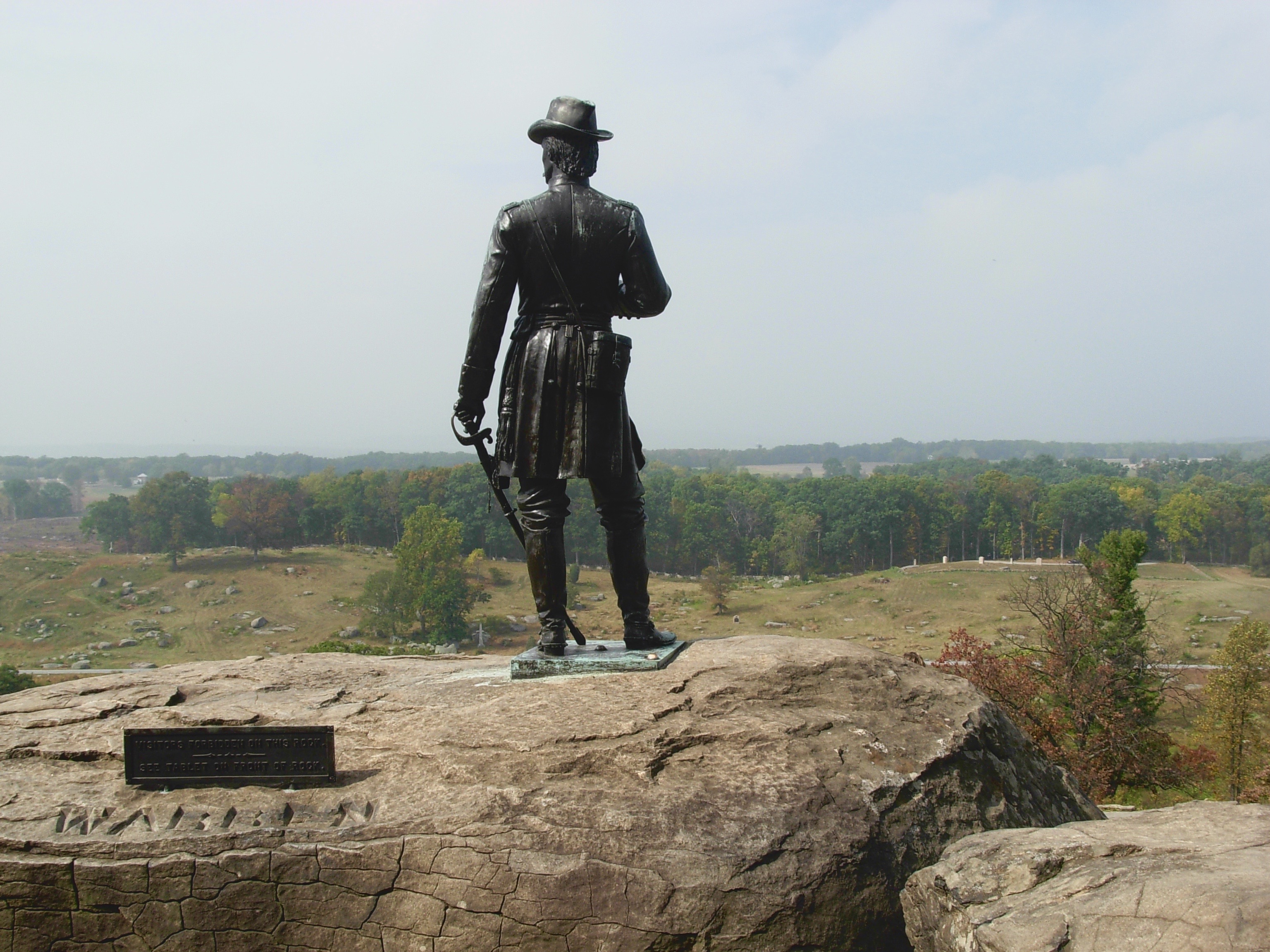
Crossroads at Gettysburg

Gettysburg National Military Park – wikipedia commons

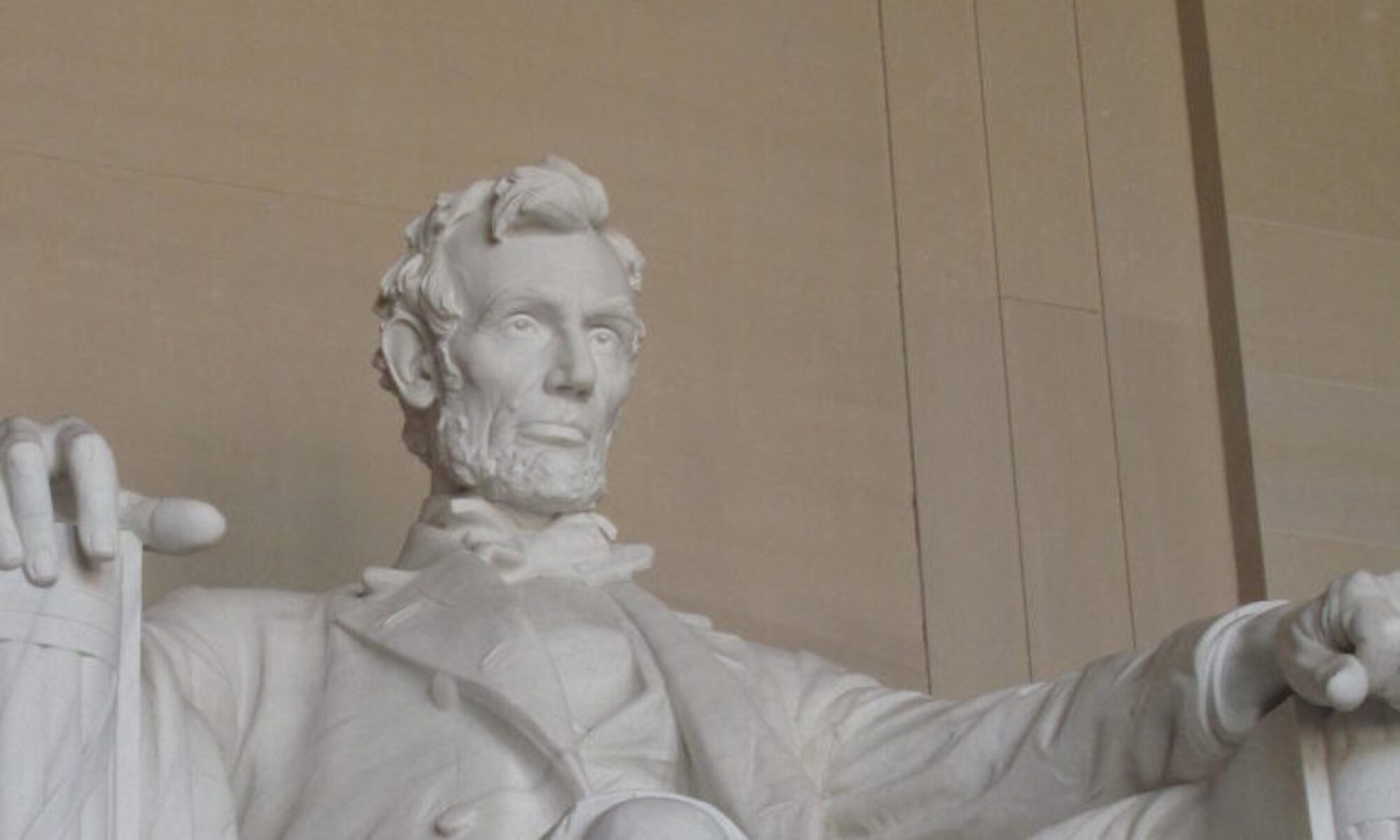
Today’s society is inwardly directed and struggles to grasp the forces of history that often re-orient destiny.  When the republic was newer, however,  and more attuned to the circumstances and elements of its birth,  most citizens had an acute recognition of the role of action and consequence.  The concept of historical crossroads, a point of time at which the direction of the arc of history is called, was acknowledged by all to be present at Gettysburg, Pennsylvania in early July, 1863.  The bitter battle over who owned the correct interpretation of the events of the American Revolution had slogged its way through two years of horrific struggle, but the indeterminate outcome thus far had only sharpened the the intensity of the philosophical commitment to determine the owners of the arc.    As Lincoln so presciently remarked in his ‘house divided’ speech in 1858:

I do not expect the Union to be dissolved – I do not expect the house to fall – but I do expect it will cease to be divided.

It will become all one thing or all the other.

The first six months of 1863 had wetted the appetite of the confederate military leader of the Army of Northern Virginia, Robert E. Lee, to bring a finality to Lincoln’s epic conceptualization.  Two crushing victories over attacking Union forces at Fredericksburg in December, 1862, and Chancellorsville in May, 1863, had led Lee to dare to visualize a path to ultimate victory, predicated upon a penultimate battle on the Union’s own territory.  Lee saw the Union forces as worn down, divided, and the Union states weary of the devastating cost of battle and indifferent to Lincoln’s vision.  He was confident, and he was wrong, but this particular historical arc required that the question be called and destiny be played out.

The crossroads of history would therefore have a virtual and actual set-piece in the little town of Gettysburg, Pennsylvania.  A unique confluence of actual crossroads and logistical support needs led the massive Union and Confederate Armies to congregate on Gettysburg on the 1st of July, 1863.  Five roads intersected the little town from the north, three from the south through some of the most fertile and prosperous farmland in the world.

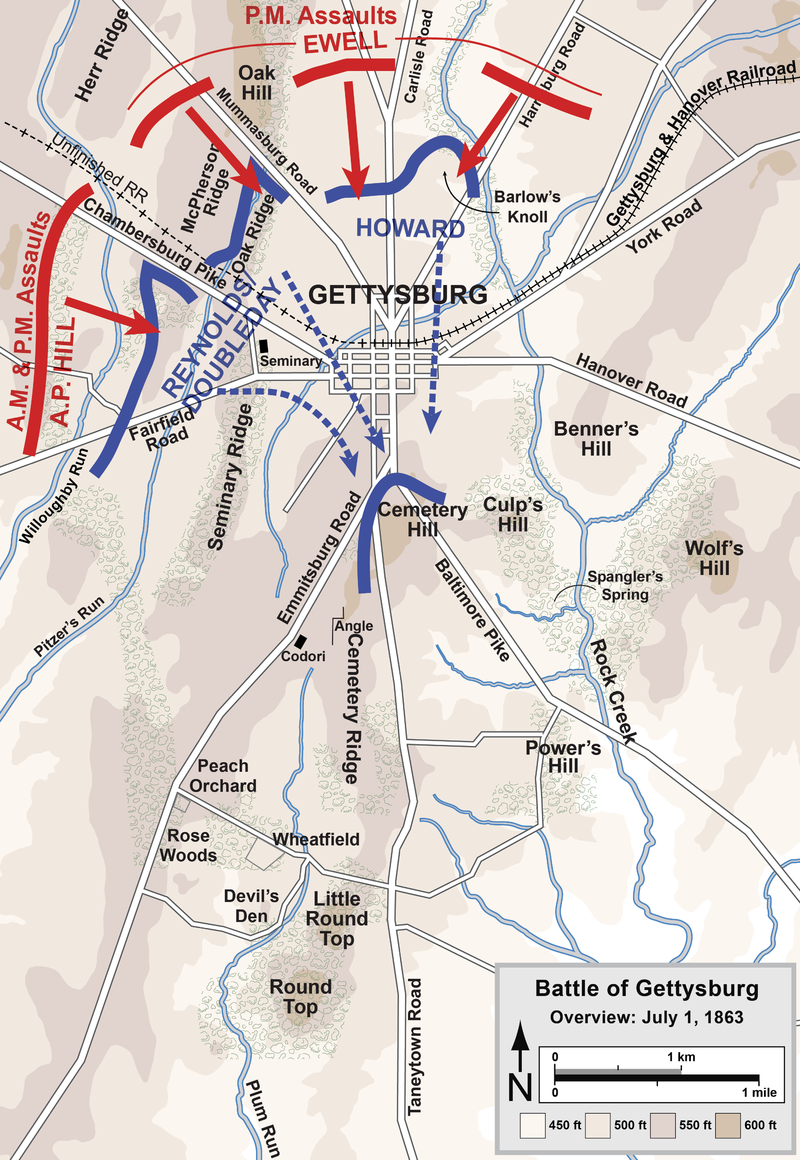
July 1 Battle of Gettysburg wikipedia

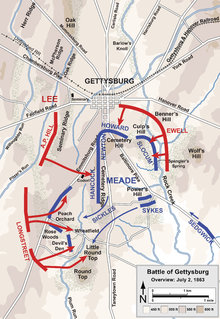
In a somewhat fortuitous twist of fate, the Confederate army would enter from the north, the Union army from the south.   The initial battles took place north and west of town as Union forces led by General John Reynolds initially contacted and repulsed Confederate brigades at the tip of the spear, but as the mass of General Ewell’s confederate Second Corps arrived, the Union forces were pushed to and through Gettysburg into a defensive position on Cemetery Hill, with the crushingly painful mortal loss of Reynolds to a bullet.   An over-confident Lee, somewhat blinded by the absence of  his ‘eyes’ , the cavalry force led by Jeb Stuart, inadvertently  caught on the wrong side of Union General Meade’s Army of the Potomac, did not recognize the bulk of the Union Army had successfully crossed the Potomac River,  and looked to roll up his union opponents in a devastating piecemeal fashion.  Meade, however, proved infinitely better than his predecessors in mobilizing force and by the morning of July 2nd, had created a ‘fishhook’ defensive line which he was able to reinforce as necessary.

The following two days of battle stand as immortal lore in the discussion of courage, fortitude, devastating loss, and magnificent victory.

The sun rose on July 2nd with Lee striving to develop his ‘role up’ plan with massive attacks to the flanks of the Union army, hoping to crush it upon itself similar to Stonewall Jackson’s attack at Chancellorsville, but Lee had no Stonewall Jackson, as Jackson had been accidentally struck down by one of his own snipers at Chancellorsville at the moment of victory.

July 2  Battle of Gettysburg  – wikipedia

Lee instead relied upon a coordinated attack from General Ewell’s forces upon Culp’s hill to the north, and General Longstreet and Hill from the south against Cemetery Ridge.  This being an era of slow and incomplete communication, no significant coordination ever developed, and the battered Union forces heroically managed to hold against massive and fierce assaults from Longstreet at the Devil’s Den and Little Round Top.  Despite huge losses, the Union lines held and Meade was able to mobilize 20,000 troops to fill the breaches to the defensive line caused by the day’s violence.   All day long, Confederate forces had come within yards of a full breach of the Union flank, with vicious hand to hand combat between individuals and their recognition of the crucial nature of their historical role determining the fate of tens of thousands, and ultimately, the fate of a nation.  On the evening of July 2nd, Lee convinced himself that the Union Army, softened by years of inept and indecisive generalship, would finally crumble under the pressure of pointed overwhelming force aiming to split the Union Army in half and drive through its reserves.  Despite the events of the day, Lee had a prismatic view of the indestructible capability of his troops and their rightful place in Providence, and sought to raise the final call to question of July 3rd.

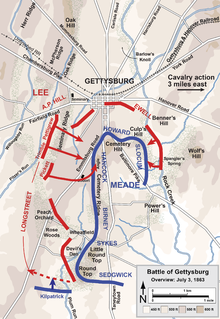
The crossroads of history weighed heavily across an open field in the early afternoon of an oppressively hot day on the 3rd of July, 1863 in Gettysburg, Pennsylvania.  The terrible, heroic beauty of the specific battle known down through time as Pickett’s Charge have been rendered by Ramparts in 2011, and worthy of a separate read.

July 3 Battle of Gettysburg -wikipedia

General Lee’s vision of the tip of an irresistible force driven to and through a tiny door, at the angle of a low stone wall, was undertaken in the epic form associated with the mythical heroes of the Iliad.  An initial artillery bombardment, designed to create a porous defensive wall was undertaken by Confederate artillery.  The door was to be blown open, and then thousands of troops would then pour through and rout the core of the Union forces and, indirectly the Union state’s morale to continue the war itself.  The artillery barrage, though massive, struggled to concentrate, and much of the damage sailed over the frontline, leaving it intact.  From the concealing trees of Seminary Ridge came Pickett’s ten thousand, across the open field, focused like a laser on the door to victory, and their place in determining the outcome of this crucial crossroad of history.  Once again, in a battle of tens of thousands of surging and seething armies, the tiny angle of a farmer’s stone wall on Cemetery Ridge just past the Emmitsburg Road held a future world of either freedom or servitude in the hands of several hundred men.  Each man on the angle assumed himself the final arbiter, one determined to be invincible, one immovable – and history wavered and heaved in the heat.

In the end the attack was repulsed, and Lee’s view of an unconquerable Confederate force protected by Providence lay in taters, along with the Union Army’s previous sense of Lee’s invincibility as a leader of men.

The crossroads at Gettysburg had led ten thousands of men to an intersecting fate, and thousands of men to their deaths.  The largest armies that had ever faced across a battle field on the North American continent, had resulted in the largest number of casualties ever suffered on the North American continent, over 50,000 for the combined armies over the course of the campaign.

On the nation’s birthday, July 4th, 1863,  the call to question –  a house divided against itself cannot stand — combined with the conclusive victory of General Grant at Vicksburg on the very same day,  was answered affirmatively and indisputably on the side of individual freedom.  The war would go on for two more long years, with much sorrow and loss to come, but the verdict of history would never be in question again for this uniquely American arc.

We face our current July 4th with a population versed on the day being a holiday of fireworks and picnics, but with little connectivity to the unique fundamentals of individual liberty birthed on that specific day in 1776, or dramatically and heroically sacrificed for in 1863.  A physical battle is not what is wanting in this country.  Rather it is an intellectual one, based on individuals versed on what is at stake with every won freedom, overcoming those who are blithely ignorant of what is irretrievably lost in their self absorbed drive toward passivity and security.

On this 4th of July, enjoy the fireworks and friends, but take some personal time to absorb all that has come before and help to make the amazing country we inhabit today.  Grab a copy of a founding document, and take a minute to digest its profound wisdom.  There is no room for a house divided.  We all inhabit the same house of freedom.