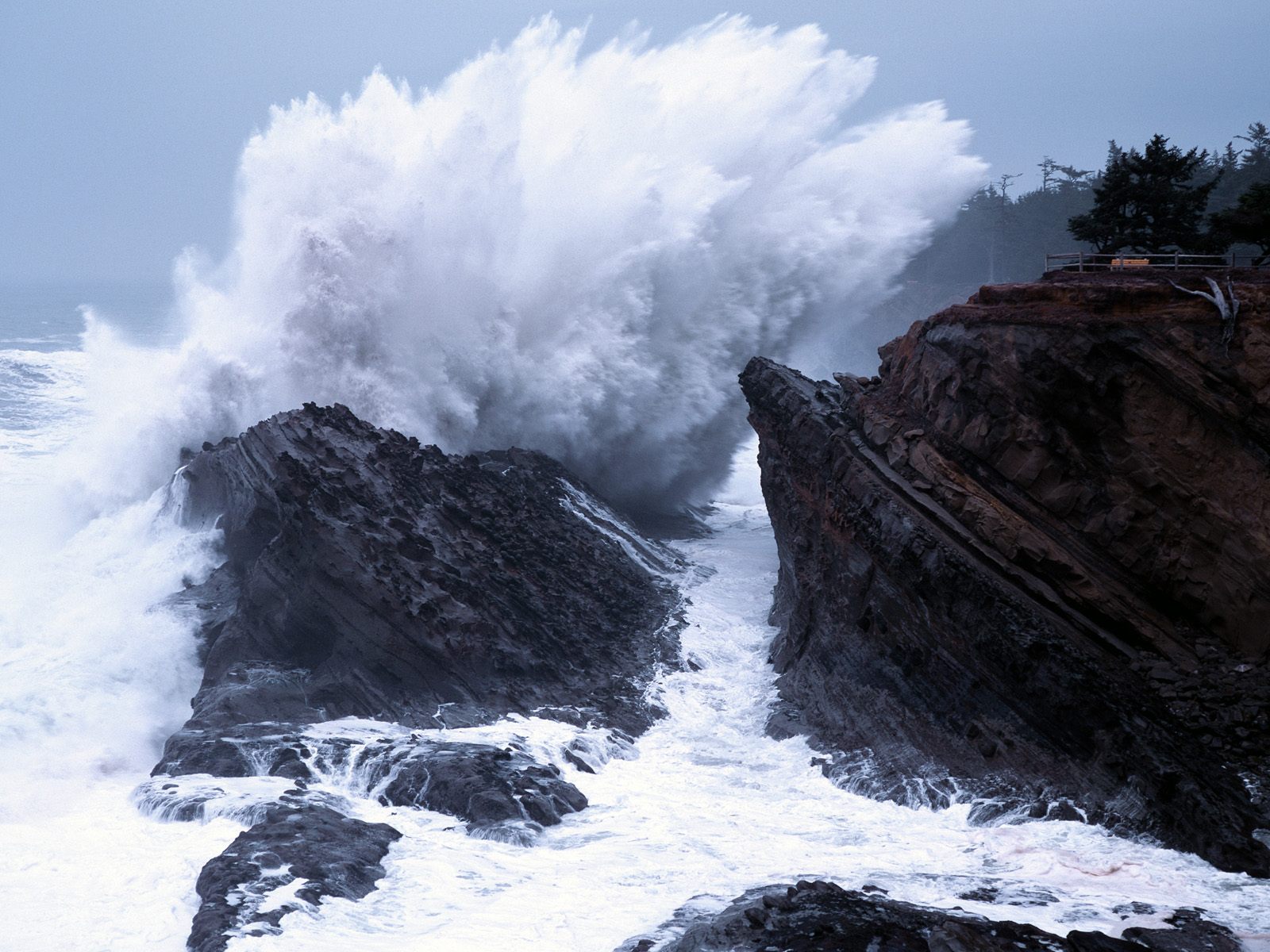
A Wave versus a Ripple

bulkupload_Ocean-Wallpaper_Crashing-Waves-Oregon

The United States nationally participates every two years in perpetual rebirth as defined by the founding fathers. The securing of a representative legislature for governance occupies the  first article of the Constitution,  laid out in means by which renewal and stability can co-exist.  The house of representatives allied most closely to local expressions is positioned to reflect the feelings of the electorate as to their sense of representation and influence over the nation’s direction.  The election of senators, adjusted by amendment to the constitution remains positioned at six years in the post to be more immune to the day to day emotional shifts of the electorate.  As the senate elections are however staggered such that a number of senators are nationally exposed to assessment at every election,  there remains the potential that if the local district ,the statewide electorate, and the national zen are emotionally confluent in the interpretation of the country’s direction, a wave election is possible.

Wave elections are not necessarily about substantial increases in a party’s representation in Congress.  They speak more toward a fundamental shift  in the electorate’s sense of the country needing to change direction, and the effects typically extend beyond the current election and may influence several election cycles.  Maybe no sea change in electoral philosophy expressed through a wave election will fundamentally top the epic wave of the 1930-32 elections. For almost 70 years since the Civil War, the country had maintained a confident sense of destiny through self actualization and growth that resisted intermittent economic downturns and for the majority of elections left a Republican bias in place.   In the depths of the depression, however,  the country demanded a hard tack to the left that has influenced the nation’s course ever since.  The 1930 Congress was composed of a house of 267 republicans and 163 democrats, a senate of 56 republicans 39 democrats and a republican President. Just two years later, the electorate converted the house to 313 democrats and 117 republicans, the senate to 59 democrats and 36 republicans, and the Presidency to FDR.  This dramatic change was not simply a “throw the bums out” reflex.  It reflected the country’s conversion from a self reliant, libertarian concept of life to a community driven, safety net philosophy that has never left.  With minor ebbs and flows, the Democrat wave secured the House of Representatives for the next 31 of 33 elections, the Senate for the next 25 of 27 elections, and the Presidency for the next 7-9 elections.

Now that’s a wave.

With the increasing influence of  money and the immediacy of social media, it seems that the ability for the country to digest the effectiveness of governance and the re-orientation of priorities has been fundamentally effected.  Waves have steadily turned to ripples as the effects of the wave are often cut off by the manipulative influences of media driven by money. With billions now spent on elections, most of it to the prosperity of those that deliver the message,  there is an industry developing to convert elections into mini-waves, increasing the hostility and inaccuracy of the discourse, and guaranteeing the progressive expenditure of money to adjust.  The waves have progressively shortened almost to the extent of each election cycle, driven by the media’s need to create conflict, and deflect the momentum of a philosophic governmental change. The shorter attention spans of the electorate, driven by the more emotional immediacy of the message, contributes to this, and plays into the hands of those who wish to control the country’s direction.

A pattern of back and forth waves, with more radical peaks and troughs, has settled in. The “Reagan Revolution” flowed for a decade, until the 1992 election re-oriented the country back towards collective economic security with the end of the Cold War and the election of Clinton. Almost immediately, the Clinton in your face style with the push toward universal healthcare, led to pushback, with the unexpected Republican takeover of Congress with republican “wave” of 64 seats in 1994, leading to the ultimate politician Clinton shifting to the right, abandoning his wife’s healthcare initiative, cooperating with welfare reform and declaring “the era of big government is over”.   Not so fast.  The overreach of the congress with the Clinton impeachment drove a schizophrenic election of 2000 that hung on a couple ballot chads, and within two years led to a republican President driving a massive governmental infusion into healthcare with the formation of Medicare Part D, covering for the first time prescriptions.  The cataclysm of 9/11 briefly aligned the country’s vision on the international stage, only to lead to the democrat wave of 2006, which wrenched a sharp escalation in the concept of debt investment and government influence, resulting in the election of the most liberal President in history, comfortable with doubling the size the nation’s debt accumulated in over 230 years, in just five, with the enthusiastic support of the democrat majority in congress.  This budget busting philosophy and a back room push of government take over of healthcare, the liberal uberweapon to control populations, led to the Republican “wave” of 2010, in which the president himself declared his party to have absorbed a “shellacking”.

The apparent”shellacking” delivered by the electorate in 2010 this time, however, led to no perceptive changes in governance, as the presence of enormous money and the shorter attention spans  was maximized by the president in collapsing the wave with his re-election of 2012. The power of the election to influence government policy proved progressively powerless against the use of media to propagate distortions and out and out lies through the power of social media. “If you want to keep your health insurance, you will keep it. Period”.  ” The massive stimulus plan of 2009-2010, will create hundreds of thousands of “shovel ready jobs”.  The IRS political motivated suppression of free speech to reduce influence of conservative discourse in elections contained “not a smidgen of corruption.”  The Benghazi terrorist attack  was a “response to a Youtube video.” One could go on and on and on.

The 2012 election secured the undoing of the 2010 election. What should we therefore make of 2014?  The polls suggest the country is again deliberating on a potentially massive “wave” response to the lack of influence of the 2010 election to change anything.  History suggests that the result will have less influence on the government’s tactics than one would suppose.  The President already is describing a massive extra-legislative process to change the country’s demographics through the executive edicts to achieve immigration “reform”, feeling himself immune to both election results and potential extra-constitutional actions. Have we reached a point where the democratic process has lost its capacity to influence government, that responds instead to the flow of money and the real time manipulation of the social media emotions through propagandistic distortion?

Like all defenders of the ramparts of civilized society, I remain wistful about the potential ability of a democracy to stop internal decay, restore fiscal sanity, secure its borders and principles of citizenship, defend against external enemies, and providentially commit to its future.  A 2014 “wave” to restrain the collapse of these ideals so influencing our current administration is the least we can hope for.  Recent history is not comforting.

On November 4th, outcome aside, it behooves us as defenders of the Ramparts to attend the barricades and vote for change one more time, and fight, fight against the dying the light.

Maybe this time, we can hold the potential of renewal beyond the satisfaction of winning an election night.
 

Canyonland

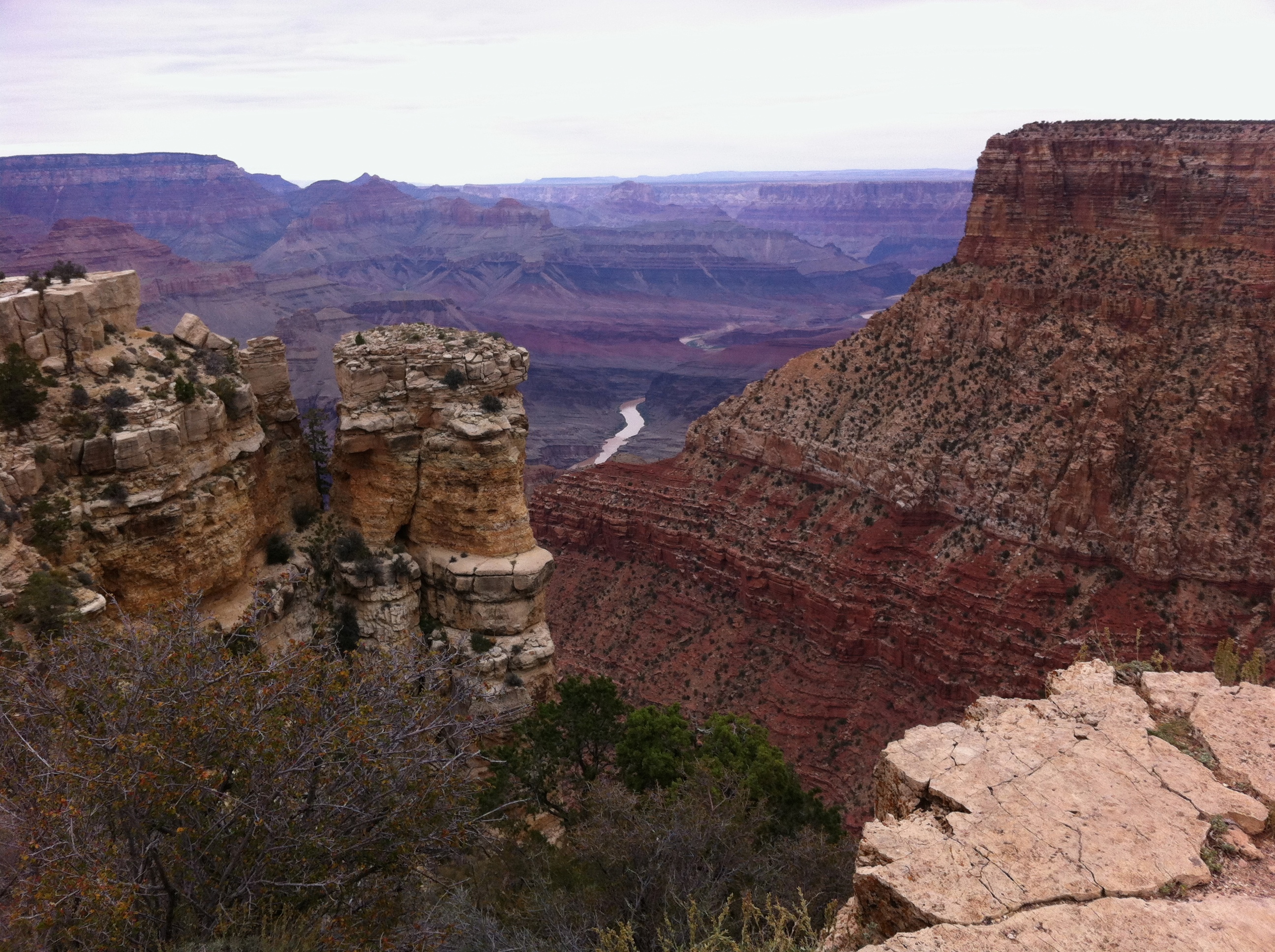
Grand Canyon
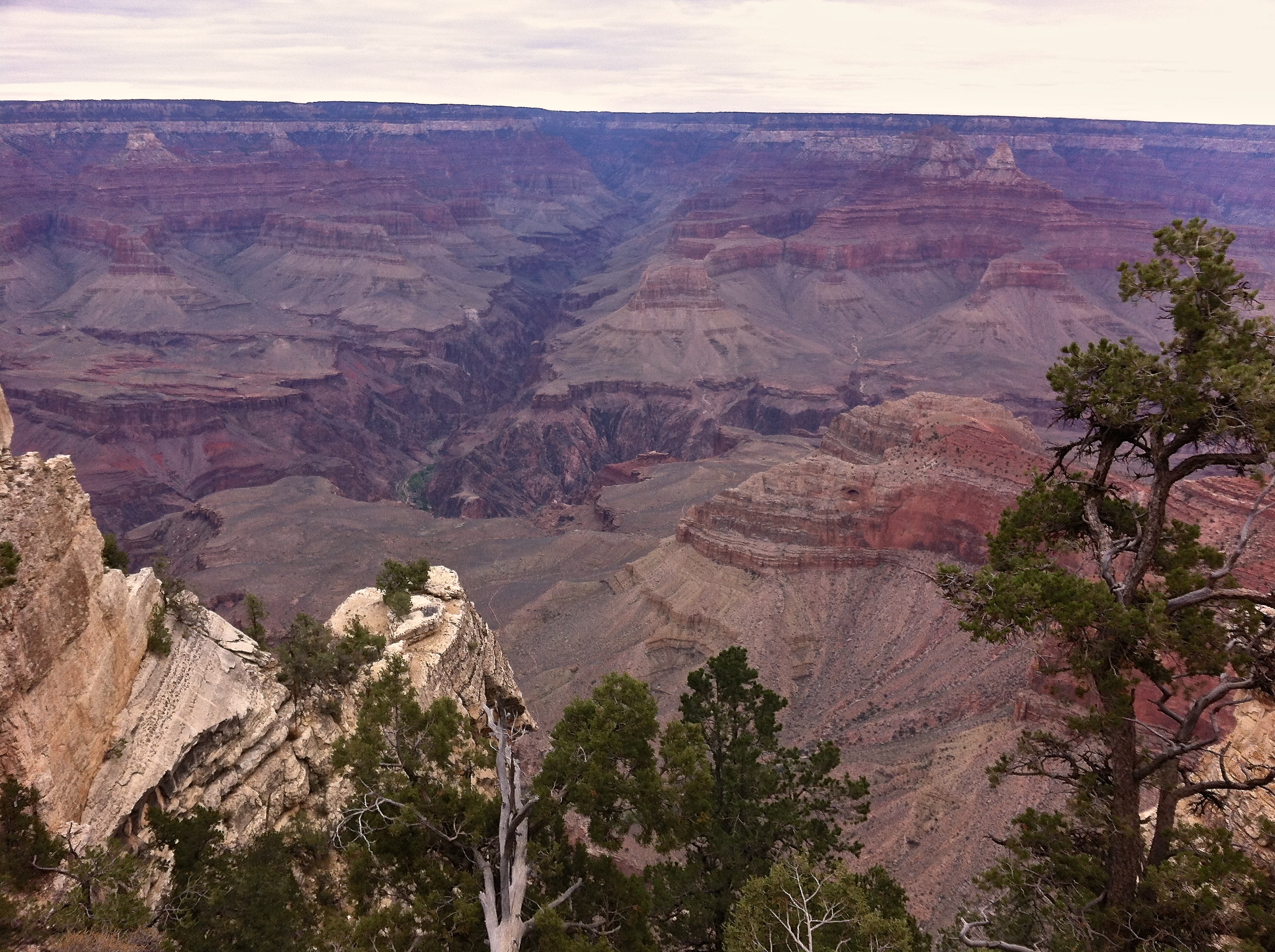
Grand Canyon

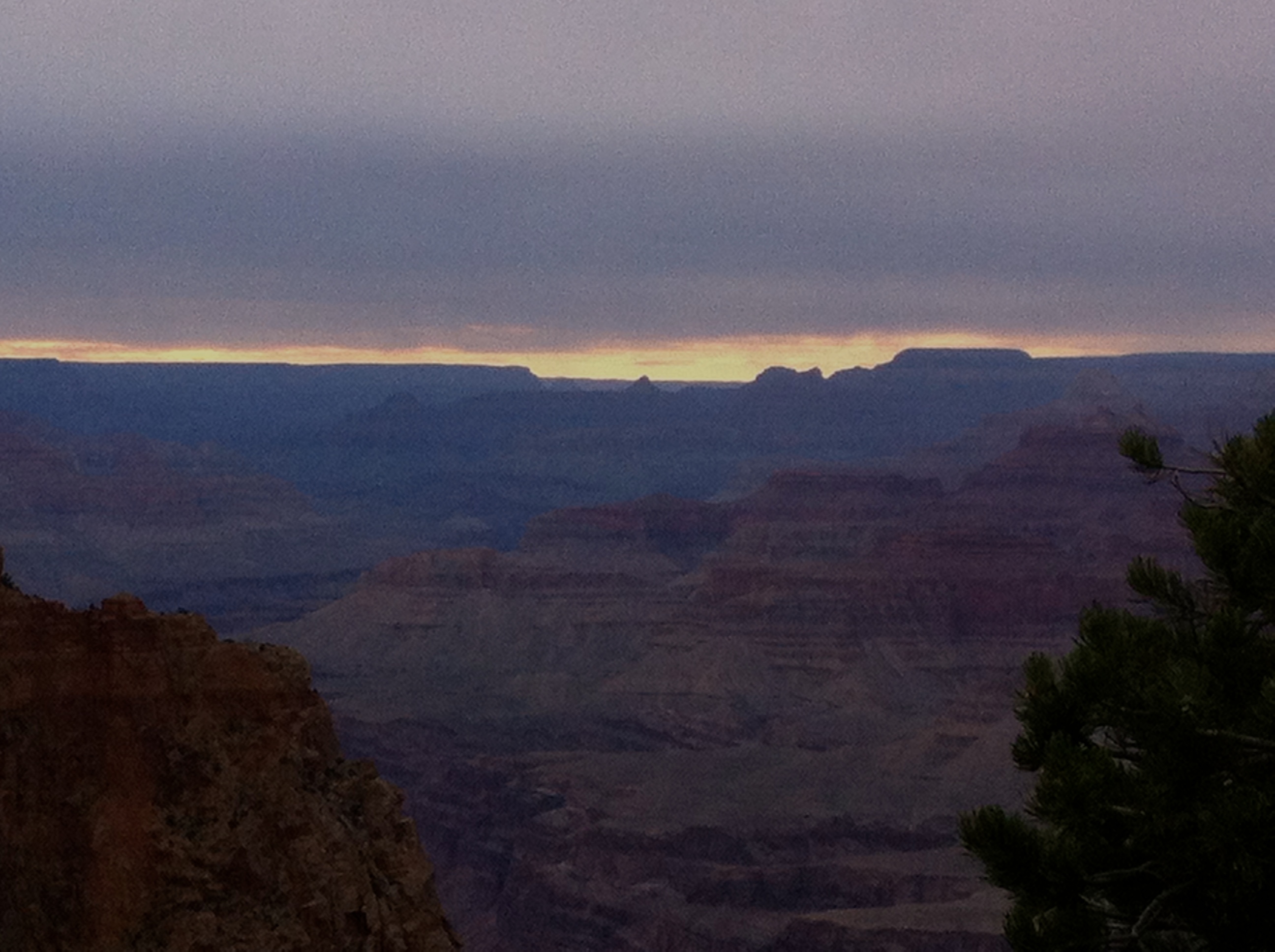
It is always a remarkable event when something you assume you know and understand reveals itself once again to be beyond understanding.  I have been to the grandest of canyons several times, but the thrill it elicits with the first sighting from the edge of the Colorado Plateau through which it has carved itself over eons remains  bordering on euphoric. It is not the rocks, or the depths, or the ribbon of the river of creation, but rather the glimpse it provides of Creation itself that comes over you.  It happens to you every time, no matter what your level of preparation.

The stillness of time transcends.  The lava and ash base rock of the canyon , the Vishnu Schist, thrust in a tectonic convulsion some 1.7 billion years ago against the continental plate, lays exposed by the river that began to reveal it to our eye only some six million years ago. Rock, that several billion years ago was not even half again as old as the planet upon which it was created.  Through volcanos and inland seas, sediments and pressures,  protozoans and dinosaurs, the layered geologic beauty of the canyon lay waiting for visual birth through the erosive force of a mighty river.   The entirety of a fulfilled human lifetime is but a fleeting wisp of wind in the immensity that is the measurement of such time.  To admit to oneself that reality, is to feel very small, yet very privileged to have it revealed.

The canyon divulged itself to no one that left any record prior to the time of Christ yet existed through innumerable sunrises and sunsets in its current state, with the only appreciation, that of its animal inhabitants.  The scale of the canyon such that the same species of squirrel has evolved into two distinct visages, the black chested whited tailed Kaibab of the North Rim, and his genetically identical cousin the Abert with his white chest and grey tail, long separated by the chasm.  The original settlers along the rim and cliffs left records of attachment but were unable to sustain their existence through the cycles of plenty and drought typical of the region, and fled near  silently out of history.  The initial caucasians exploring the canyon found it vast and devoid of people, and viewed it as an obstacle to be avoided.  It remained to the few who saw it as a potential site of habitation, empty and trackless.

Then, in 1869, perspective was provided.  An explorer and geologist John Wesley Powell, hardened to challenge by his military experiences in the recent Civil War and bereft of an arm from the damage of a minnie ball at Shiloh, found himself after the  intensity of the war unable to return to the everyday experience of an academic career in Illinois.  Powell determined to experience the  Grand Canyon from the bottom up as part of an expedition down the length of the mighty Colorado River, and his exploits through the canyon in 1869 and a second expedition in 1871 were for the first time channeled as a shared experience to an enraptured audience through the power of real time mass media, connected by reported stories as serial adventure.  To describe the voyage as hazardous is insufficient, but is perhaps preserved in the visual of a one armed, rail thin man manning the rudder of flat boat down level six rapids of an entirely untamed river.  The 750 mile voyage of the expedition of ten men from the origin of the Green River in Wyoming through the canyon lands of the Colorado is the stuff of legend.  More importantly, it presented America with a new kind of hero, the Naturist, as Powell along with fellow explorer, the Wisconsinite John Muir, presented the American West as more than obstacle, but rather a paradise of magnificent cultures, vistas, and geology best appreciated when preserved, rather then overcome.

IMG_4411The final linking of the concept of America’s image of itself linked fundamentally  to its land came in the personhood of President Theodore Roosevelt, who established the core of America’s heritage preserved through its concept of national parks.  He saw in particular the Grand Canyon critical in leaving the natural scape as untouched as possible to better absorb its eternal grandeur:

“In the Grand Canyon, Arizona has a natural wonder which is in kind absolutely unparalleled throughout the rest of the world. I want to ask you to keep this great wonder of nature as it now is. I hope you will not have a building of any kind, not a summer cottage, a hotel or anything else, to mar the wonderful grandeur, the sublimity, the great loneliness and beauty of the canyon. Leave it as it is. You cannot improve on it. The ages have been at work on it, and man can only mar it.”

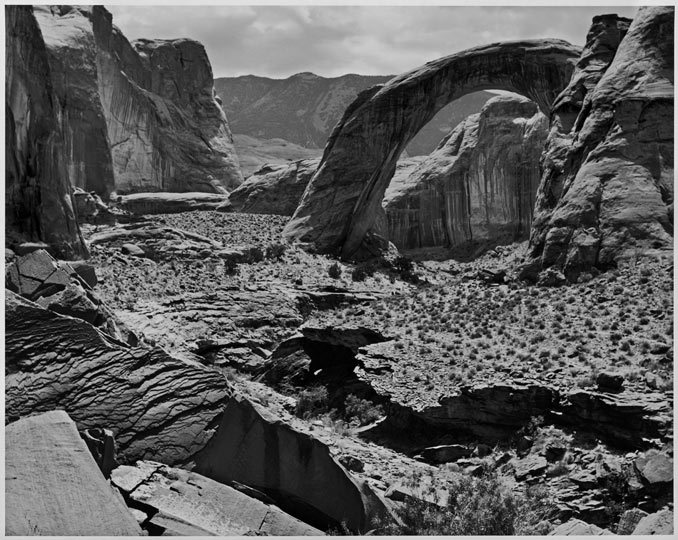
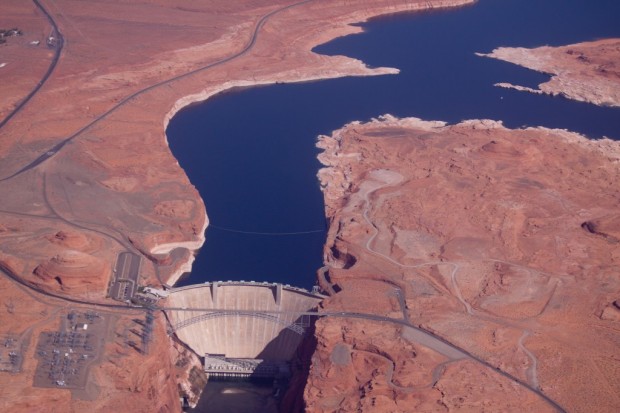
The eventual hold on the American consciousness progressed through the first half of the twentieth century as the canyon vistas and campsites became increasingly available to the average American.  Starting with  the development of the railroad to the rim, the gradual concept of individual travel and exploration as the country became more mobile through the automobile made the concept of taking in the beauty of the natural landscape of America a national obsession.  The country’s population increasing looked to the West as a potential place of permanent attraction and residence.  Yet, predictably, the diverging view of  ‘progress’ proved a powerful enemy of President Roosevelt’s vision. As hard as it is to imagine, the vistas of the Grand Canyon could have been forever marred as had its sister magnificent creation, the Glen Canyon.  In 1963, the special place that was Glen Canyon was tragically drowned in the development of the manmade inland sea of Lake Powell created by the Glen Canyon Dam.

Glen Canyon prior to the formation of Lake Powell by the Glen Canyon Dam
Glen Canyon Dam and Lake Powell  - mitch tobin photo
Glen Canyon Dam and Lake Powell – mitch tobin photo

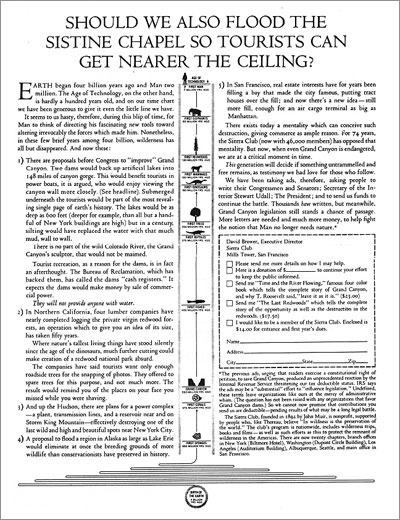
The presence of a series of dams to tame the Colorado River for water resource, flood prevention, hydroelectric power, and recreation secured with the Boulder and Glen Canyon dams was actually contemplated for the stretch that is the Grand Canyon through the Bridge and Marble Canyon dam projects.  The conversion of portions of the Grand Canyon National Monument into a lake for water skiers came too close to contemplate, with only a final securing of public outcry as groups such as the Sierra Club, recognizing their error in not standing tall with the Glen Canyon project finally marshaling the collapse of the political will for Congress to pass funding for the Bridge and Marble dam projects in 1966.  It probably as much as anything led to the formation of the political environmental movement, with the eventual formation of the Environmental Protection Agency and the idea of environmental impact statements becoming a dominant influence with any construction project, big or small.

Sierra Club ad campaign to block the Grand Canyon dam projects - 1966
Sierra Club ad campaign to block the Grand Canyon dam projects – 1966

Of course the Grand Canyon is constantly evolving, and in the saga of time may possibly be  effected by nature such as to no longer be grand, flooded again by inland seas or eroded through wind and time into unrecognizable patterns.  It is however, in our brief window of time, human time, that the canyonland exists for us to understand our on part in the story, small as it may be. We must balance our need to be, to forever demand increasing amounts of  electricity and water in isolated tracts of the world with our need to be a part of that world, and pass it along to our children, and children’s children.

To be in canyonland is to walk the road of time from all that is before and to all that will be as a traveler, not as a conqueror.  At the edge of the canyon lies the home of our own Creation through mists of time and stars, wind and water, death and rebirth. At the edge of the canyon, in the land of the canyon,  for every traveler on every journey,  there is the discovery of one’s self and the universe beyond.

IMG_4427