People We Should Know #31 – Leonard Bernstein

Leonard Bernstein
1918-1990

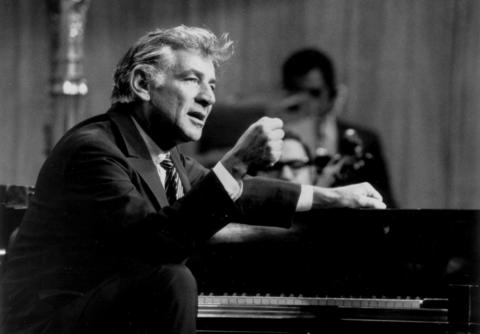
2018 is the 100th anniversary of the birth of Leonard Bernstein, and many of the world’s greatest orchestras are honoring the occasion by opening up their repertoires to display the dash and splash that was ‘Lenny’s’ compositional gifts of music to the world.  From the well known Broadway inspired cadences of West Side Story and Candide, to the more imposing Symphonies and Mass, Bernstein’s music evoked  American shades of 20th century classical music, albeit more profoundly evolved as a definitive American classical style by his contemporaries Copland, Thompson, Harris, and Barber.  His most famous contribution, West Side Story, is a synthesis of a triad of multi-genre genius, Bernstein of the score, Sondheim of the lyrics, and Jerome Robbins of the ballet.  The combination created a very modern unforgettably muscular American cultural creation that answered much like Porgy and Bess any sense of perceived inferiority complex of the American art scene against its more established European creators.  In addition to his music compositional creativity, Bernstein proved himself a polymath with concert level piano performance skills and superstar celebrity persona as conductor of the greatest orchestras, including his long tenure with the New York Philharmonic.   Leonard Bernstein, however, achieves on the 100th anniversary of his birth year status as Ramparts People We Should Know #31 most specifically for his most selfless gift to western civilization, his genius and lifetime contribution as a pedagogue,  delivering to multiple generations of performers, students and every day people alike, an unparalleled love and understanding of classical music as a critical pillar of our civilization, and distilling it into a form that all, regardless, of training or exposure, could profoundly enrich their own lives.

Leonard Bernstein was born of Jewish Ukrainian immigrant parents on August 25th, 2018 in Lawrence, Massachusetts.  His prodigious musical talent showed itself early despite his family’s general passivity towards music.  He was recognized in school for both his performance ability as well as his musical intellect, and ended up despite his humble beginnings, studying music at Harvard, and eventually Curtis Music Institute in Philadelphia.  At a young age, he interacted with famous musical talents such as the composer Copland and conductors Serge Koussevitsky and Fritz Reiner, who recognized his singular talents and helped promote the unknown Bernstein. His initial fame was achieved at the conductor’s baton, substituting at age 25 without rehearsal and succeeding in melodramatic fashion for a suddenly indisposed Bruno Walter in front of the New York Philharmonic.  In rapid sequence, he reached equally epic heights with a series of well received compositions, Fancy Free (leading to On The Town), Bernstein’s “Jeremiah” Symphony #2, and eventually the superstar status of West Side Story.  The music carried the thematic structures of modern American idioms of syncopal rhythm and jazz, less defined by its originality as its ability to evoke modern American sensibilities as the new post-war superpower melting pot cauldron of influences, rather than the tired national strains of the dissembled Old World.  West Side Story was the music of youth, the multi-cultural rhythms of the streets, a muscular declaration of a unique American style.

By the 1960’s Leonard Bernstein had ensconced himself as at a celebrity superstar level musical force, and was a much sought after conductor around the world.  He took advantage of his singular position to do something amazing on a relatively untested new medium that he believed could be a force magnifier for music popularity and understanding for the public at large, television.  As magnetic as he was on stage, in front of the cameras, he came off as welcoming, unpretentious, and never condescending in developing a complex topic.  He became famous for his patient and example laden teaching style he brought to the weekly broadcasts, Young Peoples Concerts with the New York Philharmonic on CBS.  From 1958 to 1972, Bernstein used the format of a classical music outreach concert to young people to develop their music intellect at the same time, with the concerts centered upon topics such as “What is a Melody?”, “What is a Mode?”, “The Sounds of a Symphony,”  and “Music Atoms: The Study of Intervals”.   He took apart complex compositions into digestible pieces that musical novices could appreciate, then re-assembled them into their musical canvas, enriching for everyone the hidden genius and life affirmations music can provide.  Through the bounty of YouTube, many of these master classes showcasing Bernstein’s special gift for making centuries old music come alive for the listener are available to us today:

He recorded multiple symposiums in the development of music collected as The Unanswered Questions , on of the most famous was his five minute exposition on the entire development of Tonal Exposition we know as music:

All was displayed to bring art to life for all to enjoy, in a medium that was accessible with a teaching style that was accessible.  Generations of Americans, and people the world over,  gained their willingness to make classical music a part of their life experience and learned to appreciate why western civilization could hardly be understood without music’s development alongside, replenishing and invigorating the cultural foundations of a healthy society.  Bernstein brought the artist’s lyrical brush to our understanding and appreciation of music, and likely saved classical music for another generation from being crowded out by modern technology’s assault that encourages shortened attention spans and the need for superficial gratifications.

I heard Leonard Bernstein’s Fancy Free in a boisterous local performance of my local symphony orchestra this past weekend, along with Beethoven’s ‘Emperor’ Piano Concerto #5 and Ravel’s La Valse.   I can only imagine how ‘Lenny’ might have brought the whole concert to even greater life through a running narrative of what we were about to hear. One hundred years going, he was a proud defender of humanity’s most creative impulses, and a worthy recipient of Ramparts People We Should Know #31.
Finding a Way in the Age of Uncompromise

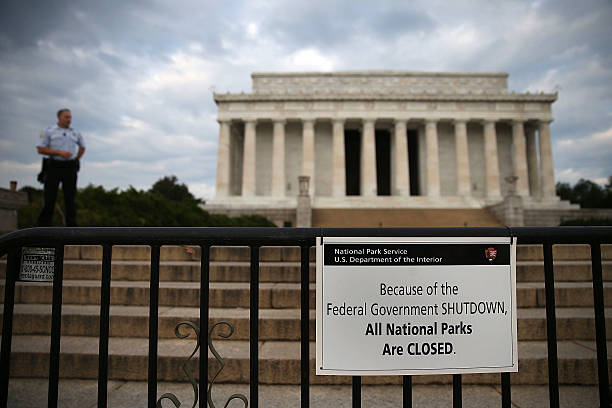
The Obama Administration barricades public monuments during the government shutdown of 2013.                                                    attrib. Getty Images

On Friday, the United States Senate failed to extend funding to United States government functions when Democrat Senators unanimously blocked the passage of a continuing resolution for government funding absent funding support for DACA (Deferred Action for Childhood Arrivals).  As with all typical government verbiage, the relatively mundane language of DACA belies its controversial roots, the acceptance of the presence of individuals who have circumvented the immigration laws of the United States.  The funding arc for the estimated 800,000 individuals affected under DACA placed at risk a policy initiated by the Obama administration in 2012 that circumvented another extra-legal reality, the application of principles of a law that was never passed, the DREAM act ( Development, Relief and Education for Alien Minors) , a proposed law put forth in 2001 that has failed several attempts to be passed into law.

And so results the current narrative, the unwillingness to fund the government to assure the passage of funding for a program to protect and support work visas for individuals who entered the country illegally on the basis of a law that has been implemented extra-legally as it has never passed into law.

How did we get into this mess? The weeds of obscuring the birth of such dysfunction are thick but the underlying causation is relatively straight forward.  The founders envisioned a constitutional process of checks and balances that would encourage the vetting of ideas and develop maturation of ideas into principled law.  For a bill to become law, sufficient consensus and compromise would have to be present to secure passage. A representatives to the legislative branch were assumed to represent their all their constituents’ voices, there was always expectation that coalitions would develop that would overcome rigid ideological obstruction.  In Robert Caro’s monumental treatise on the path to civil rights legislation, Master of the Senate,  Caro meticulously lays out how Senate Majority Leader Lyndon Johnson developed the cross party coalitions necessary to overcome decades of obstruction and achieve the legal basis for instituting critical civil rights reform that the broader nation would acknowledge as the accepted law of the land.  He recognized the simply declaring moral imperative would not be sufficient for the nation to accept actions of the government to direct the behaviors of the nation as a whole.  It would take laws that survived the gauntlet of the cacophony of opinions that existed in the country.  He understood that the moral basis for conversion of the country’s direction would come from all elements of the country seeing the process through to a legislative conclusion.

The current imbroglio is inevitable outcome of special interest groups having been rewarded in the recent past for confusing their assumed moral imperative sufficiently righteous for the achievement of  their outcomes without having to work in the arena of debate and compromise.  Immigration policy has been  a controversy since the origin of the nation borne on the concept of a nation of immigrants subsuming the native population.  Various periods of rapid population growth have had periods of intervening restriction as the nation has worked towards absorbing the new contributors and assimilating them into the fabric of the present population.  It has worked because the principle of rule of law was accepted by all, and when considered no longer pertinent to current considerations, changed as a process of law.  Since the 1980’s, radicalization by progressives of the process to re-orient society based on removal of enforcement of immigration law circumvented the society’s concern as to the speed of change, and ignored any arguments to the contrary as impediments to the assumed moral righteousness of the cause of societal change, regardless of societal damage or lack of consensus.  The inevitable reaction reached high tide in 2016, when the country voted to install a President who would stand athwart  the forced re-orientation of society.  The reaction found its muse in Trump and its symbol of resistance the Wall, that would physically force the rule of law on those elements of governmental bureaucracy  had become so enamored with distorting the law to effect the means of societal re-modeling.

Now, we stand at a crossroads, where the legitimate concerns of the nation to assure the lawful assimilation of those who seek to come to the country for its perceived unique principles of foundation can be secured, while providing humanitarian understanding for those who find themselves in an untenable position based on the actions of their parents many years ago.  The way forward on difficult issues is always a path of careful compromise assuring larger principles of fairness and balance based on rule of law.

Sit down, and hash out a law, and the nation will follow it.  Press forward with the age of uncompromising agendas driven on ideology rather than the principles of the founding, and we will see walls go up permanently at locations other than our borders.

Darkest Hour – Winston Churchill and the Monomyth

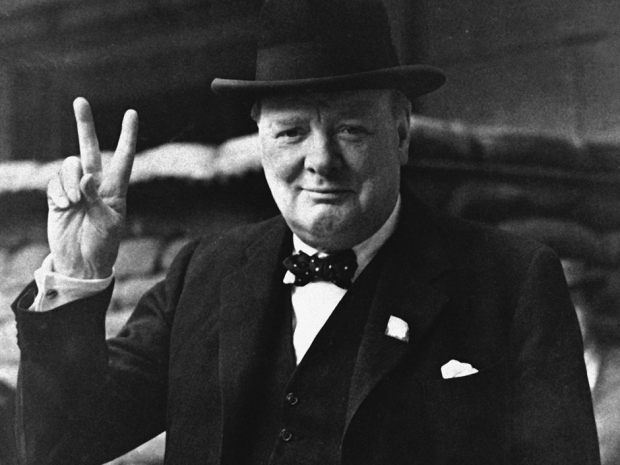
Prime Minister Winston Churchill – AP file photo

In the last six months,  bookend movies have been produced that focus on a very tight window of time from May to June, 1940, when the United Kingdom, under enormous external threat, faced an existential crisis of leadership and free will.   In a few short weeks, a dark reality presented with the spectacular collapse of its European democratic erstwhile ally France and its own military implosion on the continent as the German military machine split and cornered the whole of the British Expeditionary Force against the sea.  The assumptions of an entire generation of British political elite, that the dictator Hitler could be placated, or if requiring confrontation, subdued by fixed continental defenses, cascaded in the space of a few short days from misplaced confidence to absolute panic. The French multi-million man army possessing superior firepower and internal lines of support,  proved absent the critical will to absorb punishment, having exhausted its martial spirit in being bled white a generation earlier in the Great War conflagration.  The British forces, assuming themselves to be the flanking hammer in the low countries, found themselves instead flanked by a superior German philosophy of combined assault of armored thrusts and air cover, that quickly drove a wedge between the mass of the French force and the British forces through the Abbeville gap to the sea at Calais.  Flanked, then surrounded, the collapsing British fell against the beaches at Dunkirk,  hundreds of thousands of British infantry trapped against the seawalls, awaiting the inevitable end , like fish in a barrel.  The front line drama of this moment was captured in the summer 2017 movie, Dunkirk, and reviewed previously by Ramparts.  The missing back story of  Dunkirk, the unfolding of the impending disaster and the specific decisions of leadership as the German hegemon stood athwart Dunkirk poised to destroy British land defense capability, is the core of  Darkest Hour.

The coupling of the two movies, Dunkirk and  Darkest Hour, present at a curious time.  Atypical for the inspiration of such period historical dramas, there is no identified anniversary of events or people that would lead one to assume the enthusiasm and funding for such movies.  The events and the number of people who can physically remember them in actuality , is receding rapidly into the mists of time.  With the distance from such memories and their implied heroism, progressively goes the sense of recognition and interest in the existential  threat that faced the participants.  The globalist modern western world has little time for the concepts of “Christian Civilization” and “martial spirit” that drove Churchill and the common people of the United Kingdom to even consider that a battle to the death would be preferable to subjugation beneath  a Nazi philosophy of a master race. Modern globalists look aghast at the idea that an individual could reorder the tides of history through something as quant as personal will or loquacious inspiration.  Modern tides are defined by horizons defined by events and movements, such as Global Warming, Intersectionality, and Social Justice.  Individual freedom, the idea that one can determine one’s destiny in the face of such tides of history seems anachronistic.

The philosophical construct that great men can influence and direct outcomes in history found origin in the writings of Thomas Carlyle, a 19th century Scottish writer. Articulating  the Great Man Theory, Carlyle surmised that certain individuals possessing exceptional charisma, insight and political will  could actually shape historical events decisively.   Such Heroes and Anti Heroes existed among men through time and predictably reassert individual impacts on historical forces.  The American author Joseph Campbell, in Hero of a Thousand Faces developed the concept as a unifying multi-cultural archetype through history, the Hero of the monomyth:

In laying out the monomyth, Campbell describes a number of stages or steps along this journey. The hero starts in the ordinary world, and receives a call to enter an unusual world of strange powers and events (a call to adventure). If the hero accepts the call to enter this strange world, the hero must face tasks and trials (a road of trials), and may have to face these trials alone, or may have assistance. At its most intense, the hero must survive a severe challenge, often with help earned along the journey. If the hero survives, the hero may achieve a great gift (the goal or “boon”), which often results in the discovery of important self-knowledge. The hero must then decide whether to return with this boon (the return to the ordinary world), often facing challenges on the return journey. If the hero is successful in returning, the boon or gift may be used to improve the world (the application of the boon).                                    (wikipedia)

Winston Churchill has been identified as such a hero of the monomyth, and the very idea that this flawed individual could rise above myth and  possibly be the proof of a living, breathing example of the Great Man come to life has been the vortex of the battle of the two opposing views of history.

The movie Dunkirk,  for all its spectacular cinematic scope, stands slightly empty in that the human element is entirely interchangeable against the massive overwhelming threat that is the  unseen enemy.  The forces and events  that place the individual soldiers against the sea wall and lead others to try to save them are not developed beyond human suffering and the need to assuage such suffering.  The context that would suggest fighting to survive against overwhelming odds for an uncertain future might be preferable to surrendering to the inevitable is barely developed.

 Darkest Hour lives in a profoundly different cinematic universe.  The central figure Winston Churchill is fully developed and the action scenes only implied.  The movie coalesces around the forces of opposition to Churchill as he finds himself alone in a large sense of the movie, both figuratively and literally under attack from both internal and external forces. This movie monomyth finds himself swept up into the pinnacle of his career with, as suggested by the movie, nary a supporter other than his wife (even the American President Roosevelt throws him under the bus).  This Churchill is at times doddering and seems doubtful of his physical and mental abilities to perform the task, and needs reinforcement from his wife, his secretary, his king, and ultimately directly the British people themselves.  In actual events, Churchill had positioned himself at the crucible of moral strength through years of calling out the Conservative Party leadership for Britain’s lack of preparedness and correctly identifying the threat of Hitler while others appeased, and had sustained support from the opposition Labor party leaders who mistrusted any other Conservative leader to stand up to Hitler.  Upon ascending to the Prime Ministership on May 10th,1940, Churchill astounded others with his incredible work ethic and energy, working long days and far into the night, taking multiple flights into the war zone to buck up the French leaders, seek multiple alternative plans to attempt to arrest the tide and ultimately save the forces stranded at Dunkirk.

The movie does however function on a higher level in showing the politician Churchill recognizing that people he needed to convince were not his immediate cabinet so much as the people beyond.  The British people would be asked to sacrifice profoundly and needed to understand at their core what was at risk and what would be worthy of such sacrifice.  This is of course the monomyth’s gift of self knowledge that the hero Churchill receives, and delivers to his people that all important gift in language that has rarely been replicated for immediate impact and gathered unity of purpose.  In the gangway of the Commons, speech perched upon the red dispatch box of the Prime Minister, Churchill used his oratorical gifts  time and time again to frame the daunting challenge and stakes through the spring, summer and fall of 1940 when Britain stood alone against the Nazi war machine.  The actor Gary Oldman epically reveals the internal pressures Churchill no doubt sensed and his ability to rise to the occasion in magnificent prose and take the entire weight upon his shoulders.  In the movie, the Viscount Halifax is quoted as saying after Churchill’s epic speech following Dunkirk, ” He has mobilized the language and sent it into battle”.   Though the quote is actually Edward R Murrow’s regarding Churchill years later, it fits the drama of the moment better than any, and works in the movie.

Darkest Hour, flaws of content and dramatic license aside, speaks to assert the role of a hero figure to impose his will on history.  This most world war of wars was obviously fought upon the sacrifice of untold millions to whom mere words held little solace.  But World War II was also a profound realization of the Hero and the Anti-Hero, so clear cut that the goal of each opposing force was always to try to find a way to kill Churchill or Hitler , so pivotal to the forces of light and darkness respectively each represented. When the world is at its darkest, one looks for illumination and salvation at the most mythic levels.   In a cinematic age of cartoon heroes , Darkest Hour gives us some insight on how real heroes find their way.

2017 Hands Off A Potentially Historical Arc for Freedom To 2018

Old Year 2017 hands off to New Year 2018

Each year reaches exhaustion on the Gregorian Calendar at the same time midnight December 31st.  Since Pope Gregory in 1587 determined Julius Caesar’s calendar was sufficiently out of sync that an extra day was required every four years to leap the calendar forward and secure it appropriately with the seasons, we have counted our transition to the new year with similarity to our ancestors for 430 years.  Most of those years, the resolutions are personal, with an oath to do things differently,  a fresh start in life  upon the advancement of the calendar to the new year.  History, however,  is more continuous in arc and less amenable to rigid stops and starts.  Suddenly though , the end of 2017 has shifted the ground so dramatically  in Iran  that something similar to the real historical diversion made in 1989, may be upon us with the coming of the new year.  Maybe something truly heroic; maybe, at long last, the breath of freedom to a long suffering people.

IRAN          In 1979, the people of Iran were grifted out of their people’s revolution in overthrowing the autocratic Shah,  the autocratic dictatorship absconded by religious zealots and replaced with a theocratic one.  For nearly 40 years, the Iranian people have suffered under a small cadre of clerics that assume their brand of rigid male dominated society forcing all others into subservience will somehow continue to resonate with a population which is now 60% under the age of thirty and no longer willing to be denied their individual pursuit of happiness.  Like all religions with a dark, negativistic view of human interaction, the puritanical restrictions eventually morph into downright moral corruption and overreach that eventually cause fundamental collapse of the subjected’s passive acceptance of authority.

In 2009, President Obama, the so-called leader of the Free World, reached the lowest moral point of his Presidency when he remained silent during the protests of millions in  Iran’s Green Revolution as young people were massacred on the streets by regime thugs.  History records that he did so as he did not want to upset his fantastical plan to work with the mullahs in achieving a diplomatic pact that would place theocratic Iran in the position of dominance in the Middle East and Central Asia.  He was willing to deal away the heroic uprising, remove sanctions, restore billions of dollars to the mullahs, avert his eyes as the regime’s terrorist arm, Hezbollah threatened Israel, overran Lebanon, helped convert Syria into a human calamity, allow Iran to continue to develop ballistic weapons for nuclear delivery that could threaten Israel, the Arabian Peninsula and Europe, kill hundreds of American soldiers in Iraq, and prepare for an active nuclear capability.  It is hard to underestimate how ugly this colossal misjudgment proved to be.

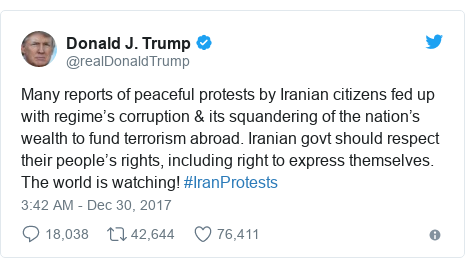
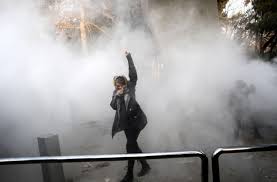
Now, seemingly  out of the blue to averted western eyes, the Iranian people are rising again to throw off their enslavers, and this time, it may be hard to put the genie back in the bottle.  The regime is full of viciousness and will not stand for a mortal threat to its existence, for each of these ‘religious” figures understand that there could be a ‘Libyan sendoff‘ for each of them should their authority erode and their role in murder , theft, and corruption becomes fully uncovered.  As 2017 ends, the clamp down on information escaping Iran by authorities makes the extent and potential success of what has erupted from the population difficult to discern.  What appears critical this time, is that the revolt of the people is across the width and breath of Iran, and transcends class.  Outgunned and up against a vicious reactionary leadership, there is little doubt that success if at all possible will more resemble the French Revolution of 1789  than the Velvet Revolution of 1989.  We at the ramparts, must watch and pray for the latter, but history suggests usually otherwise.  At least this time, the Iranian people will see an American leader who recognizes their struggle for what it is:

As 2017 leads into 2018, a historic fulcrum is upon Iran and its heroic people.  To paraphrase Ernest Hemingway, oppressive authority withers two ways : gradually and then, suddenly.