People We Should Know #3 – Mark Steyn

     There remains in liberal circles the ongoing tired mythic argument as to whether an individual can hold “conservative” views and still be perceived as intellectually intelligent, as if anybody holding “conservative” views needs or wants the annointive stamp of liberal intellectual approval.  The liberal mainstream’s conservative intellectual icon was always  William Buckley, Yale graduate, friend of liberal economist John Kenneth Galbraith, author, founder of the conservative literary digest National Review, and most identified with their acceptance,  conservative foil interviewer and debater on The Firing Line on the “”above the fray” outlet for liberal-speak, National Public Television.  Buckley epitomized the emblematic presence of the intellectual – graduate of an “accepted” school, erudite, articulate in the classical sense, and capable of hobnobbing at parties of the intellectual elite.  Certainly, they had to painfully overlook his early and consistent support of Ronald Reagan and that shopowner’s daughter, Margaret Thatcher,  but in a sense he was safe, because as far as they could tell, he was one of them, and he was the only one intellectual conservative in a sea of “dolts”.

     Mark Steyn is the modern answer to what is intellectual conservatism and a important  presence in the ongoing ramparts list of people we should know.  He is an anathema to the traditional liberalist view of accepted attributes of an intellectual.  He is a Canadian citizen who lives in the United States,  a profoundly well versed intellectual who quit school at age 18, a respected journalist without a journalism degree,  and an in-depth commentator on art and cultural issues without the typical liberal credentials associated with the humanities.  Schooled in the sharp and concise journalism of Fleet Street British tabloid style, he is very likely the most effective writer of the three hundred to a thousand word essay in journalism today.  The style is an enjoyably clear, acerbic, satirical, consise and logical tome that captures the reader into the argument regardless of the reader’s personal opinions on the subject.   Steyn has written brilliantly on subjects as diverse as Broadway musicals, obituaries, political analysis, and cultural trends in outlets as diverse as the National Review, Macleans, the Jerusalem Post, and the Atlantic Monthly magazine, all with preservation of the witty style and probing intellect that defines him.

    He has been fearless in the defense of the tenets of western civilization and is best known for the New York Times and Amazon best-selling book America Alone: The End of the World As We Know It defining the trends and effects of islamic population growth and extremist culture on western society and cultural tenets.  His strong defense of western  ideals in the face of islamic cultural intolerance expressed in a Maclean’s article in 2008 led to an attempt of an entities of bureaucracy called the Canadian Human Rights Commission and the British Columbia Human Rights Tribunal to review his right of free speech against the perceived “insults” alleged to have been received by the Canadian Islamic Congress.  Steyn has not backed down an inch on Canadian governmental  hypocrisy of “holding a tribunal “over his right to point out the intolerance and discrimination in an intolerant and discriminatory islamic culture.  He is the singular most effective voice in western society today for the honest and in-depth discussion of the collision with of the bedrock western tenets of individual freedom,  free expression, and tolerance with fundamentalist Islam.

     Mark Steyn is one of many publicly accepted voices today of intellectual conservatism once held solely by Mr. Buckley.  He is another example that the modern defender of the ramparts of western civilization’s fundamental values of freedom, tolerance, individual endeavour, and intellectual license is , increasingly, a conservative voice.
Rob Ford to the Rescue?

     On November 2nd the essence of forty years of philosophical determinism will be on trial in elections held in the United States.  Born out of the intense events and cultural tides of the sixties, a progressively overwhelming liberalist agenda has consumed the consensus of every day life in the Americas.  This philosophy of  reduction of individual responsibility, overarching governmental regulations on  life activity , policing the “correctness” of personal opinion and thought, and collectivist “balancing” of the individual’s desire for personal advancement has expressed itself in the governments we currently have and will be judging with our vote.   It has expressed itself on issues as “profound” as the temperature of the earth and man’s ability to effect and ultimately control it.  It has expressed itself on issues as “small” as the lack of each individual human’s ability to take personal account of his or her own actions without constant maintenance from an outside governmental guidance.  It is defined by the phrase “It takes a village” .   It has led to the sense by many Americans that their life is no longer their own to determine, and that government, rather than the individual, has become the expression of life experience from cradle to grave.

     Whatever.   Enter Rob Ford. 

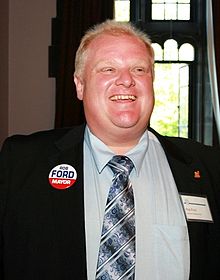
     Who is Rob Ford you ask?  Rob Ford is the newly elected mayor of the city of Toronto, Canada, elected overwhelmingly on October 25, 2010 by the citizens of Toronto completely tired of the above paragraph’s consensus.  He is the antithesis of the liberal agenda that has placed Toronto in the status of “legendary” city for all like minded to gaze upon in awe and wonder, a city full of bike paths on streets, mandated political correctness, coffee shops, drug parks, film festivals, extended city worker benefits,  immigrant cultural dominance, and a dense fee and tax structure to pay for it all.  Rob Ford is the proverbial “bull in the china shop” , a 41 year old overweight, inarticulate, in your face Toronto councilman who for years railed against the direction of the city government’s desire to become a “world” city, the perks of governmental officials, the wasteful “services” provided to all comers, the “improvement projects” without end to the taxpayer.  He based his election drive on defeating a governmental philosophy that worried more about solar panels on cars than garbage and snow removal for citizens.  His slogan “Get Off the Gravy Train” featured a well dressed pig driving a train, and is the best selling t-shirt in town.  He could care less about being in government as a vocation, like being a doctor or a teacher, or a plumber.  He sees his job as putting the citizen taxpayer first, restoring governmental fundamentals, reducing waste, and eliminating unnecessary taxes – and that’s it.  He is, in short, the nightmare of nightmares to Toronto’s liberal elite, and his tenure as mayor is going to be nothing short of fingernails on a chalkboard for them.

     The larger question to ask revolves around as to whether 2010 is a brief blip of voter angst or the initiation of the fracture of the bond between the voter and the government that led to the process of progressive establishment of liberalist philosophy over the last 40 years.  In the United States this has expressed itself in the “tea party”,  first derided as racists and country bumpkins, and now feared as a real threat to the presumed “intellectual” dominance of the current elite progressive agenda.   The reality is that Canada has no “tea party” conceptualization.  It has a liberal stream of consciousness, a strong abiding sense of the importance of “village”, and has been much more comfortable with socialist governmental structures than the United States traditionally has been.  Mr Rob Ford shows, however, that there is a limit in democracies to the tolerance of the voter for substituting idealism for competence,  correctness for common sense,  and redistribution for individual endeavor.  November 2nd looks to be only our own expression of what is coming to be a world wide phenomena.

Woe Be Gone California

     It is one week to go before the state and national elections of November 2nd, 2010.  Essentially all prognostications suggest a surge of voter anger to rival the great wave elections of the past, with voter disgust focused on the party in power and great numbers of incumbents imperilled.  The driving issue above all seems to be the surge in government deficit spending that concerns all, and the power brokers unwillingness to take any actions to arrest the country’s economic downward spiral.  This voter message is about to be painfully seared on incumbents careers across the nation everywhere – everywhere, that is, except in the state of California.

     Aaahh, California, state of sunshine,  Hollywood, and Silicon Valley.  A state beacon for national progress if there ever was one.  One would assume that California, so long a bellwether of the tides of the nation, would be in the forefront of the desire for change and reform.  Certainly the issues of governmental malfeasance are no more clearly defined then in the state of California.  California has long been the home of a democrat legislature  unwilling to deal with a burgeoning budgetary crisis that has put California in such financial arrears that it now has the lowest bond rating of any state in the nation, A-, and has been estimated to be in the top ten most likely governmental bodies for default in the world, ranking just ahead of war torn Lebanon and just behind Greece.  It is sitting on a budget deficit of over 19 billion dollars for fiscal 2010 and has accumulated  over 342 billion dollars in debt.  It currently spends 50% of its yearly budget on “public education”, though its high school graduation rates rank it as 48 out of 50 states, and 25% on health and human services, though it ranks 42 out of 50 states in health insurance coverage for its citizens.   It is home to two of the most liberal  democrat Senators in the nation in Barbara Boxer and Diane Feinstein, and proud provider of the most liberal Speaker of the House in history, Nancy Pelosi, dually responsible for promoting the public spending that has surged the national government debt over 3.2 trillion dollars in just 2 years.  Surely California, the state with the largest economy and  the highest population of all 50 states is the most acutely aware of the impending financial crisis, and will take a leadership role in avoiding the final drive off the cliff that it has been so recklessly veering toward.

    With a week to go before a bellweather election to determine the state of California’s future destiny as a beacon state or a failed state,  the polls show the progressively stable leads in the election for Senate and Governorrespectively for – Barbara Boxer and Jerry Brown.  Yes, that Barbara Boxer, and oh my god yes, THAT Jerry Brown.  Please California explain yourself – Jerry Brown was first elected your governor in 1975, 35 Years Ago, and his Utopian ideas have changed nada.  Perhaps we could also bring back  Nelson Rockefeller, Gaylord Nelson, John Lindsey, Hubert Humphrey, and Ted Kennedy himself to help  craft Mr. Brown’s vision for the state as they were all liberal lions who thought in 1975 as Mr. Brown does regarding the role of the state in people’s lives – no wait, they are all dead.   Yes, California, you are about to restore to governance a man who was governor during Gerald Ford’s Presidency as the man to lead you out of your current financial and economic wilderness.  And please don’t start me on Senator Boxer.  Is it destiny that California is too drenched in its own illusions, that it won’t do anything to try to save itself?

   Woe Be Gone, California. You were beautiful once.  We hardly knew ye….

“England Expects That Every Man Will Do His Duty”

     In 1799, a willful, brilliant Corsican named Napoleon Bonaparte who had led French troops to multiple victories under the auspices of the revolutionary government of France, managed to take advantage of the weakened and self defeating nature of France’s governmental structure and successfully undertake a coup d’etat.  Rapidly outmaneuvering the other coup leaders, he had himself named First Council, and over the next five years led France to a dominant position in Europe.   In 1804, the combined power of victory and superego brought his enshrinement as Emperor of France and the aggressive and grandiose nature of this brilliant and ruthless dictator held for all of the western world the spector of French world domination.

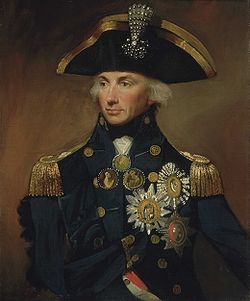
      It is one of the peculiarities of history that entire historical tides pivot around singular events, and on October 21, 1805, one of the most powerful pivots ever occurred off the coast of Spain.  The pivot point, as so often is the case, identifies one man as the opposing historical force, a slight of build,  intense Admiral of the British fleet who in an adult life of almost constant battle had given an arm and the sight of one eye in the service of his country.  The man with an ego, tactical brilliance, and battle aggression on the seas to mirror Napoleon’s on land, was Horatio Nelson.

     Added to the peculiarities of history is the fact that the catastrophic loss of  the American colonies and the untold wealth of the American land mass in 1783 paradoxically positioned Great Britain on an almost unimpeded arc of spectacular commercial and military success on the world stage for the next 150 years.   By 1805, Great Britain had restored world wide domination of the seas and was positioned to be the solitary check to Napoleon’s plan of world domination.  Napoleon had every intention of restoring French dominance of the English isles abdicated by Henry V’s 1415 victory at Agincourt, and knew the British control of the sea lanes had to be broken to achieve his aims.  He drove his French naval forces to take the fight to Britain, but struggled to find the necessary equivalent leadership in his admiralty, as most of the competent and experienced naval leaders used to doing battle with England were annihilated in the fires of the French Revolutionary tribunals.   The French Admiral leading the Mediterranean french fleet was Pierre-Charles Villenueve, a cautious and realistic admiral who had thus far succeeded by avoiding direct conflict with the British, but now was under great pressure to commit to battle.  He did his best to conjure up a fleet superior to Nelson’s in firepower and number of ships, but recognized the inferior depth of seamanship he had available and was fearful of the battle turning on the skill sets of individual ships. This proved to be a prescient insight.

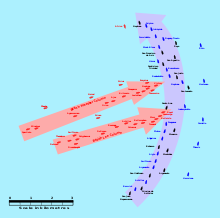
     Nelson had the opposite problem.  He could not get into a slugfest where his inferior numbers would be worn down, but sought instead to defy traditional tactics and try to cut the French fleet down to more palatable size.  Traditional tactics called for ships to remain in line, allowing each to support the other, and keep their cannons focused broadsides on the ship they were facing.  This allowed ultimate fire power delivery, and in the case of progressively poor outcome, easy ship to ship communication, coordinating either advance or retreat simultaneously.  Nelson determined to trust the superior seamanship of his captains, the training of their crews, and the detailed quality of his instructions to allow his line to break and have individual ships charge the enemy line.  The risks were enormous; a ship heading headlong into an opponent’s line would for a significant period have no canons pointing at the enemy, and would be fully at the mercy of the broadside canons of the enemy ship, not a pleasant situation to contemplate for anyone on board the charging ship.  Nelson gambled that the unorthodox approach if successful would get his ships in close where all the battle hardened skills of his crews would take over, and overwhelm the less experienced french and supporting spanish ships.

     On October 21, 1805, off the Cape of Trafalgar, Spain, the collision occurred and history pivoted.  Nelson prepared his forces with a last surge of martial pride and motivation by relaying in a special message that the success of the plan would be related to the success of each individual in the fleet to perform with courage and competence.  Nelson was one of history’s unique leaders where his troops were always able to see through his vanity and appreciate his unique abilities that inevitably would increase the chances of any seaman surviving an engagement.  No one doubted his personal courage, and no one doubted that in a real fight, it was always best to be tied to someone who could think in a moment of crisis.  All members of that British fleet knew that was the man Nelson was in spades, and they knew he was talking in a personal way to each of them when on that fateful morning, the HMS Victory flew the semaphore flags that resonated to all in electric fashion, “England Expects That Every Man Will Do His Duty”. 

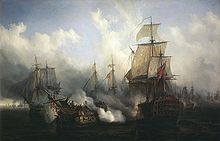
     It is is hard to express the violence ,viciousness, and chaos of sail driven sea battle in the 18th and 19th century to the individual sailor.  He faced the horror and and fury of metal projectiles flying everywhere, both huge cannonballs and grape sized razor edged shrapnel, lethal splinters of wood, heaving seas and bloody decks making mobility almost impossible, the deafening roar of 30 cannon spontaneously firing heaving the ship and making communication imperceptable.  It required a steely constitution, expert training, and years of experience for every man to “do his duty” under such circumstances. Through it all, the tradition of leadership required the captain admiral to be imperious to it all, in full view of all his men and the enemy, to provide the ultimate “backbone” to the effort.  Nelson knew in his heart that ultimate victory would likely on this day would require ultimate personal sacrifice, and resisted all efforts to reduce his exposure to enemy fire.  In the heat of the charge, Nelson stood as men around him were cut in two by fusillade, and simply directed his ship to closer contact. With the HMS Victory in deck to deck contact with the french Redoubtable, a sniper from the Redoubtable found Nelson and struck him mortally from fifty feet, through his lung and crushing his spine.  Nelson was taken below, where three painful hours later, assured that his controversial tactics had won an overwhelming victory, died, and brought himself immortality.      

       In a battle of forces in which he was outnumbered 32 ships to 27, 2500 canon to 2100, and thirty thousand men to 17, 000, Nelson’s forces captured or sunk 22 ships and lost none.  The devastating loss was one from which the French navy was never to recover, and put on permanent hold Napoleon’s plans for invasion of Britain.  Presaging Hitler’s decision following the calamitous loss of  the air Battle of Britain on 1940, Napoleon averted his eyes west and turned east toward Russia, and his eventual defeat and decline, the final blow at Waterloo in 1815.  Great Britain took Nelson’s victory and its now unrivaled seapower to create the largest empire the world had ever seen over the next 100 years.  The historical effect, a world dominated by the English language, not French; by commercial trade and mercantilism; and the British system of education and justice.

     On such days, western civilization and its concepts of individual achievement, revels.

People We Should Know #2- Jacqueline Du Pre’

       What is the spark of celestial dust that every once in a while creates a supernova of human genius out of the most mundane of environments? Every time it happens we are left in awe of its randomness, making the creation all the more special. Jacqueline Du Pre’ (1945-1987) was one of those special creations, and in her short life she made all aware of the special nature of human expression. She left an indelible mark on western civilization through her unrivaled interpretation of the unlocked passion of classical music.
       She happened upon the world with almost immediate recognition of her talent, and happened to be a musical and generational compatriot of hall of fame performers such as Pinchas Zukerman, violist, Itzak Perlman, violinist, and Daniel Barenboim, the pianist that she eventually married. What Jacque Du Pre’ brought to music was unique to her, however, in that she had the special ability to provide audible reproduction of the better nature of the human soul, no matter what she played. No one was able to express the Haydness of Haydn, the Elgarness of Elgar, the Dvorjakness of Dvorjak such that all versions that followed seemed to be imitators of the Jacque style. Like all supernovas, however, Jacque was unstable and at times personally lost. The story of Jacqueline Du Pre’ was made ever more tragic by the attack of Multiple Sclerosis at the too young age of 28, which cruelly stole her physical genius to the point where she could no longer play, then no longer lift her arms, and finally  at age 42, after 14 insufferable years, extinguish her life. She left life like an advent candle, once brightly aflame, slowly reduced in intensity, and then finally, a thin smoky ghost of its former luminescence.   The strange juxtaposition of a inner human fire that produces such exuberant physical gifts , and a disease that drains the fire with such wanton suppression is an irony too painful to contemplate, but it was Ms. Du Pre’s fate never the less.

       Through the power of recording we have luckily been able to secure the brief heights of her musical genius, and the world is better for it.  Maybe for a brief moment in Elgar’s Cello Concerto 2nd movement through Jacqueline Du Pre’s hands we can briefly glimpse just how great the devine is, as expressed through the living that are so devinely inspired.

People We Should Know #1 – Vaclav Klaus

     The President of the Czech Republic is a defender of the ramparts of civilization and the inaugural member of the new ROC category, People We Should Know.  Vaclav Klaus is the 69 year old Czech president first elected in 2003 and re-elected in 2008 who has made it his vocation to speak his mind in a very libertarian and free-wheeling mode.  This has shocked the staid establishment of the European bureaucratic elite that have opined for a singular top down voice for European political and societal correctness for the past 60 years based on a socialist model, but Klaus has withstood the pressure to conform.  At a time when the socialist democracies of the traditional western power centers of Europe are creaking under the burden of mandated regulations of the European Union and the sclerotic addiction of their populations to public entitlements, Vaclav Klaus and like minded politicians from eastern European governments in Poland, Hungary, Slovenia, Romania, and Georgia are immersing themselves in the freer expression and experimentation of their more recent, hard won freedoms, and questioning the wisdom of following in the economic footsteps of the European establishment.  

     Klaus is a particularly vocal skeptic of two European political establishment philosophical mantras, European political unity and anthropomorphic global warming.  Klaus is a university trained economist who finds the lack of diversity and competition in the regulation laden EU economic model as stultifying and inevitably damaging to the individual aspirations of free market enterprise in the developing economies of eastern Europe.  He remains an opponent of the Lisbon Treaty, an attempt of European Union countries to codify constitutionally the social regulatory model of the EU to take precedence over local elected officials.  Klaus , the libertarian, finds it an affront to free action and a frankly unhealthy economic process.  He eventually signed the treaty to prevent the Czech Republic from being labelled the outcast that prevented passage, but remains convinced that the theories espoused by his economic hero Friedrich Hayak remain the salvation to a growing European answer to the competition provided by America, Brazil, India, and China.   On the issue of global warming as a phenomena driven by man made factors, he is an even more vociferous critic.  He has said that serious scientific review provides little support for the projections of the global warming scientific establishment, and is a direct assault on the sovereignty of the individual, designed for the solitary purpose of conforming people’s habits and forcing a socialist economic system through that conformity.  He feels strongly as a survivor of communist times in his country that radical environmentalism is the new weapon for leftest elements to infuse irreversible societal mandates , achieving the control of capitalist economies at a global scale only dreamt about by their communist forebears.

     President Klaus has brought to focus the civilized concept of freedom of thought and expression that is the foundation of the western ideal.  Love him or hate him, his intelligent, cogent, and incisive opinions guarantee that there still resonates in Europe the love of the intellectual free thinker, and with it, the hope that Europe might yet still escape from the worst elements of the socialist economic harness it has placed upon itself.


The Lessons of the Chilean Mine Rescue

     Ramparts of Civilization kept a close eye on the unfolding drama of the mine cave-in at the San Jose Mine in Chile trapping 33 miners that ended in triumph with their rescue this past week.  I held back commenting on the event of the day as it was obviously truly about the heroic fortitude of each of the miners and their salvation at the hands of a committed drill team and country.   I also held back so I could absorb some of the deeper lessons of the almost perfect rescue process and see if I could put it into a worthy tome.  No worries. Dan Henninger of the Wall Street Journal beat me to it, and in a terrific column nailed it better than I ever could- the powers of human innovation, and the need for governments to unleash them by getting out of the way.

     The lessons abound to any open mind in the continuing examples of the difference in response times and quality between profit driven private innovation and government driven “job creation”.   The power of Steve Jobs to take a moribund computer company and through innovation lead it to become by value the largest corporation in the United States, creating hundreds of thousands of jobs.  The ability of Virgin Atlantic’s Richard Branson to foresee and create a space port and offer space tourism at 200,000 dollars a flight versus 40 million on a Russian government Soyuz capsule,  along with Burt Rutan’s genius creating from scratch a whole new industry.   The capacity of private funded  charter schools to accomplish higher graduation rates and academic competence in poor neighborhoods where public teacher’s union led schools underwritten with billions of public funding score worse graduation outcomes with each successive decade since the 1960’s, when government first took over public school performance.  

      The Chilean miner drama had a multitude of private enterprise innovations that created the unexpected mechanisms for rapid success.  The crisis’s outcome turned forever, when Brandon Fischer, President of Center Rock, Inc., a 75 man company with an innovative forward hammering tool leading the typical rotatory drill bits of a drilling rig drilling for water in Afghanistan offered his company’s services to the Chileans.  A piece of equipment quite a bit less glamorous than the iPhone but every bit as innovative punched a perfect man sized rescue hole through 2300 feet of diamond hard volcanic rook and granite in record time as more established drill systems fell behind.  As Henninger points out this wasn’t the only profit driven innovation at work.  The scope of the rescue was a constellation of brilliant innovative products from all over the world – micro cameras and fiber optic cable from Japan, super high grade transport cable for the “rescue wagon” from Germany, even bacterial resistant socks from a Virginia company for the miners living in the humid conditions of the mine to protect their feet.  All in all, a symphony of creativity and innovation from little and big ‘capitalist moneymongers’ from all over the globe who managed to coordinate to perfection in short order a rescue process that amazed the world. 

     We have only to look at a specific example of the American governmental response to the British Petroleum oil spill in the Gulf of Mexico this summer to recognize while the American economy is currently in its doldrums led by a clueless governmental class.  With oil gushing and soiling the gulf waters and fish beds, an innovative Dutch process of “water washing” capable of achieving 98% cleansing of the water of oil and retrieving the oil for use was rejected by the over regulated American government as it did not meet the 99% regulation standard artificially put forward by environmental bureaucrats.  Therefore, 100% of the water remained contaminated to prevent the perception of a weakness in bureaucratic control.  If the more forward thinking Chilean government had used the same principles, the Center Rock drill would still be undergoing testing to determine its environmental impact and the miners would be sitting in the dark gloomily consigned to a horrible fate.

     Innovation driven by capitalism has continued to be an unsurpassed success story in the efforts of man to raise his quality of life and provide hope for more and more of the world’s poverty striken areas.  It may be at times unseemly, ‘unfair’,  unpredictable, and in its means of egocentric success, unfathomable to the erudite, but it is the system of choice for the betterment of man because it is intimately tied to the human spirit, the driving force of all positive outcomes.  No amount of government money thrown against a wall will achieve the lasting benefits of creative intellects feeding of each other’s success for their own benefit, and collectively hwever indirectly, for us all.

A New Champion in the Art of Tunneling

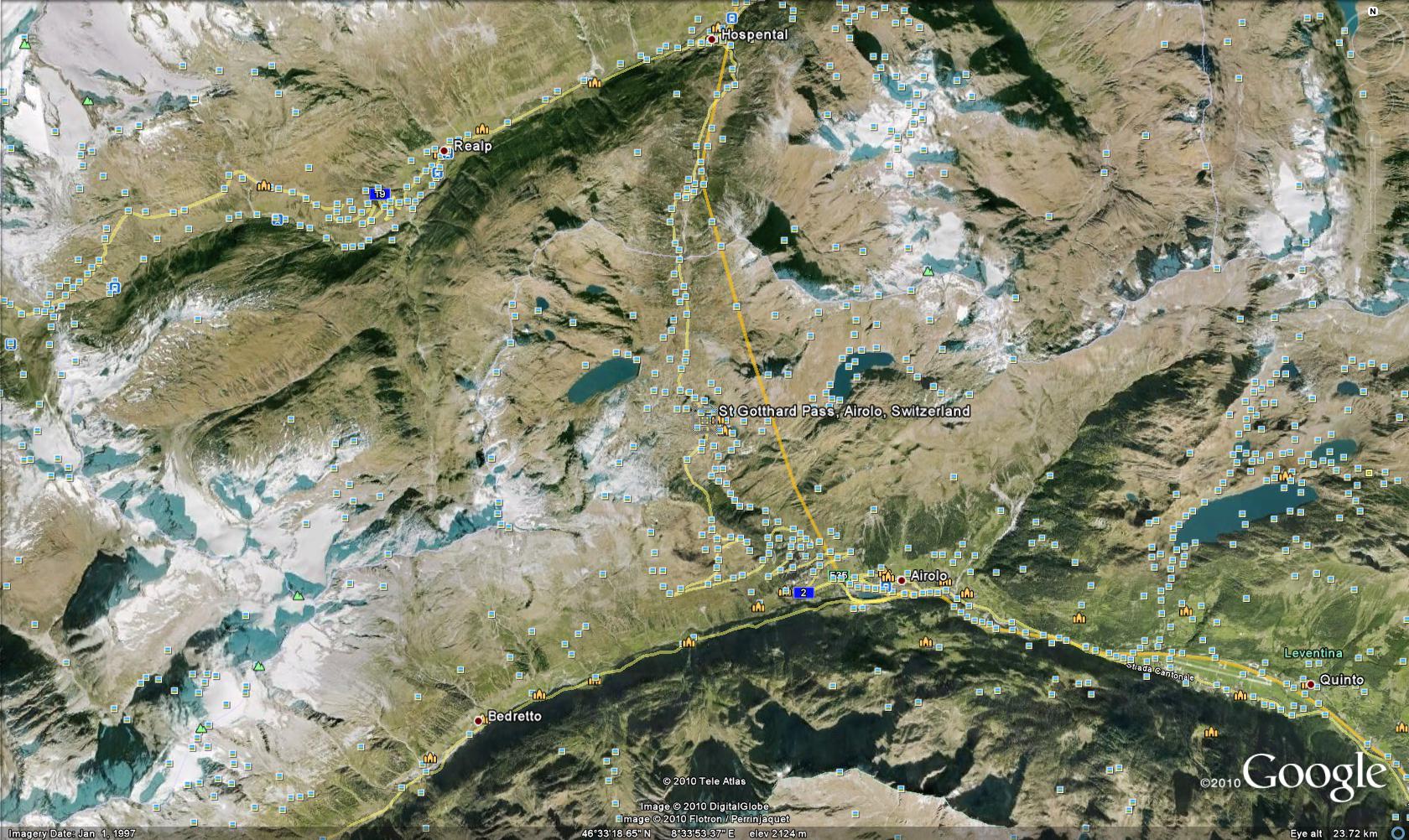
    The world was captivated earlier this week by the incredible engineering achievement of drilling teams to bore through 2300 feet of the granite rock of the Andes in less than two months to successfully provide a rescue portal for 33 trapped Chilean miners.  This same week another drilling milestone was achieved in the Swiss Alps every bit as awesome in its achievement and unsurpassed in its scope.  Since Roman times the perilous journey from northern to southern Europe has been blocked by the granite majesty of the alps with only two viable portals, the St. Gotthard and St. Bernard passes providing arduous and time consuming causeways for the motivated traveller.  In modern times these passes have been successfully traversed by roads that make trans-European travel viable, but there has been increasing concern for the threat of damage to the local alpine environment caused by increasingly high volume truck and rail freight travel through the passes.   The Swiss, however, are a particularly focused people acutely aware of their unique position on the European continent and the integral role the soaring alpine vistas play in the formation of their national character.   Over two decades ago, they determined to do something about the increasing congestion.  The  something was a massive public works project costing over 10 billion dollars and 23 years to completion- and what a project it has been.

      This week the Swiss nation celebrated the completed drilling of a 35.4 mile tunnel under the Gotthard that now forms the longest transport tunnel in the world, surpassing the Seikan Tunnel in Japan by over a mile.  The Swiss are no strangers to tunnel technology and achievement owning 3 of the 20 longest transport tunnels currently serving world travellers.    The achievement at this time is one of connectivity only as the viable use of the tunnel is expected to take 7 more years to initiate. 

      When all is said and done, the tunnel is expected to reduce the travel time for road freight slightly over one hour in passage through versus over the Gotthard, but more importantly to the Swiss, remove the visual damage to their beloved alps caused by the travel of people looking to pass through the country, not be a part of it.   Only the Swiss can say if it is worth three decades and billions of dollars to achieve this engineering marvel for the sheer joy of returning the Gotthard Pass to something closer to the vistas enjoyed by Europe’s first hardy travellers.  The toll to each Swiss citizen for this investment, 1300 dollars apiece.  Hopefully, the next time I travel the pass, they won’t try to get their investment back all in one transit through the tunnel.

A Deficit Debacle

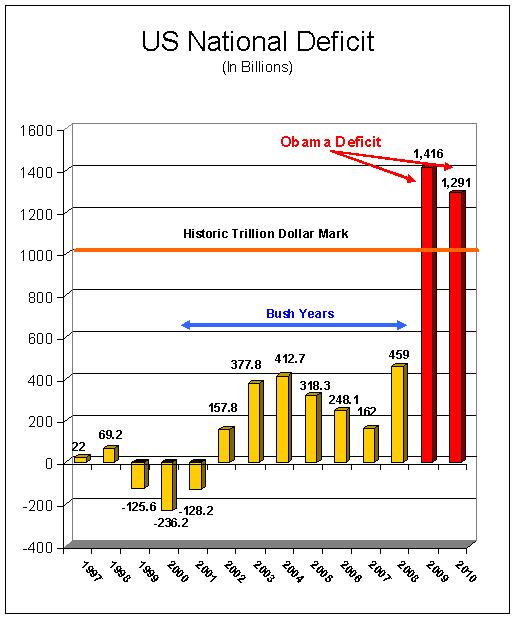
     The preliminary numbers from the Congressional Budget Office are in for fiscal 2010 and they are, unsurprisingly, as bad as predicted. The combination of completely unharnessed government spending, reduced recessionary receipts, and a progressively unstable entitlement environment have come together in a perfect storm to explode the standard of acceptability accrued over two hundred years of national budgets from 1790 to 2008.  President Obama continues to maintain a relative detachment to the whole spending debacle, recently having proposed an additional 50 billion in “stimulus” spending to follow up the trillion dollars of “stimulus” spending that had apparently little effect on the health of the American economy.  The perspective is a fairly simple one – President George W. Bush, facing the 9/11 recession, fighting two wars, and passing “big government” ventures in education with No Child Left Behind and in Medicare Prescription as a spendthrift “compassionate conservative” managed to amass 2 trillion of deficits over 8 years contributed to the national debt.  President Obama in just 24 months has already expanded the national debt by 2.76 trillion dollars, with no end in sight.   Is it feasible that profligate spending will destroy the American ideal enemy armies and national calamities failed to dent?

     Gateway Pundit tackles this issue head on with an eye opening graphic that crystallizes the proportionality of the current government’s disdain for budgetary discipline:

     At what point does this pattern of spending enter into the theater of the absurd?   The statistics get more dire the closer you look at them.  In a country where a deficit of 4% of GDP was considered outrageous, the current Obama budgets rack up 10% and 9% of GDP respectively. A ridiculous 37 cents of every dollar now spent in the budget goes to deficit spending or service of the debt, not to defending the country, supporting infrastructure improvements, or positioning this country to reach for big ideas.  

     I am approaching the point of numbness to the whole headlong self-destructive behavior.  Once again, it is time for adults to reassert authority, and take back the keys from our undisciplined kids playing recklessly with this nation’s future.  No excuses, people. On November 2nd, 2010 get it done.  Recess is over, and its time to get down to some hard work.

Christoffa Corumbo – October 12th The Man From Genoa Changes History

     A history book that holds particular joy for me  is Samuel Elliot Morison’s ” Admiral of the Ocean Sea”.  Morison was one of America’s greatest literary historians and an expert seaman in his own right.  Eventually achieving Rear Admiral U.S.Navy status for his personal involvement and superb documentation of  the role of the U.S. Navy in World War II, Morison first achieved fame as a Harvard history professor for his hands on biography of Christopher Columbus, “Admiral of the Ocean Sea”, winner of  the Pulitzer Prize in 1942.  Morison took it upon himself prior to the war to sail to the precise locations of the  Columbus voyages, to feel what he felt and see what he saw, bringing an irreplaceable awareness to the historical tome.  

     For many years prior to its destruction by political correctness, October 12th  had a special place in the American experience as a day that separated all that came before, from all that came after in history.  A single man, the explorer from Genoa, Christoffa Coromba in Genoese, or as we have come to know him, Christopher Columbus, determined to find the western route to the East Indies, and looked to find any government who could find a legitimate reason to underwrite his voyage.  Columbus was not a specially intellectual man, but was a well read one, who had come to believe strongly on the basis of his extensive sea voyages and what he had gleaned from books that a viable shorter way to the Orient existed sailing west that would compare favorably economically to the recent Portuguese discoveries of trade routes around the Cape of Africa.  The obvious financial benefits of such a shorter trade path were clear to all European powers, who were just beginning to escape the introverted scope of the Middle Ages and enter into a period of aggressive questioning and exploration known as the Renaissance.  Columbus went to Portugal first as this small country was the pathfinder in extensive transoceanic voyage.  King John of Portugal, whose own brother Henry had discovered the trans-African route, saw no reason to undercut his current seafarers.  Next, Columbus went to England, than Italy, but received little encouragement.  After all, most thought Columbus was seriously off base in his calculations and unlikely to return from such an expensive and risky undertaking.  King Ferdinand and Queen Isabella of Spain were initially not significantly more helpful, but changed their mind and granted Columbus a fairly generous contract they would later regret, of 10% of all economic benefits achieved from a successful trade route and expected discoveries.  They were comfortable with doing so as they thought he had little if any chance of  succeeding.

     Columbus was one of a growing number of conceptualizers that saw the world as round, as such, logically available to circumnavigation from either direction.  He seriously underestimated the world’s diameter, concluding Japan likely some 3000 miles due west of the Canary Islands, rather than the 19,000 it actually was.  A miscalculation of this magnitude of the distance between land masses was serious business for certainly no ship in 1492 was capable of maintaining necessary supplies to keep the ships going without replenishment anywhere near such a distance.  The Spanish monarchs, desperate to be players in the burgeoning European outreach to distant worlds, determined anyway to provide him three small ships, the Nina, Pinta, and Santa Maria, and sufficient men to staff the ships.  Columbus left the Canary Islands September 9th, 1492, and, understanding the existence of the “trade” winds better than most, headed due west.

     Morison, traveling Columbus’s route, reproduces much of the tension and disappointment in the succeeding five weeks directly from Columbus’s journals, Nada it became clear to most on board that Columbus was willing to sacrifice them all to prove himself right, as he sailed far beyond the theoretical turn around point that supplies would allow.   Mutinous grumblings grew ominously as weather grew worse and no evidence of land was apparent.  Morison describes a risky moment where Columbus in early October commands a perilous cross ship meeting to impel the sub commanders to direct their men to go a few days more, and is rewarded finally by some floating evidence of human activity on the water that buys him some time.  Then, the night of October 11th, 1492, and Columbus “sees” a light in the distance,  and men begin to believe that a momentous day is upon them, and fully understand the significance.  Morison captures the moment:

          “Anyone who has come onto the land under sail at night from uncertain position knows how tense the atmosphere aboard ship can be.  And on this night of October 11-12 was one big with destiny for the human race, the most momentous ever experienced aboard any ship on any sea.  Some of the boys doubtless slept, but nobody else.  Juan de la Cosa oand the Pinzons are pacing the high poops of their respective vessels, frequently calling down to the men at the tiller a testy order-‘keep her off your damn eyes must I go below and take the tiller myself?'” …Under such circumstances, with everyone’s nerves as taut as the weather braces, there was almost certain to be a false alarm…only a few moments now and a moment that began in remotest antiquity will end.  Rodrigo de Triana, lookout on the Pinta’s forecastle, sees something like a white sand cliff gleaming in the moonlight on the western horizon, then another, and a dark line of land connecting them…tierra, tierra! he shouts, and this time, land it is…”

    The point of contact with the New World, not the orient Columbus surmised, was an island in the Bahaman chain, Guanahani, or as it was christened by Columbus San Salvador, and the world was never the same.  Columbus had reached beyond what men could do, and what men feared to try, and was victorious.  The untoward actions of Spain and other powers evermore in their treatment of the natives and resources of the American continent does not diminish the singular achievement of the explorer hero Columbus, who imagined the far side of creation and had the will to take the perilous journey to live out his dream.