attrib. wikipedia
March 25, 2018, is Commander Jim Lovell’s 90th birthday. He is of course part of a very small group of people who know what its like to be placed upon an ignited, controlled bomb weighing over 6 million pounds fully fueled and delivering over 7.6 million pounds-force through a 33 foot diameter circle achieving a speed at full throttle of 7500 feet per second. He is one of three men who have ever travelled to the farthest point reached by humanity beyond the earth – 248,655 nautical miles. He saw 269 sunrises in space and spent about thirty days in space over four missions.
Yet, there is one career attribute that James Lovell holds uniquely among all other space farers. He is the only man who has circumnavigated to the moon twice…and never placed his foot upon its surface. The first time was part of the plan. The second, a failure of mission, that will always be an exemplary triumph of leadership. It is the compelling story of dealing with ultimate adversity and facing the fact head on that a personal pinnacle of a storied career would never be achieved, makes James Lovell , on his birthday, Ramparts #33 – People We Should Know.
Though born in Ohio, James Lovell was essentially a Wisconsin boy, raised in Milwaukee and educated at the University of Wisconsin Madison. His first and overriding interest was flight and rocketry, and to assure his interest be realized, he applied, was accepted and transferred to the U.S. Naval Academy. Upon graduation he attended flight school and received his naval aviator wings in1954 . In 1958 he was selected for Pax River Test Pilot School, met future astronauts Wally Schirra and Charles Conrad there, and graduated first in his class. By this time, the world’s attention regarding flight had been shifted from the level of the atmosphere, to space itself with the successful launch in 1957 0f Sputnik by the USSR. The best military test pilots were considered the appropriate candidates for selection for the first humans in space in both the US and USSR, as they competitively lurched toward rocketry capable of such achievements. As has been told in Tom Wolfe’s epic tale of test pilots and the early space program, The Right Stuff, some test pilots like legendary Chuck Yeager did not feel the pull to leave the active piloting of an atmospheric vehicle for the passive ride offered of a pilot on a rocket. But rocketry was in Lovell’s blood, and he applied for astronaut status. His test pilot school comrade, Wally Schirra made the first cut to be part of the Mercury 7. Conrad and Lovell would have to wait to become part of the Next 9 for the planned Gemini program. Lovell achieved his childhood dream of riding a rocket into space on December 4th, 1965 as part of the Gemini 7 mission with Commander Frank Borman spending 14 days in space and over 200 orbits of the earth, achieving a landmark controlled rendezvous with another craft in space, Gemini 6. He returned to space in 1966 aboard Gemini 12 with eventual moon walker astronaut, Buzz Aldrin, spending time outside of the vehicle, and successfully docking with another craft.
It is difficult to recall a time when the US space program was achieving on an every three month basis another space milestone, but such was the pace of the last half of the 1960s as both the US and USSR jockeyed to be the first to land on the moon. The extreme dangers associated with constant tests in space advancing untested technology eventually caught up with both countries. In the case of the US, it was realized in the horrific fire aboard Apollo 1, ending the lives of astronauts Grissom, White, and Chaffee on the launch pad. A pause in the accelerated schedule for Apollo took place for 20 months while the cause of the fire and adjustments to the command module were made and tested. This had a significant effect on crew selections, and Lovell became one of three crew members of the first human manned craft to orbit the moon, Apollo 8, electrifying the entire world on Christmas Eve 1968 with a poignant reading of biblical Genesis as they were orbiting the earth’s lone terrestrial satellite. Apollo’s 8’s spectacular success led to rapid progression to the eventual moon landing of July 20, 1969, of Apollo 11. Lovell, having been part of the crew first to the moon, looked to his turn to set his feet upon it, and was scheduled for the Apollo 14 voyage as commander of the mission in 1970. A crew re-ordering moved Lovell up in the Apollo series to Apollo 13, and his chance to be the first man twice to the moon, with it.
So set the stage for Apollo 13. On April 11, 1970, James Lovell led a team of Fred Haise and Jack Swigert into the command module and a launch towards the moon took place, thrusting Lovell into history. An initial two minute shut down of part of the Saturn V’s main stage brought an initial concern to the commander but it was adjusted for, and the flight continued uneventfully, successfully leaving earth orbit, docking the command module, with attached Service Module, to the LEM (lunar lander), and heading for the moon.
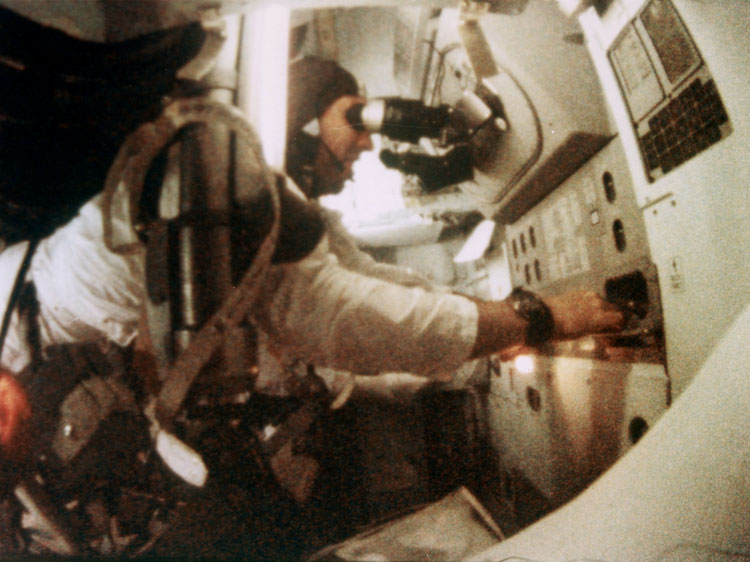
55 hours into the mission, disaster struck out of nowhere. Initiating the stirring fans for the oxygen tanks in the Service Module, the astronauts were suddenly disturbed by a loud bang, multiple alarms, and oscillations of the vehicle that worsened by the second. 205,000 miles from home, they were faced with a terrible reality, the Command Module’s power and oxygen was rapidly declining, and the source of the catastrophe were ruptured oxygen tanks visually leaking life giving oxygen at a rate that left at most 130 minutes to certain fatality. Lovell and the ground team at Johnson Space Center in Houston realized the only hope for survival would be closing down of the Command Module and transferring the three man crew into the LEM, built for two, as a life raft.
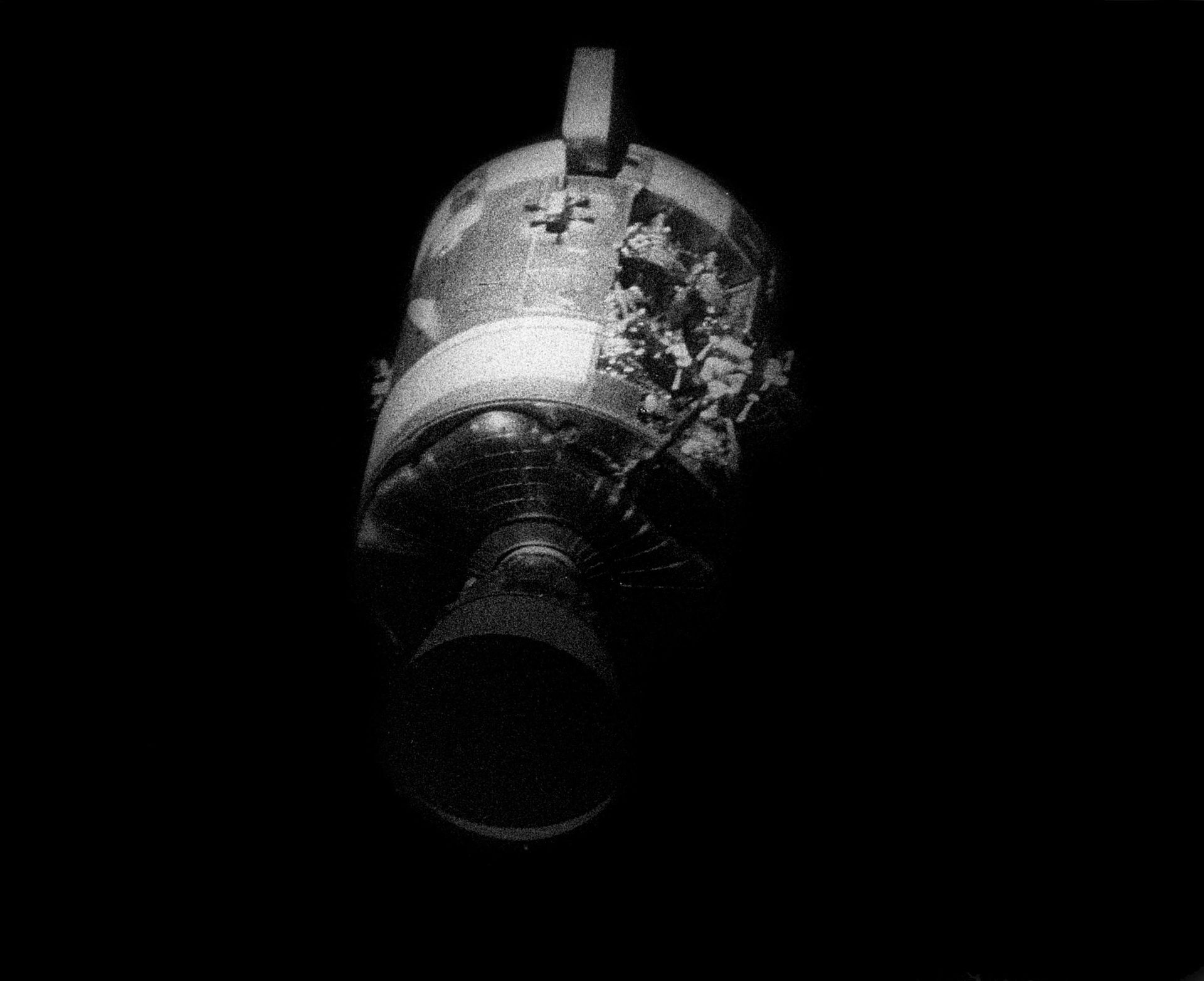
Critically the distance from earth was such that a direct abort of the mission and return was impossible, and the injured craft would have to be to the moon and slung around it to return to Earth. Within a few minutes, the mission had gone from Lovell as the crowning achievement of his professional life with a landing and walk on the moon, to a survival mission in a severely crippled craft with huge challenges in a successful return to Earth. At best, could the craft be cajoled into several more days of diminished power, reduced oxygen, rising carbon dioxide and with minimal understanding as to whether the Command Module, the only means of re-entering safely on Earth, could be resuscitated satisfactorily for the critical re-entry and landing.
It was at this moment of supreme failure and danger, that Lovell shone beyond all commanders previous. His crew struggled psychologically and physically with the miserable conditions of the craft, with temperatures maintained at 39 degrees, and Fred Haise developing a serious urinary tract infection. The LEM was not designed for either the oxygen demand nor the carbon dioxide production of three men for longer then a day and a half, and they would need a minimum of three. Alternative air scrubbers were fashioned on the fly. Circling the moon at a heightened apogee of orbit resulted in the need for course corrections, that Lovell and his crew by care timed burns navigated by dead reckoning, with a mistake likely to send them bouncing of the earth’s atmosphere to certain death. The command module, the only means of safely returning to earth would at the appropriate time have to be restarted, the LEM and Service Module safely ejected, and a heat shield that had been juxtaposed to the exploded service module hopefully undamaged. From the catastrophe of April 14 to the re-entry of April 17th, Lovell kept the crew and himself focused on the task at hand and never wavered. The dream of the moon was gone forever. It was to achieve the near impossible that interested him now, and with an 82 second extension of the expected re-entry radio silence time, it was not clear to anyone on the ground Lovell and his crew had pulled it off, the first successful intra-space catastrophe and recovery mission.
Lovell did pull it off, and the aborted mission to the moon , despite its failure, remains one of NASA’s most spectacular collaborative successes. The courage, quick thinking, leadership, and steadiness of Lovell, absorbing and implementing one of the best engineering recovery processes ever achieved by an organizational mission team is one for the books. James Lovell never got his third shot at the moon. The NASA moon program ended prematurely with Apollo 17 in 1972, and 46 years later we have yet to go back. James Lovell at 90 years of age may have missed out of being able to put his foot in moon dust and gaze at the earth from another planetary body, but he can look with pride that he is remembered for his achievements in failure above those that were part of successful missions. Getting everybody home when it looked impossible is a singular achievement of this long ago era. If we soon head back, Apollo 13 will be one of the steps that made it possible.
On his ninetieth birthday, Ramparts salutes Commander James Lovell as Someone We Should Know #33.