

Shame

The Scarlet Letter
The Scarlet Letter

Sin.  Remorse. Confession. Redemption.  These are the steps of an ancient process of acknowledging a societal standard for behavior and using a form of public confession with its resultant  humiliation to induce behavior modification.   Hester Prynne, in Nathaniel Hawthorne’s novel of the struggles of an individual and society to come to grips with ‘unacceptable’ behavior, wore a Scarlet Letter to identify her action to the community and her acceptance of her action.  The rudimentary nature of the Letter belied the complex considerations all the characters in Hawthorne’s novel face in dealing with and facing up to  sin, guilt, piety, rejection, anger, sanctimony, and hypocrisy.  Hester as part of her own redemption accepts her role and consequences of her behavior, the punishment, and takes a road of personal dignity to help others in the novel, not as strong as herself, to finally face up to their own demons.

Hester’s strong example finally gave strength to community leader Reverend Arthur Dimmesdale to admit his own role in her requiring the Letter and finally confessing and thereby achieving some redemption.  Shame, both public and private, formed a mighty anvil upon which all learned and shaped their responses.

Well, there are no Hester Prynnes in own current society’s leaders.  The concept of public shame helping to curb poor behavior in politicians and force a dignified response has lost all impact.  We are being treated to a special group of people who can not be humiliated and are immune to public shame.  The sins are old fashioned but both the reaction of the public and the individual to their liability is not.

Anthony Weiner, a nondescript former New York congressman who achieved a modicum of fame through a special talent of expressing outrageous bombast on TV and marrying a member of the  extended Clinton royal family,  proved to have a more prodigious skill – taking pictures of his privates and sharing them with anyone who would care to look.  Forced to resign his congressional position by the shear volume and inappropriateness of his hobby, he lay in the reeds for a year and a half before determining that a morally deficient New York City public would have amnesia for his personal deficiencies and love for his over-the-top bombastic politics.  He found himself in a short time leading the race for Mayor of the country’s largest and most influential city.  Unfortunately, his alter ego, a pornocentric superhero named “Carlos Danger”  continued to prowl the internet, extoling superhuman body parts and expousing the potential actions of these capacities on various young women, and has come to public attention. The public exposure of personal perversion used to be a special scarlet letter for politicians, but no more. Mr. Danger has determined to stay in the mayoral race, and  is relying on the public’s comfort with immorality as no longer defining a public character, as if complete lack of discipline in a personal life would suddenly evolve into good and just public governance.

The modern disconnect is not limited to Mr. Weiner.  The mayor of San Diego is Bob Filner, who has determined that being in a position of power as mayor, allows him special dispensation at seventy years of age to grope, taunt, grab, and demand lascivious behavior from whatever female happens to come within his force field.  Apparently as a democrat campaigning against the republican party’s supposed war on women, he felt he had vaccinated himself with women to the extent that he could nuclear. Public righteousness, private hypocrisy – the modern cultural equivalent of “do as I say, not as I do.”  Is there sufficient humiliation to force Mr. Filner to resign?  Mr. Filner doesn’t think so.  Once again, being in a position of power to tell other people how they should act and follow workplace laws has made him impervious to law in his own mind.

The examples could go on and on, but it really relates to a progressive societal exhaustion with having a shared concept of behavior. The mutual tug that both Hester Prynne and Arthur Dimmesdale felt has left us as a society, and we have drifted into the hypocritical circus of the bizarre.  Because Speaker of the House Bob Livingston felt his own internal shame of having had an affair in his life, while accusing President Clinton of similar malfeasance in office, he determined to resign in 1998.  President Clinton, who perjured himself and broke numerous workplace laws having sexual relations with employees, felt no shame, and did not resign.  Secretary of the Treasury Timothy Geithner, whose IRS prosecuted untold numbers of individuals for tax evasion, felt no shame or need to resign, despite not having paid his own.  Barack Obama in 2004 , working to gain national prominence by running for Senator from Illinois, made sure that his formidable republican Senate opponent Jack Ryan’s private court documents in a divorce child custody case be exposed through the press detailing some private accusations his wife made regarding Mr. Ryan’s sexual requests of her.  Knowing of Mr. Ryan’s unwillingness to drag his child through the political mud, he counted on Mr. Ryan’s personal shame to drive him from the race, and succeeded.  That certainly did not lead to Mr. Obama feeling a Arthur Dimmesdale moment to release private personal birth records or college transcripts which no doubt would reveal at least ‘inconsistencies’ in his personal storyline, but it did lead to a Senate seat, national prominence, and eventually the Presidency.

All roads of understanding lead to the concept of Shame requiring the secondary concepts of personal guilt and desire for redemption to be present to have any last effect.  We see in our modern society a significant disconnect, in that the exposure of personal flaws are merely a temporary hurdle to overcome, not a abject lesson to learn from, and grow beyond.  Our current society desires a feel good strategy of pick and choosing things to become outraged about, avoiding any collective responsibility, acting beyond approved laws, spending beyond approved limits, and fundamentally denying any personal remorse or collective action to change.  Is it no wonder, that our unwillingness to stand as Hester Prynne and wear our Scarlet Letter, learn about ourselves and achieve collective dignity in acts, has led to a generation of politicians who are oblivious to their own dignity and societal clarity?

Shame…shame on us all.
 

The Disease Within

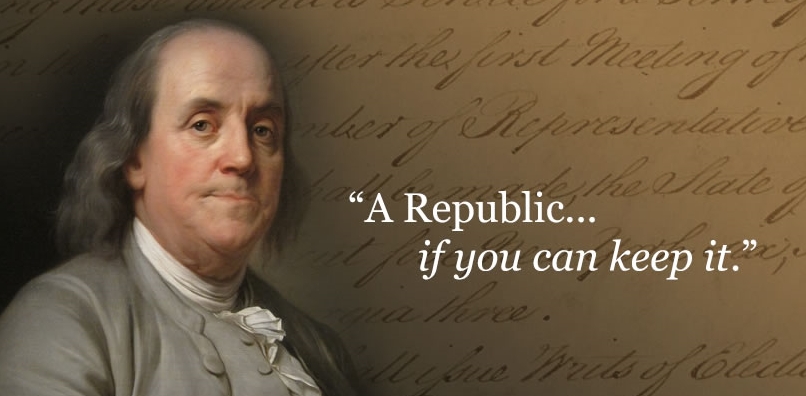
IfYouCanKeepIt     The past week was pregnant with omens for those of us who fear the permanent estrangement of a people from the magnificent experiment in liberty their founders created for them.  The fragile nature of our experiment, a means of societal empowerment in which the free will of a people is balanced by the order of measured laws, has finally become visibly shaky.  Though multiple somewhat disparate events came together to paint a picture of distress, the final framing was achieved by the President, the chief law enforcement official of the United States, suggesting the only thing separating him as a black American from a racially profiled shooting and a miscarriage of justice was  three decades of life.   Three more years of such leadership, and we can remove the uncertainty as to the great experiment’s final extinction.

The first of the peals of thunder was the declaration that the once great American metropolis of Detroit was going to file for bankruptcy. A half century ago Detroit stood as a colossus of cities, home to hundreds of thousands of jobs building the premier implement of personal freedom, the automobile, flush with the highest standard of middle class living in the world.  Fifty years of one party government and unionized monopoly in city services and education,  and city now finds itself with one third the population, a horrid crime and murder rate, a collapse of available services, an almost 50% functional illiteracy rate,  miles and miles of abandoned capital in shuttered homes and businesses,  and a suicidal governance that still manages to spend a hundred million dollars a year more than it takes in in revenue.  The final nail in the bankruptcy coffin is a common story, the governmental class securing for themselves gold plated pensions and health benefits that swallow up essentially all the available tax base, with hardly any thing left for essential role of city government, police and fire, snow removal and sewer maintenance, and no hope to fund future needs.  Is this the distortion of a republic or the corruption of a democracy?  It is very much the synthesis of both, as the key feature of contract between the governors and the governed, the integrity of the compact and the respect for its institutions and laws, has been lost.

The second wave of disturbance was the testimony of IRS officials before Congress that indicated that everything put forth by the executive branch thus far in the scandal has been a deceit.  From the initial claim that the apparent coercive efforts of the IRS to suppress  grass roots political groups they saw as a threat to the President’s election were driven by a few rogue agents in Cincinnati, to the farcical claim that the extra scrutiny was equally applied to all political groups equally, the testimony showed a ugly laceration across the chest plate of equality under the law and a government without prejudice.  Forty years ago, the idea that the executive branch would interpret the President’s will as a ticket to intimidate American citizens was an impeachable offense.  Now, a direct line of command from a political appointee of the president is secure to the offense, and the media projects a collective yawn.  The evidence is growing of a direct White House effort to use the powerful enforcement arms of the executive branch to manipulate the national election to their favor, a direct assault on the constitution they were sworn to uphold.  Darker clouds can not role across the  compact  a government holds with its people.

Finally, one of the great triumphs of a free people, the right to trial by a jury of peers with a presumption of innocence was put forth for all to see in Florida, and the result was viewed not as a  celebration of the magnificence of such a process denied to so many people throughout history, but rather a hysterical denial of the justice obtained. The Bill of Rights secures for every citizen in the Sixth Amendment the right to an impartial process without the intimidation of the governing class:

In all criminal prosecutions, the accused shall enjoy the right to a speedy and public trial, by an impartial jury of the State and district wherein the crime shall have been committed, which district shall have been previously ascertained by law, and to be informed of the nature and cause of the accusation; to be confronted with the witnesses against him; to have compulsory process for obtaining witnesses in his favor, and to have the Assistance of Counsel for his defense

The Zimmerman trial offered all Americans to see the process in all its glory, the presentation of evidence, the burden of the prosecution to identify the perceived offense beyond a reasonable doubt, and the care to allow the jury to deliberate without prejudice or intimidation. The President had a perfect opportunity to celebrate the protections the unique American judicial system offers all Americans.  Instead he found a need to demagogue the issue and incite the development of a myth of injustice and racism where by all accounts of those who watched the trial, there was none.  It was a pion to the mob mentality, that asks for a premeditated justice, a bias for a perceived outcome to assuage a perceived cultural disadvantage.  It fed into the national consciousness that once again the system of principled laws was at fault, not the actions of the individuals.  To a progressively civically illiterate population this is becoming easy to believe.

A once great city collapses on its own hubris. A government intimidates and manipulates its own citizens to secure its permanence.  An impartial ruling of law is attacked as a miscarriage.  Like a terminal disease slowly sapping the strength of the body, the outer edifice still superficially appears to stand, but progressively feels the tiredness and  incapacity.  America with so many strengths of foundation, is experiencing the death of nations, and the government sworn to diagnose and defend against threat, is instead helping to plan its funeral.


Democracy and the Radical Chic

democracy in EgyptThe collapse through coup of Egypt’s democratically elected government only a year after its inception represents another unfortunate example of the disconnect of popular will and actual governance without the bond of a common set of principles that bind their success.  In most discussions of what would represent modernity for so called backward or underdeveloped nations, the use of terms such as democracy, freedom, and popular consent are thrown about as if they were omnipotent tools for progress.  The entry of the United States into World War I was declared to be the war to make the world “safe for democracy”.  It has been suggested that the Cold War was the philosophical battle between democracies and totalitarian regimes.  The term ‘democracy’ as an indicator of popular will has even led the most authoritarian regimes in the world to style themselves as “Democratic Republics”.

What of course was lost in Egypt last week was not democratic process, but rather, the rule of law. Democracy, in simple terms, is the will of the majority, and like a great shape shifter, the will of the majority that brought the Muslim Brotherhood and Mohammed Morsi to power last year in a free election, summarily turned him out of office without a whiff of legality.  It turns out that like all radicals who utilize the levers of democracy to assume power, Morsi and his cadre were looking to rapidly make their ascendance permanent.   The radicalization of the ruling government to destroy diversity, approve popular thuggery, and institute draconian rules against personal freedom, however,  were not what brought the Morsi regime to its catastrophic end.  Democracy in its purest form has little time for those in the minority who have differing views.  No, the fact that he ended up having no ideas to stabilize a crashing economy, provide any hope for Egypt’s huge underclass, or even provide the basics such as food led to the rapid turn of the popular will against him.  Morsi’s incredible ineptitude at governance was the fatal blow to the Muslim Brotherhood using the radical chic of democracy to achieve their authoritarian ends.

The confusion of democracy and republic, freedom and governance, rights and responsibilities are the sloppy mentations of our modern society.  The founders of the American experiment in 1776 and later with the profound development of the Constitution and balancing bill of Rights, were at their essence not democrats but rather republicans, in the original context of those labels. The democracy of ancient Greece was not what they were after but rather the better characteristics of the republic of Rome.  Mob majority rule did not interest them; frankly, their opinions regarding their need for severance with Great Britain always represented a minority view in America.  They were instead profoundly interested in the rights and freedoms of the individual, and the need to set up a system of laws that would protect those rights against all potential assaults by a majority rule.  Laws were designed to promote the individual, government was designed to be limited only to provide a means for cultivating and protecting those rights, and the passions that drove mob rule were to be deflected by an onerous, purposely deliberative system of checks and balances.  An executive was to be hemmed in by the power of the people in the form of the legislature to control the monies and the judiciary to assure that governance would stay true to the principles expressed in  the Constitution.  Democratic voters could elect representatives to discern their will, but only within the range of principles that superseded every whim.

Democracy without these careful underpinnings of law and limitation has proved to be an irrepressible device for the radical chic to subvert freedom in the name of popular democratic “support”. The greatest example of this was Herr Hitler, who flummoxed around as a young radical anarchist fronting a group of thugs known as the ‘brownshirts” in the 1920’s, until cleaning up his appearance and message to a sufficient number of the voting public to allow him into power to permanently install himself and eliminate all other factions. The inherently brilliant maneuver on his part,  upon taking power, was the declaration of war and stamping out of his own “brownshirt” thug army that brought him to prominence, to assure the population that he would be ultimately a autocrat of societal order above anarchy.  For order and economic stability the democratic tide would support him no matter the severity of his vitriol against those vulnerable who disagreed.

The American radical chic has their own democracy champion in Barrack Obama.  The concept of deliberative action has little appeal to him.  The power of democracy to achieve permanence for his vision of America has been the great attraction.  The support of massive governmental takeover of healthcare in a bill termed ‘Obamacare’ was produced in a vote in which the majority voting block admitted freely they had never read the bill or really assessed its consequences.  The immigration reform that seeks to assure a permanent democratic voting majority suggests its strength will be adherence to new laws when the very need for the so called reform was the government’s unwillingness to enforce the laws already on the books.  The use of the IRS to intimidate and suppress the development of alternative opinions that would be put the inevitable march toward socialism at risk.  All are the usual weapons of intolerant majority rule to assure the eventual coalescence of power in the hands of a powerful few “true believers”.

Egypt has long been heading toward the rocks of failed statehood because like so many other states that have substituted the elixir of democracy for the hard work of building the institutions that protect freedom,  the end is a detached populous with nothing to believe in, or hope in.  Hope does not come though change, as expressed in the nonsense of the radical chic.  Change without principles and institutional protections and careful vetting, are as ephemeral as rain in the desert.  The next change simply brings more waywardness and drift. President Bush declared  freedom was an unalienable right of all men, and all men desired most of all the capacity for liberty.  Liberty and freedom, however,  are not the same as immature democratic rule, and the confusions of Iraq, Iran, the Arab Spring and Egypt show how complicated the actual relationship of such at times contradictory forces can be.  For the radicals of the planet, radicalism has never been about the reality, but about the predetermined outcome, and democracy without the rule of law and institutional maturity is an unsavory mistress indeed.  Even in the land of the free, and the home of the brave.