
In Frank Capra’s 1939 film Mr. Smith goes to Washington, an American everyman Jimmy Stewart goes to Washington as an obscure replacement Senator from an insignificant Western state. At a critical moment in the film, the inexperienced Senator Smith, under pressure from the corrupt establishment and facing personal damage to his reputation, 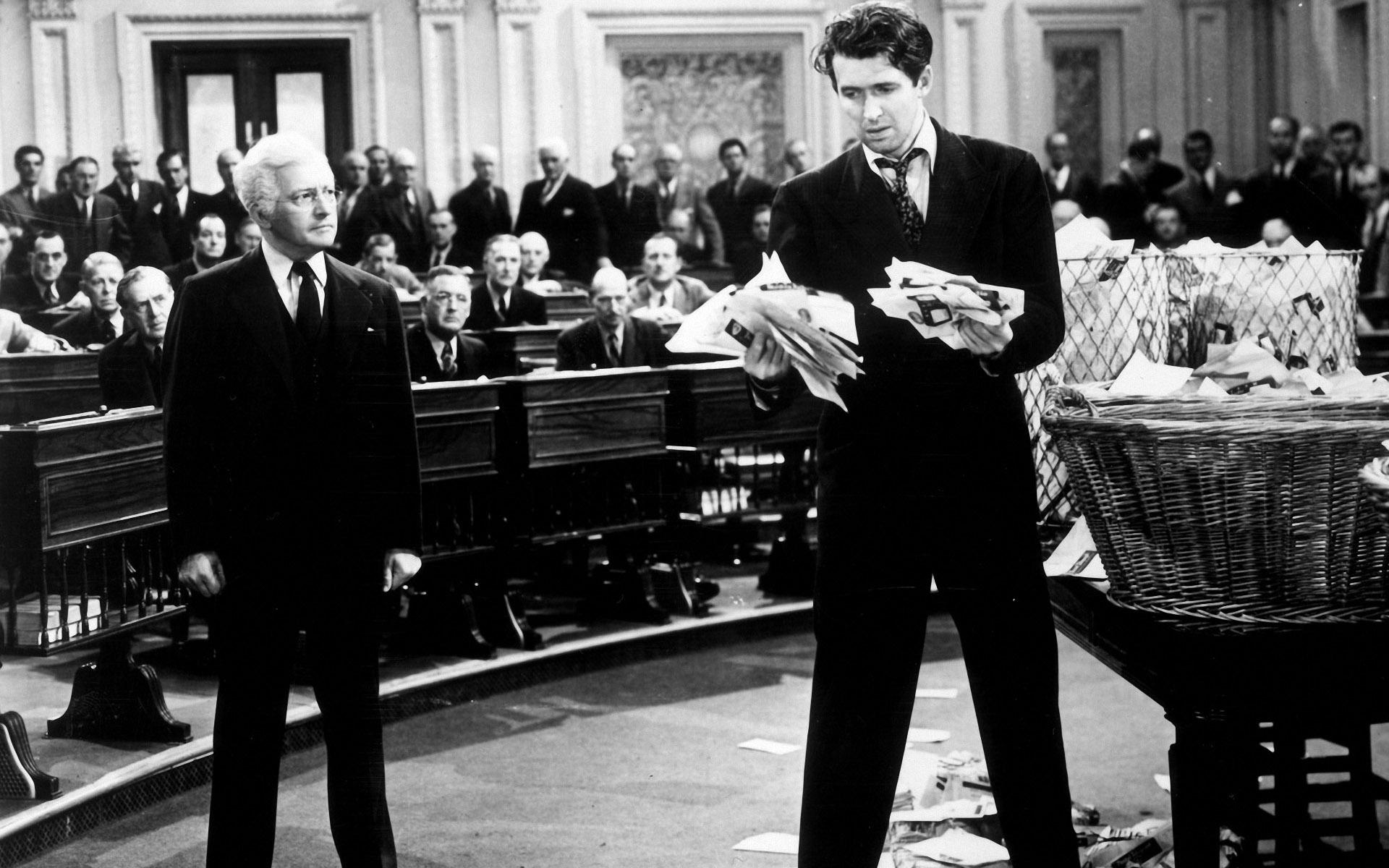 determines to fight them all and stand up for the principles of democracy, and the people who he represented. He gives it all up to filibuster a corrupt bill and, in the end, wins the day for all that is good and fair in America. The establishment, so blinded by the way Washington works, sees ultimately in Senator Smith the essentials of America they left behind so very long ago, and there is a epiphany of sorts. Well, on January 6th, 2015, another Western everyman was sworn in to the United States Senate and this everyman has done everything to set the current establishment on its heels. From his first day he has stood athwart the efforts of the establishment to accede to the authoritarians of Iran in their relentless drive to obtain nuclear weapon capacity and threaten the world. The new saga might be called Mr. Tom Cotton Goes to Washington, and this senator is rapidly becoming one of Ramparts People We Should Know.
Tom Cotton, like the fictional Jimmy Stewart, came out of small town America, born in the small Arkansas town of Dardanelle, population 4745. His parents were good Arkansas democrats and supporters of Governor Clinton. Son Thomas however was a contrarian from the start, absorbing on his own the conservative wave effecting the South. Small town or not, young Cotton was a unique intellectual talent, and his future course one of one achievement after another. He was an outstanding high school student, and was accepted to Harvard in 1995. He graduated from Harvard and was admitted to the Claremont Institute for graduate studies, determining to return to Harvard after a year when he was accepted into Harvard Law School. Graduating in 2002, he clerked at the United States Court of Appeals for the Fifth Circuit, then entered into practice of law with a prestigious law firm. By 2004, the very different nature of this individual to respond to his internal sense of purpose led him to quit the firm and join the Army, at the very height of instability in Iraq. He not only joined, but decided not to take the obvious administrative officer route of attaining a captaincy in the Judge Advocate Corps his law education positioned him for, but instead decided on a combat route, starting as a Corporal, and entering the US Army’s Officer Candidate School, earning a 2nd Lieutenant commission. He then attended both US Army Airborne School and Ranger School, and was assigned to the 101st Airborne as a platoon leader in Iraq in 2004. In 2006, Cotton became a 1st Lieutenant and was re-assigned state-side to Arlington National Cemetery as a member of the Old Guard Unit. The restless Cotton pined to return to the front lines and was re-assigned in 2008 to Lagham Province in Afghanistan where he completed another tour. Having completed two combat tours, Cotton was honorably discharged in 2009, rejoining the US Army Reserves in 2010 and finally discharged as a Captain in 2013.
Tom Cotton by age 35 had achieved a lifetime of accomplishment. Graduate of Harvard and Harvard Law. Two combat tours in the US Army. Airborne School, Ranger School and honorable discharge as a US Army Captain. But Tom Cotton has only just gotten started. His political persona and the unique personality that couples a formidable intellect with the willingness to speak his mind on principle regardless of the risk, first presented on his initial combat tour in Iraq. In 2006, the New Times proudly published classified material exposing the government’s secret program monitoring terrorist’s finances. An obscure combat Lieutenant in Iraq named Tom Cotton read the article and determined to let the world know that to front line soldiers, what the New York Times had done risked American lives and bordered on treasonous. He wrote an open letter, a technique he would use in the future, to go around the establishment and get his opinion out directly to the public. The letter struck a cord and was an internet sensation. This obscure lieutenant became overnight an international figure, and an almost immediate thorn in the side to his superiors. The need to speak his mind risked court marshal and given the political sensitivities of army hierarchy, the potential destruction of his career. It might have been the first time that a letter on the internet required a decision by the Army Chief of Staff, but luckily for Cotton, General Peter Schoomacher backed his right to state his opinion.
The legend of Cotton was born at that moment in conservative circles, and he became a future star to be nurtured. When a House of Representative seat opened up in 2012, Cotton’s political career began with a run for the seat, and he was elected to Arkansas’s 4th Congressional District in 2012, defeating his opponent 59% to 37%. With the Cotton resume now in national focus, he was immediately appreciated for his intellectual and rhetorical skills on the House floor, and his reputation grew well beyond typical freshman status. By 2014, a vulnerable democrat Senator Mark Pryor was in Cotton’s sights, and a similar electoral wuppin’ took place, with the ever more popular and skilled Cotton defeating Pryor 56.5% to 39.5%.
Now Senator, Tom Cotton has focused his attention with laser beam focus on the Obama’s administration’s focus on overturning thirty years of American policy toward the theocrat dictators of Iran and their desire for nuclear weaponry. In typical Cotton focus, where the rest of the establishment political crowd has passively stood by as Obama. determined to get an agreement at any cost, has given in on one critical issue after another to Iran, Cotton has singlehandedly manned the rhetorical and constitutional Ramparts against the administration’s appeasement. Using his now famous Open Letter technique, Cotton published a letter to the Ayatollah countersigned by 47 other senators, that any executive agreement presented by President Obama designed to subvert the constitutional treaty process mandated in the Constitution would not have the obligations of a treaty:
What these two constitutional provisions mean is that we will consider any agreement regarding your nuclear-weapons program that is not approved by the Congress as nothing more than an executive agreement between President Obama and Ayatollah Khamenei. The next president could revoke such an executive agreement with the stroke of a pen and future Congresses could modify the terms of the agreement at any time.
Like Cotton’s previous letter, this brought faux outrage from opponents, and particular disdain from the President, who has sought extra-constitutional actions as his modus operandi again and again. Despite the enormous pressures applied from all directions, Cotton as usual remained non-plussed. Cotton has been the direct visible opponent of each Obama appeasement to Iran – from sanction removal to anywhere anytime site inspection to centrifuge research to release of a monster cache of frozen funds to, the final outrage, the furtherance of Iran’s ballistic missile systems, thus improving Iran’s capacity to threaten the world with weapon deliverance, once they have nuclear weapon capacity. Throwing aside President Obama’s usual deceptive tactic of stating the opposite of the obvious to a superficially attentive population and media, Cotton has become a pillar of strength in the effort to protect the world against the Iranian threat. He has proven he can hold his principled opinion even under the challenge of hostile media. Cotton did not rest when the President and the Secretary of State attempted to present the agreement as a fait accompli. He has led to organizing of the Senate to review document in its entirety, including side deals with Iran the administration had purposefully obscured from public notice as they ran contrary to the narrative of a “tough” deal.
Senator Tom Cotton is 38 years old, the youngest Senator in the US Senate, and already is the stiff backed principled opposition to the idea the United States is a has been power that must except its decline, and subject itself to decline as a punishment for the “wrong” it has done as a superpower. Harvard Law graduate. Combat Veteran. Captain in the Army. US Representative. US Senator. Lion in the defense of America and her unique constitutional design promoting limited government and individual freedom. At 38, the future sky’s the limit for Senator Tom Cotton. Resoundingly, Tom Cotton is Ramparts People We Should Know #27 . If Frank Capra,were to make the movie now, Mr. Tom Cotton Goes to Washington very likely would have an even more impressive sequel to come.