In the darkest times, when it seems that the world has fallen from grace, and the way out has been obscured so densely that hope appears extinguished, miracles can occur. We live in such times, but these are not the first of those times. Finding a way out of the morass is often predicated upon pressing onward, and having faith.
Evil feeds upon the angst and weakness that lies in the absence of faith. It looks to declare the absolute certainty of a future, to remove all hope, and to force compliance. Faith secures the ultimate freedom, elevated from the native fears and doubts that can bring such turmoil to human existence. The faithful don’t need reassurance, because the present holds no sway over an ultimate truth.
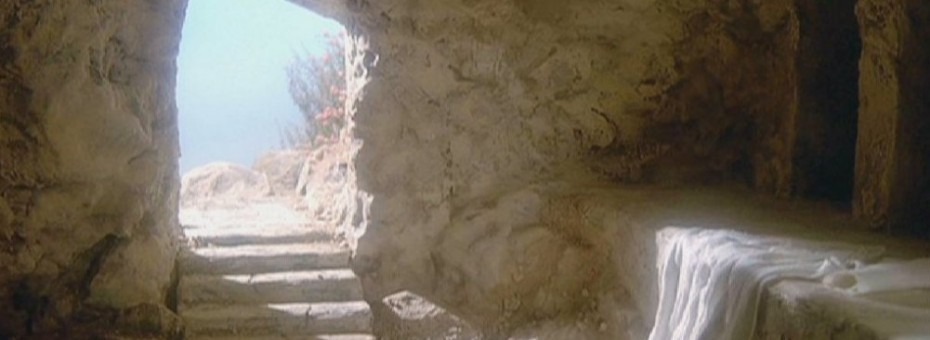
A transcendent faith is the gift of that day so many years ago when the tomb was visited on the first day after the sabbath, the stone was found shunted aside, and the inhabitant of the tomb was nowhere to be found. Those that gazed in and were dumbfounded showed expected human reactions, worrying where the body was taken and who would have removed it. The truth was of course greater than any perceived before in human existence, in that the truth was amongst them as they wondered, and had been all along. Those of the greatest faith could see the truth, and those who would doubt but were open to a better world, could still receive the truth.
The realities of our days bring doubts, but not certainties. The faith that good will triumph over evil speaks to the enormous power of good and the inherent weakness of evil. In good is the future of enlightenment, love, and paradise. In evil, lies the empty blackness of a world devoid of meaning.
The miracle of Easter morning is not only that it happened, but that it happens continuously, through the breath of spirit that infuses people with the strength to carry on through the darkness, and never given in to those who would surrender or desecrate our goodness.
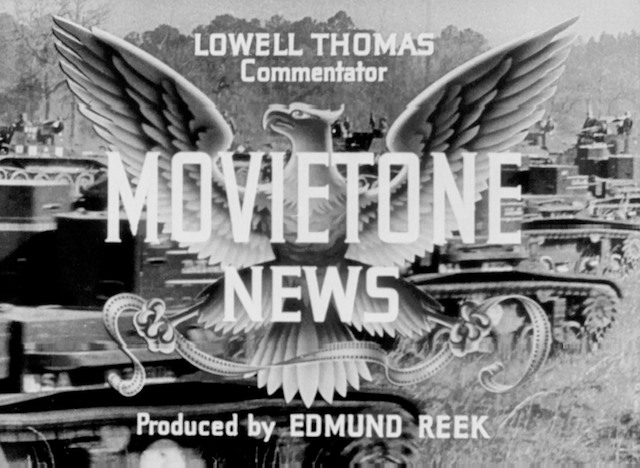
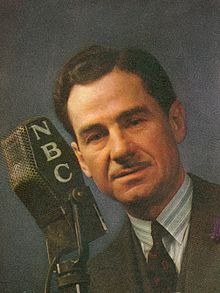
Lowell Thomas used to bring you the world on Movietone
At the height of the calamities of the mid twentieth century, an assured and distinctly American voice brought focus and attention to world events in brief movie vignettes presented at the primary American gathering place of that time, the movie house. Thomas, a very American entrepreneurial character, was in a strange way his own news
Lowell Thomas
service, and invented many of the concepts that currently form our visual news services today. Thomas was the man who brought the visual media to news celebrity, finding and engaging T.E. Lawrence, helping turning him into “Lawrence of Arabia”. He helped found nightly radio national news broadcasts, was responsible for the first television news broadcast, and anchored the first telecast of a political convention. But Lowell Thomas is secured in history for going around the world in Movietone News, tying crisp and tight prose to sharply edited and dramatic newsreel footage to bring impact to the stories of the day, often in far off places ,to the contained world of the viewer. You could leave the movie theater knowing what you needed to know, because Lowell had synthesized it for you.
Well, nobody could possibly do like Lowell Thomas, but there are plenty of reminders out there of a world of ongoing events that we should keep in front of us as cascade down the year of 2016. Rampartsthereforehumbly borrows the snapshot techniques of Lowell
Thomas and Movietone and takes you Around The World with RAMPARTS-TONE NEWS.
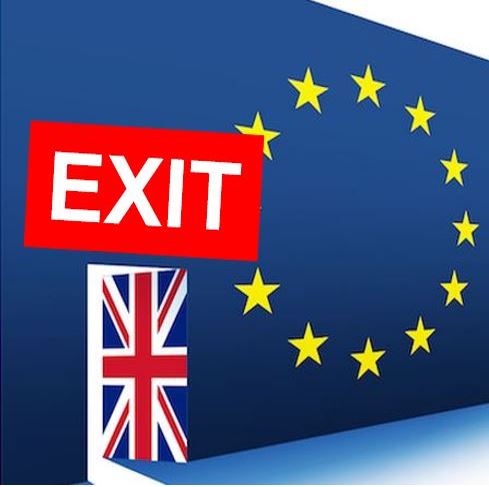
Great Britain: On June 23rd, 2016, the voters of Great Britain will contemplate in the voting booth a referendum decision to potentially overturn the political directions of Europe cultivated over the last 70 years since the end of the Second World War. Out of the calamity of war, the governments of Europe determined to bind themselves together ever more securely in a union that they hoped would sublimate the nationalist tendencies that bedeviled Europe’s peace for five hundred years. What was at first the concept of a common market, has progressively become more of a political union in which the member states have less and less to say regarding their own economic and political decisions. Great Britain, the fifth largest economy of the world, feels increasingly hamstrung by its place in the European Union, the rules of trade with any partners outside of the EU at the mercy of joint EU decisions, its monetary system based on the pound sterling unteathered to the Euro. Germany and France, the joint force behind both EU and Euro policies, is not about to let Britain make independent decisions without being lashed to the Euro. Given the economic events in Europe over the last several years, being lashed to the Euro is the last thing on Britain’s mind. What makes up a modern nation state, how do economies work, what would happen to the United Kingdom (particularly pro EU Scotland), and what is the effect on the stability of post WWII Europe are just some of the small considerations Great Britain’s voters will need to educate themselves upon before voting on June 23rd. Polls suggest that those who want to stay in the EU comprise 45% of the voters, those that wish to exit, the BREXIT voter are close behind at 40%. The BREXIT referendum currently has a volatile 14% undecided, so with so much on the line, the heat will certainly turn up as one gets towards the June referendum.
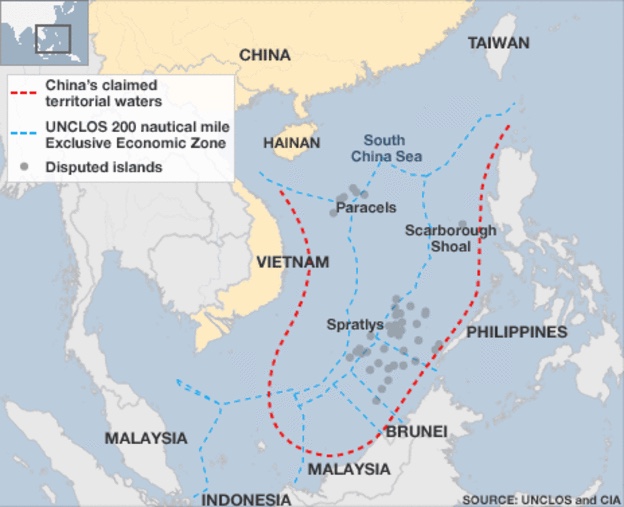
South China Sea: A great economic power inevitably looks to secure its economic future and defend it with a strong military. What is happening in the South China Sea is more complicated than China simply defending its right to commerce. China is claiming hegemony over the South China Sea and the islands within it, and it is not asking the opinion of any of its neighbors. The South China Sea happens to be one of the world’s busiest sea trading lanes, and many countries see it as vital to their independence and prosperity.
The South China Sea – and the competing claims of the little atolls and reefs that form the Spratly and Paracel Islands
The sea lanes have been guaranteed for decades by the world’s largest military, the United States. What happens when a country such as China sees free access to a region it feels is vital to its economic self interests is a recipe for real trouble. The region is thought to contain huge oil and gas reserves, and the neighboring countries of Vietnam, Malaysia, Indonesia, the Philippines, Taiwan, and Japan, do not intend to allow China to exclude their access to the riches of the sea, or the freedom to navigate. China is forcing the issue by building up the reefs into capable islands with air and sea access for their military, and the United States, responsible for freedom of the sea lanes is none too happy. When a country like China starts determining to secure its neighborhood, the reverberations can be very,very dangerous. This is a building story that will go far beyond the calendar year of 2016.
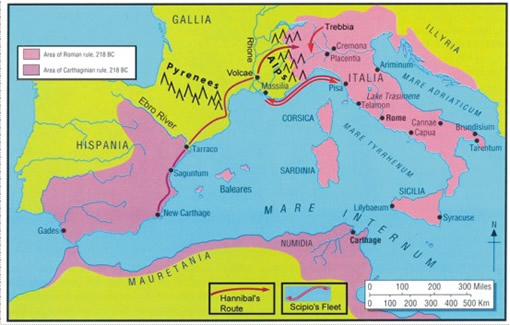
Libya: Unfortunately for Hillary Clinton, it doesn’t look like the calamity of Libya she fostered in her ill considered decisions as Secretary of State, is going away any time soon. The country was unravelled by France, Britain, and the United States by assisting in the overthrow of Muammar Quadaffi in 2011, then passively standing back as the wolves descended on the carcass of the country. Clinton’s unique role in the US disaster at Benghazi is still being investigated, but the future is much scarier than the past. The country is split in half with a General Al-Sisi like strong man, General Khalifa Haftar, running the eastern half of the country and looking to extend his control over the western half which includes the capital of Tripoli, , truly a wild,wild west, run by competing Islamic extremists, including with increasing radicalism and strength, ISIS. The formation of a caliphate with its dagger edge pointed much as in the days of Carthage
Carthage and the Punic Wars
directly at the Italian and Iberian peninsulas is a dream come true for ISIS and a nightmare for Italy and Europe. In classic President Obama fashion, the lead from behind strategy has promulgated special levels of damage in a region where passivity is seen as true weakness, and ruthless strength is considered the calling of greatness. Obama, and his apparent successors in Clinton or Trump, are not exactly the type of deep thinkers that understand existential risks. It may be up to Europe, if it wants to survive, to start understanding and reacting to what is at risk from its southern exposure.
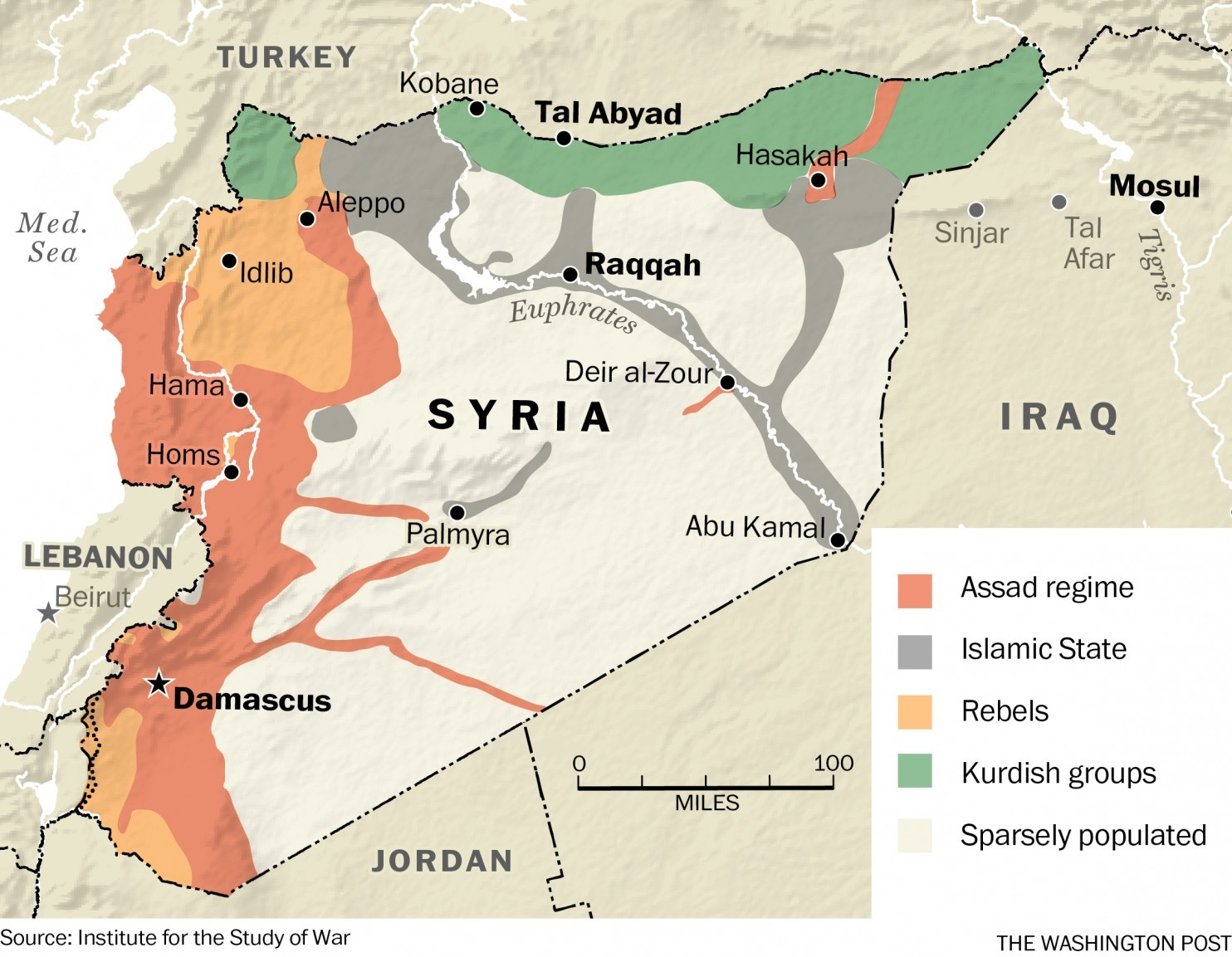
Turkey and Syria: Lawrence of Arabia, if he were to accompany Lowell Thomas today to the Middle East, would recognize the increasing calamity that is Syria and every one of its players. Events are happening on a daily basis that are rending the decisions of the day before rapidly past tense. The vestiges of the Ottoman Empire continue to vibrate in every action and reaction. Syria, converted into a horrible wasteland by marauding warriors from distant places and the corrupt and genocidal acts of its on government is at the mercy of ever larger forces.
The current battle for Syria – washingtonpost
Turkey, looking to insert its dominance on the region in an effort to reinstitute an Ottoman past, now finds itself under dual direct threat from a vicious ISIS terrorist cell and an increasingly aggressive Kurdish minority that sees a way to a greater Kurdistan across Iraq, Syria, Iran…and Turkey. Russia has masterfully succeeded in entirely usurp US influence in events to become the dominant international broker, creating strange bed fellows, but now must see how to lock in its newfound position while avoiding getting sucked in to the day to day battles. The pressure on the innocents has led to the greatest migration of people within Europe since the wars of the twentieth century, and ISIS has diabolically placed its wolves among the sheep, making for multiple threats across the continent. Iran, Russia, Turkey, Israel, Saudi Arabia, and Egypt are warily watching each other, knowing an emotional decision could create a real, first class regional war. The Obama United States, forever inward turning, can only watch, as 70 years of being the steadying influence, is going up in smoke.
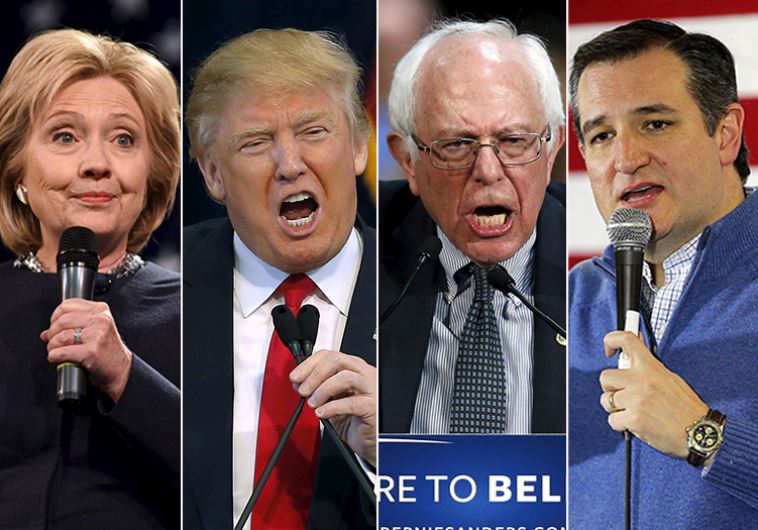
United States of America: Can a great country overcome its desire to self destruct? Facing a world of increasing instability and threat, internal debt, and a progressively self absorbed, uninterested population regarding the hard work of a republic, the US is looking at a socialist, a populist, an ideologue, and crony capitalist would be felon, three of the four around 70 years of age, to lead it through these many events demanding innovative and assertive leadership. Sanders. Trump. Cruz. Clinton. That is the roster of talent that will be asked to handle this increasingly difficult world. Not exactly an inspiring thought. There are terrific talents waiting in the wings, but none are positioned to help the country on November 8th, 2016. Will the rest of the world be willing to wait for the US to get its act together?
Stay tuned. Now it can be shown. Maybe just like the old days…
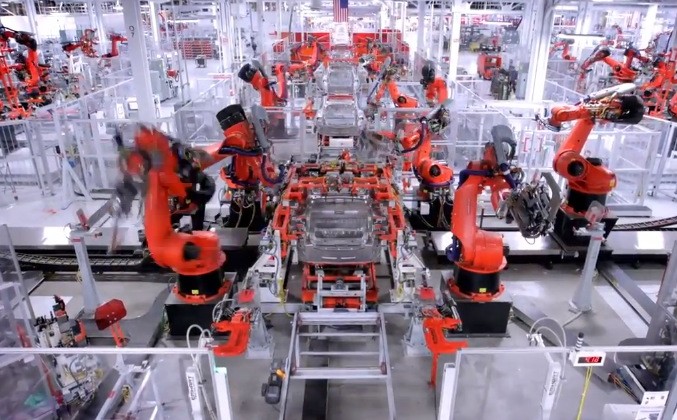
Fully Automated Robotic Assembly Line in a Tesla Factory photo/smashgear.com
It’s an emotional time when one is transitioning from what was, to what will be. America, as a result, appears to progressively be an emotional wreck. The economy sloths along at an anemic 1-2% growth rate with job growth being led by service industries such as call centers. The most powerful military in the world has devised rules of engagement that defy any engagement that would secure any meaningful outcomes or strategic advantage. The political parties are in tatters, with candidates promoting populist nationalism, serving up extreme versions of the past in an attempt to preserve what is no longer viable. The foundational principles that have adjudicated so many other previous periods of upheaval are helpless to buttress an increasingly ignorant population that has only the vaguest notion of what they are. What passes for public discourse is increasingly more reactionary, emotional, and agitated, defined by the slogan, What Do We Want (fill in the blank), When Do We Want It? NOW!!
Its enough to make you want to simply sign off. That would be denying however any hope for civilization, and we of course, in our own little way, are defenders of the ramparts of that very civilization, so a little more introspection and looking for silver linings are called for.
The first thing is to recognize that we are at the end of one order of civilization, and yet to discern the elements that will begin another. In the chaos of watching things fail that no longer work, it is easy to believe you are seeing change at work, when you are simply watching the last tired efforts of a society to desperately hold on to what it knows. The current President thought he was bringing the Change and the Hope, but the reality was that trying to make people’s behavior bend to your will was a worn out idea that was bound to fail. Something new is indeed coming, but we need to understand what is likely gone forever and let it go, if we are going to be able to respond and potentially flourish in a new world. The answer is leveraged in a return to, and a celebration of, critical thinking, and the challenge is to raise our consciousness to that reality.
Personal Privacy: The concept of personhood as mysterious as an unbreakable code and unique as a fingerprint is about to disappear. Almost every fact and nuance about each of us is available electronically to those who would look, and is progressively given up by many freely without the least concern. We are a data cache to large companies, governments, and social exchanges to the extent that our behaviors, thoughts and reactions are comprehensively known and open to manipulation. Social exchanges such as Facebook have discovered people are only too willing to put the most intimate information out into the cloud to any one who wants it. The health information of essentially every modern society is on an electronic platform, and what you eat, drink or interact with, are increasingly owned by the society rather than the individual. Governments such as China see themselves as the ultimate owners of every citizen’s thoughts, and have become world leaders in surveillance cameras, internet monitoring, and even proactive policing (predicting and preventing the “crime” before it occurs).
There is no sense to arguing the information is yours any longer, the question is, will we be willing to protect our individuality, our personhood against unwanted invasion or manipulation. You can’t be comfortable with the loss of some fundamental liberties, and be squeamish about losing others, without losing them all. A higher definition of liberty and personhood is in order, and the fight for the next generation is to recognize what is at stake.
Labor as a Means of Personal Freedom: A physical job used to link directly to personal opportunity and freedom. It provided the stability of predictable income, health care and future pension that allowed the individual to either maintain or position oneself for advancement. A relatively small group of people had the pride of ownership and production, and the risk/reward equation that came with ownership. For most people, the job was simply the byproduct of a stable life and other pursuits. Now, the very concept of “job” is disappearing. Manual labor, the capacity to contribute to production of goods and services, that would provide the economic means to eventually secure those goods and services for oneself, is, for most of the planet, the relic of a bygone era. Robots are substantially more productive than people in assembly work, mining, and farming. Computers reduce the value of human data interpretation, with their ability to summon and source massive amounts of data in infinitesimal amounts of time compared to humans. What will most people do, when there are fewer and fewer jobs for them to do? This has been the primary impetus of our current anxieties about immigration, free trade agreements, and loss of industries to other countries. The very number of jobs in the world are diminishing, as the ability to more productively outsource to machines increases. No amount of tariffs or taxes as proposed by current candidates are going to protect jobs that will be increasingly performed by machines no matter how onerous we make their transition to other countries. Governments placating people with safety nets will only delay the critical thinking required to recognize what is at stake. What will more and more people do when their productive value is progressively outsourced to machines? Critical thinking regarding what brings value to lives, not protectionist tactics, will be necessary to imagine a way forward when industry labor is no longer the source of individual productivity.
Traditional Education Defining Advancement: Education has become the unholy home of artificial value and pseudo – self actualization. Increasingly exploding in cost beyond anyone’s rational ability to pay, at the very time that the ‘education” offered promotes the lack of any actual skill development, traditional means of education are becoming incapable of providing us with the critical thinkers to help solve our problems. Degrees lean more and more to dividing our knowledge base into expertise in victimhood, chaos theory, and manipulation of the masses, rather than rewarding critical thought and linking disciplines to provide creative outcomes. Requiring massive amounts of individual investment or societal support to fund further examination of our divisions – our blackness or brownness, our sexual variance or physical differences, does nothing for recognition of our common problems or contribute to their creative solutions. Forcing people to identify their intellectual development through a degree rather than an accomplished set of achieved insights or skill acquisitions has led to an enormous ignorance as to what provides real personal development. Education no longer requires rigid isolation to campuses where thinking becomes both expensive and able to be manipulated into a politically correct ‘groupthink’.
Government as the Collective Answer: The sense of loss of control and situational anxiety has led to people seeking the comfort of worn out concepts of the last century to protect them against change, particularly lashing themselves to the masts of an ever larger and more intrusive government. Once designed in America to support only actions that individuals could not do for themselves, government has become the dumping ground for every failure in insight. Designed to exist for our collective defense against attack, it now seeks to protect us against unconquerable foes such as changes in climate and equality of outcome. The result is a morbidly bloated government that promises everything and secures nothing except the pathologic maintenance of the status quo. We are now inexorably committed to securing our future health and well being through devices that were inadequate from inception, long ago destined for failure, and financially, catastrophically unsupportable. And yet we cling to the concepts because the alternative to government’s sclerotic approach is to require some risk of ourselves, and anxiety makes it easier to pass the responsibility onto an unborn generation. It won’t matter because the virus effecting all world order is the reliance on historical conditions that no longer exist and insight that long since failed. The beauty of the critical thinkers that fashioned the Constitution is that they built the perfect machinery to evolve a society, rather than codify solutions. We need a return to critical thought processes in our governance to cleanse ourselves of the last century’s loss of focus.
Nationhood: The concept of what makes a nation has been traditionally tribal. A tribe linked by language – Uzbeks forming Uzbekistan, Swedes forming Sweden, Japanese forming Japan – has conceptually been the means of nation building. Where ignored or artificially subverted, strife has resulted. Kurds have seen their cultural whole divided into multiple countries within each they are a restive minority. Catalonians feel little affinity with Spaniards. Yugoslavia was ripped apart by sectarian and religious differences once the totalitarian government fell. The United States was formed on a unique concept-a union of various peoples bound by a political philosophical culture founded on British juris prudence, British legislative governance and the British concept of freedom of assembly and speech. To best codify this political culture, the tribe became Americans and the binding language of freedom, English. The permanent nature of this union was never in doubt when America was seen as the beacon of freedom in a world of torment, and the nation was the undoubted economic superpower of the world. Strains are developing, however, after decades of flat economic performance, progressive assault on institutions, and a general laissez faire attitude regarding the vulnerability of hard won freedoms. There is a growing perception that there should not be an American “tribe”, and the nation should simply be a repository for whoever sees reason to subsist there. The critical thought that formed unique nationhood for America is no less critical today, if the idea that a nation of shared ideals rather than genetic commonality is to survive.
This year, America has determined to vote for the end of something, rather than the birth of a new beginning. The three top candidates for President will be 70 or older, by the time they would be inaugurated, and they are selling a clinging grasp of the past with promises of illogical economics, class and racial envy, and perpetuation of the status quo. All of which are doomed. It is understandable that a citizenry, poorly educated about its innate strengths, looks to others to be strong for it. It is a scary time for those who see human freedom and individual opportunity for what it is – mankind’s most successful means of maximizing our species’ capabilities and conquering our fears and darker instincts. Inevitably, the choice is ours. And regardless of what we think, history will not wait for us.