You Did Build That – That Was You

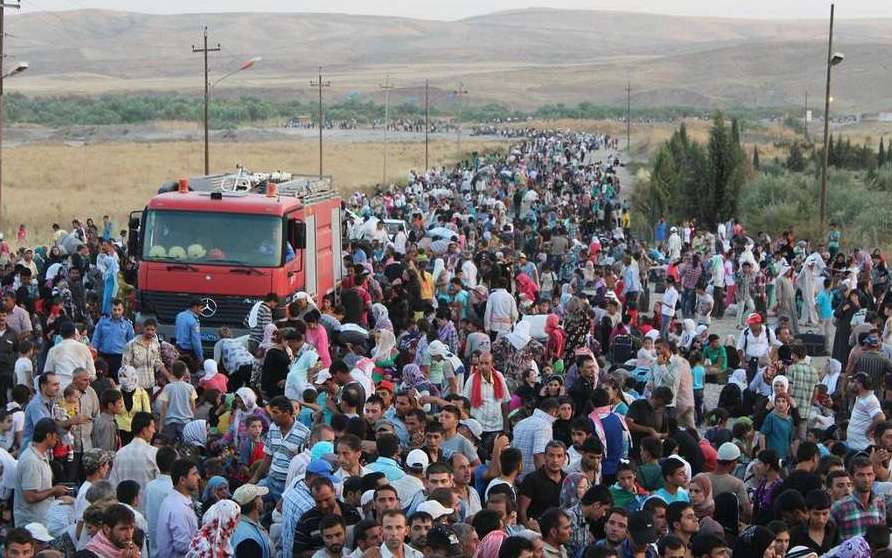
Fleeing for their lives, Syrian Refugees pour into Kurdistan

President Obama is proud of delivering the socialist mantra to entrepreneurs that their success in life was fashioned not through their own hard work, but ultimately through the critical contribution of infrastructure and faceless laborers who are owed the redistribution of the success. “You didn’t build that- someone else made that happen!”, the quote by which his admonition to capitalists and personal economic philosophic view was revealed.  Well, when it comes to the current unfolding multiply layered international calamity that has transpired since President Obama took office in January, 2009, the verdict of history is already clear.  You did build that, President Obama- That was you, and you alone.

President Obama made the mistake of confusing the potentially appropriate foreign policy argument that the international role the United States was playing had grown beyond its perceived national interests, with the argument that the United States role as global world leader in the twentieth century had nothing to do with world stability.  In other words he had taken the socialist domestic argument and extended it to the international arena.  The United States had not built world stability.  Its very presence had exasperated natural regional aspirations and allowed the United States to “take advantage” of the rest of the world and reap undeserved benefits. The United States needed to recognize its role of being only one of many nations, and accept its consignment to “improve” the world through fairer redistribution of resources through participation in climate change and World Banking and Justice initiatives.

On the domestic front, the philosophic vision of the President has led to predictable economic stagnation, worsening of conditions for the most vulnerable, and progressive mountains of debt.  On the international front, the vision is leading ominously to something substantially more serious.

It was quoted recently that the only two countries that it could be suggested under the Obama Doctrine to have developed improved relationships with the United States are communist Cuba and the leading supporter of international terrorism, the theocratic dictatorship of Iran.  The rest of the world, sensing the effects of the vacuum left behind by the withdrawal of the steadying presence of US influence, has disintegrated into an appalling mess.  China, noting the weakness of American resolve, has expanded its prosperity sphere into the international waters of the South China Sea and is militarily pressing against the sovereign lands of Japan and Vietnam, and looking to bully the Philippines and Australia.  Russia, having reversed its attempt to create a modern diversified economy and having stamped out the nascent elements of democracy, now feels free to use its time honored hegemonistic tactics against its surrounding states of Georgia and Ukraine, and soon, the Baltics, risking seventy years of relative peace in Europe.  The carefully tendered relationships the United States built up with Europe and the Pacific Rim countries, based on the fundamental trust they felt in being able to count upon the US at a moment of crisis has dissolved.

Nothing compares to the affect the Obama Doctrine has had on the Middle East and North Africa.  The fundamental belief by all the players in the region that the United States would work as a stabilizing force and not leave allies exposed has dissolved in a pit of calamity.  The US acted to demolish the tyrant Qaddafi in Libya without any plan to secure a stable outcome post removal.  The country is now a warlord paradise threatened with the ultimate warlord ISIS being positioned to gain all of Libya’s oil resources, and with it, the enormous strategic position of a dagger to the underbelly of Europe.  Egypt, the epicenter of the arab nation, and long time stabilizer under American support, is positioned as a pariah by Obama for throwing out the Muslim Brotherhood, and progressively finds itself under threat from the region’s instability.  Syria, the crossroads of ancient civilizations, is thrown into chaos by the Obama Doctrine dithering on support, then rejection, then support, and finally rejection of both the hated Assad regime and it’s equally despicable Islamist radical opponents, particularly ISIS.  Caught in the middle are the Syrian people, now approaching 500,000 dead and millions upon millions of refugees pushing into the few remaining stable havens in the region for protection and survival.  Hell has come to Syria.  Next door Iraq, declared by the Obama Administration as recently as 2011 as one of its greatest foreign policy successes, has crumbled to the brink of non-existence, and has potential to make the hell in Syria look like child’s play as Iraq degenerates into the front line of a massive Sunni-Shia fault line. With ISIS now at the gates of Baghdad, having brutally overrun one-third of the sovereign country, the government of Iraq, progressively a Quisling government of Iran, no longer counts on the US for any tactical considerations, only materials.  The many Iraqis who trusted the word of the United States, that if they took the risk of supporting a modern culturally diversified state, they could count on US protection, have discovered the ugly reality. A must read.

And finally, the sublimation of American regional interests to Iranian ones with the decision to subvert the strong control that sanctions had on the Iranian regime’s nuclear ambitions.  The pending agreement with Iran has reversed the policy of constraint, offered Iran economic freedom to pursue its aims in the region, and placed the remaining two American allies in the region, the world’s greatest supplier of oil, Saudi Arabia, and the region’s only stable democracy, Israel, in the Iranian cross-hairs. A conflict between these three behemoths wouldn’t stay regional for even an eye-blink.

It turns out, President Obama built this mess, and it’s the President’s legacy for the ages.  When the next President is sworn in on January, 2017, he or she is going to have an ungodly mess to deal with, and will likely have to make the brutally painfully decisions that this President has carelessly tendered upon the next.  The loss of American resolve, the loss of integrity of a nation’s word, the willingness to let the bullies win and destroy hundreds of years of human progress.  Now that is one heck of a legacy.
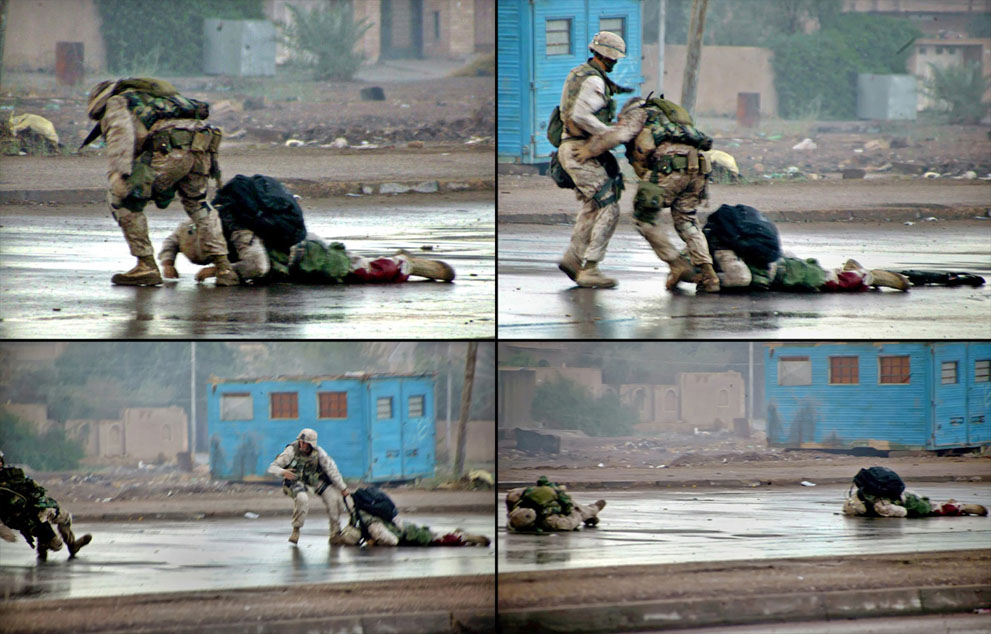
 

Remembering

Gunnery Sergeant Ryan Shane shot while trying to rescue a wounded Marine in the Second Battle of Fallujah- 2004 photo by Cpl Joel Chaverri US Marine Corps
Gunnery Sergeant Ryan Shane shot while trying to rescue a wounded Marine in the Second Battle of Fallujah- 2004
photo by Cpl. Joel Chaverri US Marine Corps

One life is all we have and we live it as we believe in living it. But to sacrifice what you are and to live without belief, that is a fate more terrible than dying.
                                                                                                                                                 Joan of Arc

As this Memorial Day descends upon us, the tendency to forget the core of the day, and celebrate instead its release from the weekly grind is strong.  In a democracy, however, in which the request to serve the nation and potentially give one’s limb or life for whatever dedicated purpose the nation’s leadership purports worth sacrificing for is a voluntary decision, the need to feel the day viscerally is critical to the nation’s existence.  Each individual sacrifice is unredeemable loss.  The important question is- is the national purpose worthy of the accumulated sacrifice?  Without the belief that the nation’s goals are purposeful and just, can anyone expect to continue to maintain the level of profound dedication and quality of those who have served at the ramparts of  this nation for over 200 years?

We live in dangerous times. But the determination by the nation’s leaders as to the need to confront dangers has been present since inception.  Some times requiring sacrifice have been heroically worthy, others in retrospect, less than heroic, but to the individual asked to sacrifice, the belief in and love for comrades, brought dignity to the sacrifice, no matter how difficult it was to recognize the logic of the action.  The military of the United States has been asked to sacrifice almost continuously from the nation’s birth to the present day:

  • American revolutionary War                    1775-1783                           25,000
  •  Northwest Indian War                               1785-1795                               1056
  •  U.S. European Quasi-War                         798-1800                                 514
  •  War of 1812                                                  1812-1815                           20,000
  • 1st Seminole War                                        1817-1818                                   36
  • Black Hawk War                                                   1832                                 305
  •  2nd Seminole War                                     1835-1842                               1,535
  • Mexican-American War                           1846-1848                             13,283
  • 3rd Seminole War                                     1855-1858                                    26
  • American Civil War                                  1861-1865                           625,000
  •  Indian Wars                                               1865-1898                                  920
  • Great Sioux War                                        1875-1877                                   314
  • Spanish-American War                            1898                                          2,446
  • Phillippine Insurrection                          1898 -1913                               4,196
  • Boxer Rebellion                                        1900-1901                                    131
  • Mexican Revolution                                1914-1919                                       35
  • Haiti Occupation                                     1915-1934                                     148
  • World War I                                             1917-1918                               116,516
  • American Campaign/ Russia               1918-1920                                     752
  • Nicaragua  Occupation                          1927-1933                                       48
  • World War II                                           1941-1945                              405,399
  • Korean War                                             1950-1953                                36,516
  • Vietnam War                                           1955-1975                                58,209
  • El Salvador Civil War                            1980-1982                                       37
  • Lebanon/Beirut                                      1982-1984                                     266
  • Grenada                                                              1983                                        19
  • Panama                                                              1989                                        40
  • Persian Gulf War Desert Storm          1990-1991                                      258
  • Kurdish Defense                                    1991-1996                                        19
  • Somalia Intervention                           1992-1995                                        43
  • Bosnia                                                     1995-2004                                       12
  • NATO Campaign Yugoslavia                        1999                                        20
  • Afghanistan                                           2001-2015                                   2,356
  • Iraq                                                         2003-2013                                  4,489
  • Cold War                                               1948 – present                     Undocumented
  • CIA Wars                                              1943- present                Undocumented                                      attrib./ militaryfactory.com

Over 1.2 million Americans have died in action since the nation’s inception.  Millions more have been injured and maimed, their lives changed forever.  To the individual serving his or her country, the purposeful sacrifice was no less heroic in the questionable principles or merits of the actions of the Great Sioux War or Philippine Insurrection as it would be in the visible threat and evil in World War II.  Ultimately a country is judged by both the priniciples underlying an action and in the ultimate success of that action.  To the families left behind, the loss is assuaged faintly ,but perceptively, if the loss was not “in vain” or “for a good cause.”  To note that the individual did their job to the ultimate, but the nation’s leadership failed theirs, adds only pain to the already tremendous burden accompanying sacrifice.  More and more, it seems the nation’s leaders are struggling to indicate the value principles of actions, and to see them through to the completion of the goals, assuring the sacrifices required might be worthy of their request.

A prime example of the detachment of leadership from the need to understand what the sacrifices have engendered are the brutal and now thrown away sacrifices of Fallujah.  The harrowing photo above captures one small but seminal event in the horrific Second Battle of Fallujah fought by US Marine and Army forces against Al Qaeda in November,2004.  The progressive crumbling and mismanagement of the supposed American “victory” over the Iraq army of Saddam Hussein in 2003 became clear in the Anbar Province city of Fallujah. The peace was ruptured and a challenge to the American assumptions regarding Iraq was placed,  with the Al Qaeda calling card of 4 burnt and hung American contractor corpses on a Fallujah bridge for all to see.  The First Battle of Fallujah in April, 2004, by the Marine Corps rousted out the initial Al Qaeda forces only to turn over the local policing of the city to a Sunni division of the ‘new’ Iraqi army, the Fallujah Brigade,  led by a former Baathist general Latif.  Ignorant of the long standing hostility of the Sunni locals to the now Shia overloads in Baghdad, the Fallujah Brigade ‘defended” the city by allowing thousands of Al Qaeda insurgents to nest and take over the city under the leadership of Musab Al Zarqawi, a vicious terrorist warlord whose goal was the expulsion of Americans and the slaughter of the Shia and Kurd Iraqi segments of Iraq.  The city became a place of horror to the subjugated, full of fascist Chechians, Somalis, and Syrians imposing their will and looking forward to Armageddon with the Americans.  The need to destroy the new fortress of the growing Al Qaeda threat led to the second battle of Fallujah.

The Second Battle of Fallujah is considered some of the most difficult and violent urban warfare American troops have faced.  The six months in between American intervention had been used by Al Qaeda to turn Fallujah into a deathtrap.  The narrow alleyways of the ancient city were full of explosive devices.  The stair wells of buildings were bricked to create dead ends were American troops could be slaughtered by hidden machine guns. The Al Qaeda troops were allowed drugs to stimulate aggression and super human strength to buttress their courage and sense of sacrifice. The battle was fought door to door, alley to alley, hand to hand in a gruesome dance to the death.  The brave forces that faced the killing machine in Fallujah, lost 107 dead and 613 wounded to take back in brutal combat what they had given away just six months before.  The two month action has been felt to rival the battle for Hue in Vietnam or the Pacific campaigns of World War II in ferocity.  The Second Battle of Fallujah is a story of sacrifice – the picture above relates the purest form, a soldier under direct fire risking all and coming back for his wounded comrade, only to fall himself under the same torrent of enemy fire.

And what is it all for, such sacrifice?  Fallujah, now stabilized in 2004 through such heroics, required more sacrifice in a Third Battle of Fallujah in 2007 with the Surge, before finally achieving with the rest of Iraq a measured and sustainable peace.  But peace did come, and the sacrifices by so many could at least be measured in victory – until it was thrown away by American political leadership in 2011. Eager to prove the politics of American presence in the Middle East wrong, the Obama administration was willing to withdraw Americans and the risk the hard won gains of Fallujah and so many other Iraqi conflict sites  for their own political satisfaction.  The result is almost complete nullification of the 4,489 Americans who made the ultimate sacrifice in Iraq, and the tens of thousands more scarred forever by their efforts.

Memorial Day is for remembrance.  It is for taking a moment to demand that sacrifice not be asked of individuals when the national leadership is not up to securing those sacrifices for the long term.  Those mighty warriors of Fallujah and so many other battlefields around the world had some measure of confidence that the nation shared their beliefs and would stand by their sacrifice to the end.  As Joan of Ark said, to sacrifice what you are and to live without belief,  that is a fate worse than dying.  That’s true for nations as well as individuals.  A nation without the strength of its belief in its guiding principle, is already as dead as the brave people it asked to sacrifice for it.  The walking dead political class of Washington better take notice.

On this Memorial Day, a special thank you for all that have given so much  and selflessly served their country, in particular my own father, who served his country in both the army and navy, denying only the skies above  the contributions of his courage and patriotism.


The Wright Brothers and the American Way

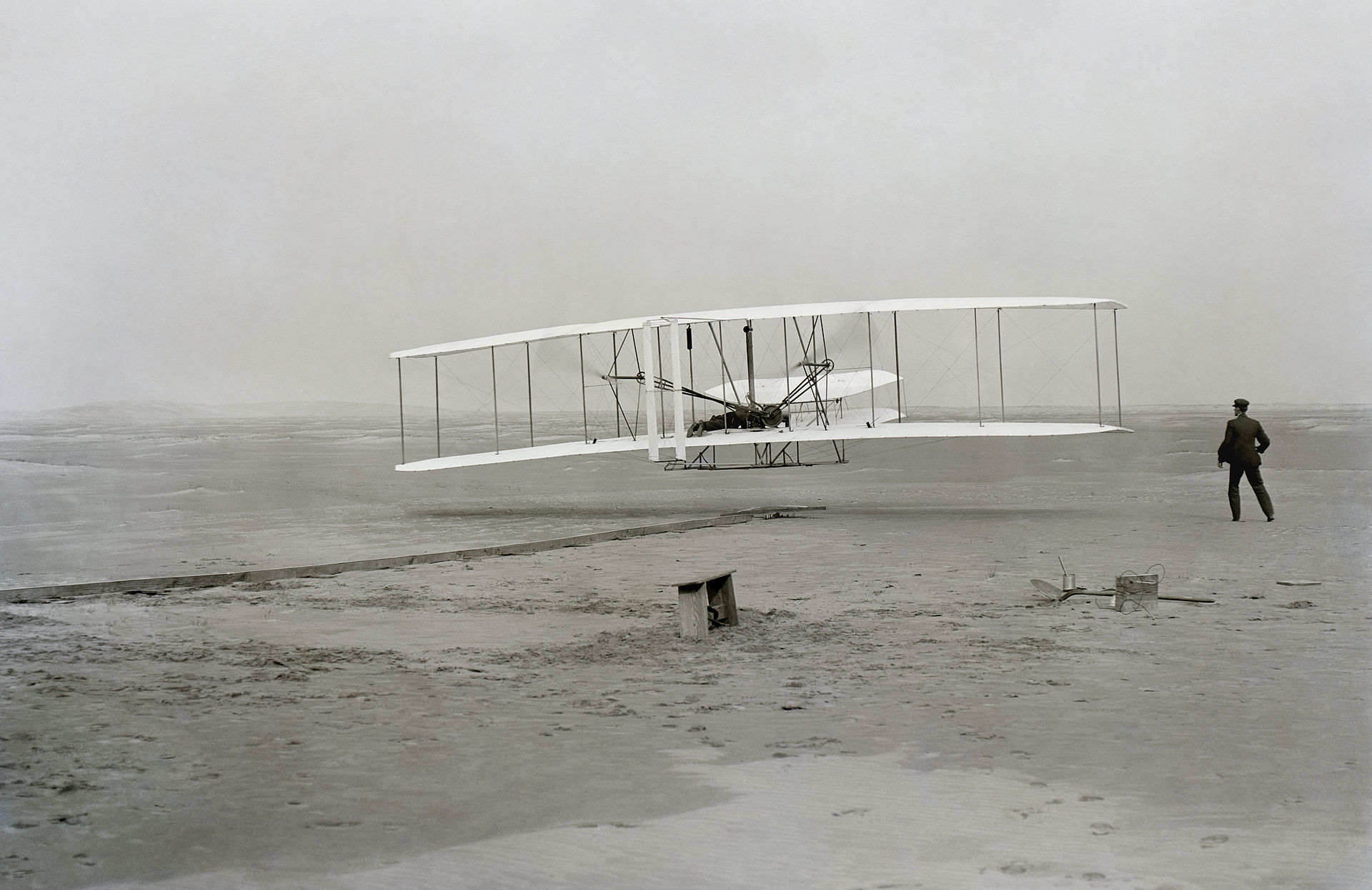
The First Controlled Powered Air Flight - Orville at controls, Wilbur alongside December 17,1903
The First Controlled Powered Air Flight – Orville at controls, Wilbur alongside December 17,1903

At the Smithsonian National Air and Space Museum in Washington DC, a fragile looking craft is nestled among the imposing rocketry, massive jets, and space capsules that catalogue man’s drive to free himself from his earthbound status and soar like the hawks and eagles.  Made of spruce wood and muslin fabric, crisscrossed by bicycle wire, and supported with landing sleds, it looks like a glorified box kite.  It is, though, the 1903 Flyer, the machine developed by two insightful bicycle mechanics from Ohio named Wright – by which all the other craft became possible.  It is the alpha craft of sustained, controlled flight, and there is no more important relic in the museum.

The story of how this craft came to be, and the special nature of the geniuses behind its development, is the subject of David McCullough’s latest book, The Wright Brothers, and once again, McCullough has brought us a tremendous read.  The two time Pulitzer Prize winning historian, now 81 years of age and himself a national treasure, continues to refine his biographic look at epic Americans, the real people behind the larger than life stories, and the thread of ‘Americanism’ that makes them an ongoing recognizable part of the nation’s unique story. McCullough’s Wright Brothers, are the Americans described by Alexis De Tocqueville – religious, modest, small town diamond-hard workers, who are humble, reserved, yet proud and capable of great vision.  Their success is distinctly American, taking the hard truths of difficult problems, making them their own, and inevitably conquering them, when so many others with more advantage  failed.  McCullough, like the careful craftsman he is, doesn’t try to tell the story through others, but relies on the brothers’ own notes and letters.  McCullough is a storyteller, not a psychoanalyst, avoiding the modern deviations and contrivances of modern biographers, who pretend to be able to understand their subjects’ states of mind and prejudices.  McCullough does not ask you to like or not like The Wright Brothers personalities, only to follow their unbending will as they meticulously conquer earth bound gravity, and foster a revolution in man’s place on this planet. McCullough recognizes better than most, America’s unique philosophic foundation centers the idea that opportunity should abound for all men equally regardless of their individual circumstances.  From such cauldrons of self confidence, unfettered opportunity and an inherent industrious nature, America has produced its Lincolns, Edisons, Reagans, and Wrights.

The Wright brothers,  Wilbur and the fours years younger Orville were born just after the American Civil War. in which the nation was directed toward rebuilding and focusing on its future.  This was the age of civilizing the hostile and unknowable world.  Railroads conquered the difficult terrain to connect the continent.  The light bulb brought activity and awareness to the dark hours, and electricity heretofore unharnessed power.  The combustion engine drove the economy, reducing distances, powering agriculture and eliminating hunger, and providing work for millions.  The Wrights were witnesses, and assumed a natural providence to it all. Their father, a bishop of one of the many sects of the Protestant wave of individual integrity and initiative that underlies the revolution, engendered in his children the balancing act of  personal humility and faith, and competitive need to contribute to the civilizing culture any way God led them.  Achieving the broad education of life as well as in depth foundations that high school provided at that time, the boys were confident they had the tools to understand and self educate as needed, and never sought a college education.  They applied their intuition and industriousness first to publishing, then transportation for individuals through a successful bicycle business, all the while, absorbing the world around them.  When hearing of the attempts by others to solve the millennia long quest to conquer gravity with air travel, the passive transport by hot air balloons restricted by the vagaries of wind direction did not appeal to them so much as the infinitely more difficult concept of individually controlled flight – flight occurring at the spontaneous whim and the premeditated direction of the individual desiring it.

The Wright brothers took to solving the problem of flight much in the way Edison undertook his creations – insight was created by logically understanding the failures that would lead to success.  Having read much of the available literature on aeronautics, they determined success lay instead in their own meticulous build of a knowledge of flight from personal observation.  Hundreds of experiments and thousands of hours of unreimbursed work followed, starting with observations of birds and their tactics of flight, kites, then gliders, materials and environments that might be conducive to flight.  As Wilbur looking back at the process of discovery put it, the key intuition they brought to understanding bird flight others failed to grasp was the process of dynamically controlling flight, not anatomical characteristics of birds conducive to flight.  In other words for Wilbur, it was about the bird, not the wing.  For the Wright brothers, the human pilot would have to be the bird, making continuous flight adjustments, not the passive inhabitant on a flying wing.  Progressively, they combined their experiments into larger and larger gliders, that took the science of aerodynamics and added the control of pitch, roll and yaw to the pilot through the capacity to “induce” the wing to respond to the need by warping to turn or the rudder elevator to lift or dive.

The experiments lead to a glider craft large enough to support a human directing the glider, and the brothers realized they would need a laboratory where they could, unmolested, make the mistakes and adjustments and test them repetitively in ideal conditions.   The key ingredient for gliders was wind, and the most predictable continuous wind on a massively large unimpeded space allowing for soft landing failures was oceanside.  They discovered the outer banks of North Carolina through the US Weather Bureau, and the result was Kitty Hawk, North Carolina and the dunes of Kill Devil Hills the launching ground to the immense flat beaches of the outer banks that would be their laboratory.   In 1901 and 1902, the brothers performed glider experiments that led to sustained flight and impressive control, but when the wind died, the spontaneous flight died with it.  As noted by others, a barn door could ‘fly’ if projected from a height. It would only be recognized to be flight if the barn door once projected towards the ground had the means of changing direction and restoring itself to height again, and reproducibly.  The ultimate step would be powered flight, directed by the individual, not the elements, and by 1903, the Wright brothers felt they were there.

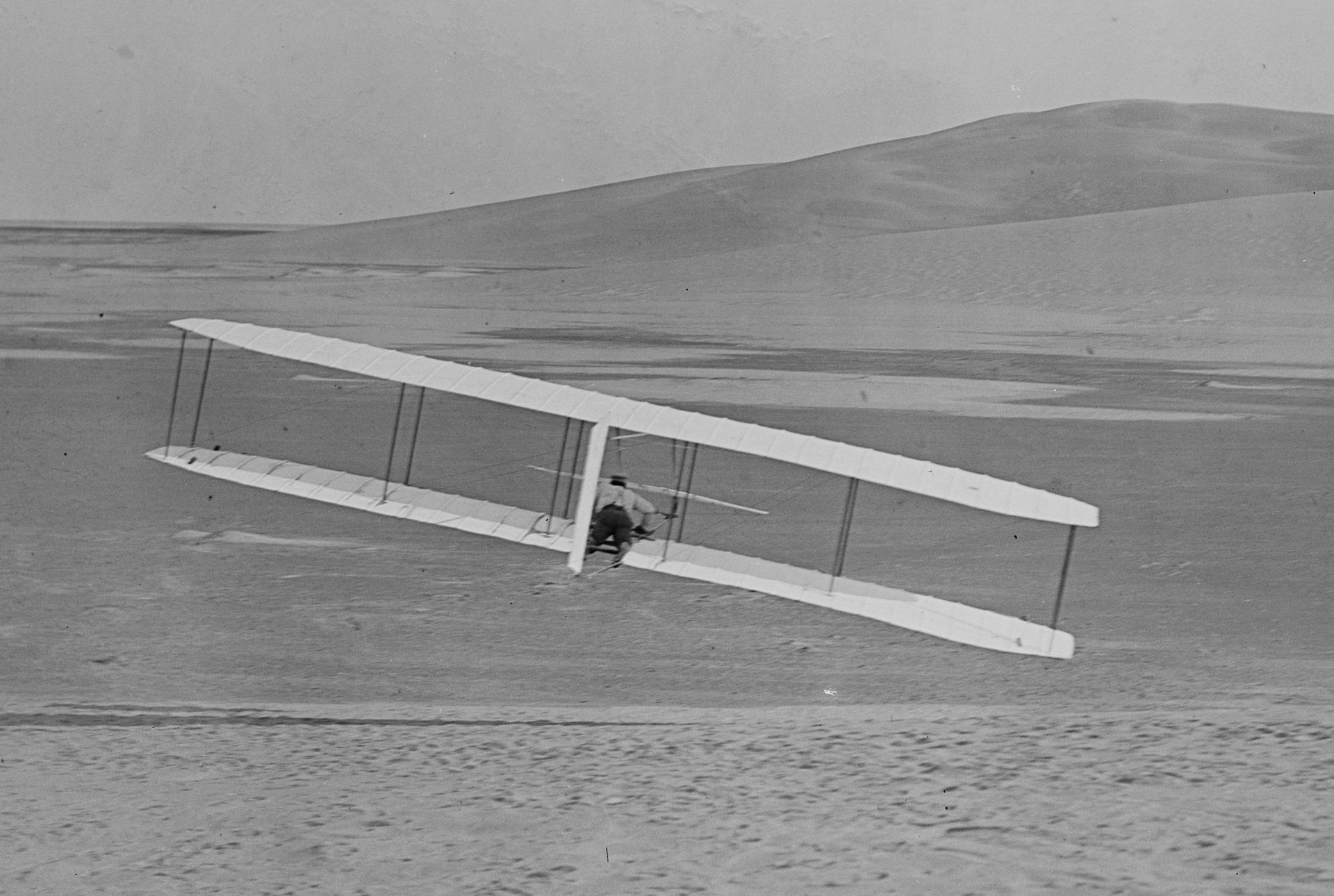
Wilbur Wright demonstrates a controlled turn on a glider at Kitty Hawk - 1902
Wilbur Wright demonstrates a controlled turn on a glider at Kitty Hawk – 1902

The brothers were not twins, but worked so intimately together over a lifetime, that they seemed like a single organism.  They studied their experiments together, fought over results together, and suffered in the harsh conditions of Kitty Hawk together.  The one thing they didn’t do together was fly, for the dangerous conditions were such that they wanted assurance that at least one of them would be able to carry on if there was a tragedy in the course of flight.  Progressive work on the problems of powered flight, including the means of propulsion, lead to advances in craft design including use of a wind tunnel to test, unique propeller design, and a light weight first of its kind aluminum engine to drive the propellers.   With the moment of powered flight seemingly close in December, 1903, the brothers flipped a coin as to who would be the pioneering pilot, and Wilbur won.  The first attempt on December 14th, 1903 by Wilbur was unsuccessful due to conditions with an aborted flight of three seconds causing minor damage to the craft.  Unfailingly humble and consistent in their approach, the next acceptable flight environment was on December 17th, 1903, this time with Orville at the controls.  Wilbur intelligently positioned a camera to record a successful flight and an assistant, John Daniels, snapped the shutter that froze in time one of the most famous moments in history, the photo seen at the head of this article.  In the first recorded powered flight under directed control, Orville travelled 120 feet in 12 seconds, a speed of 6.8 miles an hour,  at 1035 am, landing safely. The brothers alternated 3 more flights that day, the longest Wilbur’s 59 second flight over 800 feet that cemented Kitty Hawk as the birthplace of airplanes.

With the tall tales of so many pretenders, the tragic and at times pathetic failures of so many more educated and infinitely more financed, the immense achievement of the brothers took some time to become known and believed.  Their innate desire for privacy and isolation didn’t help, but their confidence and pride in their accomplishment eventually led to opportunities to show others, and the fact that flight had been conquered by two obscure bicycle mechanics seemed to fuel the achievement internationally.  Over the next years the Wright brothers and their updated Flyers would amaze international audiences of thousands and lead to record after broken record of sustained and controlled flight that was the envy of many other designers. More importantly, the achieving the unachievable cracked the ice forever on creativity, and within ten years the capacities of flight were exponentially expanded, to hours of flight, thousands of feet of elevation, and hundreds of miles an hour.  Materials changed, uses changed, propulsion changed, and the fragile little flyer that lifted of the dune at Kill Devil Hills in December, 1903, soon became unrecognizable.  The principles the Wright brothers had meticulously revealed, however, remain the universal foundation of all human flight, and are still apparent in the pilot seated in the ultralight craft of today.

The Wright’s story does not end in perfect glory and McCullough does not belabor the foibles of human pride and tragedy that interfere with a perfect ending, but Orville at least lived to see the concept of safe flight turned into a routine event for average people.  The story of the providential shift of history achieved by unlikely people from unexpected directions has been the beautiful outcome of the American experiment, and the Wright brothers are one more example of what happens when people determine their own destiny, and drive their own ambitions.  We are steadily heading to a country that wants to foster communal concepts of equal outcome, not equal opportunity, and the result will be millions of lost creative attempts to advance civilization.  We don’t need a country that tries to determine how many bicycle mechanics are needed to best serve society’s needs.  We need a society that stands back and allows bicycle mechanics, if they desire, to try and soar like eagles.


May 8th, 1945

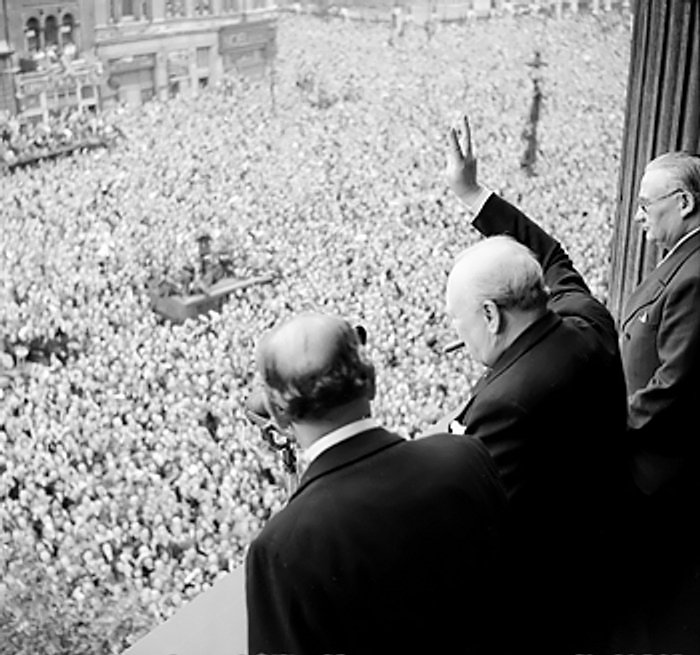
World War II in Europe is over- Prime Minister Winston Churchill waves to celebratory London crowds

At 300 pm, May 8th 1945,  the formal, unconditional surrender of the forces of Germany to the United Nations forces occurred, and the war state that had nearly destroyed Europe lapsed into a peace of sort.  The million man armies of the warring nations on the continent stopped their organized efforts to obliterate each other, and for the first time since September 1st, 1939, the outcome was officially assured.  For the 20 year old infantry man on the front lines on May 8th, the miserable sensation of potentially being the last man to die for his cause so close to the end of judgement mercifully came for a time to a close. As it did for the 24 year old captain, the 30 year old major, 34 year old colonel, and the 44 year old general.  Now 70 years later on the 70th anniversary occasion of VE Day – the day the official end of the war in Europe – the few captains of those men that can say they were there, are 94 years of age and the men they led 90, and all the rest are lost to the mists of time.

At the conclusion of the European portion of the conflict known as World War II, the military colossus astride the world was not one of the ones present at the start of it. The U.S Army in 1939, the year of the European war’s initiation with Germany’s Blitzkrieg into Poland, stood at 178,000 men, the 19th largest force in the world positioned meekly in size between those of Portugal and Bulgaria.  On VE Day, the United States had 12.8 million people in uniform and over 9 million of them in fighting forces across the globe.  By the end, it could project 100 fighting divisions, 60 aircraft carriers, thousands of fighters and bombers, and probably the most devastating submarine service  in the world.  This massive force was linked to the greatest economic production capacity the world had ever seen, supported by the most effective logistics, and capable if necessary of taking the war to any corner of the world with overwhelming weaponry.  With VE Day, those 8 million fighting men turned their martial attentions to defeating the last of the axis of evil, the Japanese Empire, with a horrific and staggering one million casualties estimated still to be necessary to subdue the fanatical mainland defenses of Japan, beyond the 600,000 casualties the Americans had sustained since entering the war three years before.

The picture above reminds us, seventy years later, that the outcome eventually achieved by  the combined titanic forces of the allied nations needed to defeat the Nazi war machine, paradoxically revolved around one man, Winston Churchill.  From the fall of France in May, 1940, until December 1941 with the attack on Pearl Harbor, Great Britain stood completely alone in the way of the incredible German military behemoth. One must remember that by May 10th, 1940, the entire continent of Europe was secure in the hands of the Nazi warlord, and the other totalitarian military power, the Soviet Union, was  six months into a nearly two year period cooperating with Germany as its ally in the domination of Europe through treaty.  The scrap remnants of British and Free French forces had escaped destruction of Dunkirk by the barest of margins, leaving Great Britain nearly defenseless to a determined German assault.  Great Britain, was alone and by most measures defeated, and everybody thought so.  Everybody except Winston Churchill, who gambled that the seas that had always provided the buffer for Great Britain. might just allow a certain technical difficulty sufficient to forestall any easy land invasion of the island, and that the ownership of the skies could assist in the delay until Great Britain could somehow convince the Untied States that the means for self preservation lay with fighting the Nazis on the continent of Europe, not the coasts of America.  When no one else believed, Churchill ringingly enunciated belief ,and his words served as power as significant as any division or battleship. He would not quit, and thereby Great Britain would not quit, no matter how overwhelming the odds.  The counterfactual of a world without Winston Churchill easily could be discerned, with a prostrate Great Britain seeking to avoid invasion through  a calamitous peace of enslavement with the Nazis, the Soviet Union soon to face its erstwhile ally now alone, with no counterforce nipping at its heels, and the United States, the buffers of oceans insufficient to successfully fight off the entire rest of the world.  Instead what proved to be Great Britain’s finest hour was ultimately because of the pugnacious leadership of the descendant of the Duke of Marlborough channeling his ancient ancestor.

May  8th, 1945, brought to the end the 2000 year history of Europe as the helmsmen of world history, initiated with Alexander’s conquest of the East in the 4th century BC, through the thousand year dominance of the Roman Empire, the linking of Christendom to the remnants of empire marshaling forth the enormous energies of the warrior kings of The Holy Roman Empire, Spain, and France, the spark of the birth of the individual genius in the Renaissance and Enlightenment, the power of the Industrial Revolution and the reach of the citizen marine of Great Britain, that brought the efficient transfer of goods, administration, and connecting language across most of the globe.  On V-E Day a bankrupt and exhausted Great Britain was incapable of funding even a day of its own recovery, and the once formidable nation states of Europe forged from the Peace of Westphalia in 1648 at the end of the previous devastating Thirty Years War , lay crushed under the combined weight of the sacrifice of multiple generations of youth and almost 80 million dead in the second Thirty Years War from 1914 to 1945.  The decisions as to the helmsmen of future civilization and power projection instead on that day 70 years ago stood in the grip of the colossus of the New World and the Slavic Empire of the Eurasian continent, and the basic status quo remains to this day, with Europe incapable of projection of influential power by any significant means.

May 8th, 1945 asked America to take on the mantle of helmsmen for those that had made civilization western, and in the seventy years since, when there were ramparts to be defended, America was there.  When the world needed an injection of technology, America provided it.  When the world was in crisis and needed food and assistance America marshaled the resources. At this seventieth anniversary, one has to ask if America has succumbed to the fatigue of sacrifice and endurance required to be the helmsman of so long a tradition, with the contraction of America’s willingness to lead over the last six years.  There does not appear to be any Churchill out there to focus our attentions on the task at hand.

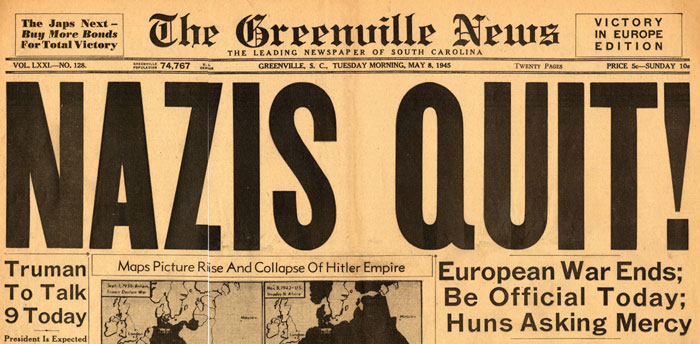
May 8th, 1945, however, most especially brought that unique moment when there was almost universal acknowledgement that the forces of good had triumphed over a marauding evil.  An evil so malign, that the most advanced structure of civilized social structure, education, and culture had succumbed to its dark forces, and that had come to within an eye-blink of dominating the entire globe.  A world in which racial genetics, perverted science, and ruthless totalitarianism would have extinguished any whisper of the world’s diversity, creativity, and individual destiny.   But on May 8th, the most technologically advanced pervaders  of programmed death the world had ever seen, the Nazis, had Quit, and the world deservingly rejoiced.

VE Day   May 8th, 1945
VE Day May 8th, 1945

Stumbling Toward the Failed State

The Baltimore Riot - 2015 Photo by Drew Angerer/Getty Images
The Baltimore Riot – 2015
Photo by Drew Angerer/Getty Images

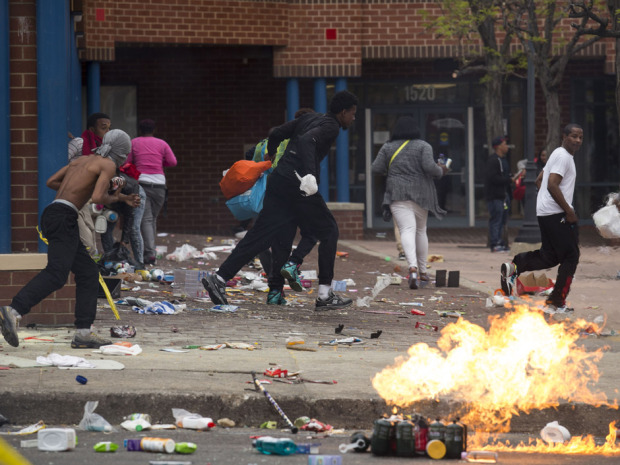
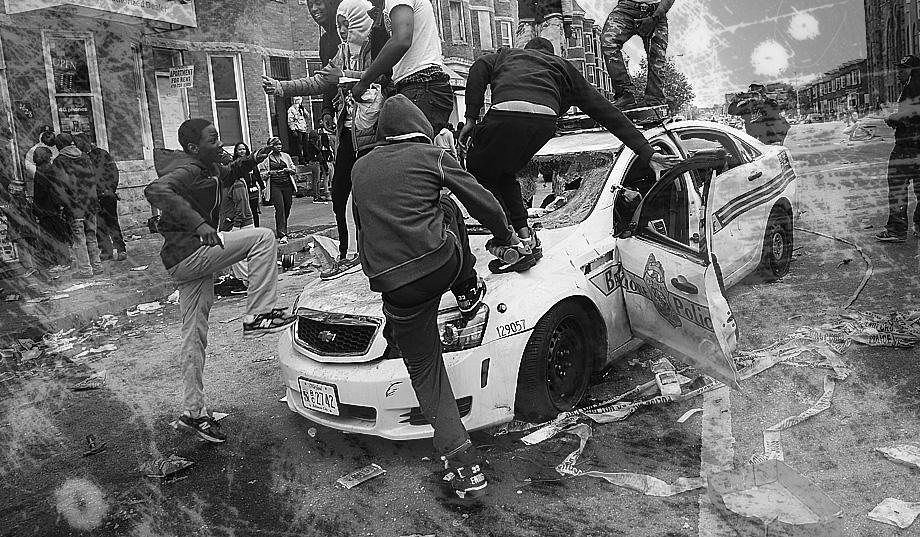
The looters frozen in time in the above photo have just swept a CVS pharmacy clean of goods as their particular expression of free speech to protest the circumstances surrounding the arrest and subsequent death of Freddie Gray in Baltimore, Maryland police custody. Freddie Gray was 25 when he was arrested and subdued by officers on April 12th,2015 for attempting to flee police.  He was chased down by officers and shackled hand and foot, and in the period of time from the arrest process and the subsequent 45 minute drive in the police wagon to detention, he sustained a severe spinal cord injury that led to his death one week later.  The city of Baltimore erupted in violent protest, and the city authorities struggled to find a way out from the anger.  The initial incoherent response by the mayor to give the rioters “space to destroy” to vet their emotions quickly was superseded by the governor calling out the National Guard and the authorities instituting a curfew.  The states attorney  Marilyn Mosby, without waiting for completion of the police investigation of the event or interviewing all witnesses,  announced her own department’s initial investigation determined sufficient evidence to rule the death of Mr. Gray as a homicide, and charged six officers of the Baltimore Police force involved in the arrest with various charges, including false imprisonment, negligence, assault and second degree murder charges.  She expressed her actions were a direct response to the riots, stating emotively, ” I heard your call, ‘No Justice, No Peace!’ ” and underscoring her intent to obtain “justice”.

Mr. Gray was arrested in the Sandstown-Winchester neighborhood of Baltimore, where, according to his brother in law as reported by CNN, his occupation to ‘support his family’ was pharmaceutical sales – of the street kind.  In his short life he had 20 arrests and several incarcerations for various crimes including being a repeat offender of drug possession with intent to sell.  He was already scheduled for an April 24th court date for repeat drug charges when he was stopped by police on April 12th and the subsequent tragic events occurred.  His life parallels so many other urban blight stories that the particular tragic ending to his earthy contribution no longer shocks, so often occurring, as it might in isolation.  The particular willful and uncaring negligence that may prove to have been present by the arm of societal order that interacted with Mr. Gray, is really a microcosm of the societal negligence that has secured the environment for such tragedies prevalent in so much of our modern society. Baltimore is just the most recent example of repeated examples of how we continue to stumble toward a failed state, by our continued willingness to ignore the underlying critical components of the toxic brew.

Mr. Gray’s neighborhood of Sandstown- Winchester is rife with the results of the poisonous potion of modern statist policies.  Two decades ago, the neighborhood was selected for attention to solve the progressive urban blight that had seized the once ordered and prosperous region. Baltimore, for more than 50 years, has been in the hands of statist elites, linked by the terrible triad of democrat monopoly power politics, liberal programs, and self interested local leaders.  The plan to ‘save’ Sandstown- Winchester was not absent of funds or effort – private investors looked to infuse 130 million dollars of ‘quality affordable housing’ cocooned by the usual government designs to provide direct government assistance and to improve health and education of the afflicted neighborhood residents.  Schools were built, over a thousand homes were renovated.  And the neighborhood collapsed even farther down into the terrible engines of despair – poverty, crime, and drug trade.  After two decades of focus, the region is more hopeless than ever, and the calls in response to the recent violent outrage – is for more government programs and ‘targeted’ spending. And nothing, but nothing, done to restore employment opportunities, support individual initiative, or reward behaviors of self improvement.

The Shakespearean ‘hero’ of this tragedy turns out to be Mr. Grey, who was using his own wits to survive in such a neighborhood.  As with so much of the statist impulse, the fact that he and others have continued the cycle of despair with such ‘opportunity’ offered them,  leaves the elitists agog at the failure of collectivist logic to win the local inhabitants hearts and minds. As with all Shakespearean tragedies, the players of the tragedy are foreordained.  Billions of dollars of failed urban investment lead the government to turn to billions more of failed investment.  Generations of immobile inhabitants repeat the failures of the previous generation addicted to the triggers of continuing poverty, with broken families and out of wedlock children, no job experience and worthless educational processes, artificially supported and encouraged by governmental allotment. Government leaders that fight over the amount of governmental largess and the power that comes with it, rather than taking responsibility for the continuing and progressively failed societies they are supposed to serve.  The increasingly distracted police force, that, incapable and unsupported in their role of restoring order and safety to the community, progressively sees the community as a threat and an enemy to be avoided, or subdued.

So is written another chapter of a book with no ending in our modern society.  The local inhabitants without hope, strike out in anarchic fashion.  The statist authorities look to blame race, poverty, police, and the society to prevent the focus on their own cluelessness or any attempt at reduction of their role as power broker.  The police know no one really cares, and they become immune to their own contribution to the madness. And the civilization founded on the principles of life, liberty, and the individual pursuit of happiness through the unfettered opportunity to control one’s destiny, crumbles evermore.

Shakespearean tragedy indeed.  As the Great One said:

Men at some times are masters of their fates.
The fault, dear Brutus, is not in our stars, but in ourselves.

Baltimore Riots 2015 nationalreviewonline
Baltimore Riots 2015
nationalreviewonline