
Checking The Box

The Ballot Awaits - What will you do?
The Ballot Awaits – What will you do?

Voting is one of the great privileges and responsibilities of citizenship.  The vote represents the compact a country’s people hold with its government to follow the agreed upon constitutionally ordained mandates, laws, security, and strategic investments.  It is the pat on the back for positive performance, the weedwacker for removing governmental congestion,troubled concepts and inadequate or corrupted leaders. The great arsenal of democracy is the ballot box, converting the performance chart into measurable, digestible time frames that allow an engaged citizenry to control their future.

The zenith of the American voting process is the vote for the Presidency.  Every four years, the country puts its prospective leaders through an onerous process that vets each prospect’s  capacity to articulate a vision, respond and modify to others’ criticisms, and engage and hold the attention of a majority of Americans who see the future as they do.  Its an intense process, and it should work at a level of outcome worthy of the great democracy it serves.

Yet, for years, the process has appeared significantly out of sync with the voter, and has time and time again positioned candidates that seem incomplete or unworthy, and that leave the voter with a choice of selecting the lesser of two evils.  Progressively, the Presidential vote has come to voting against someone we feel will be damaging to our future, rather for someone who positively represents our views and our vision. For the past thirty years, this has been particularly an unsavory process for the conservative or libertarian voter.  The Republican Party, positioned to represent the world of the individual initiative and limited government, has put forth candidates who are further and further removed from this philosophical pact.  It has demanded the conservative go into the booth, hold his or her nose, and vote against the other party rather than for the republican candidate, to protect a rapidly diminishing societal compact with those two pillars the party claims to be fundamental.

This year, the wheels have completely come off the wagon.  Short of a radical change in events, the two party nominees will be Donald Trump and Hillary Clinton, the Clown against the Criminal, and a huge segment of the Republican Party’s base are left with the impossible choice of voting for intolerable options, or abdicating their responsibility as the ground troops of democracy and staying out of the Presidential vote all together.

The Republican Party is wholly responsible for this approaching debacle.  Every four years, the process of selecting candidates has leached out the more principled conservative candidates on the premise that a principled conservative could not possibly appeal to the greater population.  The Voter got Bush instead of Kemp, Dole instead of Graham, Bush instead of Forbes, McCain instead of Romney, and Romney instead of Perry.  Each time, the consensus candidate either significantly let down their conservative base of support once elected (in case of the Bushes), or got clobbered by the ideologically purer democratic alternative in the general election.  On multiple occasions, the base got back of the floor and organized off year election victories and with the exception of 1994, had their elected legislators turn their back on the ideological struggle and give in to the statist Borg.

2016 was going to be different. This was to be the year in which the executive election ideology would match the legislative thrust, and the conservative voter could go into the booth and positively pull the lever for our version of an ideologically pure candidate. Perry, Jindal, Walker, Rubio, Cruz, Fiorina.  All are gone or nearly so, and the man left standing is Donald Trump, the anti-ideologue whose base instincts would fit securely into the Democrat Party’s vision of leading society through correct beliefs rather than correct facts if he had determined to run under his life long party, rather than his recent epiphany that he must be a Republican. Certainly a surprise to his children, who didn’t even have time to change their party allegiance in order to vote in the “other” party’s primary in New York for their father.

Instead the party of individual initiative and limited government will be represented by the             very candidate who has publicly declared these concepts an anathema to him.  The result has been a sense of doom and withdrawal that are normally foreign to the conservative voter, usually the most committed and engaged supporter of the constitutional process.  One can vote for Trump and pretend that what one believes doesn’t matter in governance, or stay out of the election and allow Clinton to be rewarded for a life of insolent behavior, statist, collective ideology, and lousy performance.  Peggy Noonan in her Wall Street Journal editorial of April 28, 2016, refers to this sullen recognition of  what she calls the Moment, when the lack of an out is expressed as a psychological wounding.  The Republican Party,clumsily looking to expand its appeal rather than firm up its convictions, set up the primary process so that an outside demagogue could parley minority anger into a majority delegate position. The Party is now desperately attempting to imply the conservative voter must once again “hold their nose” and vote to prevent a supposed worse outcome, or risk the shuttering of the party.

The final defenders of the Ramparts are being labeled the NeverTrump clique and are being set up to either be a hypocrite to their principles, or permit a final closing of the door  of a vision of a country once uniformly seen as a place of opportunity, self responsibility, and societally moral relations.  Well, a stark future awaits, and unless something unexpected happens, it is not clear  a way out of Peggy Noonan’s Moment can be formed out of the madness.

A difficult, tumultuous summer and fall looms.

Unleashing the Whirlwind

Old North Bridge Concord Massachusetts
Old North Bridge                 Concord, Massachusetts   / thecrowleyconnection.com

Two coiled springs had been tightening, gaining immense potential energy for years. The question was simply where and when the spring would release, and whether it would be premeditated, or spontaneously let go. The overwhelmingly powerful British Empire, supported by the greatest military capacity present anywhere, was coiling against a perceived challenge to its authority that had consequences that were simply unacceptable for its very being. The opposite spring, a group of British subjects in the far away American colonies, saw a world that had yet to be invented, and like a prophet that had foreseen the glories of heaven, could not wait any longer to undertake the ascension.  On April 19th, 1775, the spring uncoiled, and the whirlwind was released.

Since the climax of the French and Indian War, that in 1763 left Great Britain in the dominant position on the North American continent, the seeds for strife between the British crown and its colonial subjects grew progressively, and inexorably.  This journey to the American Revolutionary conflict is (or at least was) an essential foundation of every elementary history course.  Following the French and Indian war, the British Parliament felt that a significant burden of the massive financial debt created by the war should be assumed by the American colonies given the tremendous advantages for growth and security that had been created for them with the victory.  The most direct was the Stamp Act, a tax that the colonists objected to not so much that it was oppressive in size, but rather in that it had been enacted without any representation and discourse with the colonies.  With the elite educated class in America, progressively enthralled with the momentum of what would be called the Enlightenment, the lack of ability to influence their present or future was intolerable to the concepts of personal liberty and freedom of initiative.

Particularly in the restive New England colonies, radical discussions and progressively organized dissent proliferated. One such group, the Sons of Liberty led by Samuel Adams, became recognized as driving for a world beyond British parliamentary representation.  The Adams radicals looked to kindle the fire that would make the world anew. The answer from Great Britain was to assert its authority, and progressively British regular soldiers were seen in Boston. The spark first showed itself in the so called Boston Massacre of 1770, in which a  platoon of British soldiers threatened by a snowball throwing mob lost its cool and shot into the crowd, killing three.  The Boston Tea Party of 1773 led by Samuel Adams was a direct affront, and the British government saw a local problem beginning to spiral out of control.  The response that turned the process into an irreconcilable mess were the Intolerable Acts of 1774 enacted by Parliament, that asserted a form of military dictatorship over the colonists, restricting assembly, seizing control of the critical Port of Boston, removing a legal authority over British troops by American courts, and allowing British troops to be housed in American homes without consent of the owner.  The response was predictable, for now the colonists that for 150 years had pretty much determined their own way in the Americas were forcibly notified of their subservient position in the British hierarchy.  The colony of Massachusetts exploded in fury, and initiated a shadow government to the local British authority, a Provincial Congress that put forth the Suffolk Resolves, a group of acts that declared a boycott of British goods and public disobedience with the Intolerable Acts until they were repealed.  Even more worrisome and threatening to the British, a meeting of all American Colonies took place in September 1774, forming a continent wide shadow legislature known as the 1st Continental Congress, that suggested the local radicals had permeated the concept of disobedience to British authority across the entire continent.

The Suffolk Resolves suggested the detachment of British authority from its American colonies and was an Intolerable Act to the conservative parliament and the king.  Regular army detachments were sent to Boston to put it in a vise, and the reaction of the colonists were to form organized militia capable of rapid deployment with arms collected and positioned for maximum impact in case of conflict. The arms were distributed to allow 12000 militia to respond immediately to an aggressive British military maneuver, secured in 50 man units known as Minutemen.  The commanding general in Boston, General Gage, recognized he could not possibly stand by and allow an organized force to arm itself.  He determined to extend his forces into the countryside with strength, arrest the radical leaders, break up the militias, secure the arms, and send the leaders back to Britain for trial for high treason.

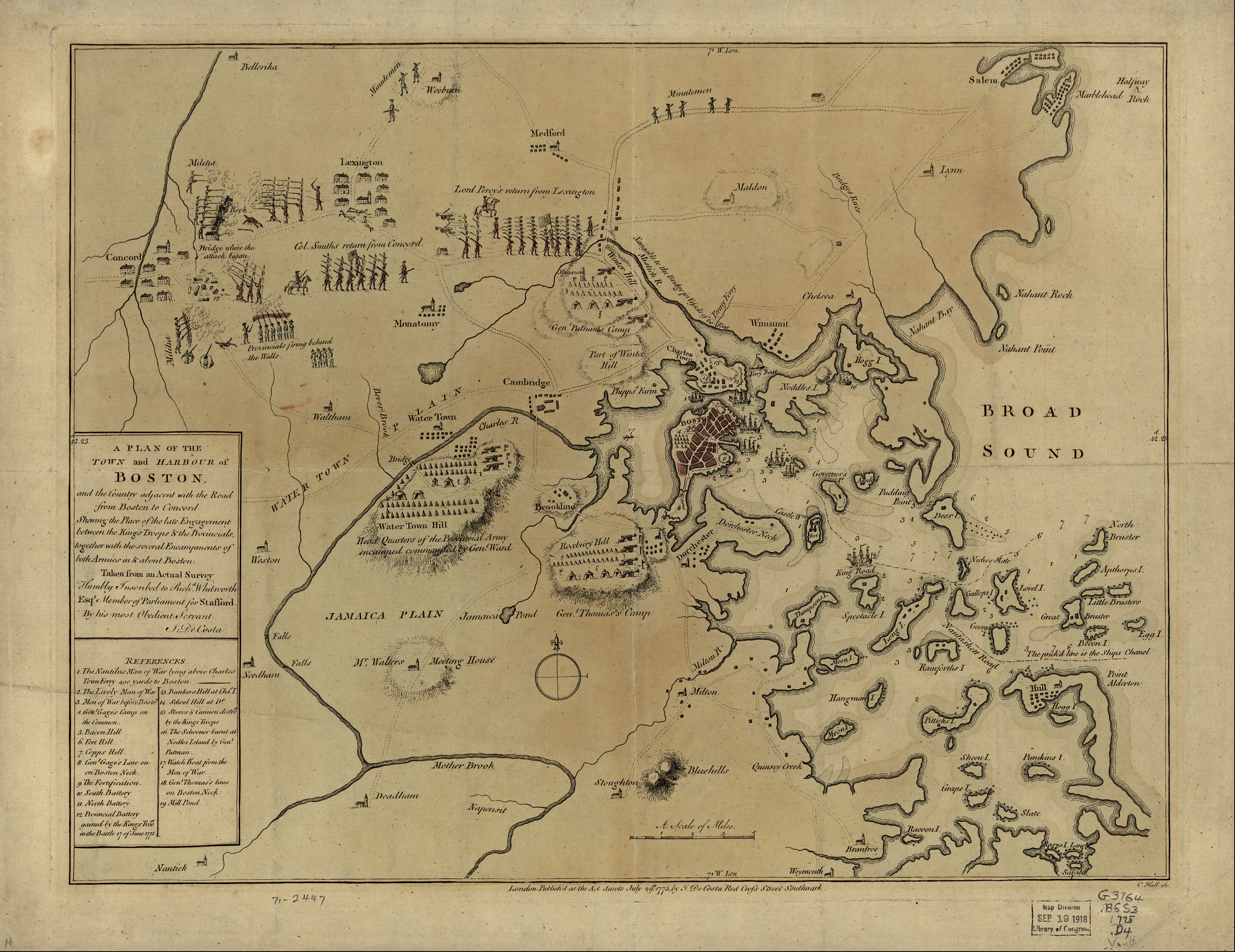
The when was April 19th, 1775 and the where was the public green in Lexington and the Old North Bridge in Concord.

The opening battle of the American Revolution - April 19th, 1775 Lexington and Concord
The opening battle of the American Revolution – April 19th, 1775 Lexington and Concord /wikipedia

Gage heard of massive stores of arms being collected in Concord, Massachusetts and selected the little town 24 miles from downtown Boston to be the sight to reassert British authority.  The goal was to send overwhelming force in a stealthy fashion, marching through the night, but Boston was rife with spies, and the rebels had already planned for an early warning system.  When it was determined that British troops were moving and their determined target, the Internet of the time sprang into action.  Horsemen, most notably the silversmith Paul Revere, left Boston in three directions to alert the many communities that contained the Minutemen companies, and for the most part succeeded in marshaling the rapid deployment force before the British could intercede. Gage sent a massive force of 700 regulars on the road to Concord, with a desire to break arm stores in the intervening towns of Monatomy and Lexington.

At Lexington green, just as the sun came up, the advance British forces encountered the first of Revere’s alerted Minutemen led by a grizzled Indian fighter named John Parker.  77 minutemen stood in formation on the green nervously facing a representation of the most powerful military on earth, led by Major Pitcairn of the Royal Marines, who demanded the “rebels” immediately disarm and disperse.  Parker, fully aware of the gravity of the moment and the importance of how it had to evolve to secure the right side of history, had told his men earlier,  “Stand your ground. Don’t fire unless fired upon. But if they want to have a war, let it begin here.”  There appeared to be a brief moment of indecision as both sides realized what might result from a mistake, but a shot rang out, and the British fired a point blank volley into the Americans.  The damage was done. 8 Americans lay dead or dying and the British moved in and bayonetted.  The minutemen dispersed and retreated to Concord.  The British marched on to Concord and soon realized they were in a world of trouble.  Initially the town allowed them to search uninhibited, but it was obvious that the weapons stores had already been removed, and the British became frustrated and burned downed several structures in town.  British detachments moved to secure the bridges into town, and at the Old North Bridge it became clear the honeybees were being replaced by hornets.  Minutemen were waiting for them on the bridge, and this time they didn’t just accepted the punishment delivered at Lexington.  The volley was returned, and this time there were dead on both sides. As Ralph Waldo Emerson famously described,

By the rude bridge that arched the flood
Their flag to freedom’s breeze unfurled
Here once the embattled farmers stood
And fired the shot heard’round the world

The British retreated, and it became apparent that a potential calamity was underway.  The officers began to retreat back toward the safety of Boston, and the extent of the hornet’s nest they had kicked over became apparent.  The march back to Boston became a Hell’s road, facing a fully aroused guerrilla force, having been made aware of the morning’s events and sacrifices, that sought nothing short of full annihilation of the 700.  Behind every rock and tree for twenty miles, a diffuse force of militia trained in the savage warfare of the Indian conflicts, snippered, ambushed, and harassed the beleaguered British force to massive loss, saved only by a rescue force from Boston that brought heavy artillery and cavalry to bear.  The proud British force had been decimated with 0ver 250 casualties compared to 88 for the American militia, and came within an eye-blink of complete annihilation.  The British, who hoped to assert complete authority, now found themselves under siege in Boston ringed by an entire countryside of furious hostility.

There was no going back from the brink, and the whirlwind was unleashed.  The fighting was more savage than anyone could have predicted, and the losses stunning to the British. The Americans recognized the next battles would be of epically greater scale and began to form a Continental Army led by a Virginian named George Washington.   The British saw that this was no longer a mob action led by a small minority, but a growing fire that could consume their hard won dominance in North America.

It would take 8 years of incredible sacrifice, amazing moments of heroism and initiative, epic mistakes, and a level of savagery of relative against relative that would presage the Civil War 80 years later.  At the end of it all stood a dream and a promise, of equality of men, freedom of thought, and liberty in action that is as close to anything that man can claim as inspired greatness.  On the 241st anniversary of the April events that shook the world at its foundations, we can only gaze in awe of the tiny contingent of brave men who stood their ground in a little town in Massachusetts  and were willing to make such an ultimate sacrifice, on the sliver of faith that a promise could support a dream and create a better world.  The impossible was made the possible, and the possible, happened.  The dream and the promise held by common men were able to surmount the greatest military force of their time and turn the world upside down.  Some felt it was Divine providence; it amazed even the most secular of men, when they looked back and realized what had transpired. As fellow Virginian John Page wrote to Thomas Jefferson after the after the Declaration of Independence was signed:

We know the race is not to the swift nor the battle to the strong. Do you not think an angel rides in the whirlwind and directs this storm?

We are still in the whirlwind of history.  Maybe we will once again listen to our better angels, and find our way through our current storm.


Ssshhh! …Still Some Clear Thinking Going On…


General Petraeus in Field - Roberto Schmidt getty images/cnn.com
General Petraeus in Iraq           photo Roberto Schmidt getty images/cnn.com

The political discourse these days is so trivial, hyperbolic, and lacking in thought that we might wonder if we are undergoing staging for a reality show rather than vetting potential Presidents of the United States.  The idea that there might be a philosophy of engagement for the most powerful nation on earth or an identified self interest is anathema to the candied brains of the current front runners.  The Democrat front runner sees the Libyan fiasco as a great accomplishment.  The Republican front runner wants to get rid of NATO and demands fools gold from other allies to maintain positions in the world that long have been critical to the nation’s self interest.  The current President uses political calculus rather than in-depth analysis to attempt a policy of retrenchment.  As a result, his concept of retrenchment waffles between red lines and withdrawals, disdain for his enemies capabilities and inept, pinprick reactionary responses to threats.  Is there anybody left who has thought this through?

Well, there is someone.  Someone who could have been President, but ruptured his bond with integrity and took himself out.  General David Petraeus, who served both Republican and Democrat Administrations and was the strategic genius behind the Iraq surge that finally won the Iraqi conflict, only to have it dissolve with the forced withdrawal of his carefully and painfully won stabilizing force.  The general committed political hari-kari when he exposed three classified documents to his biographer mistress, who as an intelligence officer additionally had classified document clearance.  It resulted in a very public humiliation by the Obama  Administration by Petraeus, who was forced to resign as CIA Director, and a Justice Department prosecution that led in 2015 to 2 years probation and a 100 thousand dollar fine.  The four star general’s career was over, and the unique means of his political demise takes on special focus when weighed against the massively larger security breach that was brazenly propagated by Secretary of State Clinton. Ms. Clinton, who could very well be our next President.

It is David Petraeus, not Hillary Clinton, who is banished to the wilderness.  We should remind ourselves however who General Petraeus is, because the old war horse has a soaring intellect and much yet to teach, if we are willing to listen.  David Petraeus was in the top 5% of his 1974 graduating class at West Point, the top graduate of his 1983 class at the 1983 US Army Command General Staff College, and subsequently earned a MPA and PhD in International Relations from Princeton University.  As a commanding intellectual, Petraeus proved equally adept at the real testing ground of soldiering, becoming a commissioned Army Ranger, promoted to commanding a battalion of the famed 101st Airborne Division, a brigade with the 82nd Airborne Division and eventually the commanding major general of the 101st in the second Gulf War combat assault on Baghdad, Karbala and Mosul.

What tied Petraeus’s unique balance of intellectual depth and combat assertiveness into success was the depth of his own philosophical development in concepts of counter insurgency.   Petraeus saw counter insurgency as requiring creation of security and stability by the twins of tactical force and political compromise, achieving the trust and the buy in of those he was asked to defend.  Nowhere did he succeed more profoundly then when he was asked to command the surge of US forces in 2007 in the desperate attempt to salvage the floundering US effort to pacify Iraq. Recognizing the Anbar Awakening for what it was, Petraeus presciently identified the appropriate winners and losers and supported his winners until they could assert their own control.  The success of the surge was so dramatic, that the key issue of the 2008 presidential campaign was lost to then candidate Obama. By 2010, the Obama Administration, noting that Iraq was so pacified that US Army deaths due to monthly training accidents exceeded combat deaths, declared a stable Iraq as their Greatest Achievement, and promptly threw it all away by not renewing the Status of Forces Agreement with Iraq.  All of the hard work and sacrifices of the American effort in Iraq came to nothing as the black anarchy of death rapidly seeped into the vacuum.

Obama requested Petraeus’s help in Afghanistan and then the CIA in an effort to contain Petraeus rapidly rising political star, before Petraeus removed himself as a political foe through his own foible.  Nobody was more relieved then Obama.

Petraeus might have been the next in line of the perfect citizen soldier statesmen, such as Washington, Grant, Marshall, and Eisenhower that helped this nation out of its doldrums in the past.  Instead his personal vanity led to foolish weakness that has deprived us of this generation’s great leader.  Petraeus thankfully has not given up on helping format a way out of our current international morass.  In a Washington Post OpEd, Petraeus helps suggest the principles in countering the plague of radical Islam, that could direct future Administrations to a restoration of stability in this most unstable world.  His Five Big Ideas in the OpEd reflect Petraeus’s philosophical underpinnings he has previously described for breaking sclerotic impasses and achieving Institutional Change: First: Get the Big Ideas RightSecond: Communicate the Big Ideas EffectivelyThird: Oversee Big Idea ImplementationFourth: Capture the Lessons Learned, Refine, and Repeat the Process.  The current opinion piece mirrors the foundational Big Idea concept. Petraeus defines the Five Big Ideas as :

  1. Recognition that ungoverned spaces contribute the agar dish of chaos that draw radicals and allow them to flourish.
  2. Radical Islamists will not confine their attacks to their lairs or strongholds.
  3. The U.S. can not absolve itself of responsibility as the singular world leader capable of coordinating a counter insurgency
  4. The path to success will be comprehensive, multi-faceted, involve allies and friends,   and not just precision strikes and special operations.
  5. Victory ( and Petraeus does not see U.S. self interest in something short of victory) will require sustained U.S. effort for extended periods, defined by conditions on the ground, not enforced timetables.

What the general is describing is nothing more than the reversal of the last seven years of U.S. strategy of leaving the chaos of the world for others to solve, and retrenching to the role of leading from behind.  Such strategy has led to propagation of Syria’s catastrophic collapse, Iraq’s dissolution, ineptly permitted by  a puppet government of the Iranian mullahs that lost the Anbar to the ISIS monsters, sacrificed the Yazidis, offended the Kurds, and seek to destroy the Sunni ,  and the Libya, Mali, Somali, and Nigeria calamitous infernos of Mad Max warscapes.  I could easily see where it might be long past time to reverse such strategy.  Unfortunately, the political discourse would suggest we may  be willing to elect even more wrong way thinking approaching at its extreme, real bone headed logic.

There is real thinking out there.  If the country is willing to overlook completely profligately amoral and sustained behavior from its leading candidates, could it possibly overlook a brief lapse in a career of brilliance for our nation’s sake?

Where have you gone, General Petraeus, Our nation turns its lonely eyes to you woo,woo,woo…

Down The Homestretch

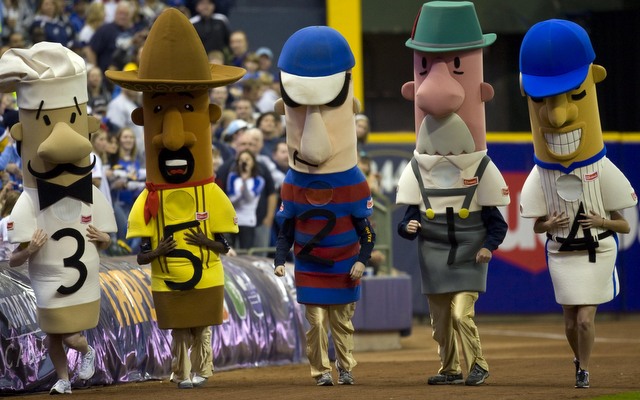
Apr 25, 2010; Milwaukee, WI, USA; Klements Racing Sausages get ready for their race during the sixth inning of the game between the Chicago Cubs and Milwaukee Brewers at Miller Park. The Cubs defeated the Brewers 12-2. Mandatory Credit: Jeff Hanisch-USA TODAY Sports
Down the Homestretch with the Final Five                                                                                                      Photo : Mandatory Credit: Jeff Hanisch-USA TODAY Sports


The Great American Extravaganza that culminates in the election of a Chief Executive  of the United States is fully upon us.  There have been tens of scores of debates, town halls, fundraisers, greeters, and interviews.  Over half of the state party caucuses and primaries have declared their voters’ preferences.  The compression of the pack has seen the dropping out of the race of the O’Malleys, Chaffees, Walkers, Perrys, Jindhals, Rubios, Huckabees, Santorums, Patakis, Carsons, Fiorinas, Grahams, Gilmores, Pauls, Bushes, and Christies.

We are are left with the Not So Magnificent Five.

Every four years the  over-wise pundits that suggest an ideal candidate for the nomination of either party are left dumbfounded with the recurrent verdict of the electorate to select someone who is anything but ideal.  How does the vetting process designed to get us a Washington or a Lincoln, end up with Sanders, Clinton, Trump, Cruz, and Kasich?  When somebody famous was quoted as saying anyone could grow up to be President of the United States, they weren’t kidding.  The process has become a manipulable grind that removes measured considerations of a candidates bonafides in any discernible way the average voter can engage.   We are left with winners of ‘Survivor’, and the country is the loser.  Different from other years at least, some of the winners are not yet sure if they survived and some of the losers refuse to admit they are beat.  It makes for some superficially compelling drama. Let’s see how the Not So Magnificent Five are positioned as they approach the final furlong.

Hillary Clinton:  It was supposed to be a coronation.  The old war horse had the money, political machinery, and the pedigree to swat aside the ridiculously weak challengers she would face, and yet last weekend, the sure thing candidate lost to her opponent challenger Sanders in all three contested states by historically enormous margins.  Sanders won 82% of the vote in Alaska, 70% in Hawaii, and 73% in Washington.  Are you kidding me? What kind of sure thing front runner loses by margins 4 of 5 voters, and 3 of 4 voters respectively anywhere?  Where is the love?  Hillary Clinton once again has shown what a notoriously poor candidate she has always been, and the lack of connection she makes with people.  Add to her natural lack of political talent, the uncomfortable reality that in her own party, polls have shown only 36% of Democrats view her as honest or trustworthy, and you have the makings of an epic fail.   Clinton has a substantial delegate lead for her nomination becomes of the previously secured so called “super” delegates, but she leads Sanders only by 1243 to 975 in delegates selected by voters in her own party.  Facing a potential spring of squeamish and uninspired voters, and an elephant in the room investigation by the FBI of potentially both security breeches and influence peddling, the coronation may look more like a Charles I moment.

Bernie Sanders:  What do you do for an encore after a life of back bencher eccentricities and contrarian views acknowledged by no one in power? You at 75 years of age run for President, and install the Glorious Revolution on the strength of voters who weren’t yet born when you turned fifty. Pretty amazing for a self styled radical of the sixties who protested under the banner ‘don’t trust anyone over thirty‘.  Awards should be given for anyone who can stand the rigors of an extended election campaign at nearly 75 years of age, but then again, Bernie looks youthful compared to the irritable and forgetful nearly 70 year old he is running against.  The fountain of youth has struck this back bencher on a wave of unachievable dreams of tax rates of 90%, tripling the deficit and making everything free, but… at least it’s a plan for the future.  Having principles, even when they are this wayward, looks appealing to kids, who feel their only other choice is to support their mean grandma.

Donald Trump:  The whole thing was supposed to be a publicity campaign to support a flagging brand.  Spend a few months talking about how everyone else is stupid, you’re the smartest, and then get out while the going was good.  Who could have known that the cynical opinion of the average American held by the billionaire real estate pitchman from New York, was not remotely close to how cynical the voters actually were?  Now he finds himself the leading delegate getter in a party with which he has no philosophical commonality and people are starting to take notice that he actually hasn’t thought anything through.  At some point, talking about 80 foot walls, 45% tariffs, and taking countries’ oil was going to run into stiff winds when people began to realize the guy might actually win the nomination.  Well, he suffers rebukes not at all.  The race is such that even this realization may not be enough to stop a Trump nomination, but watching the whole edifice collapse in a cloud of dust and fire is going to make for real entertainment for those who thought conventions were boring, predictable exercises lost in distant yesteryears.

Ted Cruz:  Somewhere way in the past, teenage Rafael Edward Cruz decided no matter what the circumstances, if he simply hung in there with his significant intellect, unbounded ambition, and thick skin, even a person of his circumstance could become president.  Well, he is one of the few survivors of The 17, and probably the one no one would have predicted still standing, based on his narrow vision, and reputation for poor relationships with his comrades in arms.  Don’t look now, but he seems to have outsmarted and outworked all the more ‘deserving’ choices, and has secured the rail position as alternative to the Trumpzilla.  Would a one term Senator who has cut his teeth on irritating everyone he has worked with blossom into a leader who sees beyond the horizon and fashions a future for this suddenly uncertain giant of a country?  It likely comes down to Wisconsin.  A Cruz win, and it will be interesting how many hesitant travelers jump on board.  A Cruz loss, and the tenacious effort will have only delayed Cruz joining the Other 14 who have been booted off the island.

John Kasich:  I’m No.3!  hardly seems like a path to victory, but Kasich will not be denied.  A record of 1 win 24 losses does not exactly instill a veneer of inevitability but some people just can not be dissuaded.  The race for President is usually about seeing a potential path for victory, but Kasich is after something else entirely.  His idea apparently is to stand by and see if the other two candidates kill each other off, and leave the electorate yearning for the Ohio Everyman.  The problem for Kasich is, if the top two go, it is likely that everyones’ next up, will not be the current No. 3.

On April 5th Wisconsin votes, and from that point onward, the Great American sausage race will run for the tape.  Its times like this, I wish I was a vegetarian.