American History is no longer Statuesque

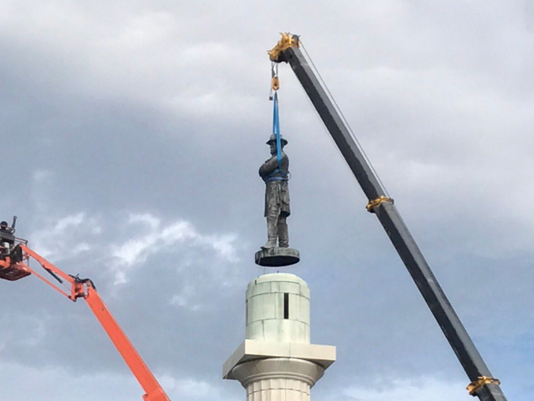
The General Robert E. Lee statue is removed from its pedestal on Lee Circle in New Orleans May 19th, 2017

In 1884, 19 years removed from the intense passions of the brutal interlude of the American Civil War, an illustrious crowd led by Confederate royalty, including the former President of the Confederacy, Jefferson Davis, the Confederate General Beauregard, and two daughters of General Lee, saw the dignified and solemn statue of the Confederacy’s most famous general dedicated in New Orleans.  The statue survived on its pedestal through the twentieth century and many re-interpretations of the causes and principles of the struggle, and levels of veneration of the  reluctant general who vigorously led the South in battle.  The statue on its 107th birthday was placed in protected status on the National Register of Historic Places.  Rising nearly a hundred feet over New Orleans, its was one of the more recognizable and representative historical  structures in the city.

On May 19th, 2017, the monument to the South’s peculiar cultural identity and tragic mis-direction was taken down, as the city’s government’s final success in removing Confederate historical figures from the city.

New Orleans’ drive to expunge its connection with secessionist history injected momentum across the United States to find ‘inappropriately venerated’  historical monuments and expunge them and perhaps what they teach us about ourselves , from our consciousness.   The focus by self interested groups on the left to roust out such history accelerated after the events of Charlottesville, and have led to less civilized and more aggressive removal and destruction of similar monuments. As with all movements where the original logic for the actions shift with the political motivations of the activists, the destructive eye now points toward previously uniting monuments
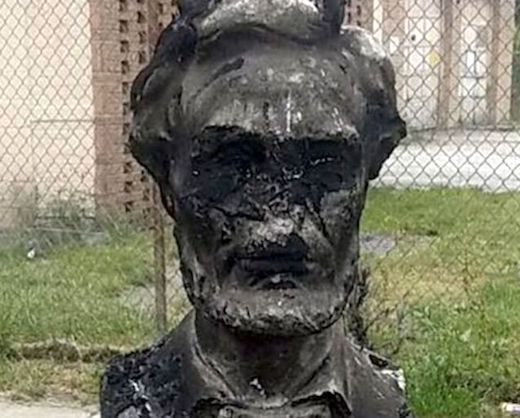
Abraham Lincoln Bust defaced in Chicago

to the American story such as the Jefferson Monument and Mt. Rushmore.  The radical aggression has spilled beyond the country’s founders to the very base disgust the radicals feel for anything that defines America, such as Christopher Columbus and yes, Abraham Lincoln.

Really.   Abraham Lincoln.

We are living through a dangerously anti-historical time, when the extent and meaning of events, so formative in how we became, are being evangelistically eradicated by those with little sense of history and a real hatred of who we are.  It is nonsensical to not understand that monuments are often erected to highlight what people have seen over years to be enduring and important, rather than any pretense that these individuals represented were without flaw.  Robert E. Lee is venerated for the way he led men, not for the fractured logic of his divided loyalties.  Thomas Jefferson elevated for all time the principle of individual rights and the expressed equality of man, not his own timid, very human  inability in his time and culture to live up to his own principles.  The many representations of a heroic southern sacrifice do not celebrate the horrid culture of slavery, but of an epic, crushing struggle that left a million dead, nearly twice as many as in World War II, in a country a third as populous.  In the profound battle to end the wretched scar of American slavery hobbling a society founded on equality and freedom, the passions that drove one side to the righteous, and the other to a doomed and inhonorable and erroneous principle, were complex and inexorable.  Tearing down history, without recognizing its ability to teach, encourages the very close minded  processes that led to such passions in the first place.

That said, history and our human story is too imbued within us to fall silent when facing the the poorly chosen  specific statue or monument.  Heroes are etherial and not locked in their time. A statue to Roger Taney or a George Wallace are not time heroic.  There is no feasible need to teach  their inhumanity, regardless of their skills, that suggests any need for their continuing memorial existence.  A modern society can reflect upon its heroes and determine their relevance soberly, and cull with care. We needn’t feel sentimental justifying a particular malevolence, because of a peculiar skill. There is justice in removing a Hussein or Stalin from the pedestal, once their own societies have identified the hypocrisy of their veneration.

Yet the danger always resides in the zealous nature of our own perceived purity and our unwillingness to register our humility in judgement of others.  Could it be possible that we could even learn from a Nathan Bedford Forrest?

Civil war, such as you have just passed through, naturally engenders feelings of animosity, hatred, and revenge.  It is our duty to divest ourselves of such feelings, and, so far as it is in our power to do so, , to cultivate feelings toward those with whom we have so long contested and heretofore so widely but honestly differed.  Neighborhood feuds, personal animosities, and private differences should be blotted out, and when you return home, a manly, straightforward course of conduct will secure the respect of even of your enemies.  Whatever your responsibilities may be to government , to society, or to individuals, meet them like men,  The attempt to establish a separate and independent confederation has failed, but the consciousness of doing your duty faithfully at to the end will in some measure repay for the hardships you have undergone.

LT. General Nathan Bedford Forrest to his soldiers

May 9th, 1865

Before we tear it all down, maybe we should hear out all the strains of history, and find the better angels of our nature.
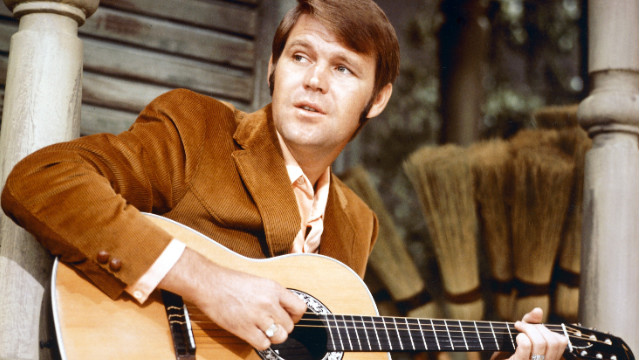


An American Original – Glenn Campbell

Glenn Campbell
1936-2017

The current over enhanced and emotion deadened noise that passes for modern American popular music has separated us from the power that once was evoked from the marriage of lyric, voice, and musicianship that represented the golden age of music performance and recording.  Self absorbed and over engineered performers play one generic tome after another, calling out mechanical and soulless structure that blend together like musical hoppel poppel ,that leaves as soon as it is digested and extends no decernible satisfaction.  Attempt to recall, to sing, any of the ‘epics’ of the last twenty years and one is left with empty beat and emptier emotions that don’t linger beyond the vapid moment of vague familiarity and oppressive shallowness.

Then Glenn Campbell dies, and memories of musical greatness, like a sudden breach of a whale, or the ecstasy of one who has held their breath for too long under water and first gasps to fill one’s lungs with massive gulps of life giving oxygen,  come to mind.  Glenn Campbell was the holy trinity of performers.  He could sing like an angel. Interpret lyrics to touch one’s very core, and play the absolute hell out of a guitar.  No one who ever heard him failed to be just a little bit in awe of what the country boy from Arkansas was able to do with almost any strand of music.  When Alzheimer’s Disease stole his prodigious talent in 2012, and inevitably silenced him on August 8th, 2017, a ripple across the Cosmic celestial spheres was felt.

Glen Campbell came out of the outer banks of the American Frontier, born just outside the aptly named Delight, Arkansas on April 22, 1936.  His family was musical and Glenn took to the guitar like a fish to water, soon becoming  a participant in some of the family’s musical projects, a polyglot of american backwoods — gospel, bluegrass, and “cowboy” swing.  The teenage Campbell honed his craft in family efforts such as the Sandia Mountain Boys and the Western Wranglers, dipping into the vortex of post world war rural sound that was part Bob Wills  and part Ralph Stanley that would eventually become a force in American music known as Country and Western, with seminal stars such as Hank Williams, Kitty Wells,  Webb Pierce, and Ray Price.  C&W music no only told stories that brought sophisticated reflection to the rural life experience, but also the injection of seriously good musicians, like Chet Atkins and Buck Owens, innovators in both the acoustic and electronic voices of the new recording technologies of the post war world.  A great instrumentalist by the time he was 25, Glenn went in the opposite direction of most country inflected performers, away from Nashville and out to California, where nearly every performer recording in Los Angeles looked to have his tight and elite musicianship backing every album, from the Beach Boys to Frank Sinatra.

The not so hidden secret among studio musicians was that not only could Campbell play, he could sing as good as any performer he backed.  The general public did not discover this until Glenn Campbell discovered the songs of an obscure Oklahoman named Jimmy Webb, who could write as epically as Campbell could sing.  From mid-1967 till mid-1968, Glenn Campbell and Jimmy Webb managed to displace the colossus of the music world, the Beatles, as the world’s greatest selling artist,  with songs such as Galveston, Wichita Lineman, and By the Time I get to Phoenix.

In Jimmy Webb, Glenn Campbell had found his muse, and in Campbell, Jimmy Webb his siren.  The songs matched a profound and dignified humanity to real, everyday people caught in life’s most reflective moments, and Campbell’s perfect 21/2 octave ,innocent and aching, clarion of a voice made the simple words immortal.  Jimmy Webb, America’s greatest baby boomer songwriter and Campbell, America’s troubadour, had careers that lasted decades after, but were forever linked to their brief perfect union.   The two artists had collaborated on music that transcended pop, country, and rock to become indisputably American Music.  Fifty years later, it speaks to us in emotions and reflections as fresh as the day they were borne.

Glenn Campbell became a huge television star, hosting his own show, the Glenn Campbell Good Time Hour, promoting little known acts like Waylon Jennings and Willie Nelson, would revolutionize the staid world of country music in the 1970s and 80s. He starred in movies such as True Grit and Any Which Way You Can, was a regular on Johnny Carson and achieved superstar status with songs such as Southern Nights and Rhinestone Cowboy.

The natural humbleness and boy next door on screen personality, however, could not withstand the typical stresses and attention of uberfame, and Campbell like many artists, lost himself in unstable relationships and substance abuse.  The productivity and quality suffered as well in the 1980s and 1990s until he was eventually able to achieve sobriety and take stock of himself.  A chastened performer in his final decades, he still at times overwhelmed audiences and fellow artists with his off the charts talent. The videos below are a wonderful memoriam to Glenn Campbell’s amazing talent, a man and his guitar wowing some of the biggest names in country with his beautiful honey tinged voice and guitar chops. The horrible prison that is Alzheimers took Glenn Campbell away when he still had so much to give. If you get a moment, turn todays’ pale imitations off, open your mind and absorb some true sensorial pleasure, on what legendary talent in the person of Glenn Campbell was all about.