
Swing Vote


      The 2008 movie Swing Vote  puts forth the premise that as a result of an impossibly splint American electorate and an election night malfunction the entire result of the Presidential election comes down to the single unexpressed vote of a New Mexico ne’er-do-well played by Kevin Costner. The future direction of the United States is implausibly tied to the ultimate “fence sitter” whose personal leanings are essentially unknowable.  Mark Steyn in National Review Online in his typically brilliant style  relates how a similarly absurd process is underway at the Supreme Court hearings into Obamacare, and how the shifting sand ideology of Justice Anthony Kennedy may be the deciding scale upon which the entire future of a United States, balanced or unbalanced upon a constitutional platform, is determined.

     I am not remotely suggesting that Justice Kennedy is a ne’er-do-well. The superficial comparisons with the movie end at the gate of Justice Kennedy’s accomplished career and intellect.  I am suggesting that our society’s ne’er-do-well attitude regarding civilized process has led us to this abyss.  When Chief Justice Marshall ruled in Marbury vs Madison in 1803 that it was the onus of the judicial system to determine the extent to which a legislated act conforms to the Constitution, he could not have possibly imaged that such a consideration would lead us to the calamity we face today. Reflecting upon a set of principles, commitments, and responsibilities outlined in a mere four pages of a Constitution, it was a capable step to interpret how a single action could be reflected in the clarifying single sentences of the various brilliantly crafted Articles.  He would have been dumbstruck to consider the constitutionality of a legislative act of governmental enumerate powers that spanned 2700 pages under the ludicrous title of the Patient Protection and Affordability Care Act, a leviathan of a law that seeks to delineate all potential considerations in managing an American citizen’s well being, currently one sixth, or 2.6 Trillion dollars of the Gross Domestic Product of the United States.
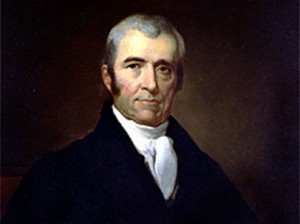
     I am additionally not suggesting that Justice Anthony Kennedy is the modern day equivalent of Chief Justice Marshall.  He’s not-Not by a long shot. Justice Kennedy has , however, unfortunately been put in the position, as a result of a perfectly split court reflecting a perfectly split electorate, of determining what will be the American Truth every bit as important as Marbury vs Madison.   I don’t envy his weighty responsibility.

     Oh, to have to assess the potential constitutional conflicts of a law that at 2700 pages already is a temple to conflict with constitutional values.  The legislative crafters of this Noah’s Ark of Health Care, the crafters that nurtured and voted for it, had little if any idea of the consequences of such a blizzard of regulations, organizations, and powers. The main sponsor, the Speaker of the House Nancy Pelosi, suggested the best way to find out what was in the bill was to vote for it. The influential congressman, John Conyers of Michigan, suggested the very size of the law assured that he would have no time to read it, and that he felt comfortable voting on it sight unseen, if the people who assured him the law was a good idea would stand behind it. Behind such indepth analysis, the future of the implied contract of freedom of the individual and their relationship to a government with clearly limited enumerative powers hung in the balance.  No worries.  Certainly the justices who would be required to assess the law’s constitutionality would take the time to deconstruct the massive missal to governmental overreach. Actually, no.  A 2700 page law proved beyond their capabilities and as Justice Scalia opined, would represent “cruel and unusual punishment” to any one individual who dared break the seal and read.  So we are left with Justice Kennedy, the deciding vote, determining the very future of the United States, interpreting a law that no one has read, and invoking its future permanence or demise.

     Mark Steyn makes all writers take a back seat when he puts his mind to paper, and in the case of dissonance of writing laws that no one can read, and its effect on a democratic society, he stands as a Zeus:

“Who does read the thing? “What happened to the Eighth Amendment?” sighed Justice Scalia the other day. That’s the bit about cruel and unusual punishment. “You really want us to go through these 2,700 pages . . . ? Or do you expect us to give this function to our law clerks?”He was making a narrow argument about “severability” — about whether the Court could junk the “individual mandate” but pick and choose what bits of Obamacare to keep. Yet he was unintentionally making a far more basic point: A 2,700-page law is not a “law” by any civilized understanding of the term. Law rests on the principle of equality before it. When a bill is 2,700 pages, there’s no equality: Instead, there’s a hierarchy of privilege micro-regulated by an unelected, unaccountable, unconstrained, unknown, and unnumbered bureaucracy. It’s not just that the legislators who legislate it don’t know what’s in it, nor that the citizens on the receiving end can never hope to understand it, but that even the nation’s most eminent judges acknowledge that it is beyond individual human comprehension. A 2,700-page law is, by definition, an affront to self-government.”               national review online Mark Steyn

      We are left to balance our futures and all that we have on the inscrutable machinations of Justice Kennedy. The careful balance of the three branches of government, so carefully weighted, and so brilliantly expounded by Madison and Hamilton, have been deformed beyond all recognition.  It is up to Justice Kennedy, to free the tethers of the future from the whims of a solitary individual,  and send this immutable mess of a  “law” back ,forcing Congress to do its job of writing laws that invite structured debate and are knowable to all, so that rational choices can be made.  Obamacare stands on the pretense of Accountable Care.  We all know upon reflection that President Obama’s centerpiece is of no account, providing care that is simply uncountable.  That’s no Affordable way for a democratic society to work.
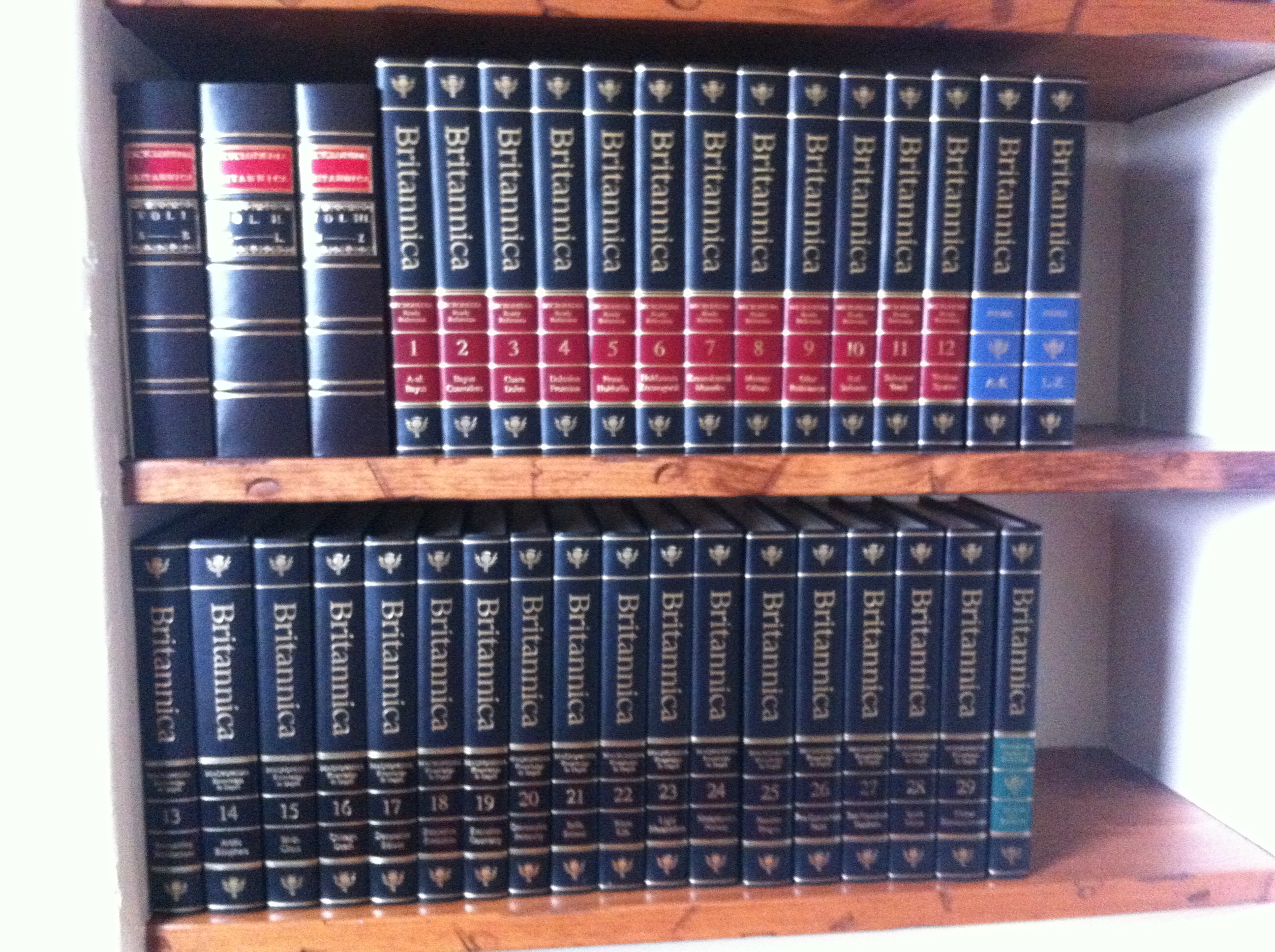


All That We Are In One Place


       This past week saw a cultural changing of the guard in the defense of civilization’s ramparts.  The Encyclopaedia Britannica company annouced that they would no longer produce a printed version of the Encyclopaedia Britannica and that the 2010 printing of the 15th edition would be the final one in book form.  For 244 years, the Britannica stood as the undisputed reference champion as to the accumulated compendiumof man’s acknowledgement and understanding of the world around him.  The first addition, published initially in 1768, by its Scottish founders Andrew Bell and Colin Macfarquhar, contained in three volumes a summary of the natural, historical, and physical world, with the intent to be both scholarly and to educate.  The three volumes were assembled by a single editor, William Smillie.  The final 15th Edition, published in 2010, claimed the contributions of over 100 full time editors, and over 4400 contributors, including many of the greatest reviewers known to their field of interest. Over 40 million words and half a million topics comprise the final printed edition.

     I of course had to own both.

     The pull to personally own the editorial bookends of 244 years of academic effort to summarize in a reference, available to all, the available knowledge of the world was too great for a lover of books such as I.  In physical value, maybe not so intelligent a purchase.  The progressive demise of the printed book after all has been well underway before Britannica’s announcement, and nowhere more acutely realized then in the reference book.  Placing on a shelf a significant investment that almost from the moment of placing the words on the printed page is already a dated set of facts is the inherent fatal flaw of dinosaurs such as Britannica.  The spectacular, universal, and immediately current information now electronically available on the Internet has brought printed references to their knees.  The amateur scholar of today leans on the enormous capacity of search engines such as Google and rapidly updated resources such as Wikipedia to focus his search for fact and underlying truth.  The 2010 Britannica edition in-depth article focused on global warming is immediately obsolete as the facts that form its basis have since been called to question in the East Anglia scandal and contrary evidence since. Similar problems with the permanence of printed truth versus the flexibility of updatable electronic truth inevitably made resources such as Britannica, Compton’s, and World Book a progressively poorer investment for individual research and education.

     Oh, but what a run. The Britannica brought to bear the great minds over the centuries to countless topics that every family could peruse at their leisure.  To review economics with Milton Friedman, Astronomy with Carl Sagan, Relativity with Albert Einstein, or Heart Surgery with Michael DeBakey was the unique calling of Britannica.  The exalted position of Britannica was cemented in 1901 with purchase and movement of the company to the United States, exposing the vaunted treatise to the wonders of market concepts.  The Britannica publishers piggy-backed their book on the concept of door to door sales, and the Britannica rapidly became a status symbol and an indication of the desire for higher learning in many American homes.  People now could know what the privileged few at universities were privy to, the vast expanses of civilization’s knowledge base limited only by the effort and energy required to sit down and read the Britannica.  It became a status symbol to claim to have read the entire set, and some claimed to have read multiple editions.  Whether it was the Aardvark or the Zeppelin that interested you, Encyclopedia Britannica was prepared to make you a learned student of the subject.

     There is of course a certain arrogance to attempting to cover all that we know in a tolerable collection of words.  Arguments over the decades of what was left out and what was left in Britannica were as much a part of the story as the facts within.  And now, the obvious champion is the Internet, with millions of experts and intense and constant vetting of information.  I am a proponent of the Internet and the magical quality it has to bring the freedom of ideas to the entire world, both the privileged and subjugated, in a way that a few volumes never could.  Encyclopedia Britannica acknowledges this, and continues from now on in the more flexible digital form for its subscribers.  The romance of the leather bound books with gold leaf, however, brought a stateliness that the egalitarian Internet can never hope to have, and I mourne its passing.

    The ongoing progress of civilzation often  requires we leave some cherished traditions and concepts behind, but with the purchase of the first, and the last, attempt to place on paper that which we want to know, I have allowed myself a few more decades of the wonderful experience of wondering, reaching, searching, and knowing in the pages of a book.  I look to William Smillie the 1st Edition’s editor to remind us of the value of such actions, in all their glory:

Encyclopaedia Brittannica 1768, 1st Edition

Heaven

“literally signifies the expanse of the firmament, surrounding our earth, and extended every way to an immense distance.

Heaven is considered by Christian divines and philosophers, as a place in some remote part of infinite space, in which the omnipresent Deity is said to afford a nearer and more immediate view of himself and a more sensible manifestation of his glory, than in other parts of the universe.  This is often called the empyrean, from that splendor with which it is supposed to be invested; and of this place the inspired writers give us the most noble and magnificient descriptions.”

     Now, that’s Heaven.

Dont’ Know Nothin’ ‘Bout History

     President Obama, as is his wont, took upon himself the role as professorial instructor during a campaign speech at a local college in Maryland this week.  Deriding his opponents as contrarians and anti-science in the ongoing debate regarding America’s energy needs and potential new sources of energy, the President clarified for adoring students the role of “rubes” in history in attempting to obstruct progress:

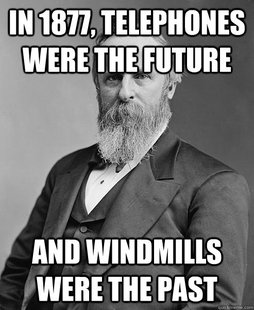
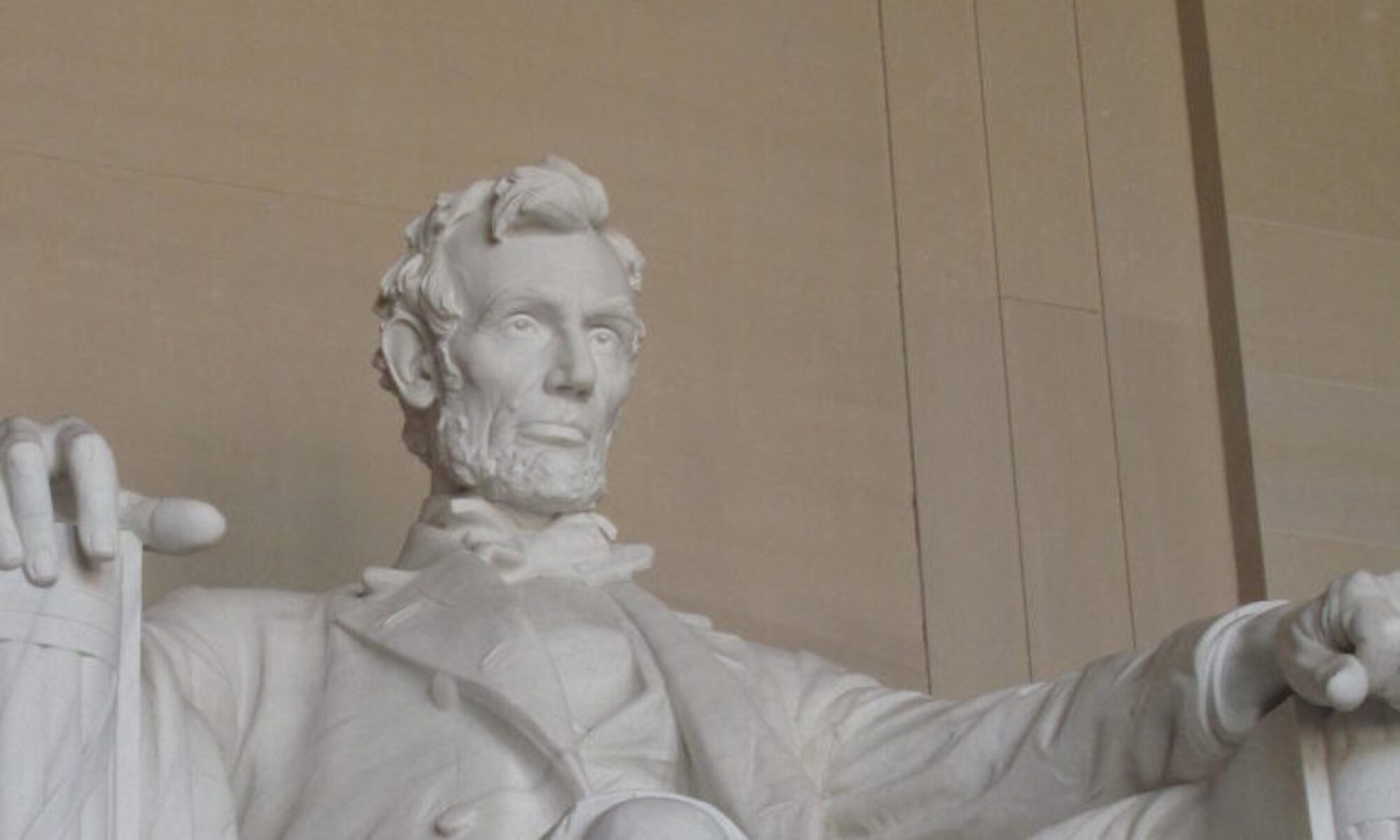
“Of course, we’ve heard this kind of thinking before.  If some of these folks were around when Columbus set sail, they must have been founding members of the Flat Earth Society.  … There always have been folks who are the naysayers and don’t believe in the future, and don’t believe in trying to do things differently.  One of my predecessors, Rutherford B. Hayes, reportedly said about the telephone, ‘It’s a great invention, but who would ever want to use one?’ That’s why he’s not on Mount Rushmore because he’s looking backwards.  He’s not looking forwards.  He’s explaining why we can’t do something, instead of why we can do something.”

         It is certainly not the the first time a politician has used an endearing nonsensical understanding of history to try to prove a point, and it won’t be the last.  Many presidents have made assumptions based on superficial understanding of past events and cultures to promote many wayward programs and agendas.  The problem of course begins to arise when a politician uses a general disdain for accuracy and a superficial shell of understanding of history, science, geography, and culture to form a bedrock philosophy.  President Obama continues to use historical facts and figures as if he got them from the back of a bubblegum wrapper, and it shows in his tendency toward naive and oblivious maneuvers in both domestic and international events. 

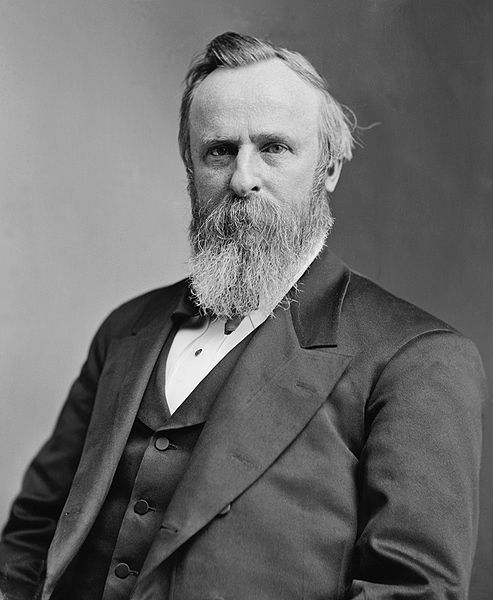
      President Rutherford B. Hayes, 19th President of the United States, may not have been Mt Rushmore material, but the assumption that he was a culturally backward neanderthal is just one more example of not bothering to let facts get in the way of a good story.  President Hayes was a highly educated and intelligent individual, conversant in ancient Greek, a Harvard College law graduate, and a major general in the victorious Union Army.  He proceeded to become a U.S. representative and governor of his home state of Ohio, succeeding to the Presidency of the United States in the highly contested election of 1877 against Samuel Tilden, the governor of New York. In an election so contested that it required a decision by the House of Representatives to finally declare a winner, Hayes proved equal to the task, bringing a reputation for honesty and progressivism to the job.  The period after the Civil War was a time of significant political instability and Hayes brought a steady hand to the task, achieving an end to the north’s dominance of the south through reconstruction, attempting to restore integrity and performance to the civil service system, a tireless advocate for availability of education to all, and working to achieve what was felt to be at the time an enlightened policy of assimilation of native americans into the greater culture.  It also turns out that he was, much like Lincoln before him, a technology geek, and a believer in American industry and ingenuity.  The first functioning wire phone service of Alexander Bell’s invention of the telephone listed the Hayes White House as phone number 1, and Thomas Edison frequented the White House, demonstrating new fangled inventions such as the phonograph, to the delight of Hayes.  Even Obama’s dullard remark that Hayes’ attitude regarding science is what kept him off of Mt Rushmore comes up short. Hayes, a popular President, served on term not because he could not gain another, but because, he had campaigned on serving one term and one term only, and he was a man of his word.  There are worse legacies to be had than that.

     Is it necessary for our leaders to have a solid foundation in historical accuracy to make good decisions?  One is reminded that the highly successful foreign policy president Truman was a high school graduate, and President Reagan was accused of using Reader’s Digest as his predominant fact checker.  Even a President acknowledged to be a voracious reader of history, and a frequent interviewer of historians’ perspective in his analysis of current events, George W Bush, failed to articulate an in-depth understanding of events, at least in any way recognizable to his opponents.

     President Obama, however, is unique in his acquired knowledge set.  What kind of grasp can you have on the forces of history if you have bothered to restrict your reading and devise your thinking only through the bent prism of history’s aggrieved?  Can the man who is quoted as saying there are 57 states in the union, understand the bonds that led to each of the actual 50 joining the American union of states?  Can the President who felt a telling weakness of the American role in Afghanistan was the lack of available Arabic speakers in the military, possibly discern a victorious strategy in an Afghanistan devoid of Arabs?  Can a President who hugs President Chavez of Venezuela in front of President Uribe of Columbia possibly mediate a conflict between the two important South American countries, when Chavez promoted the harboring elements  of the murderous columbian terrorist organization FARC, within his territory?  Can a President who assumes that people from Austria speak Austrian, have the facility to understand the historical considerations that led Austrians and other Europeans to see the Euro as the means of integrating Germany peaceably into the  fabric of a modern Europe?  The list goes on and on.  The anointing of President Obama by historian Michael Beschloss as “probably the smartest guy ever to become President” flies in the face of this President’s clumsy grasp of ties of history that bind, and speaks to our loss of rationality in assessing common sense, achievement, and reasoning.

      The President is an ongoing example of our sharp societal lerch towards the domination of feelings, victim-hood, and pre-formed ideas in the national conversation.  It proves increasingly difficult to have an intelligent debate on issues such as economic progress, climate change, freedom versus responsibility, the principles that uphold a functioning democracy, the role of a constitution in a republic, and the extremely complex considerations of war and peace when the acknowledged leader of the free world has disdain for accuracy and the intellectual rigor for those very discussions.

     Rutherford B. Hayes may not be on Mt Rushmore, but he understood his role in promoting, not rejecting the American ideal, and saw his role as president as a steward, not an adversary, to those ideals.  Based on President Obama’s ongoing assault on history, the constitution, and the unique strengths of the American story, I can assure him when future historians review his time at the tiller of America, the stone head they will be referring to will not be a facsimile granite edifice on Mount Rushmore.


The Battle at Hampton Roads


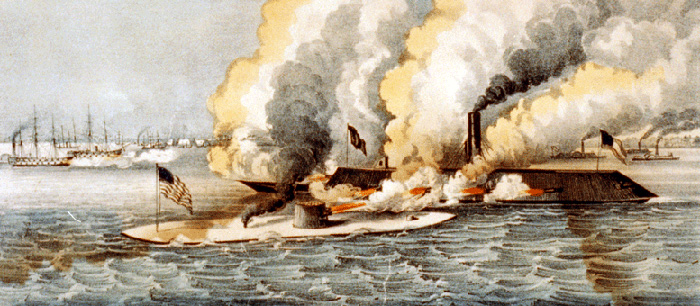
     At the estuary of Virginia’s James River with the Atlantic Ocean, a waterway known as Hampton Roads, history turned on March 8-9th, 1862.  The navy of the United States of America was participating in a progressively successful blockade of the breakaway Confederate States of America, designed to strangulate the economy of the natural resource poor, industrially underdeveloped  southern states and force an environment of surrender.  Warships of the U.S. Navy, the USS Cumberland and the USS Congress were positioned to shut down the critical Hampton Roads waterway and prevent maritime resupply of the confederate capital at Richmond while facilitating the impending Peninsula campaign of Union forces directed by General George McClellan. The two great ships were positioned in blockade to take on any challengers when on the evening of the eighth an entirely new threat presented itself.  The wooden battleship USS Cumberland found itself under attack by strange sail-less craft with angled sides upon which its canon shell harmlessly bounced off and in a technique worthy of ancient Greek battles, rammed by her and sunk. The strange craft turned its sites on the USS Congress, who found itself equally helpless against the impervious craft and determined instead to dash itself against the shoals to prevent sinking.  This made the Congress an immobile object for target practice by the alien craft and it was pummeled into surrender.  In a relatively brief battle, a single craft had taken down two American warships, caused the deaths the deaths of 241 naval seamen in the greatest loss of life to the American Navy until 1941’s Pearl Harbor, and put the entire strategy of blockade to victory in peril.  This unique threat was the CSS Virginia, the redesigned ironclad warship reconstituted on the shell of the previously captured USS Merrimac. In a brief battle, the south had found its magic bullet that could re-orient the entire world of military strategy.  For centuries, the concept of naval battle was unchanged – the goal was to attain close quarters with the opponent craft and turn your armaments upon it, achieving destruction of the craft, or at least sufficiently damage it to prevent its further utility as a sailing vessel.  The logic of several thousand years of armed combat at sea ended in one fell swoop on March 8th, 1862, when a vessel impervious to canon and whose mobility was driven by power under the water line rather than sail presented in the reality of the CSS Virginia.

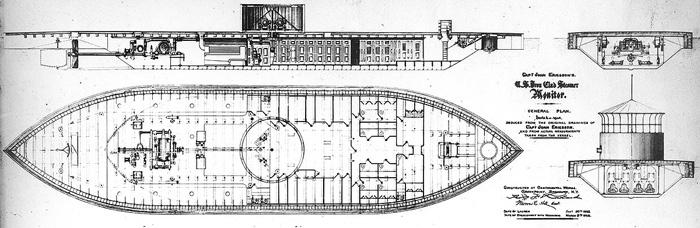
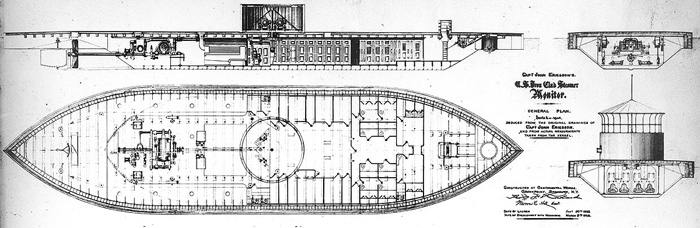
     Unknown, however to the Virginia, on the same night of March 8th, an even more revolutionary craft had entered Hampton Roads from the ocean, and was positioned on March 9th to take on the indestructible Virginia.  She was the USS Monitor, and she was not just a revolution in armour and propulsion  like the Virginia, but additionally, a revolution in armament.  The Monitor was the culmination of the revolutionary engineering ideas of Swedish immigrant engineer John Ericsson and the enormous resources of the north applied to technology.  The south’s engineering was creative and facile, but limited to the available resources, and putting the Virginia with her iron plates together was a major stress.   To obtain enough iron for armour plating many railroad track tailings had to be sacrificed, and the south was not in a position to create a fleet of such vessels. The Virginia was placed on the platform of a previous wooden ship, and her plating placed to the water line.  As she fired off ordinance, she became necessarily lighter in the water and began to draft less, exposing her wooden underframe.  The Monitor was something else entirely.               

     Ericsson designed her as a new type of vessel, providing almost no available target with the craft designed to float as a craft even along the waterline, and for the first time, with armaments impervious to the craft’s position in the water as they were placed in an armoured rotating turret that could rotate to any necessary firing position.  Ericsson had undergone the struggle of all immigrants, having his evocative ideas dismissed by so called experienced naval personnel who felt they would never work, and who had his reputation injured in a previous disastrous trial  years earlier when a previous demonstration in 1844 in the presence of President Tyler of an early turret had exploded, killing 8, and making Ericsson a pariah.  Ericsson, who had the design of the rotating turret pilfered rather than designed by him, never gave up the idea.  When spies suggested the development by the south of the Virginia, interest returned to Ericsson’s idea, and President Lincoln, who had a love of new technology, approved the very expensive building of the Monitor.

     On March 9th, the CSS Virginia came out to play and found itself blocked by a craft even more distorted than itself.  Ramming the craft proved unfeasible as the monitor’s underwater screw design powered by steam and raft design proved too nimble.  Additionally the Monitor’s available outline for canon fire was its rotating turret alone, made of impregniblehigh grade steel to the Virginia’s explosive, non-penetrating shells.  The battle proved inconclusive; but the lesson was clear.  The Virginia, now raised in the water, was becoming vulnerable, and its tactics would have no effect.  The battle was ended with the ships removing themselves from close contact, but revolutionary first battle between two ironclads at sea changed naval warfare forever.

     The amazing Monitor design put forth by Ericsson had over 40 patentable designs and navies across the world took notice.  Steam powered screw propulsion, rotating, repeat firing armament turrets, reduced available target design, comprehensive rivet armour plating – Ericsson’s little Monitor was inspration for what would become the massive Dreadnought class battleships of the 20th century and would change forever battle tactics.  The Virginia, as spectacular as was its brief success, was made impotent by a superior craft, and as the south was incapable of creating numerous ironclads as could the north, became an expendible structure scuttled by its own crew later that year.   The blockade held and grew in intensity and eventually the south was strangulated from the vise from without and the lacerations within.

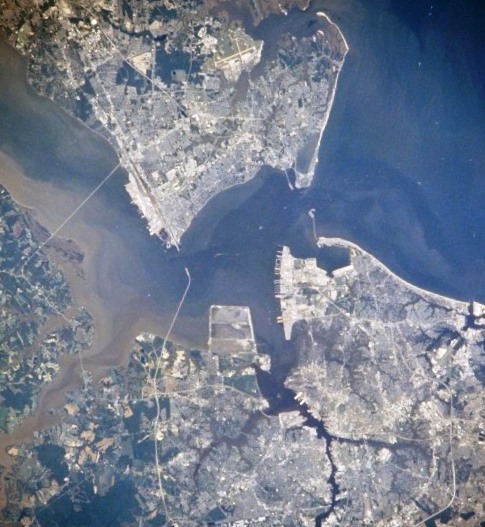
     Hampton Roads, Virgina is now the site of the one the great naval bases in the world in Norfolk, Virginia, and one can look at the docks and see the various permutations of John Ericsson’s breakthrough thinking as far as the eye can see.  Once again, the experiment that is America, the freedom of immigrants to prove themselves in the free expression of ideas, came to fruition in the narrow waters of Virginia in 1862, where it had done so many times before. 

      (further study of this event and other stories of the American Civil War are available online on the terrific site http://www.civilwar.org/)

People We Should Know #20 – Andrew Breitbart


    The Lion sleeps tonight.

     Andrew Breitbart passed away yesterday at the too young age of 43, an age when the clarity as to what in the world your purpose might be on earth begins to gain real definition.  At just such an age Andrew Breitbart was every day re-writing and re-framing his own definition of worthy activity and purpose. It is a nearly intolerable loss to the fragile movement to restore the concept of intelligent and healthy skepticism to a world that has fallen in love with “settled” science, political correctness, and self loathing for the great achievements of western civilization.  Andrew Breitbart’s enormous contribution to defining and constructing a media platform for universal availability of information and insightful opinion, and the courageous exposure of those who would seek to pervert and exploit the government’s progressive power to control individual expression, makes Andrew Breitbart an archangel of the western ideal,  a passionate defender of the Ramparts ,  and #20 of Ramparts People We Should Know.

     Andrew Breitbart’s singular skill has been a savant’s understanding of the power of the Internet.  A classic collegiate underachiever who self-admittedly majored in partying in college, Breitbart was a liberal supporter of the usual college causes, but had his eyes opened by the Clarence Thomas inquisition as to the inherent hypocrisy of those who loudly proclaimed the accepted litany of racism or sexism, than turned around and attacked individuals on the basis of race or sex, simply because they had differing personal stories or philosophies to the accepted mantra. It didn’t fit Breitbart’s gut sense of how individualism should be celebrated, not categorized, and it forever changed him.  Recognizing the potential of the infant internet, in 1995 he got himself introduced to Matt Drudge of the Internet pioneering Drudge Report, and proved to be a natural at understanding the internet’s incredibly brisk pace, huge store of information, and universal access.  He became an editor and headline writer for the blog post and was so impressive, that Drudge introduced his talents to others seeking a start in the new world of alternative media. He was hired by Arianna Huffington to help her structure her internet media site and with Andrew Breitbart’s help, managed to achieve a dominant status in alternative media as the Huffington Post.  It became clear to many that Breitbart had special skills and he found himself writing for many online outlets, including National Review Online and the Wall Street Journal.

     Andrew Breitbart was certainly not satisfied to be just your average quality editor and blogger.  He began to synthesize his personal vision of alternative media to what he viewed as the corrupted and stilted viewpoints of traditional media.  It started with his own internet news site, Breitbart.com, and his big ideas grew into a multifaceted platform for the sifting of information on entertainment, government, foreign policy, and media itself.  The Breitbart empire grew into an aggressive counterview to the prevailing liberal inflection to every news event.  Then, the moment of transition when Breitbart went from passive reporting to active exposure of injustice and hypocrisy.  A child of television and familiar with traditional media’s predilection for gotcha news with hidden cameras, (such as the stings venerable 60 minutes was renowned for), Breitbart devised a sting operation in which he arranged to have an absurd proposition be proposed to the notorious community activist group, ACORN, to expose their flagrant lack of morality in the service of organizational power.  A fake pimp and prostitute presented themselves to ACORN representatives as desirous of setting up an underage brothel to be supplied by illegal alien conduits.  Absurd of course to everyone but ACORN, an organization positioned to filch from the American taxpayer a cool billion dollars in support of such incredible immoralities.  Breitbart played the hidden video releases serially like a concert maestro, letting traditional media outlets put up excuse after excuse for ACORN’s actions, only to have each reaction destroyed by a further Breitbart videotape.  It caused the exposure of the blatant partisan nature of ACORN, and forced the Congress to de-fund it.  It made Breitbart a mega Internet star, and forever, the devil incarnate to establishment defenders. 

     The ACORN sting was followed by others, and Breitbart became the internet face of the mad as hell we are not going to take it anymore crowd.  He found his special muse in the actions of the Tea Party, enamored with their spontaneous rejection of governmental dominance, adherence to the fundamental founding principles of the republic, and the visible hatred they engendered in the traditional media, for simply declaring their rights to disagree and organize opposition as Americans.  Breitbart traveled the nation speaking at Tea Party gatherings, supporting the cause, and defending agressively against those that sought to do damage to the movement.  Breitbart had become this generation’s Teddy Roosevelt, using his bully pulpit to re-align American thinking, and defend American exceptionalism.

     He was nowhere near tapped out in ideas or energy when the great warrior’s heart began to fail him.  Friends have suggested that Breitbart had sustained a significant heart attack just a month ago, but had ignored warnings to rest or reduce his crazy schedule.  He was preparing to present his latest internet vision this month when his heart failed him and put out his light.  The incredible flurry of responses, both laudatory and savage, showed the tremendous impact he managed to have on the dominant informational source of our times, the Internet, and the emotions he stirred.  His mind was a creative one, and his soul visionary.  We have managed to lose one of the great defenders of the Ramparts, at a moment western society needed him most.  Although Andrew Breitbart will live on through his creations, the voice of those of us who hope for a world where  individual capacity is elevated, not oppressed, was diminished measurably.  Andrew, travel the river Styx in peace – we the forever indebted will make sure there is money for you for the boatman.