
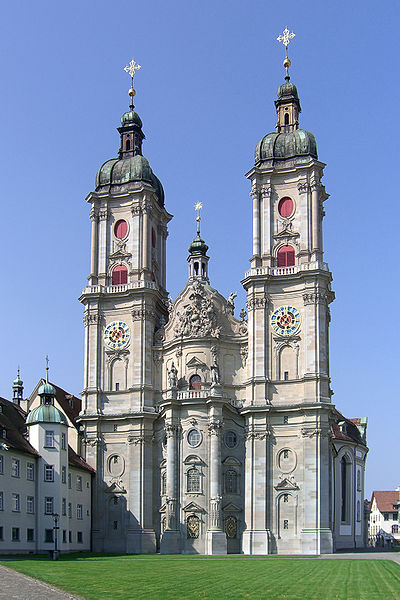
 My recent neglect of my duty at the Ramparts has been driven by time constraints, not by the lack of living in interesting times. I thought I would get ‘back in the saddle’ with a good old fashioned immersion in the complex ribbons of history that have formed our perception of ourselves, our western ideals and way of thinking. The stimulus is the visit of one of my Swiss relatives who harken from the venerable city of St Gallen, at the Eastern edge of Switzerland, but at the epicenter of many of the fascinating formative influences of modern Europe.
The glory of St Gallen is not in its epic leaders, warrior kings or trading routes. The little city of St Gallen instead claims its heritage as the home of people who preserved the knowledge of the world when it was considered the least valuable possession of a violent and harsh time of autocracy in Europe. The center of knowledge of St Gallen was its Benedictine abbey, and the epicenter its magnificent library, a world heritage site. How so many great books came to populate this library, preserved from the 9th century onward, is the story of knowledge and its battle with darker forces, and in the history of its shelves the story of the path to a modern Europe.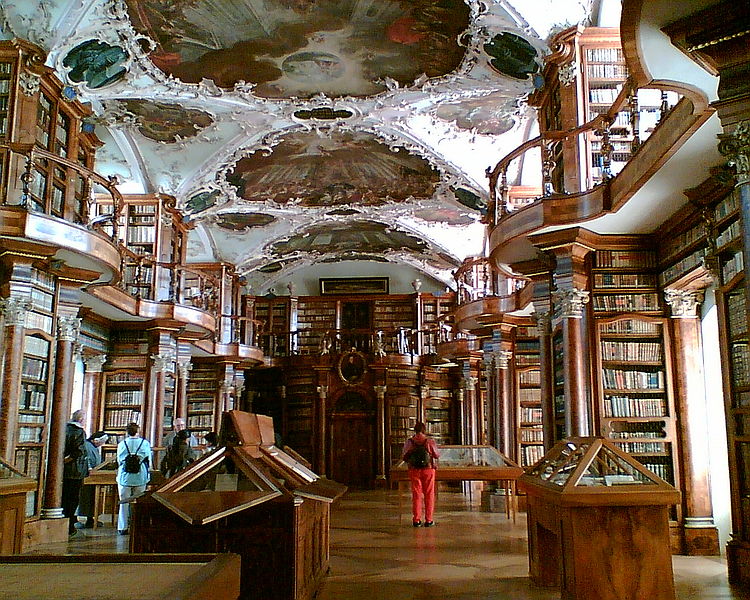 The creation of a center of knowledge in the central European continental wilderness of the alpinian foothills near Lake Constance is wonder of man’s striving for something more than just existing, and starts in of all places, Ireland. Christianity had a powerful evangelical influence on Gaelic culture and the concept of knowledge and piety as intertwined concepts made Ireland an oasis of education at one of the truly dark times in history. The collapse of the Roman Empire in the fourth century led to a multi-century period of tribal control on the continent with war and conflict a constant. At a time when a man’s life often depended on his ability to stay within the confines of his feudal lord’s domain, Irish monastic evangelism boldly traveled far from home, spread the word of Christ and the process of education that the training entailed. First across the Irish sea to the western shores of Albion (England and Scotland) and from there to the far environs of the continent, the Irish Evangelists brought not only the word but the idea of knowledge and study with them. Saint Columbanus with twelve fellow Irish disciples spread across the continent around 610 AD and brought their concepts and evangelistic fervor to the wilderness tribes at the periphery of civilization’s reach. Gallus, one of Columbanus’s disciples traveled with him down the Rhine, but due to illness, found himself unable to continue with Columbanus’s journey to Italy and was left to fend for himself in the wilderness around Lake Constance. Here he developed a hermitic existence in the forests proselytizing to the locals. Upon his death, a little church was established, but it took other events to shape the eventual importance of St Gall.
Elsewhere in Europe other forces were coming to bear. The monastic tradition of desert isolation so much a part of the early church was being changed by the experiences of the Irish monks and others. Monastic life began to evolve into the fabric of the surrounding populous rather than be completely separated from them, despite the isolation suggested by monasticism. St Benedict would define rules of monastic life that would provide a bridge between individual isolation and zealotry and the realistic necessities of community life with like minded individuals. The central focus would be service to God, but it began to extend into behaviors with others and focuses of communal life that suggested the value to this service of activities such as work and education. This lead to a closer positioning of the monastery to the population, and the monastery as a source of education for the secular class, bonding the religious tradition in a safe embrace with those who would rule the population, and ultimately protect, the monastery. With the development of large imperial empires on the continent through the resources of the Carolingian kings such as Charlemagne and the later eastern competitors under the Habsburgs. Kings, recognizing the importance of the organized monastery in elevating the capacity of the empire, began to “assist”the placing of abbots who would adhere to Benedict’s rules of order.
Under the auspices of the Carolingian kings, St. Othmar would be the actual developer of the monastery at what was eventually to become the abbey at St Gallen, and the site of the little church that marked the hermitage of Gallus, was converted to Benedictine rules, and became the site of great Benedictine abbey of St Gallen. The focus of Benedictine monks on introspection and study required the presence of a scriptorium, a place where concepts of religious thought and learning could be secured by monks permanently onto paper, for others to study, and eventually the development of a repository, or library, for the accumulated scripts of the community. The abbey at St Gallen became acknowledged over time as one of the great repositories of knowledge in Europe, and St Gallen became a prized location for various factions who felt the city belonged in their sphere of influence. The city became a center for education and eventually industry, with its skill in textiles particularly valued.
St Gallen had made itself valued through its abbey, but the progressive prosperity of the city increased the strains between the abbey and the burgeoning middle class that wanted to control their own destiny separate from the princely power of the abbot. This led to a period of great instability in the fifteenth century, in which the town and its guilds rebelled against the abbey’s administration and the abbot threatened to move to the town Rorschach on Lake Constance. The city would have none of it and the result was a tumultuous time of conflict that eventually led to the spread of the conflict to the surrounding cantons and the intervention of the Hapsburg Emperor Maximilian. The Hapsburg Empire, thoroughly galled by the ongoing autonomy of the Swiss confederation cantons was not interested in seeing this border city or others like it act independently, particularly when it came to valued assets and progressively the cantons and the empire slid towards war. The Swiss, however, were not amateurs to conflict, having become known as front line troops in the conflicts of the Holy Roman Empire, and Maximilian proved rapidly in over his head, absorbing a humiliating defeat to the Swiss confederation in the battle of Dornach in 1499, ending the set of conflicts known as the Swabian War, and securing the independence of the city state of St Gallen and the other Swiss Cantons until a brief conquest in 1798 by Napoleon.
The abbey was not quite as lucky given the outcome of the Swabian War. It lost its connection to imperial protection, and with it became vulnerable to the rigid hold it had on its properties. When the Protestant reformation swept through St Gallen as it did much of northern Europe, the Catholic abbey lost its influence, and in 1803, its existence as a monastery, with only the surviving segments of the functioning monastery, the baroque inspired cathedral and the library.
Though pummeled by forces of history and at various times losing portions of its magnificent collection, the library remains a window into thirteen hundred years of European history, with the particular gemstone of its collection over 2100 hand scribed manuscripts from the Middle Ages, and over 400 preserved manuscripts more than a thousand years old. Reaching back into the time when the only secure connection of man’s intellect with history was preserved by the isolated monk accepting as a concept of service to God the hard work of scribing for posterity human thought, the library stands as a rampart of civilization that has come to us ennobled by time. In the little town of St Gallen there stands some of the brighter embers of man’s capacity for greatness.