American Adagio

SAMUEL BARBER  1910-1981
SAMUEL BARBER
1910-1981

The musical world of the 1920’s and 30’s  was taken with the influence of the bold American genre of jazz which seemed to capture the independent, self reliant and mildly undisciplined nature of the new world.  To sophisticates, however, the musical creations of American composers such as Morton and Gershwin were relegates of the music hall, not the decided seriousness of the concert hall.  American music held for them a decidedly superficial rhythm oriented character that fell short of the depth of conscience and emotion that were the province of the great European composers.  Of particular sensitivity was the concept of the middle movement of a classical piece, since Haydn’s classical construction a piece of contemplative and reflective interlude that elevated classical music from entertainment to a direct treatise on humanity itself.

The center movement was typically framed at a pace that projected at 55-65 beats per minute, or about a beat a second.  Not morbidly slow, but consistent with breathing or walking, to focus on the individual and inward direct nature of the movement.  The tempo was known as Adagio, and the great composers were noted for the Olympian heights their creativity carried this uniquely human tempo.  Wolfgang Mozart with his magnificent Adagios in the Piano Concertos No. 21 and 23, Ludwig Beethoven  with his heavenly Adagio in the Emperor Piano Concerto No.5 set the standard for the performer rising above the hushed mass of the orchestra to strike a very individual strain of beauty and contemplation.  The sound of something almost otherworldly projects from these masterpieces that always leads the listener to clear their mind, breathe slower, and consider a connection to the sublime.  The depth of soul required was felt to be confined to a European sophistication that projected from almost 2500 years of civilization.  Americans were juveniles to that tradition.

As in art, American composers were creating every bit as sophisticated a musical composition legacy as their European counterparts, but the credit was scant.  Composers such as Copland, Hanson, and Ives brought American inflections to classical compositional structure but fought for attention at the concert hall even in their own country. The American ear sought the traditional voice of the European composer as much as the European audience.

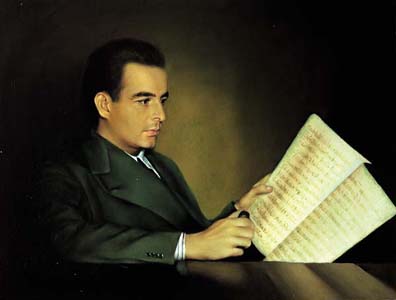
Samuel Barber (1910- 1981)  changed all that with a piece of music that connected to the soul every bit as much as the great composers, and using the sacred weapon of the Adagio. With his String Quartet Opus 11, composed at the age of 25 in 1935-6, Barber plugged deeply into the evocative tempo of the Adagio and created a composition that resonated at all levels, from the intimate sounds of the quartet to the intense layers of the orchestra.  Here was pathos, yearning, searching, and otherworldly in nine minutes of perfection.  Barber knew he had in his words a ‘knockout” of creation, and it didn’t take long for the serious performance world to agree with him as Barber created the Adagio for Strings for the concert hall.  Toscanini, who saw American music as casual and rarely performed it, recognized Barber’s masterpiece for what it was, a magisterial creation using the Adagio tempo, worthy of any European composer’s best work.

Barber, born in West Chester, Pennsylvania to a musical family, likely stands as the greatest American composer of the classical concert tradition, with his Violin Concerto, Piano Concerto and Second Symphony having a regular rotation in any international orchestra’s  armamentarium.   But the Adagio is his moment of genius, when he discovered the perfect language of humanity’s core that transcended all nationalities. Whether in Beijing or Berlin, Boston or Beirut, audiences are immediately transported to their inner depths of recognition of the soul and frail majesty that is human creation.  From the occasion of national crisis, state funeral, personal tragedy, or evoking of a simple human life, Barber’s Adagio brings everybody to the edge of intense emotions and to the verge of tears. Not for its sadness, but for its clarity of what is so human about all of us.

The Adagio for Strings has taken its place in the pantheon of great orchestrial Adagios, but I am emotionally struck but the simple beauty of Barber’s genius in the form of the quartet.  I am particularly moved by the organ like performance of the Amstel Quartet’s version below that goes through one’s chest like a great bellows, using an instrument I usually avoid for any introspective listen, the saxophone.  Barber by his death in 1981 achieved the recognition as a composer of stature, but the singular achievement of his Adagio, raised him to greatness.
The Clash Within Civilization

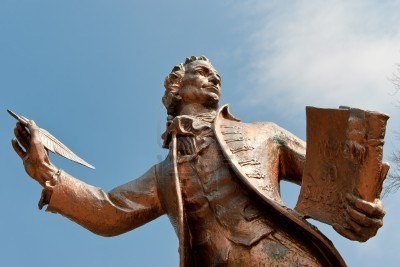
Thomas Paine - author of Common Sense and the Rights of Man
Thomas Paine – author of Common Sense and the Rights of Man

Thomas Paine in 1776 did in 1776 what Thomas Paine in 1774 was incapable of.  In an extended treatise called Common Sense, he laid out the logic of why even soft despotism was an unnatural condition for an enlightened time, and why it was a act of common sense to remove oneself from monarchial oversight and govern oneself.  The singular change that had transformed this Englishman  was his move from Thetford, England to America in 1774.  Having placed his very existence at risk to come to America, in a few short months, the profound energy that new found freedom injects turned an English corsetmaker and excise officer into the clarion for a revolution.

In his new book Inventing Freedom, excerpted in the  New Criterion,  Daniel Hannan reflects on the uniquely ‘Anglo-Saxon’ nature of what we characterize as civilized governance, and how it is under constant attack from within by those purporting to be ‘western’ in their outlook. Hannan, an English member of the European Parliament and Ramparts of Civilization’s #9 on People We Should Know has long been a vocal defender of the hard earned rights of the individual against the ever more burdensome state.  From Hannan’s perspective, Paine’s very Englishness positioned him to recognize how individual freedom provides the final crucial patina to English common law and how the American experience offered an improvement, not a rejection of the English tradition of governance.  Hannan draws the wonderful quote from Alexis de Tocqueville’s Democracy in America regarding the roots of  this evolutionary process:

“The American, is the Englishman left to himself.”

Hannan posits three fundamental features of governance in  anglosphere civilization that sets it apart from its other cultural inhabitants of the western world, and is leading to a progressive clash across the western world.

First, the rule of law. The government of the day doesn’t get to set the rules. Those rules exist on a higher plane, and are interpreted by independent magistrates. The law, in other words, is not an instrument of state control, but a mechanism open to any individual seeking redress.

Second, personal liberty: freedom to say what you like, to assemble in any configuration you choose with your fellow citizens, to buy and sell without hindrance, to dispose as you wish of your assets, to work for whom you please and, conversely, to hire and fire as you will.

Third, representative government. Laws should not be passed, nor taxes levied, except by elected legislators who are answerable to the rest of us.

Its no small thing to suggest that the growing trends in both European and American governance are in progressive conflict with this definition of ‘western’ civilization.  Hannan attacks the current tendency of each to rule by regulation, not the concept of debate, passage and then living under the law. He is particularly harsh on European bureaucrats that see laws as superficial instruments meant to be observed by the public when it serves the dictate of the state, or ignored by the state when it does not fit the ruling class’s  long term goal of progressive state control.  He reflects on this as not particularly surprising, given that the tradition of individual freedom and governments as servants of the people is not a long cherished value of the non-English speaking world.  For the Frenchman, Spaniard, German, or Russian the history of governance has been more one of top down rule then a reflection of the various peoples.  By this argument western civilization is more than a commonality of love of individual expression in art, music, literature, and science.

The current American experience with the recent perversion of time tested principles of anglosphere governance becomes ever more clear when viewed under this particular view of civilizational clash.  The Obama administration views the principles of governance laid out by the country’s founders as dated, obstructionist, and faintly racist. The administration is in love with the European bureaucrats’ view of the populous.  The citizens of the country are backward and corrupted, self absorbed, and needing to be managed. This leads to laws to govern each individual’s very existence, like Obamacare, with the provisions of the law less important then the power it gives the state to manage. Thus, the components mandated by the law can be arbitrarily delayed when it exposes the  government’s failures, enforced when allows the increasing hold over the population.  The very passage of the law itself required a tortuous bending of the rules of debate, and once in place, a complete removal of the legislative process from any role in its application.  It is the age of the top down bureaucrat and the soft despot like Obama, who suggests that opponents to the ‘law’ are terrorists, extremists, and reactionaries. This is the language of despots, who suggest that the overarching ‘good’ occasioned by their actions takes precedence over any ill placed upon the individual.

Daniel Hannan is another one of those voices who need to be read if our society is  to be more than an expression of celebrity, sport, and political horse races.  There are hundreds of years of evolved thought under attack in this clash of forces as to who owns our civilization, and we would do well as the defenders of the Ramparts to expand our reading lists to people like Daniel Hannan and measured important venders of ideas like the New Criterion. It will be worth your time and investment.

The New Kind of Monument

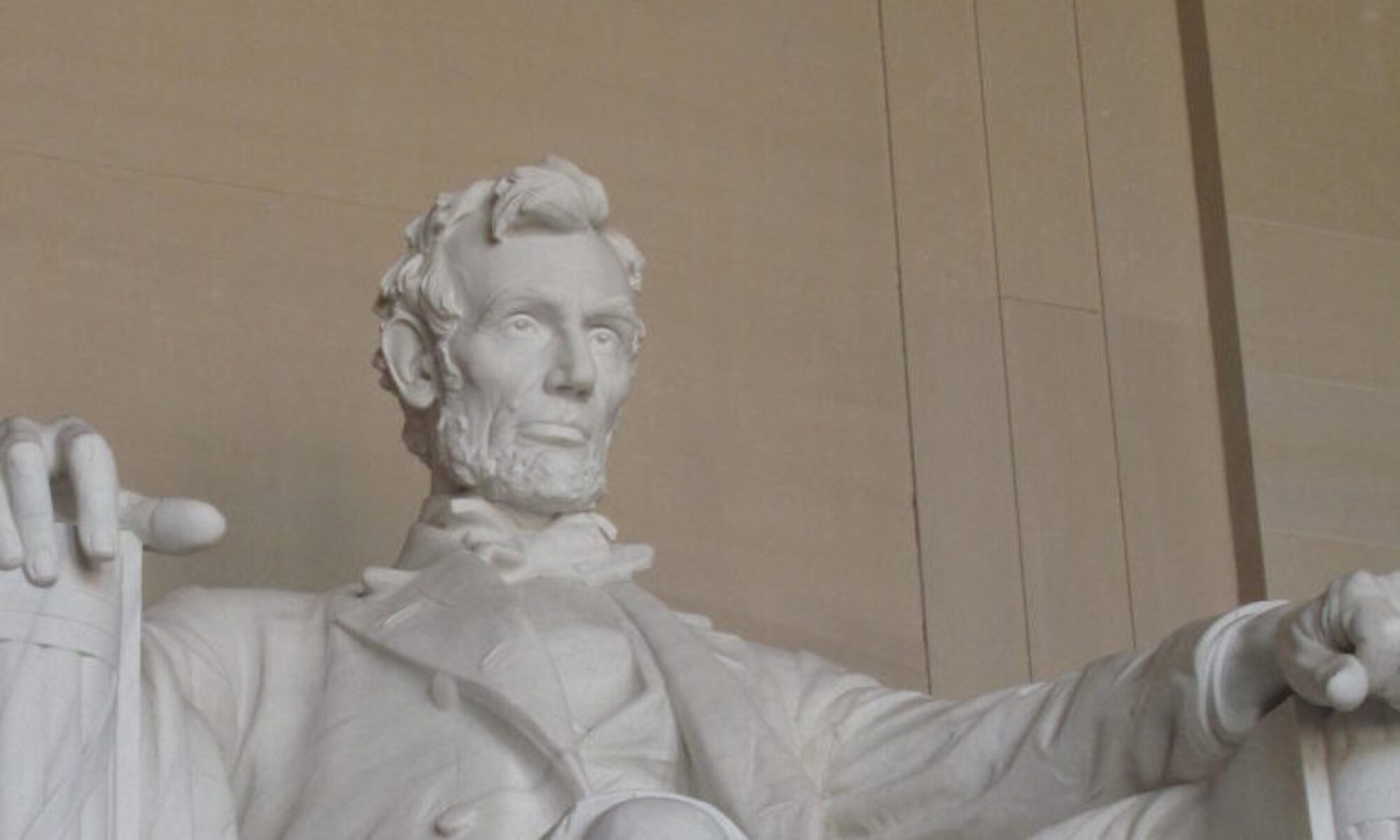
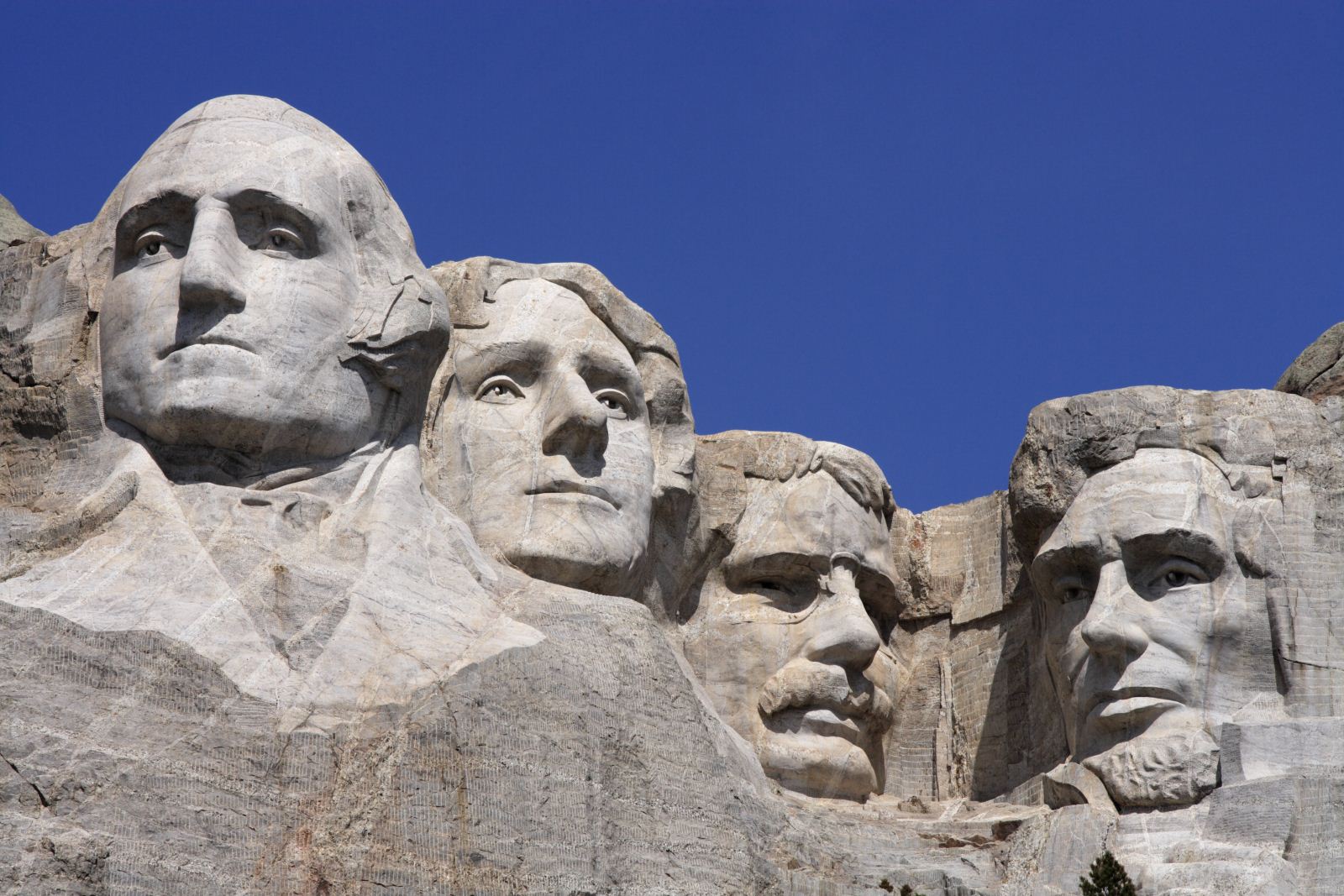
Mt Rushmore    The battle between the incredible shrinking president and congress plods along with no end in site of any kind of solution that will not involve the requirement to squeeze the tip of one’s nose to eliminate the acrid odor of what will be ‘the deal’.  The perspectives of country and principle that at one time inspired and emboldened an nation to consider a permanent memorial to greatness to be etched on the side of a mountain, now leads the midget leaders of that same nation to attempt to block the view of such a monument to greatness with barricades.  Well, it is understandable in a certain context.  You certainly wouldn’t want people to take a moment to contemplate what they once had, and what they now have.

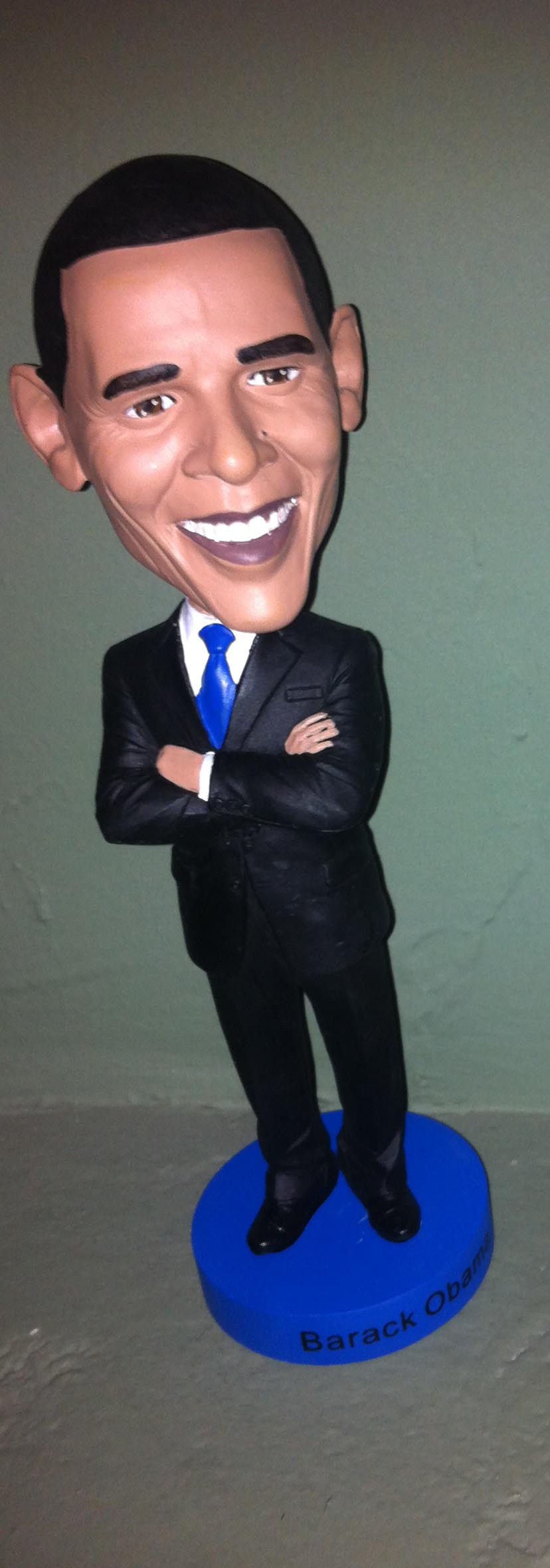
Frankly, the better perspective to understand the current batch of leaders is not a monument in stone , but rather, a bobblehead. Obama Bobblehead Small, plastic, and distinctly non-monumental. Something that can shake its head yes and no at the same time.  The bobblehead serves as the perfect reflection of the throwaway nature of our society, and its reproducibility of one indistinct forgettable figure after another.  Yet, its not that these leaders are not into building monuments.  No, they are building monuments every bit as lasting as the granite edifices in South Dakota’s Black Hills.   They are taking care to meticulously achieve a lasting memorial to their smallness that will dwarf the achievements of the epic giants we see on Mt Rushmore.  The current leaders’ children and  grandchildren will not have to travel to the Great Plains only to have their view of a great momument obstructed by a National Park Service barricade. Instead they will see the special immenseness of our modern momuments in their everyday lives, casting an colossal shadow over their every activity, their hopes and their aspirations.

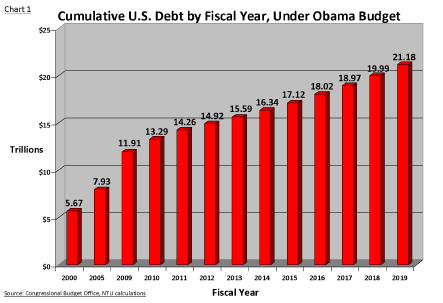
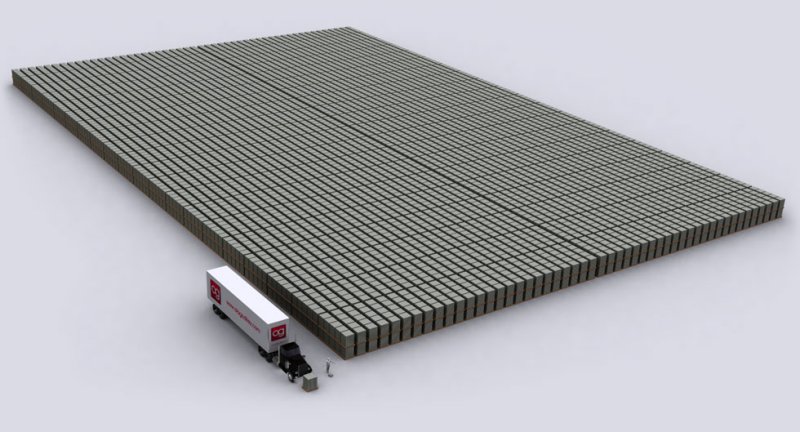
The modern monument to be constructed is made of promises and paper, not granite.  The initial plans were constructed decades ago, but were vastly improved by the current architect.  The monument will be comprised of trillions of dollars of debt obscuring any shadow of the country the leaders we see in granite on Mt Rushmore felt they were endowing.Obama Deficit Spending - nationaltaxpayersunionThe current foundation of the mountainous monument is being added to at approxiamently a trillion dollars a year, with a recent slowdown taking into account the wrenching effect on the nation’s economy of such an epic burden.  We need remind ourselves of the stature of such a monument.  We can gain some perspective if we consider the hundred dollar bill, and project what just one trillion dollars (much less our current 17 trillion in debt) would look like in stacks of one hundred dollar bills:one_trillion_dollars_USDThe small figure to the left of the semi-trailer truck is you.  The pallet in front of the truck supports a hundred million dollars in one hundred dollar bills.  Every day, your leaders add 40 of those pallets to the innumerable pallets to the left that comprise a trillion dollars in one hundred dollar bills.  And that huge collection of pallets on the your left is only one 17th of what we currently owe.  And estimated to be only one hundredth as high as our unfunded mandates we are leaving our future generations.  More owed then the current accrued value of all the economies on earth.  This is the monument the current generation of bobble heads are building.

In Washington, the argument is not regarding this ominous future prospect, it is about whether a president gets what he wants.  If a president wants the future destruction of a nation, are we obligated to give him what he wants?  In a world of little, soft dictators with protruding egos and cults of personality, leading country after country down a path of societal collapse and economic paralysis, are we obligated as a great nation designed to be ruled by law not men, to allow the appeasement of our own leader who fashions himself after such soft dictators?  Is the progressive belligerence and police action of previous administrative arms of government as disparate as the National Park Service, the Internal Revenue Service, and the Environmental Protection agency the emblems of this soft dictatorship? If the answer to these questions remains the current neglectful ignorance by the very citizens the country’s founders worked so hard to protect against such action, then I would submit the time is coming where we need to think of building a new granite monument, one to the new generation of leaders whose influence will tower over those that were giants.  This monument will be a very interesting engineering and artistic challenge – how to support the bobble that will rest upon the granite shoulders.  Like the monument this leader is building, there’s a decent chance it would come crashing down.


Insane Asylum

Honor Flight Vets Overcome BarriersIn 475 AD, the western Roman Empire received its new emperor, Romulus Augustulus.  This particular child, estimated to be about 15 years of age when elevated to the pinnacle of Roman power by his father Orestes to serve as a figurehead, is known to us only because he was deposed by the German chieftain Odoacer in 476 AD, effectively ending over a thousand years of continuous Roman rule.  The last emperor, named for the founder of Rome and its greatest emperor, achieved nothing remotely deserving of the name he took, and is lost to history as soon as he was replaced.  Such a magisterial name, such an ignominious end to the greatest empire the world had ever  known. Neither Romulus or his dominant father Orestes, head of the Roman army likely had the slightest idea they were participating in the end game of a millennia of history.

Such are the times we now live in.  For nearly 240 years, the greatest democracy the world has ever known is undergoing cultural implosion, and the elected ’emperor’ has not a clue of the wrenching historical pivot at play.  Great nations, so superficially permanent in their appearance, actually are quite transient actors on the historical stage.  The magnificent power of Genghis Khan ruling half the land mass of Asia held little solace to the frustrations of Pu Yi, the last emperor, as he met the manipulations of the many European overlords and the revolutionary  Sun Yat Sen, ending ignominiously as the puppet leader of the stump state of Manchukuo, and pathetically powerless to be a Chinese balance to the Japanese Emperor Hirohito.  The court of Queen Victoria’s  Britannia lording over one third of the globe, seemly immortal in its power, finding itself within a century fending off the cries of irrelevance  of the monarchial  existence on the home island of Britain itself.  The mighty Soviet Union, astride the Asian and European landmasses, holding an intense intolerance to any deviation from absolute rule, took barely eighty years to collapse under its own corrosion. It appears no matter how apparently powerful, nothing is forever.

And so one wonders if the American experiment, of a governance ruled by its people, so profoundly the ideal by which all other peoples striving for individual freedom have held up as a bulwark, may be tottering on its own contradictions.

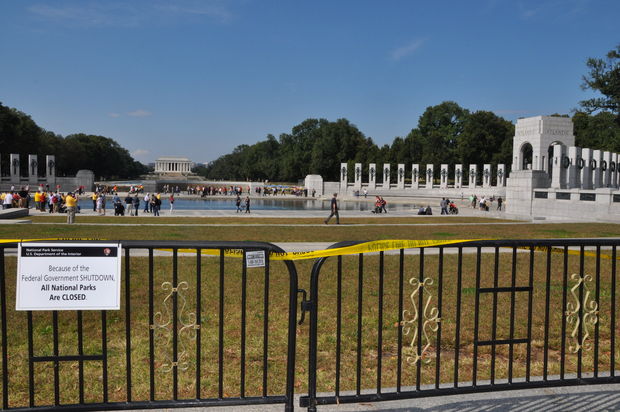
This past week saw the government barricade an open memorial just off the sidewalk on the most public ground in America, the National Mall, as if to say the government, not its people, was the owner of the land, the history, and the symbolic projection.  The World War II memorial, was dedicated in 2004, to the citizen commitment to the greatest conflict the country had ever seen, at a price of over 175 million taxpayer and privately donated funds.  With the inability of the country’s legislature and its malignantly bull headed chief of executive to come to collective agreement on a continuing resolution to fund the government, the government saw fit not to undertake its moral responsibility and reach a compromise to keep the government services running.  This government has  exploded the debt of its citizens, turned its back on its warriors, allowed its borders to become sieves, and passed bloated unworkable laws , only to make itself exempted from its malign demands of everyone else. After all that, it now seeks to claim ownership as if it were an entity, not an expression of the will of its people.  The World War II Memorial was barricaded by the government to feign compliance with the financial necessities of the closure of government.  An open square visited by the very aging warriors that participated in the brutal fight that allowed this form of governance to continue to exist were denied access.  Barricades were placed to prevent wheelchair restricted octogenarians and nonagenarians, the true owners of the space and its history access.  A government declaring, “Everything is mine, and you will use it at my pleasure.”  The Sun King of France would not have been so bold.

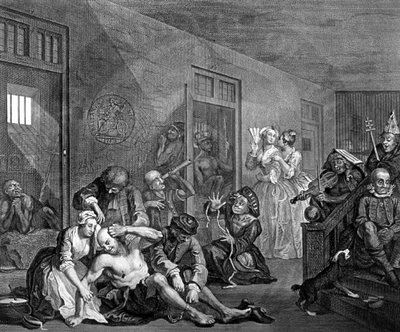
This is how an insane asylum works.  In particular, an asylum run by its inmates.  This out of touch government, slouching toward Gomorrah, has the arrogance to keep its government golf courses open for its private use, but shut down the very symbols of freedom, to the men and women who made its continuance possible.  This government, that has increased the indebtedness of its future generations by nearly half in only five years, who mines with impunity  the personal privacy of every citizen on the sketchy premise it is trying to stop foreign malevolence, that sears the country with intolerable laws and regulations it itself refuses to live under – this government seeks to ‘punish’ us for electing representatives that are trying to stop the runaway train.

Insane Asylum

An insane asylum, its halls filled with wannabe potentates, mirror gazers, giggling idiots, and irrational self immolators, has infested our beautifully balanced principles of governance.  I, for one, don’t care if they ever restore their funding.  The longer the lunatics are without their levers of power, the less we will miss them and their paltry contribution to our welfare.  Look up, and see if you are truly punished by their inaction, or rather elevated to a new awareness of their true irrelevance to your life, liberty, and pursuit of happiness.

We will need to reform this asylum, before they do any more damage to themselves, and us.