Republican Party 1854 -2016(?)

The Republican Party - Heading For The Rocks?
The Republican Party – Heading For The Rocks?

On March 24th, 1854 in an unadorned schoolhouse in Ripon, Wisconsin, a group of men came together to form a new political movement.  The impulse was provided by the passage of the Kansas Nebraska Act of 1854, which opened two new territories to the possibility of slavery, allowing the settlers of both territories to determine through popular sovereignty the presence or absence of slavery in the territory.  This abrogated the Missouri Compromise of 1820, which permitted slavery in the Missouri territory to “balance” the entry of “free soil” Maine into the union, but contained any further slavery introduction below the 36th latitude. With the Kansas Nebraska Act, both Kansas and Nebraska fell above that line, and the future of slavery suddenly became a matter of who could get the greatest number of their supporters in place.  “Bleeding” Kansas resulted, with nasty violence growing rapidly into a low intensity civil war that predestined the massive carnage of the national civil war to come.  The nascent republicans in that schoolhouse recognized the country could not possibly survive the extension of a concept like slavery antithetical to the very foundational philosophy of an American union.  They determined to form a party that stood up for the concept of both personal and economic freedom, imbued in the slogan, “free labor, free land, free men.”  The party found its voice in the form of Abraham Lincoln, was forged through the ordeal of the Civil War, and became a dominant force in American politics.

The party has put forth great presidents like Lincoln, Theodore Roosevelt, Eisenhower, and Reagan.  It has matured into a firm conservative reflection of the American experiment, championing free enterprise, personal initiative, fiscal responsibility, muscular defense, and equal opportunity.

The current party should be at its zenith.  Having secured itself as the effective representative of the individual versus the collective state, it has achieved current electoral dominance at the state level with 3044 of 5411 state lower chamber representatives, 1,134 of 1,972 state upper chamber representatives, 31 of the 50 US governorships, 246 0f 435 US Representatives, and 54 of 100 US Senators. That last piece of political unity with the nation, the Presidency, occupied by a philosophically secure conservative, stood before the party in 2016 like never before, with a cratering government party stuck  defending its last political redoubt reliant upon an unrelatable candidate potentially fatally weakened by felonous behavior with America’s most secret information.  The Republican Party appeared  poised for an electoral renaissance that would finally implement a fundamental restoration of the principles of exceptionalism that brought America such bounty and morally secure standing in the world.

Yet..Its all about to go up in smoke.

In 2016, the national party has been infected by an insurgency that is bringing it to its knees and will fracture it forever if not eradicated. The insurgency is through the dark forces of demagoguery and nihilism in the human form of one Donald Trump.  All democracies are potentially susceptible to the charlatan who speaks to the population’s baser instincts of survival, envy, and revenge.  It is why the prescient founding fathers secured a constitution with checks and balances, separating powers to prevent such a demagogue from usurping power.  It is why they devised an electoral college to prevent the   unrestrained mob majority from securing the executive.  To many in today’s day and age, however, these olympian principles that have bound America’s diverse population into a workable whole are entirely trifling.  In a complicated world full of competing strains, many people who feel left behind  are looking to others to solve their problems, and are willing to trust them with unbounded power to do so. Trump has seen this before in the microcosm of his own life, using the concept of self importance to overwhelm any careful vetting of facts.  It has led to a veneer of uninterrupted success, when the facts suggest multiple bankruptcies, failed concepts, and at times outright fraud.  It was a sign of his shrewdness that he felt the timing was right to sell his pablum on a national stage.

One doesn’t have to travel very far back in time to see this developing trend in American political discourse,  of the so-called indispensable man.  President Barrack Obama has been a savant in this tactic, presenting himself initially as the everyman, appearing from nowhere to course serenely above the fray, seeing not a white America or a black America, only America.  Obama suggested he could achieve through his very persona a resetting of  the national attitude on race, stop the oceans from rising, heal the earth, restore America’s reputation for fairness through  constant apology and humility, and fundamentally change America from its moorings in personal risk, unfettered markets, and non-collective morality driven individuality.  He progressively overcame the restraints of compromise and coordination through a combination of bully pulpit and executive action that circumvented those constitutional restraints.  The IRS became a tool for surgical strikes against perceived enemies.  The EPA devised a regulatory vendetta against coal and oil to attempt to make the market for the products untenable.  Budgets became quaint relics of the past, so that burgeoning unvetted spending would annually move forward, with the only alternative government shutdown. On and On.

Now Donald Trump has risen from the muck and fashioned himself a better, more streamlined version of Obama. Threats to those who would oppose him are now direct and malevolent. Other countries will pay for our laxity and incoherence. Banks and insurance companies will lose decision making capacity in their businesses. No proposed solutions, just the assurance that things will be “so much better”, “waste fraud and abuse” will be eliminated, and enemies will be “destroyed”.  The executive can be trusted with the coalescence of power because he is so much smarter, more successful, and realistic than everyone else, and is the greatest deal maker that ever lived.

A tired citizenry is increasingly vulnerable to such balderdash.  Say it enough and the seepage into the national consciousness can become unavoidable.  The weak , ineffective governments of 1920 Italy and 1932 Germany were susceptible to the ubermensch argument, and the results were devastating.  It is no small coincidence that Trump quotes Mussolini:
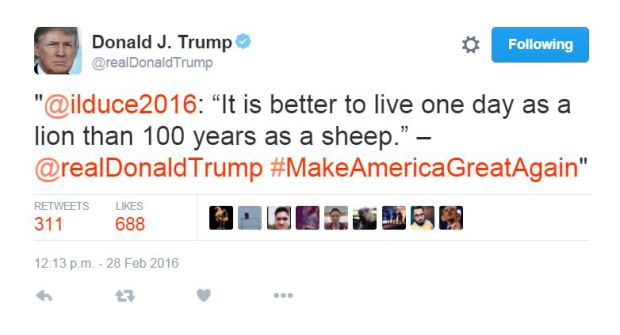
Trump quotes Mussolini on Twitter February 28,2016

Is America the sheep the Trump lion is about to devour?  Possibly not, but the Republican Party will not survive the Trumpian form of fascism.  The virus of an unprincipled demagogue is not compatible with the generation of conservatives that conceived the ideal of the modern mantle of limited government, individual rights, tax fairness, national security, and belief in the founding principles.  If Trump achieves the coup d’etat and runs the primary table, the vast segment of millions of identified republicans who wear this mantle as the definition of the patriotic American will leave the party in droves, rather than directly participate in the country’s deconstruction.  To the party establishment who have help create this unbounded frondeur, a word of warning.  This particular Pandora’s box can not be re-sealed.  The Republican Party will permanently fissure and will cease to exist as a national force.  So get a grip, America.  You still have time to come to your senses.

For millions of Americans ,there can be no ‘getting’ along with our own home grown Mussolini.
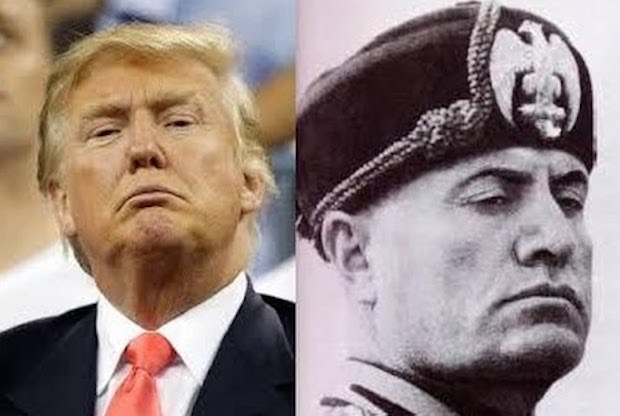
mussolini

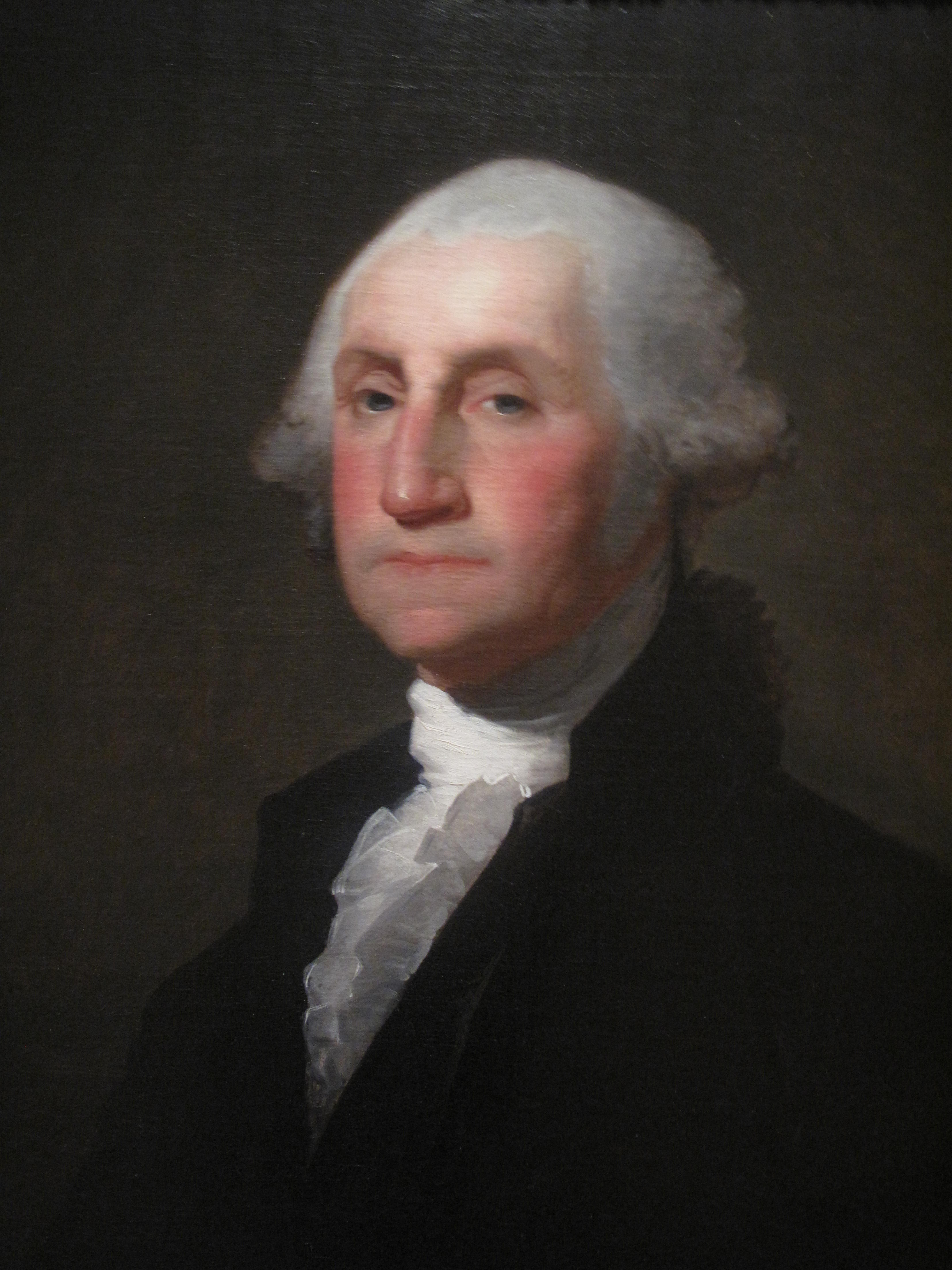
George Washington – The Virginian

GEORGE WASHINGTON - Gilbert Stuart - Corcoran Gallery
GEORGE WASHINGTON – Gilbert Stuart – Corcoran Gallery

February 22, 2016 is the 284th anniversary of the birth of George Washington, a giant of history, that with each passing year and with ever more complete research into his actions and motivations, grows evermore in stature. The somewhat dour portraiture of the man promoted by his portraits late in life do not begin to capture what a towering force of nature he was, and the intensity of impact that he had on others, and on his time.  Each presidential election season seems to bring us the challenge of finding individuals remotely worthy of the office and the understanding of public service that he so uniquely defined.  Ramparts paid tribute to him on February 22,2011, and a return to our essay, The Virginian, is a exemplary reminder of the mettle and character of the man that the current crop of candidates dare to be associated with.

In our more cynical, superficial age we find it hard to imagine the set of circumstances that would lead a man to risk all that he had, and give up the greater portion of his life, to an idea. 279 years ago today, such a man was born in the colony of Virginia, and his indomitable life quest almost single-handedly made possible the American Experiment. There was no expectation in early life of his sacrificial nature, borne to a prominent Virginia family, and he could have settled in to a life of plantation farming and land acquisition that was his family’s mantra. Something restless and animal was part of his makeup , however, and his early journeys into the wilderness to survey land created a unique need not seen in other family members. This man, George Washington, was tuned into a special stereophonic muse that was characterized both by the Age of Enlightenment and the Age of Possibility. His forays into the vast American continent began to coalesce for him that this particular land was special, and the capacity of each individual man special, within it. He began to seek positions that would both make possible the maximization of who he was, and steadily, the risks he would need to face to achieve fulfillment.

The young adult Washington showed a warrior instinct. He was named the military leader of an attachment that was to derive the position of the competing French in the Ohio country coveted by both the British and French superpowers, and managed in a short time time get himself involved in both a massacre of French soldiers near present day Pittsburgh, and later a complementary catastrophic massacre of British soldiers in the ill fated Braddock expedition to eject the French. The sequence of events showed Washington to be aggressive, impetuous, and in a trait glorified later in life, unconscionably brave and seemingly immune to battle chaos or bullets. The controversies of these events left the British and the American politicians with different impressions of the Virginian Washington. The British saw him as inferior to the British officer ideal with his Americanized instincts for cagey warfare over stand and shoot soldiering. The Americans saw him as an example of individual creativity and persistence. Both concepts were of Washington, but did not completely describe him, to those who later felt they knew how the “true” Washington in battle would respond.

A leap forward in time to 1775, and the continental congress is desirous of a leader that holds both warrior skills and revolutionary ideals in his make-up. There was frankly little “in-house” experience to chose from, but Washington recognized before anyone that the warrior leader would have to a special hybrid. He would need to be able to commune with the common man who would ultimately provide a volunteer force that would need to be willing to sacrifice and die for abstract ideas, and would have to project a consistent warrior bearing and confidence that would assure all that taking on the most powerful military on earth and winning was not the ludicrous proposition it seemed. He played these two roles to perfection, and retrospectively, was the unique persona for the impossible task.

The revolutionary war years of 1775 to 1783 were epitomized by the crushing reality of the sacrifices necessary by men like Washington to achieve the miracle of independence. The challenges were overwhelming. He was required to fight the greatest military force in the world with a rag tag army of citizen soldiers with little military training and limited resources. He was challenged time and time again to rebuild this volunteer army as deferments ran out, or men simply gave up on the intolerable nature of it all. He was expected to maintain a continental strategy with troops who were thinking that their home to defend was their own state and not necessarily the “foreign” state to which they were forced to defend. He was forced to defend his actions in defeat after painful defeat against individual politicians who thought they knew better and refused to monetarily support the cause or mandate the troops. He did this all continuously for eight years with a price on his head, away from his home, under atrocious conditions, and with the foreknowledge that defeat meant for him certain death and loss of all that he had. He faced all these enormous obstacles – and he won.

When it came time years later to select a chief executive that would form the initial government of the United States, the selection again turned to one man, the Virginian, Washington. He was selected not for any impassioned rhetorical brilliance or acknowledged philosophical depth, but again, because he was the single individual every competing interest group felt they could trust. He was selected for his acknowledged ownership of the American Ideal through the worst of times, and his willingness as a man, to give up power when it was his to take. As the first President of these United States he set for all time the standard that the office, not the man, the Constitution, not the trappings, were the key ingredients of the American Experiment.

On his birthday, at a time when mediocrity of character and lack of in-depth understanding of what makes this American Experiment work frequently desires to inhabit the office of President, our first president, the Virginian, stands forever, like a colossus.

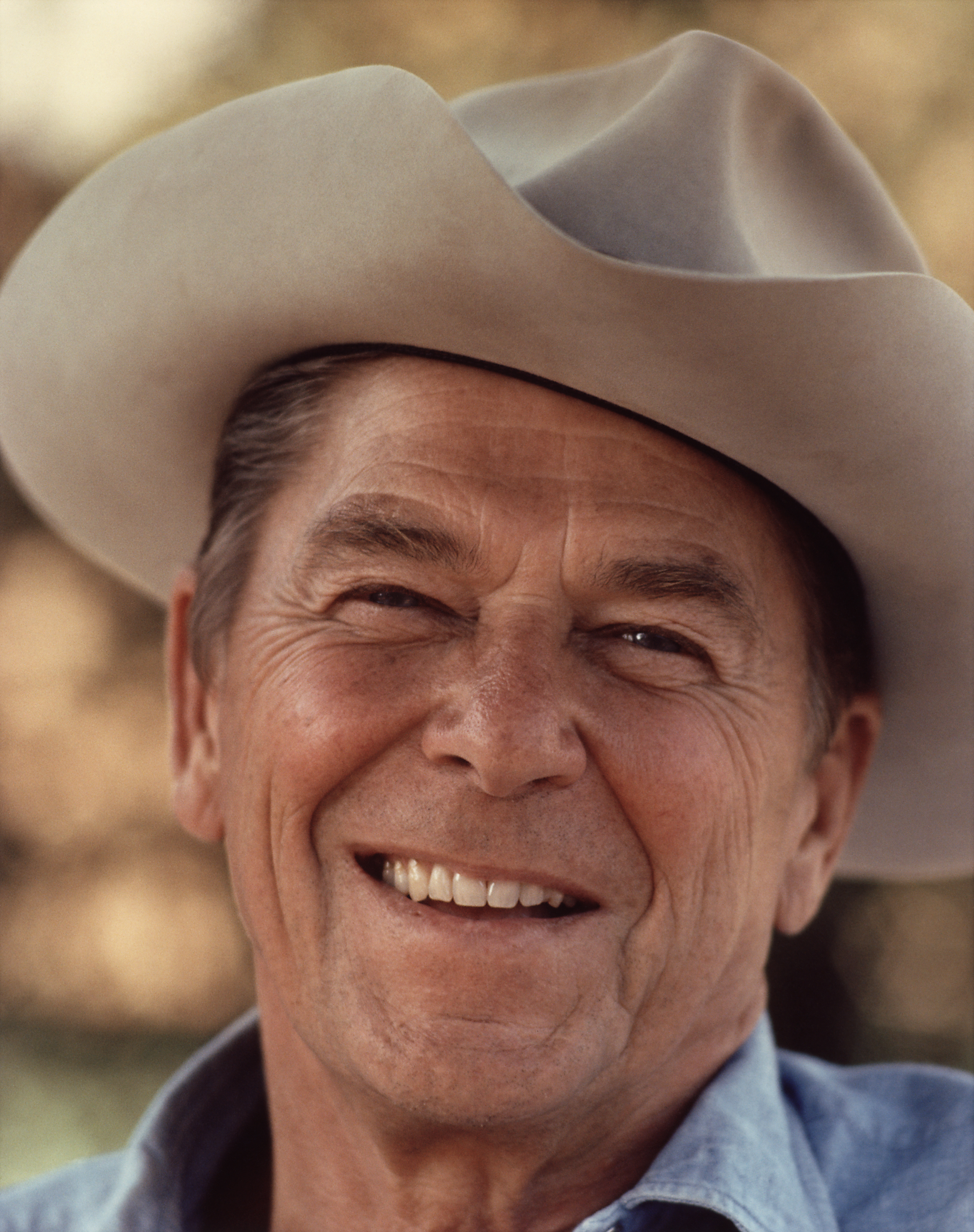
Reagan at 105

Ronald Reagan 1911 - 2004
Ronald Reagan 1911 – 2004

February 6th is the 105th anniversary of the birth of the last great President of the United States. The fortieth of a line of greats, near greats, disappointments and even scoundrels, the reputation of Reagan has only grown in stature since he left the political scene in 1989.  Greatness, as always, is not just a list of accomplishments. It is the sense, by friend and foe alike, that the real achievement of Reagan was that he was consequential in the lives of people in a way that left an indelible memory. Reagan secured renewal in America, which is an innate American characteristic flowering intermittently,  permitting the country to throw off the pessimism and corrosion of previous versions, and restore the core beliefs that make this country like no other. Approaching another period in time when people fear that the country may be in a permanent decline, the search for another Reagan-like figure is driving the political process, as a general exhaustion for the  divisiveness of the last 25 years progressively looks to unify behind a leader that believes in the infinite capability of a people that believe in themselves.

Reagan was the antithesis of the modern model for an executive of an organization as contentious and complex as the United States.  The modern model calls for elite training, breeding in the corridors of influence, intellectual power, vigor of an executive personality at the height of its powers,  and calculated ruthlessness.  Reagan was born of backwater parents in Tampico, Illinois, and attended not Ivy League, but backwater schools, graduating with gentleman’s grades from little Eureka College, and striving not to become a captain of industry, but a reflection of the common man. The natural goodness that was Reagan resonated upon the fairly recent form of mass communication known as cinema, and secured in Reagan a belief that the stories told in the movies were characteristic in form to the real life stories that created the unique  American society. To Reagan later in life, the cinema stories blended with reality, not because he was deluded by their contrived nature, but because he believed stories evoked the true, formational American psyche.  Having essentially finished one career as celebrity, he then proceeded later in life to a second career of working the levers of power to respond to his beliefs that the success and influence of America was best appreciated in its people and their story. He didn’t see Americans as needing constant direction to prevent chaos and ill considered decisions. By the time he ran for President in 1980, he was already one of the oldest men to do so, but somehow his simple, principled manner and his unwavering confidence in the American dream blew through all generations as a bracing rush of fresh air and energy.

Reagan didn’t need to feel himself the smartest man in the room as more insecure men who followed him to the office did. He sublimated the concept of intellectual heft to the equally awesome  power of personal wisdom and understanding of what motivates people to achieve great things.   He did not need to demean people or ruthlessly use them, because he knew the gains would be short and superficial.  He understood that true power resided in a country’s sense of self esteem and shared story. He crushed the opposition time and time again not by explaining to the people why trusting themselves would overwhelm any insecurity, and the people became his army that no opponent could hope to fractionate.  When Reagan ran for re-election in 1984, he didn’t really need to tell them it  was Morning in America.  They felt it at the very core of their conviction, and they knew that he had renewed them.

To the elite of the country, Reagan’s simple faith in Americans and their ability to seize opportunity and trust themselves , was polyannish and ultimately irrational. Elites knew that most Americans could not be expected to understand the complexities of modern society and make good decisions.  Real, altruistic governance would always be not so much  a safety net as a it should be a hammock, designed to soften the blows and disappointments of life for those that could not possibly be expected to absorb and overcome failure. Reagan’s simplistic view of Americans having more in common with the concept of being American rather than the bonds to any individual group, suppressed grievances and blurred the political divisiveness that could build voting blocks.  By the time an Obama positioned himself as a deliverer, Americans had subjugated themselves to smaller and smaller self interest groups, and the exploitation of perceived grievances allowed base instincts of envy and advantage to take rigid hold. Obama saw no value in shared success and people feeling self worth. Political power lay in making sure if there was failure, it was important to have someone who would clearly reveal for those who failed who was responsible – their neighbor, their fellow American.  Obama’s over-riding impulse was to extend this attitude to the global perception of America, If there was instability and chaos in the world, America could be seen as a driver of such malfeasance, and she could make it up to others only by apologizing and getting out of the way.  The self esteem of America and its people, renewed by Reagan and allowed to flourish for twenty-five years, required an Obama to restore the elites and crack America’s can do spirit.

Reagan unbelievably at 105 somehow seems younger than the tired contrivances that pass for leadership today. The restless rejection of the so called establishment candidates for president in Clinton and Bush seem to foretell however, a stirring of another renewal.  If the country begins to sense there is real hope, not the nonsense of 2008, and that people will once again be given the chance to live their lives unencumbered by those who would crush their spirit for renewal, we may yet see a tidal wave of confirmation in the person who can define a path back out from the wilderness.  If so, like 1980 and 1984, you won’t be needing to interpret any broken chads to know who won.  It wont be a republican or democrat wave, it will once again be an all American one.

Happy Birthday, Mr. Reagan.