Memorial Day and the 1st Minnesota


There are so many vignettes that ennoble the concept of Memorial day that to select one brief story seems wanting. Memorial Day, a day of remembrance for those who have served a higher purpose and sacrificed all for that purpose, is a special part of the American fabric.  The element of sacrifice certainly wasn’t in every case heroic – very likely in most it was the element of fate driven bad luck- in the wrong place, at the wrong time – but in all cases the sacrifice was contributive to the greater good that freedom and free will are worth exposing oneself necessarily to the harsh judgement of fate.

There have been some very special moments of great clarity in American history when the participants knowingly chose their sacrificial destiny in hopes of in some way extending the fragile life of the candle frame of freedom.  Many are sacrifices known but to few; some have reached the legendary status of epic saga.  What drives a man to face impossible odds and end his time on earth is no doubt individually diverse, but is it possible that hundreds of men could accept the same moment, the same clarity of purpose, the same love of freedom to willingly and collectively snuff their own lives out in defense of it?  It happened on the second day of Gettysburg, and it happened to the 1st Minnesota regiment.

The 1st Minnesota was formed in the initial passion of the start of the Civil War  in 1861.  The newly formed western states of Wisconsin, Minnesota and Iowa were among the most enthusiastic to the cause of the Union, and there was little difficulty in filling the ranks with men who hoped to show their willingness to defend the concepts of the Union.  The regiment by the time of Gettysburg was already significantly battle tested, having served in the initial battle of the war at Bull Run and many engagements since.  Gettysburg was clearly to all however something all together on another level.  A vigorous southern army led by General Robert E. Lee, fresh from crushing serial victories at Fredericksburg and Chancellorsville determined to take the war to the northern states and end it there.  Convinced of its own superior generalship and mettle of its troops, the southern army looked to a knockout punch and by the fateful connection  of various roads and turnpikes found itself in the “country” of Pennsylvania at the little town of Gettysburg.  The reeling army of the north, now led by taciturn General Meade, was positioned on the southern army’s flank protecting the capitol of Washington until direct contact between the two armies was initiated just outside Gettysburg.  The battles of the first day secured the positions of the two armies, and the next two days were to witness the ultimate clash of wills.

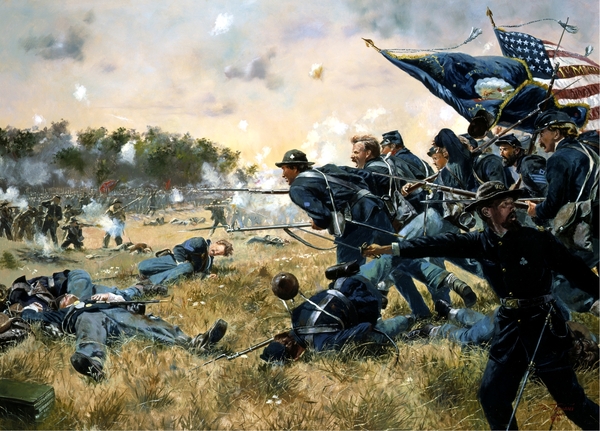
The fighting of the second day was filled with epic stories, and epitomized the snarling aggression of the Southern army to split the Union forces in two and finish the war for good.  Places with names like the Devil’s Den, the Peach Orchard, and Little Round Top saw man to man fighting of an intensity and drama that have reached legend and have been told innumerable times.  The Union army, bent like a fishhook around Cemetery Ridge, was pummeled on its left by savage thrusts of Southern warriors.  Southern Generals Mclaws and Hood punched deep into Union reserves all afternoon and the wavering the Union defenses were recognized by its on site Corps Commander William Hancock.  At about 6:20 pm a new blow north of the battered Union left came to the weakened center that had spent the day re-inforcing the left flank.  Alabama troops under General Cadmus Wilcox staggered the vulnerable center and a massive gap began to form.  All eyes saw the moment the same way.  Wilcox could eye the cottage that held the Union senior command and beyond it the road to Washington.  Hancock could see the unmitigated disaster of a union line split in two.  Devoid of troops and needing to gain time, he called out to the commander of the 1st Minnesota regiment, Colonel William Colvill, and ordered his 262 men to fill the gap and against over a 1000 southern marauders buy that precious time for the Union forces to reinforce the breech.

The great historian Shelby Foote captures the clarifying moment for all time:

“Colonel, do you see those colors?”  As he spoke he pointed at the Alabama flag in the front rank of the charging rebels.  Colvill said he did. “Then take them,” Hancock told him.

Quickly, although  scarcely a man among them could have failed to see what was being asked of him, the Minnesotans deployed on the slope- eight companies of them at any rate; three others had been detached as skirmishers, leaving 262 men present for duty – and charging headlong down it, bayonets fixed, struck the center of the long grey line.  Already in some disorder as a result of their run of nearly a mile over stony ground and against such resistance as Humphrey had managed to offer, the Confederates recoiled briefly, then came on again, yelling fiercely as they concentrated their fire on this one undersized blue regiment.  The result was devastating.  Colvill and all but three of his officers were killed or wounded, as well as 215 of his men.  A captain brought the 47 survivors up the ridge, less than one fifth as many as had charged down it.  They had not taken the Alabama flag, but they had held onto their own.

And they had given Hancock his five minutes, plus five more for good measure.

For those precious five minutes General Hancock needed to marshall enough reserves to stem the breech and save the Union army to fight another day, the 1st Minnesota sustained a casualty rate of 83%, the single greatest loss of men of any surviving military unit during a single engagement in U.S. military history.

To knowingly give up all that one has to potentially preserve freedom for five more minutes.  The 1st Minnesota serves as a reminder to all on this Memorial day of what true selfless behavior is and what it means to be called and accept the call.  In honor of Colonel Colvill and every one of the 215, as well as the untold others who gave their last measure so the rest of us could live in this great land of free people, God bless, and Thank You All.

Euro Collapse – 2012?


The prudent thing to do when a major storm with potentially cataclysmic destructive power is heading your way, if you have sufficient warning,  is to prepare by boarding up the windows, gathering supplies, and make plans for the aftermath.  It is clear that the countries and organizations that are oases of financial stability in Europe are seeing the gathering storm clouds and preparing for a very rocky night.  The crushing weight of bond obligations are beginning to violently  shake the southern foundation of the Euro zone and the painful efforts at austerity by the countries at risk and the financial shoring up by the European economic giant Germany may be reaching its limits.  The aggressive efforts at trying to sufficiently underwrite Greece to allow it to stay in the Euro is cracking the will of both Greece and the underwriters, and the prime minister of Greece has declared the end of June as a point of bankruptcy and default, unless further funding is made available.  German patience and financial wherewithal is, as German Foreign Minister Hans-Peter Friedrich has declared, limited, with Germany “unwilling to just pour money in a bottomless pit.”  DeutscheBank Co-CEO Juergen Fitschen described Greece as a “failed state run by corrupt politicians.”  When your major lender has such opinions of your credit rating, the future is dark indeed.

The inevitable Greek default on their financial obligations, and resultant exit from the Euro now appears – inevitable.  The countries outside the Euro are preparing.  Switzerland, with its rock stable Swiss Franc looking Olympian compared to the Euro, fears the inevitable over valuing of the swiss currency as billions of euros pour into the safe haven of the Franc, and is contemplating a minimum rate for the Euro against the Franc to protect its export economy if default occurs.  Lloyds of London is reviewing the capacity to switch to multi-currency underwriting to protect its exposure on the continent.  The  overt effect upon Europe and in a global economy, the world at large, is return to deep recession, and to Greece, a catastrophic default with dramatic reduction in economic value, loss of savings, lack of supplies, and blackouts, as creditors cut off the lifeblood of the country.

Other than that, things might just get worse.

Spain’s major banks are reeling under the strain of increased interest rates, and the credit ratings for the massive economies of Italy and potentially France are due a significant downgrade in their credit rating, resulting in borrowing costs that may prove unsustainable in the continent inflexibly on a single currency. Defaulting by  Too Big To Fail countries like Spain, Italy and France would likely plunge the world into a depression.

The sixty year experiment of buying European peace and stability by assuring cradle to grave security for its citizens is coming to an end, and it is not yet clear its citizens have grasped their role in precipitating their impending crisis.  France, faced with limited,  peripheral reductions in its welfare state under Sarkozy, determined with its recent election of the Socialist Hollande to throw its fortunes to whims of destiny.  The United States, a debt behemoth that dwarfs any European obligations, is heading toward its own election in which the current socialist president who blithely expanded the national outlays by 22% over the last three years with no means of paying for it, stands a reasonable chance of being re-elected.

The concept of democracy is an old idea, but the inherent instabilities of this old idea are very modern.  Can a citizen recognize the difference between promises of security and the responsibilities of personal freedom?  Can a citizen be their own country, recognize their responsibilities and obligations, contribute where they can contribute and start being part of the solution, rather than the nexus of the problem. The world is going to find out and it looks like 2012 is as good a year as any for some real self realization.

In The End – All Fizzle, No Sizzle


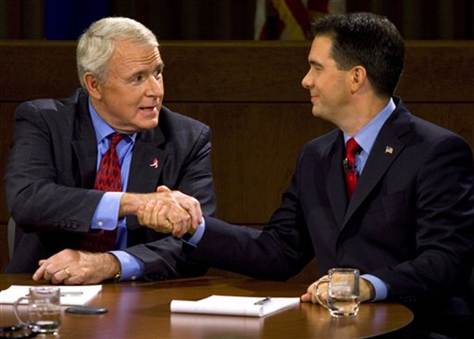
The present and future governor of the state of Wisconsin met in debate on May 25 in advance of the epochal recall election of June 5th, 2012 at which time the voting citizens of Wisconsin will determine if they are the same person, Scott Walker.  A year and a half of trench warfare politics with comments and actions at times bordering on buffoonery and hysteria have led to a culminating vote that will frame not only for Wisconsin but for the nation an electorate’s capacity to discern adult and necessary policy and electorally stand behind it.  The debate was a microcosm of the entire calamitous process of the past year. After all the yelling, Governor Walker remained serene and on point and his opponent Barrett, who gagged on the word governor, calling Mr. Walker “Scott” or “you”, waddled around the issues like – a man with no issues. If you are the political junky type, you can watch the nothing left to debate debate in its entirety  on C-Span.  After 18 months of incessant protest, innumerable recalls, million signature petition drives, and claims of Armageddon, the protest voter’s candidate found himself even unable to stand up for reversal of Act 10, the bill that constrained collective bargaining for some public unions and allowed Governor Walker and the state legislature to finally achieve budget sanity and balance, and the supposed line in the sand issue that led to all this recall nonsense in the first place.

The mayor of Milwaukee, Thomas Barrett, has engaged in two previous runs for governor and lost, with a recent clubbing by Scott Walker in the 2010 election fresh in his memory.  A politician who takes pride in having no discernible opinions that would irritate anybody or accomplish anything, Barrett has compared himself to Goldilocks,  “neither too hot or too cold- just right” as if  personality was the defining issue to solving the massive current problems of state and national budget crises.  Mr. Goldilocks while apparently personally aghast at Governor Walker’s legislative process to achieve budgetary balance had no problem in using the tools Act 10 provided him for balancing his own city budget, to the chagrin of the same public unions who must now stand wobbly behind him.  It seems Goldilocks was a hypocrite.

The problem for the democrat party of Wisconsin is after all the hullabaloo the polls are showing Wisconsinites are beginning to absorb the successes achieved by Governor Walker and elements that comprise his  true political talent.  The first legitimately balanced budget in years without one time gimmicks or tax raises. A pending budgetary surplus next year. The initial evidence of real private sector job growth and reduction of the unemployment rate. The restoration of rational purchasing and budgeting to local governments and local school boards.  The achievement of educational savings without significant layoffs or reduction in class size.  Mr. Barrett was left arguing that such success was making Governor Walker a national figure and a political “rock star”, and that was not what the state would get if they voted for Barrett.  Translation – I don’t want to be a success, just a guy …vote for me.”  I must say, that doesn’t  exactly send a tingle up my leg.

The polls would suggest that Governor Walker has a small but consistent lead of between 5 and 8 percentage points over Barrett in the final week leading to the election.  In the state of Wisconsin where  voting is done repetitively, and by busload,  and with voter ID being suspended by a liberal Dane County judge conveniently for this recall vote, the  Walker lead may be ethereal.   The process of democracy is at times very messy, but the Wisconsin recall drama over the last year and a half  has framed the issue in increasingly sharp focus progressively for the nation.   People – do you want a “guy” – or do you want a future?  Let’s hope we are done with those “guys”, and both democrats and republicans will finally be free to vote for people who are willing to be part of the solution.

People We Should Know #21 – Elon Musk

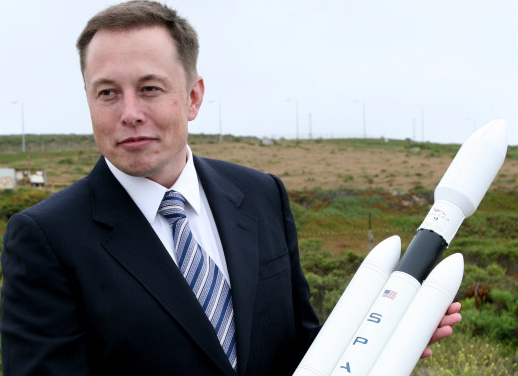
          If all goes according to plan, tomorrow, May 7th 2012 will be a seminal day in the annuals of American entrepreneurial know-how spirit and the advance of science.  The Falcon 9 spacecraft, a heavy load rocket capable of manned orbital flight, will blast off from Cape Canaveral for an intended rendezvous and docking with International Space Station.  The unmanned spaceflight, if successful, will represent the first wholly private commercial orbital space transit and will throw the doors open to a huge new venue of private American economic enterprise and development, private enterprise space.  The driving force for the breakthrough company, SpaceX, and another of those amazing individuals America’s free enterprise system with its risk/reward pathway seems to continually produce, is Ramparts People We Should Know #21 – Elon Musk.

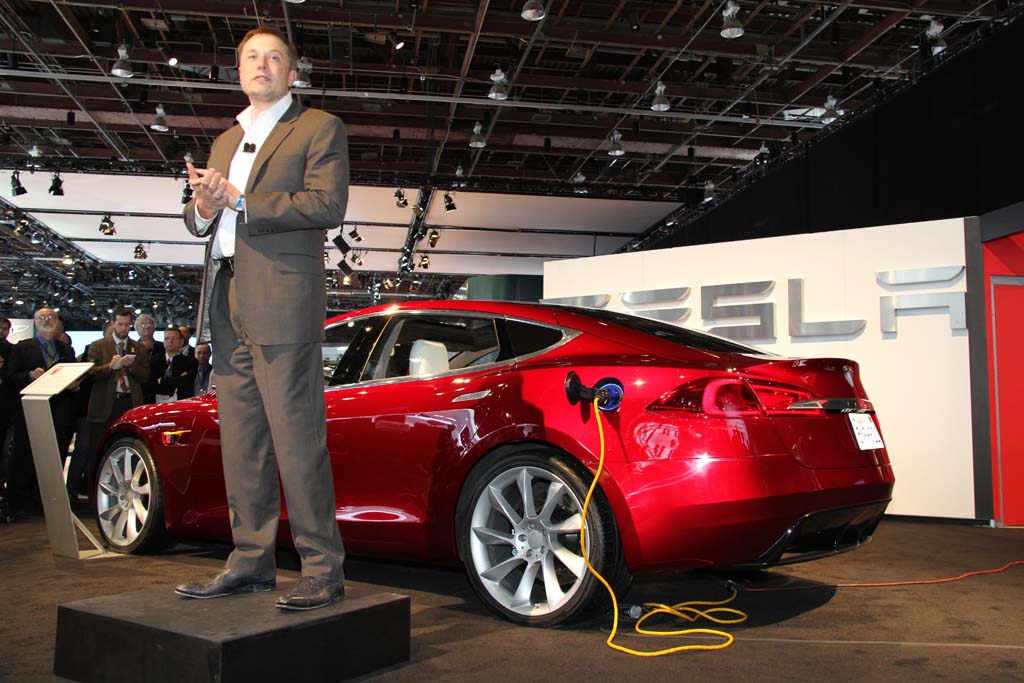
     Elon Musk is among those rare individuals who maximize their talents and energies on the concept of creation.  Like unique human forces like Steven Jobs and Burt Rutan, Musk has been forever searching for the path to the end product he has already envisioned, and success and failure along the way are assumed characteristics of the eventual conquering of the vision.  Elon Musk has already achieved conceptualization and production of the world’s foremost internet financial transaction system, PayPal, devised and shepherded the most advanced production line electric drive train automobile, the Tesla, and with Monday’s launch, potentially will be America’s primary private cargo and eventually manned transport service for the United States, a country without an available transport system since the retirement of the shuttle.  If you feel that this represents several lifetimes of contributions to the advancement of civilization, recognize that Elon Musk will not celebrate his 41st birthday until June 28th.

     Musk was born in South Africa of a South African engineer father and a Canadian mother.  At 17, he determined to emigrate from South Africa to avoid compulsory military service and eventually live in the United States, as he was quoted, ” It is where great things are possible.”  Settling with relatives in Regina, Saskatchewan, he eventually emigrated to the United States where he attended the Wharton School of Business where he achieved dual undergraduate degrees in business and physics.  He was accepted to graduate school at Stanford in applied physics, but lasted only two days before he was tempted with an internet software entrepreneurial opportunity with his brother in California’s Silicon Valley.  Musk has stated a driving force for him intellectually was to be involved in solving “important problems” – particularly internet, clean energy, and space.  Early success with Zip2, the company he started with his brother, brought capital of over 300 million when they sold their fledgling company to Compaq.  Capital led to the start of Musk’s company X.com, a financial services and internet payment company that morphed into PayPal.  In just three years PayPal grew into a force in internet financial services and was purchased by EBay in 2002 for over a billion dollars. 

      A 31 year old Musk could have taken the money and bought yachts and castles, but instead poured the money into two venues with visions of spectacular advance and horrendous risk.  He started the electric car company Tesla Motors in 2003 and the space exploration and transport company SpaceX in 2002. Musk poured much of his own money in both start up ventures and by 2010 was almost completely tapped out.  As if that mattered to such people.  Musk began to see some light with the addition of more deep pocketed investors and the resources of the United States government – as well as that old stand by, creative success and innovation.  The Tesla Roadster, an all electric sports car initially produced in 2008, and the soon to come Tesla S sedan, have carved out a market for the innovation buyer, promising the drive capacity of a modern vehicle tied to the clean energy of all electric power.  SpaceX, if successful on the launch and orbital docking test on May 7th, is in line for a multi-billion dollar services contract with the U.S. for cargo and eventually manned transport, that will revolutionize space transport and likely explode innovation, as only private competition can do.

     Elon Musk will create, because that is what he was genetically programmed to do.  We can all be thankful that people such as Elon continually focus their talent and energies on risky but worthy projects that benefit all of us, and make our lives better.  In a special way America’s unique entrepreneurial laboratory continues to produce amazing results that drive progress better than any organized educational process.  College dropouts like Steven Jobs and William Gates, savants with 3 months of official schooling like Thomas Alva Edison, and Google Stanford schoolboys Larry Page and Sergey Brin join Musk among the many who have thrown their talents into the success and failure game of American entrepeneurial adventures and advanced civilization beyond the what could be devised from an advanced degree.  What a magnificent creative cauldron is the American ideal of personal initiative, risk, and reward.  We do honor to our past by recognizing the elements of society that help nurture the Elon Musks of this world, and protect our future by preventing government from interfering with this very successful but fragile process.  Elon Musk will soon be 41, and one can only imagine what he has yet to offer.  Ramparts salutes Elon Musk as People We Should Know #21, and looks with certainty to next Elon Musk somewhere in our American midst, as long as we remember to let them fail or succeed upon their own unique vision – without us getting in the way. 

Triumphalism


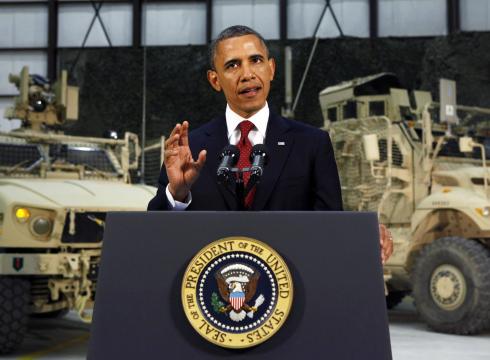
     Modern politics continued its progressive downward spiral in relevance last night. We were treated with the bizarre circumstance of an American President travelling half way around the world  to give a speech in the middle of an Afghan night to an empty room , fronting his only attendants, some lonely Humvees, extolling his leadership in achieving the triumphant “conclusion” of the war on terror.   And then he flew home.    This was to be the pinnacle of a carefully choreographed week of focus on the Obama commander in chief review.  First, the intense focus on Obama the Warrior, bravely leading a decision to send special forces into Pakistan against Osama Bin Laden, and contrasting it to the supposed hesitation of a President Romney facing the same odds.  Then, Obama the Avenger, with his army of drone assassins seeking out the Al Qaeda fugitives and annihilating them in their hideaways.  Finally Obama the Peacemaker, closing out conflict in Iraq, and the Afghanistan, and standing before the cameras of an empty room declaring victory and closure.

     If only…

     The current president certainly didn’t invent triumphalism.  It was not so long ago that a President Bush found himself landing a fighter on an aircraft carrier, standing before a Mission Accomplished sign and prematurely declaring the end of hostilities.  But there is a uniquely narcissistic character to this President’s framing of himself as the indispensable cog that drives the successes and fashions a compliant world.  It is disturbing and unseemly that the President and Vice President celebrate the “kills” as if they are bounty hunters or democracy’s enforcers.  First, the elimination of Bin Laden, then the “taking out” of Awlaki in Yemen, and now the the President bragging about the erasing of “over 20 of the top 30 Al Qaeda leadership”, continuing today with the evaporation of 15 nameless Al Qaeda militants in the Yemeni desert.

     What is the end game of this triumphalism? When did the policies and international interests of the United States becoming inextricably linked to  a hit-man superhero and a scorecard of results?   History is unfortunately littered with examples of premature crowing and assertions of personal indispensability.  These examples have more often than not ended  in untoward ends for both triumphalist and the cause they so blatantly declared superior.  The American model of being about the philosophy not the individual is being subsumed by a new kind of politics more suited for the propagandistic bellows of a 20th century dictator, and its bound to end ignominiously.  Being the President who has collected the most scalps is unlikely to be a respected leader among those who still have their hair.

     We are left with the scenario of an awkward gladhanding  speech to an empty room have way around the world designed to impress a nation back home.  It does nothing for me, and I suspect intimidates no one who is in this President’s crosshairs.  Triumphalism. Profligate spending.  No budget in three years, and no budget in sight.  Extra-constitutional judicial leanings.  A country in economic wilderness.  The driving force of re-election – I may have accomplished little, but I am great nonetheless.

    Put it all together, consider the delusion of the man and his conceptualizations of the American process and I remain convinced. Worst. President. Ever.