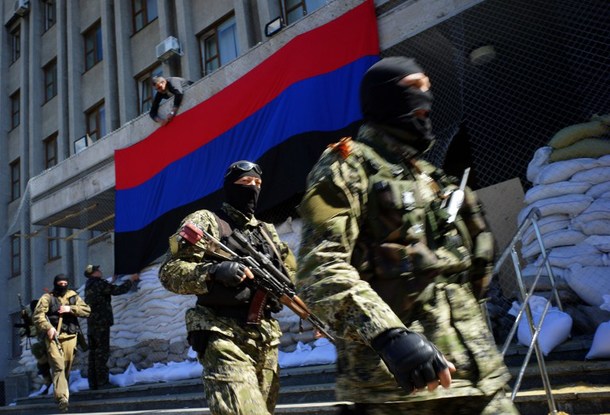
Men With Masks

Pro Russian Militia in Eastern Ukraine -kyivpost.com

In 1989, there was an interesting moment for those who were in the map business.  Almost overnight, it seemed almost as if the entire Eurasian continent would require a reorganization and renaming. For those at Rand McNally , the midnight lamps were burning as new countries popped up daily as free standing entities – Estonia and Moldova; Montenegro and Georgia; Slovenia and Slovakia; Armenia and Azerbaijan; Russia and the Ukraine.  An enormous re-ordering of the world occurred peaceably as the two great powers, the United States and the Soviet Union stood down to allow it to happen without major bloodshed.  A new world order was declared – a world in which the principles of free choice, self determination, peaceful cohesion and global interconnectiveness would overwhelm tired old tribalism and cultural malevolence.

Well, the new world order did not last long, and it may be time to get those map makers busy again.

There’s a new technique being used to subvert international order and territorial integrity and it basically requires producing a map and finding men with masks to enforce it.

Charles Kupchan, former Professor at Georgetown and current Senior White House Director of European Relations for the Obama Administration, and one of the mentors for the President’s shall we say interesting interpretation of history, has defined this new technique as ‘hybrid warfare’ :

“Because I think one of the things that we’ve learned from the situation in Ukraine is that oftentimes in this new world that we live in, NATO or individual countries may be facing not armored columns coming across their border, which you can usually see in advance, but guys coming across in masks, you don’t know who they are — what we could call hybrid warfare, or asymmetric warfare. And that requires a very different kind of military response than NATO has traditionally been focused on.”

Charles Kupchan is the author of the book  “No One’s World: the West, the Rising Rest, and the Coming Global Turn”  in which he sees the West – meaning the US, Europe and Japan – in a position of irreversible decline and the need to deal with a world where no one will be ‘in charge’.  This administration is well on its way to making Dr. Kupchan’s vision a reality.

These men in masks seem to have a proclivity to ignore international borders, and part of their technique is to suggest the border has no validity.  You do that by getting a map the reorders the border – thus the sudden existence of Novorossiya (or New Russia) – a country President Putin is referring to as spontaneously existing, and therefore the need for a map:
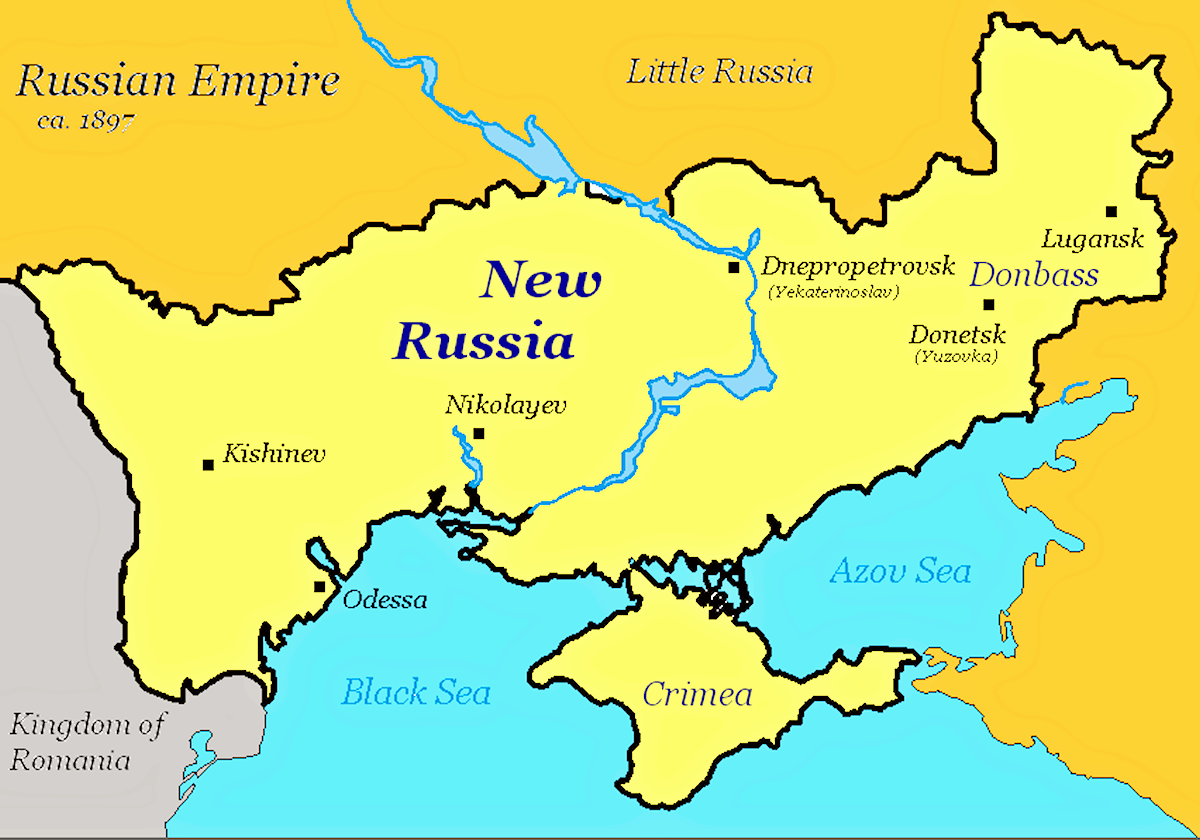
Novorossiya as Putin would see it

We seen this pattern in the recent past in another conflict:   Masked Men
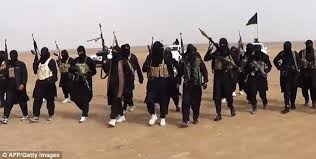
Masked Militia of ISIL

And a Map of the Caliphate they assume will be theirs:
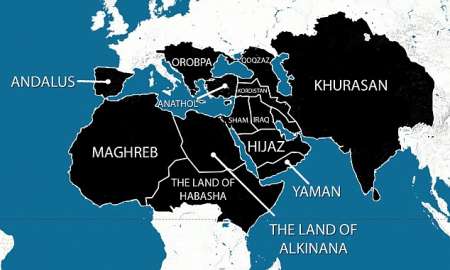
The ultimate Caliphate desired by ISIL

So what’s with the masks?  The masks are a device to allow the anonymity of not just the warriors but their nation sponsors. These so called hybrid warriors as Kupchan would have us believe spontaneously form have no desire to be recognized for what they are – shock troops for the countries that want to see maps changed in their favor.   Masked men who hide their nationality and their identity allow free transition between borders and the ability for countries to provide them with sophisticated weaponry and support.  These shock troops allow  the Irans, Qatars, Saudi Arabias, and Russias of the world to engage in proxy war that otherwise would position them as old fashioned pariahs and might even engage an old fashioned response from the part of the world that is self absorbed in self induced decline.

The United Nations Charter of which of the above aforementioned are member states, pledges in Chapter I Article 2  of the United Nations Charter:

All Members shall refrain in their international relations from the threat or use of force against the territorial integrity or political independence of any state, or in any other manner inconsistent with the Purposes of the United Nations.

That charter of course doesn’t matter if you can get the map to say a new territorial reality is present, and you have masked men to enforce it.

This is a very dangerous game that countries like Russia are playing, and it is awakening people from the political spectrum one would think would be the last to respond.  The President of the United States however is still formulating a strategy that will permit the progressive decline of the West without him being perceived as directly responsible for its destruction.  That’s a balancing act we have not seen him showing the high wire skills necessary to pull off.  Then again, the United States has a border, a southern border, that the administration is loathe to enforce territorial integrity over. It won’t be long before we see our own masked men.  And they’ll probably be carrying a map:
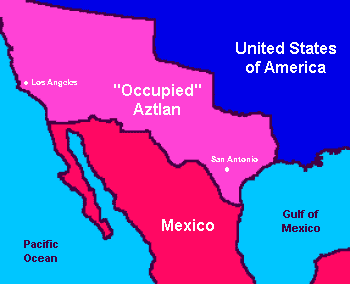
AZTLAN
AZTLAN

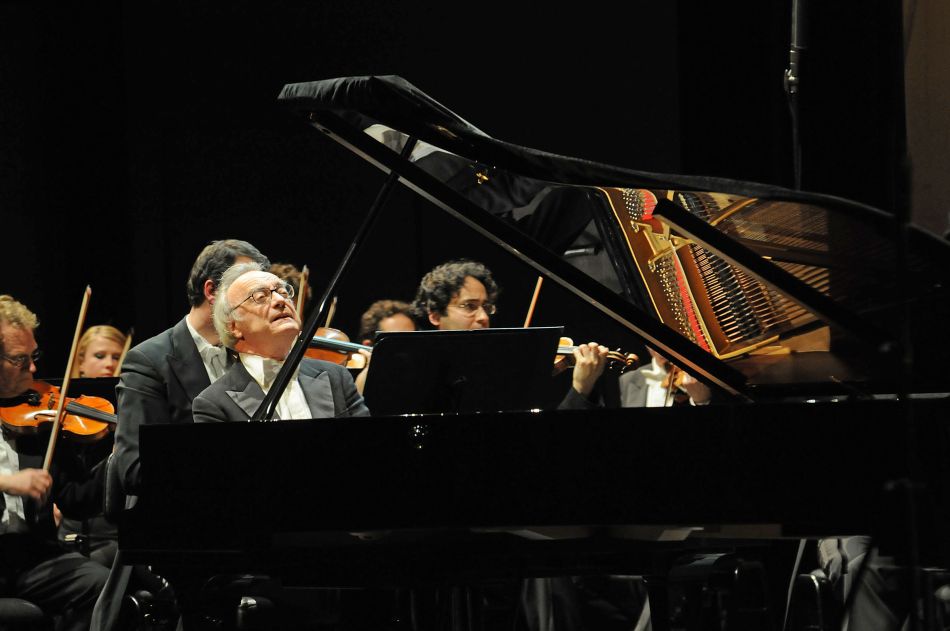
Alfred Brendel and Beethoven’s Ghost

ALFRED BRENDEL
ALFRED BRENDEL

About twenty five years ago during my study years, I had the opportunity to see Alfred Brendel in recital performing Beethoven. I had a vague understanding through recordings what I might hear, but I was not prepared for the possibility that I was going to be involved in a seance.  Among other pieces, Brendel performed a late Beethoven piano sonata.  It was during this piece he became simply transfixed and other worldly.  Several minutes into the central movement, a listener developed an annoying recurrent muffled cough in the hushed recital hall.  The sublimity of Brendel’s face on stage began to reveal a series of anguished contortions, as if he was being pulled from a deep dark place into blinding light.  After several moments, he stopped playing, to the astonishment of the audience, and turned to the horrified cougher with an intense expression, then said, he could not channel Beethoven and play it the way the master wanted, and the audience deserved, unless the dissonance from the audience stopped.

The coughing stopped, and the sublimity returned.

No one can play Beethoven like Alfred Brendel, and  the means to the answer was on the stage that night. Brendel plays Beethoven like a re-incarnated Beethoven, and it  may well be that he is capable of channeling the master composer’s spirit directly into his body and soul.  To hear Brendel in recital is likely the closest you will ever get to hearing Beethoven himself perform his works at the height of his prowess in Vienna in 1800.  Frankly, you probably will never know how Beethoven must sound until you hear Brendel perform Beethoven.  The perfect phrasing, the precise articulation, and the masterful but limited use of the pedal makes a Brendel interpretation of a Beethoven sonata not a performance but rather, a re-creation.

Alfred Brendel was born in 1933 in the remnants of the Austro-Hungarian Empire, born in the Czech Republic, moving to Croatia at an early age and eventually settling Graz, Austria.  He showed early musical talent,but the horror of WWII swept away any capacity for rigorous formal training.  It may well be that his self taught style in the absence of overbearing influence of piano teachers may well be the means by which Brendel has maintained the purity of the compositions in his performance.  Regardless of formal instruction, Brendel’s performance genius particularly for the classical masters of his homeland, Mozart, Schubert, and most specifically, Beethoven was evident in the years after the war and through his long career since until his performance retirement in 2008.

Interpreters of Beethoven are particularly cherished for their ability to remind every one of the unique olympian genius of Beethoven.  In the first half of the twentieth century, the ultimate interpreter was recognized to be Artur Schnabel, and there has been a need by music critics ever since to use Schnabel’s intense concentration on the Beethoven works as the standard by which to evaluate all others.  We have only the older recordings by which to judge Schnabel, but thanks to the wonders of YouTube, we have an extensive performance record of high fidelity by which to immerse ourselves in the wonders of a Brendel performance.

Two Beethoven creations of Brendel frame this performer’s mastery well.  The first is the most beautiful and elevating seven and a half minutes of music in the classical literature, Beethoven’s Adagio movement from his epic ‘Emperor’ Piano Concerto No.5. The second, Brendel’s recital performance of Beethoven Sonata No.32.  The concerto performance will make you cry a little as you feel Beethoven reaching for the essence of human beauty at a time of enveloping hearing loss, but the Sonata will leave you stunned, as you realize Brendel is reaching through time and space, and bringing Beethoven physically through his hands onto the piano, to the everlasting wonderment and joy, of us all…

The Big Ditch Turns 100

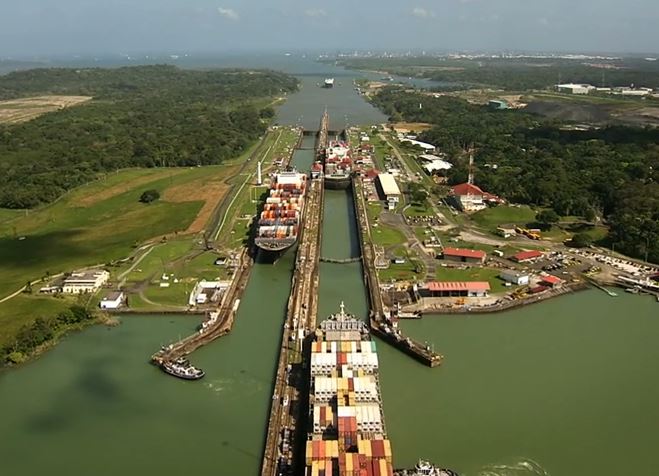
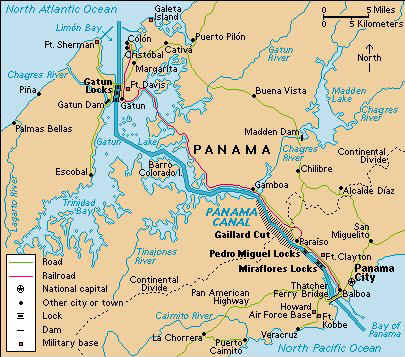
PANAMA CANAL
PANAMA CANAL

In today’s culture of dependency, it is hard to remember a time not so long ago when a visionary idea no matter how difficult, time consuming, or potentially immensely risky, was seen as a genetic characteristic of our civilization.   For thousands of years until the nineteenth century, the progressively discoverable world was available at the speed by which a man could walk or run, or horse could be ridden, or a sail could push a boat by a fickle wind or current.   A world so vast, that a day’s voyage could be arduous simply within the limits of a man’s sight, and the idea that one could know the world through personal experience seemed beyond  the scope of a man’s lifetime.

Yet, there seemed to be no shortage of individuals that would take on seemingly impossible and dangerous journeys to somehow reduce the globe to human conceptualization.  The ancient Polynesians using rafts to turn the Pacific Ocean into a highway between settlements.  Marco Polo traveling for twenty-four years and 15000 miles along the Silk Road to the Forbidden Kingdom and back, to document a civilization superior to his own and open up a trade revolution that changed his home forever. And 500 years ago, Ferdinand Magellan pointing his ships west rather than east to develop a sea route for trade that ended three years later as a 24000 mile voyage that circumnavigated the globe.

Especially poignant is Magellan, for he did not live to see the fruits of his great achievement, having died two-thirds upon the way of his massive voyage, massacred on a remote Philippine Island at the hands of an angry chieftain’s warriors who took umbrage at his desire to play favorites and Christianize those he preferentially selected.  In fact, of the 230 or so intrepid voyagers who accompanied Magellan on his epic journey, only 18 managed to circumnavigate and three years later return safely to their point of departure in Spain. These explorers were however to make Magellan immortally famous in their careful records they took of the voyage, so meticulous that they determined they landed one day younger than the number of sunrises and sunsets that had been catalogued since they had left, the first humans to document time travel, associated with traveling against the world’s rotation.

Magellan achieved many identified firsts, but it was certainly not his intension to take the longest possible route to East Asia.  He  rather hoped for a shorter rout traveling west to east then was at that time required to sail around the Cape of Good Hope and across the Indian Ocean. His desire for potentially  shortened sea routes led him to avoid the rumored foul weather and dangerous waters of Cape Horn, at the southernmost tip of South America, instead navigating and ultimately discovering the Straits of Magellan, at the northern most aspect of the Tierra del Fuego, thus cutting several hundred miles off the voyage compared to around the Cape Horn. Through the straights he named the new ocean he encountered the Pacific, or ‘peaceful’, for it’s apparently placid waters as compared to the tumultuous Atlantic.  The short cut was nice, but the travel west from Atlantic to Pacific around south America still required an 8000 mile journey, and certainly represented no bargain for traders in regard to time or risk who wished to go to the East Indies or China.

You might wonder how all this Magellan business leads us to the Panama Canal. Well, I’m getting there.  You see, Magellan was not the first to recognize the new ocean, the Pacific.  That honor went to Vasco Balboa,  who in 1513 crossed the Isthmus of Panama and became the first European to view the western Pacific, suggesting a path thousands of miles shorter than Magellan’s circuitous route.  But nobody got efficiently rich transporting goods across scores of miles of mountainous jungle (at least until the Conquistadores discovered native slave labor) simply to reload then in a boat.  No, fortunes were made filling the massive cargo hulls of sailing ships and bring the goods home in one  watery trip, making even the thousands of extra miles of the Cape Horn trip more viable than cross country.

Balboa’s vision of a shortcut across the Isthmus travelled the centuries unrequited until the machine power of the nineteenth century began to make the idea of a canal more than a pipe dream. The Europeans were still the initial visionary force behind the dream of a canal and the French got the farthest, developing a canal company  that beginning in 1881 spent the next nine years on a tragic and fruitless effort to tame the 48 miles of mountainous jungle that separated the two bodies of water. Nine years later, having lost 22,000 workers to tropical diseases such as yellow fever and malaria, and having sunk the investments of 800,000 French investors, the effort was abandoned.

The canal idea was not too big, however, for the bountiful new world republic to the north. Despite having connected the continent by rail in an equally spectacular engineering achievement, goods and services were infinitely too expensive to travel by rail from New York to San Francisco, taking instead the ultimately cheaper, but daunting sea trip around the Cape Horn that would take months.  The United States, in the midst of a boundless can do spirit occasioned by becoming the world’s biggest economy at the beginning of the twentieth century, saw the opportunity of the canal, and the power that  would go to the country who ran it, too valuable to not take up the epic challenge.  The United States engaged in some very dubious politics,  positioned itself as the overlord of the vision and never doubted for a minute its ability to get the job completed.

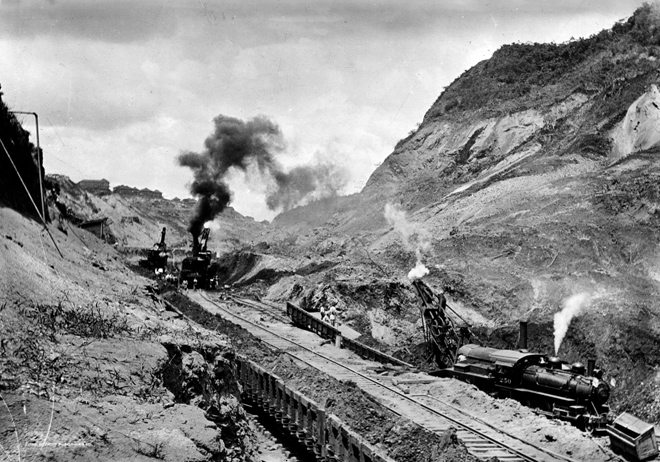
The final vision came in the form of Theodore Roosevelt, a president who saw the future of the United States as a world power, and focused the immense energy and economy of his country on the huge project. From 1904 to 1914, the United States through its Army Corps of Engineers ,spent some 8.6 billion dollars in today’s  money, used some of the world’s

The Earthmovers of the Big Dig 1904-14
The Earthmovers of the Big Ditch 1904-14

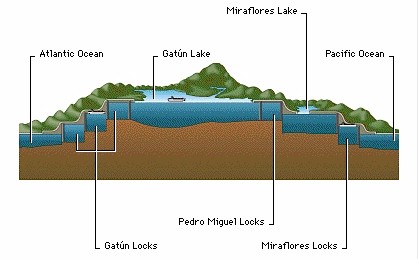
first bulldozers and earth movers to blast and sculpt its way through the Panama wilderness, moving over a 152 million cubic meters of excavated earth, losing 5600 workers to the same diseases that plagued the French, and creating the world’s most spectacular set of locks and dams that continue to function today in magnificent fashion.  The locks still make possible for some of the biggest ships in the world  to traverse huge quantities of goods from sea level up over the

The Locks Solution to the elevations of Panama

mountains and back to sea level without ever unloading a crate off a ship.  The 48 miles of beautiful locks and transporting tug trains make possible the movement of billions of dollars of goods across the Isthmus each year and reduced the epic path of Magellan from 800o miles to 48 miles and the time from months around South America to just 20 hours.

The Path Between the Seas-   PANAMA's CANAL
The Path Between the Seas- PANAMA’s CANAL

The nefarious politics that ultimately gave the United States the rights to build the canal and ultimately run the Canal Zone, and the just as uncomfortable politics that lead to the canal hesitatingly being turned over to Panama ultimately in 1999, can not take away from the incredible achievement that incredibly connected two oceans.  The 150,000 dollar fee for traversing the canal is worth every penny for the ships filled with the hugely profitable trade goods  that magnify Magellan’s dream a million times over.

August 14, 2014 was the 100 year anniversary of the opening of the canal, and the world has benefited greatly from the daring of a young nation that naively felt that it was chosen to do great things, and somehow got them done.  It would do us well to remember the civilization we are so quick to blame for every inequity was once the natural spring of  visionaries that conquered the Silk Road, circumnavigated the globe, made distance our servant, and took the impossible, and made it happen.

Barbarians at the Gates

ISIS deals with prisoner of war issues in Iraq - AFP Photo
ISIS deals with prisoner of war issues in Iraq – AFP Photo

To comprehend events, one must be willing to descend into the faint mists of time and history to possibly understand the here and now.  The boundaries that define the modern country of Iraq are artificial drawings on a map that simplify a maelstrom of historical peoples, events, and passions that are the basest contributors to the whole known human story.  The fertile crescent of land between the Tigris and Euphrates rivers has been the birthplace of great empires and religions, and perhaps the most contested real estate on the planet.  At the northern edge is noted to be the birthplace of man as a creature of record. Some three thousand years before Christ the tribes of the region founded the worlds first recognized governmental structure, the Semitic kingdom of Semites and Sumerians known as Akkadia, soon divided into Assyria and Babylonia. It is said that the Assyrian Semite Abraham traveled out of Assyria around 1800 BC to eventually become the father to the Hebrew peoples. By the tenth century BC, Assyria may have comprised the largest empire in then known world and provided the legacy of one of the great core language structures, Aramaic, influencing people from northeast Africa to central Asia.  The Assyrian people became  important contributors to the expansionist Greek empire culture and subsequently were influenced to assume many of the philosophic constants of the Greeks, in many cases becoming early Christians as did their Greek counterparts in the first through third centuries AD.

With the arab Islamic conquest of Mesopotamia in the seventh century, the centuries long process of this ancient culture having to subordinate and assimilate while trying to preserve its identity began.  Through Islamic pogroms and Mongol invasions, Ottoman overseers, British protectorates and Baathist dictators, the identity of the ancient Assyrian culture managed to survive.

Until now.

The city of Bakhdida, also known as Qaraqosh, is the home of the Assyrian Christian population of Iraq and the gateway to Kurdistan.  With a population of 50,000, it represents one of the last congregations of Christian influence in Mesopotamia and its existence as such is an anathema to a virulent strain of Islamic puritans known as ISIS.  On friday, August 8th, Bakhdida became the latest city to be overrun by the ISIS horde and the consequences to an entire people who profess a different fate are dire.  With tens of thousands of Christians fleeing the genocidal sickness that is the ISIS modus operandi, President Obama finally determined to take action in some form to address his administration’s developing Rwanda event. It was not the fate of the Christians or their Kurdish or Shia muslim brethren that stirred him so much as the plight of the Yazidis, a small sect connected to the ancient Zoroastrian faith of monotheism that precedes Islam, Christianity, and Judaism.  ISIS forces have forced them into the mountains with the intent of starving them to death, or killing them in place, whatever opportunity presents.  For the ISIS  adherents, this is the holy work that should have been done centuries ago.

The western world has always struggled to get too upset about genocidal outrages against Jews and Yazidis, but Christians?  That used to be another matter.  There is no Richard the Lionheart to lead a Crusade, likely not even a George Bush the Earnest.  The post-Christian western world does not connect well with the outrages committed by Islamic extremists, whether it is the lunatic fringe Boko Haram in Nigeria slaughtering entire villages of Christians and trafficking in human slavery, or ISIS with its religious cleansing fury in Iraq. Christian outrage and responding to attacks is so Seventeenth century.

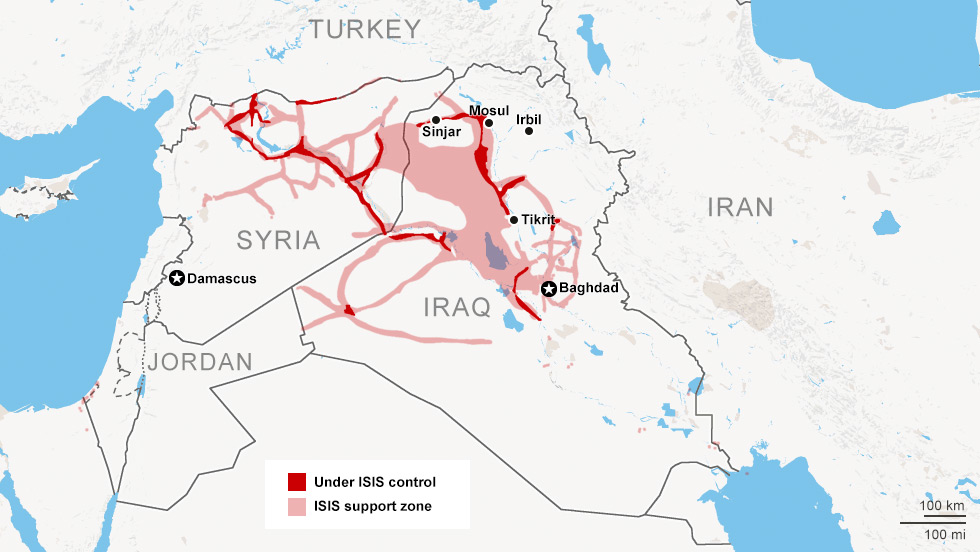
But ISIS is working in the seventh century and doesn’t give a flip to modern mores.  Having stunned most of Iraq, conquering oil fields and water supplies, drowning in money from bank robberies and sympathetic fat cat Wahabiast poseurs from the Arabian peninsula, and in possession of millions of dollars of sophisticated weapons abandoned by the Potemkin Village Iraqi national army as it fled,  ISIS is a Tamerlane disciple of the twenty-first century, with the will to kill who doesn’t submit.  The map shows an effective reality on the ground that suggests they are succeeding in their vision:

ISIS in Mesopotamia - CNN maps
ISIS in Mesopotamia – CNN maps

So the President of the United States finally acted. Not to save Christians or Iraqis.  That would have required previous strategic thinkings and actions.  No, the action is to prevent current genocide against the Yazidis, certainly deserving, but no more deserving than any of the other hundreds of thousands already crushed under the foot of the marauding 7th century jihadists.  President Obama thinks he can pick and choose his genocides he determines to intervene upon.  I suspect ISIS and Boko Haram will give him plenty of choices from which to choose.

What is there to do in this inevitable world calamity approaching?  It is frankly too late to recognize what would have been the easiest solution in Iraq.   President Obama’s political trump card was the withdrawal from Iraq no matter what the consequences, when twenty-thousand in country troops would have likely prevented this travesty.  Imagine you are the warden of a prison filled with 500 dangerous characters and innocents alike.  With just 20 guards providing organized control, you can maintain the security of the prison and keep the most dangerous inmates from killing you, or each other.  The previous warden gave you after much effort a stable place, with effective control.  But you are a much smarter warden, who believes the previous warden was a doofus, and should not have been allowed to have made warden decisions in the first place that did not sit with your world gestalt.  You therefore instead announce you are pulling all the guards, opening all the prison cell doors, and putting the kitchen staff in charge of negotiating with the prisoners.  Its pretty easy to predict what will happen, unless apparently you are President Obama.  Now, if you want to contain the violence, restore the security, and protect the innocent,  it’s going to take a hell of a lot more than twenty guards to achieve a renewed stability and civility.  And a lot of people are going to pay a very grave penalty for your naiveté.

What to do with a modern world that would like to believe we have grown beyond the barbarians that defined our human past-the Tamerlanes, Attilas, Genghis Khans, and Hitlers – that would create a single vision of humanity on the slaughter of nonbelievers? The Assyrians of Bakhdida would like to know soon, and hope its more than a few food packages and pinpricks.  But if the western world cannot decide this is serious business, don’t worry.  We may soon get first hand knowledge of what the Assyrians of Bakhdida are up against, at a location much closer to home.

Claude Debussy and the Prism of Life

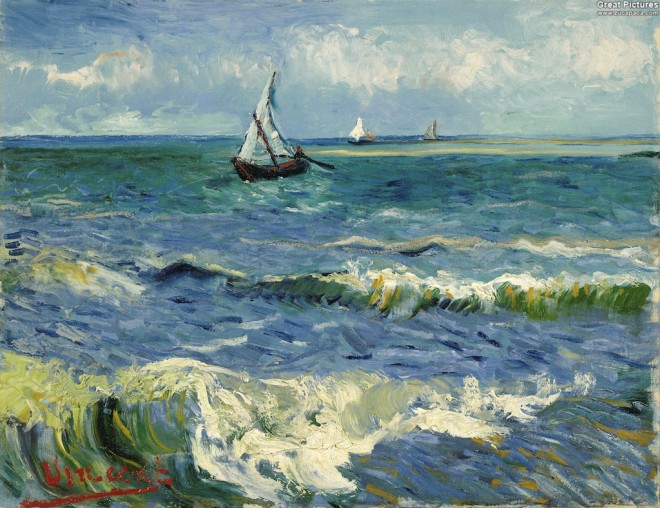
Seascape near Les Saintes-Maries-de-la-Mer, 1888 Vincent Van Gogh
Seascape near Les Saintes-Maries-de-la-Mer, 1888
Vincent Van Gogh

Until the seventeenth century, light was accepted as a force of illumination, colorless and devoid of structure, the essential device by which God brought life from a formless void.

In the beginning God created the heavens and the earth.  And the earth was without form and void; and darkness was upon the face of the deep.  And the Spirit of God moved upon the face of the waters.  And God said Let there be Light. And there was Light. And God saw the light, that it was good. And God separated light from the darkness.                                                            Genesis 1:  1-4  

Then Isaac Newton came along, and revealed that colorless light was actually a complex spectrum of many colors, the beams made of heretofore unknown constituent particles that disassembled by the prism could be easily reassembled. The understanding of the world and its realities were forever changed.  With the microscope, the wonders of microscopic life, with the telescope, the celestial heavens comprised of so much more than the visible known.

This new understanding, that the miracle of nature and life was not for simple interpretation but for complex experience of the seen and the unseen, the heard and the sensed, inevitably established itself as a device by which the artist and musician , as interpreters of the two most visceral senses, expanded their creative forces to interact with man’s ultimate tool of expression, his imagination.

The 19th century was period of the most intense experimentation in these concepts, with the end of the century achieving the synthesis of this ideas in a merged artistic school known broadly as Impressionism.  The goal of the impressionists, whether in writing , art, or music was to achieve a projection of the essence of a subject, rather than a description of it.  Paintings fragmented or blended light, removed both clarity and shadows, brought an ethereal sense of place without specifically demanding accuracy from it. To look at the same haystack at three different times of day or two different seasons changed entirely the essence of it, and the feelings it emoted.  The power of this human impulse to interpret the natural world this way was most developed in France, linearly from Manet to Monet to Renoir to Van Gogh and beyond.

A parallel track was occurring in music, initiating with Berlioz and the Russian Five developing the telescopic power of the modern symphony through Wagner and his symbolic use of sound through motifs, but the back to France to join the painters and authors, through the most original stylings of a very unique genius, Claude Debussy.

Claude Debussy was born in the town of Saint Germaine in countryside near Paris in August 1862, just before Manet’s Luncheon in the Grass was revealed to Paris in an exhibition highlighting the first transitions from realism to something altogether more evocative.  Debussy’s family was driven from Paris by the crisis of the Franco-Prussian war in 1870, and moved to Cannes, where his musical talents were discovered and allowed to flourish under a diverse set of colorful instructors, that appealed to his contrarian and bohemian genetics.  Artistic education for talented people propelled through France’s Academe, where the principles of classical art and music were rigorously enforced.  Debussy like all scoundrel talented youths from time immemorial had no patience for the judgements of accredited types, and sought his own muse almost immediately.  He was never a fan of the concept of Impressionism as it was then understood, but preferred the symbolic aspects devised by Wagner, while repelled by its bombastic Germanic expression.    He was drawn more to the world of the microscope than the telescope, relating to more intimate expressions and internalized emotions, consistent with other avant-garde composers like Satie.

Debussy reduced the experience of music to its essence, but he was not averse to beauty.  For him the natural world was so inherently beautiful that even discordant voices and cords could be, like the prism, used to emote a unified whole that was spiritual by his definition.  And beauty was for him the most primordial expression of the senses.  It flows like its own force from the tone poems of Images,Iberia,  and La Mer to the crystal glass intimacy of Clair du Lune, Reverie, and l’apres-midi d’un Faune.  The music soars and dives, roles and ripples, like light through leaves or wind through a screen.  It is tactile and physical, but does not exist in the conscious emotions of passions or anger.  This is  the serenity of the natural world on the floating mind, clouds between storms and waves driven by the eternal tides.  Expressing like JMW Turner, we are left to feel the boat on the ocean, or is it only a cloud, though it matters not because it is after all, the essence of the sea.

Debussy produced volumes of work that ushered in other great composers like Ravel, and contributed side by side with contemporaries like Stravinsky.  He unfortunately lived long enough to see the realities of the mechanized world destroy the intimacies of the old innocence with the brutal forces unleashed by World War I, another August anniversary of note.  The faintly discordant sonorities of Debussy were soon over taken by the cold  post industrial mathematical expressions of Berg, Schoenberg, and Webern.  The prismatic quality of Debussy was no longer capable of being reassembled as a unified expression linked by beauty.  The immense calamity of World War I and its effect on the psyches of both artist and audience alike saw to that.

But then, nobody is meditating to Schoenberg, or rocking their baby to sleep with Webern.  The innate stimulus of a special human place in the brain is Debussy’s gift to us, and like the prism, separates and re-assembles the world into a unified beautiful whole we long for in our daily lives, when the real world gets to be just a little too much.  Tomorrow is the 100th anniversary of the fateful declaration of war of Great Britain against Germany, exploding the conflict in the center of the continent into a world war, and changing the individual intimate world Debussy created for us forever.  The better memory will always be the gift of Debussy’s prisms of life.

And God said, let there be Light. And there was light.  And God saw the light,  that it was good.