Maverick

Maverick
photo attrib art_cred-krista_kennell


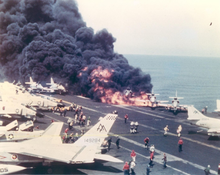
Zuni Rocket sets L.Cr. John McCain’s plane aflame on the USS Forrestal

At 10:51am July 29, 1967, the USS Forrestal, an American aircraft carrier positioned in the Gulf of Tonkin off the coast of Vietnam prepared a flight deck for participation in the strategic bombing campaign, Rolling Thunder, and had a deck full of fighter aircraft loaded with ordinance. Completing the dangerous process of loading live ordinance , an A-4 Skyhawk captained by Lieutenant Commander John S. McCain III was docked at the stern of the carrier when a Zuni rocket secured to a craft on the opposite side of the deck, due to an electrical surge on the craft, spontaneously fired and released, shooting across the tarmac directly into McCain’s jet fuel tank, spilling hundreds of gallons of highly flammable    fuel.

Deck crewmen, quickly realizing the extreme gravity of the situation, rushed to douse the flames.  McCain got himself extracted from his cockpit, jumped down off the craft and raced across the deck as the fire crews ran past him to spray fire retardant.

McCain got half way across the deck when the first 1000 lb bomb beneath his craft ignited from the fire’s heat, blasting him 10 feet in the air, peppering him in shrapnel, and instantly disintegrating the courageous fire team behind him.  Before the conflagration was over, scores of bombs exploded on the deck of the Forrestal tens of thousands of gallons of jet fuel ignited, and in the worst on deck accident in U.S. history, 134 servicemen were killed, another 161 injured.  John S. McCain, so close to the center of a death defying ordeal, managed to come out of the conflagration to live another day.

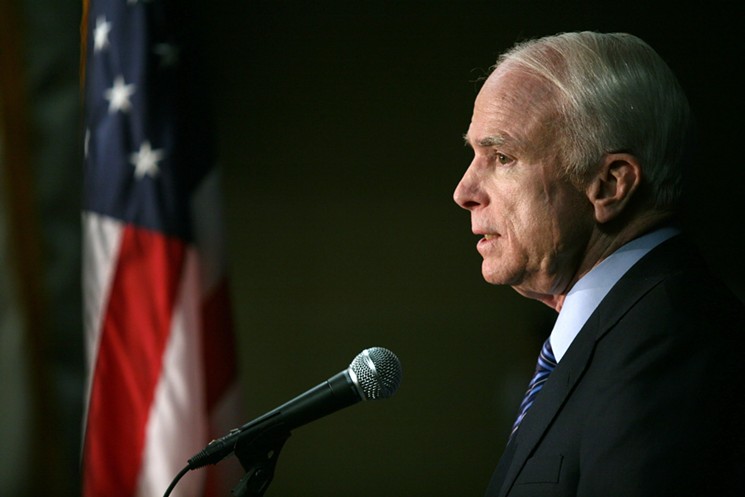
Yesterday, the Maverick met an ordeal beyond even his unique survival skills, and succumbed to brain cancer at the age of 82.  Like every other adversary he had the misfortune to face in his life, he proved himself both courageous and circumspect in his place in the battle to survive.

John S. McCain III left an indelible mark on the world in the 50 or so years he was a public figure.  History called him from birth to be a participant, not an observer.  His grandfather John McCain was an integral part of carrier actions in World War II.  Foreshadowing his grandson, he was a Naval Academy graduate,  hard driving, profane individual who liked to take responsibility on his shoulders, and was empowered by the proximity to danger and action.  A top Pacific commander at the end of the war, he died of a heart attack just four days after the Japanese surrender, completely worn out by the demands of the job.  His son, John S. McCain, Jr., followed his father’s footsteps to become a four star admiral in charge of Naval Pacific Operations in the Vietnam War.  It was an unavoidable destiny, therefore, for John S. McCain III, nondescript student and having a reputation as a hell raiser at the Naval Academy, to follow his father and grandfather’s path as a Naval aviator in the midst of the Vietnam War and a participant in the fighting during his father’s command.

The Forrestal was just the first of MCain’s life altering brushes with death.  The second occurred three months later from the Forrestal disaster, when on October 26, 1967, when on a bombing mission over North Vietnam, McCain was shot down by a surface to air missile.  Forced to eject from the plane, McCain fractured both arms and a leg on the ejection impact, nearly drowned when he parachuted into a lake, then was dragged out by North Vietnamese troops, who permanently crushed his right shoulder with a gunstock and bayoneted him.  Transported to the notorious ‘Hanoi Hilton’ prison camp, the severe injuries were left untreated, and further torture followed until it was discovered who his father was by the captors.  This led to a hospitalization for basic treatment in hopes that McCain could serve as a propaganda tool against his father, and country.   McCain lost fifty pounds in the ‘hospital’ and was not expected to live.  When he revealed to the enemy the Maverick survival orneriness that everyone back home already knew about, he was placed in solitary confinement for the next two years.  The beatings resumed in an effort to get him to sign a ‘confession of guilt for  war crimes’ and he was offered early release if he would sign.  The horrendous treatment could not break him, refusing any preferential treatment.  He remained steadfast in the five and one half years that he was imprisoned until his release in 1972.  He carried the physical and mental scars of his brutal treatment to the end of his life.

McCain returned from the war a different man, but as events that are as severe as the ones he had lived through, reinforced both his good and bad impulses.  He returned to navy command and performed well, but recognized he would never achieve his ambitions to the extent that his father and grandfather did in the Navy.  He turned his direction out of the military — and away from his faithful wife, who had been injured in a car accident, and suffered much of the same rehabilitation requirements that McCain endured upon returning to the States.  He requested a divorce, and remarried, this time to an Arizonan who was an heir to a fortune and who’s father related to Arizonans of real influence.  McCain entered Arizona politics, and won the congress seat for the Ist district as part of the Reagan wave of conservative victories, then subsequently, won the Senate seat of the retiring legendary senator Barry Goldwater.

Assumed to be a pure conservative, Senator McCain began the conversion to a contrarian that would earn him the title of political Maverick by a conflicted press, that, while enjoying  his willingness to destabilize his own party unity and his love  of the battle, confounded by his residual tendency to hold, for them, abhorrent conservative foundations and ‘warhawk’ persona.

He enjoyed the public world, never shying from a headline, and relished the discomfort his ‘reach across the aisle’ attitude caused his fellow Republicans.  His ambitions showed full flower when he engaged in a bitter race for the Republican nomination for President in 2000 against the front runner George W. Bush, losing , but holding a fairly significant grudge in the process, that led to McCain functioning as an unpredictable thorn in the eventual President Bush’s side in legislative issues such as tax cuts, carbon taxes, campaign finance, and gun rights.  He remained illogically  close to John Kerry, a radical anti Vietnam war protestor following a controversial Vietnam combat experience, leading to a timid support of Bush in the 2004 election, and a further distancing from the party’s conservative core.  Yet, when a quagmire and a potential ignominious defeat in Iraq loomed, MCain was unwavering in his support for President Bush’s decision against all odds and advice, to support an American military surge tactic, that turned the conflict and removed direct war in Iraq as an obstacle for future Presidents.

The moment of truth for John McCain came in 2008, when his ambitions and the party’s presidential opportunity coalesced in a Presidential nomination at the party convention.  McCain worked tirelessly, but his contrariness and his lack of party discipline got him into trouble from which he never recovered.  McCain made several crucial mistakes that doomed the already difficult task of defeating a Bush weary country against an unknown idealized Democrat candidate, Barrack Obama – young, sophisticated, and of mixed race — an exotic combination that proved intoxicating for a compliant press and a country looking to get a way from a war footing.  McCain became disappointed that his personal rapport with the press held little sway when up against someone that exemplified their idyllic view of government.  He selected an obscure candidate for Vice President in Governor Sara Palin of Alaska , who he hoped would restore his shaky relationships with conservatives, only to nearly abandon her when she proved shaky in her grasp of facts and unexperienced with the full court pressure applied by the press.  He grossly misread the effect “suspending” his Presidential campaign when the October 2008 banking crisis hit, traveling to Washington to ‘work for ‘solutions’ where he was easily tarred  as an accomplice in the disaster.  Obama, also a Senator, wisely stayed away and let Washington flail, allowing  Obama to remain clean of all the necessarily politically unpleasant decisions required to survive the crisis.  McCain’s likeablity and hero status translated to nearly 60 million votes, but he was swamped in the electoral college by nearly 200. John McCain had reached the pinnacle of his political life, only to come up against a more presidentially projectable maverick than he, in Obama.

He spent his residual years in the Senate prior to his illness trying to fashion the illusory middle ground that he felt was the way forward for the country.  Opposed to the Accountable Care Act as an unworkable and undemocratic bill, he ended up being the crossover vote that protected the bill against rejection in 2017, when he felt the alternative was equally unstructured and undemocratic.  He sided with the Obama administration in the ill conceived actions in Egypt and Libya, but was virulently against the inactions in Syria and the process of negotiating with Iran’s theocratic dictators  without Senate treaty submission.  Despite being the Senator of a border state, he could never find a comfortable position on the need for border security and immigration reform.  Regardless, as with all historical moments in his life, McCain positioned himself in the center of the action, and determined a course he felt he could live with, and a priority and principle he felt was consistent with his personal calling.

John S. McCain saw himself as a maverick, and like all mavericks was comfortable with the inconsistencies and flaws the maverick nature tends to expose.  But more than maverick he was heroic, living through pain, torment, and controversy as if they were ennobling, rather than dehumanizing.  He was authentically American in his heroism, sometimes losing the consistent and realistic for the ideal, and never, ever wavering in his love of country or mission his family had taken over multiple generations to sustain it.  Choosing politics as his ultimate personal mission, he exhibited some of the recklessness that lost him the coalescence of support from all the factions that are necessary to ultimately prevail.  The maverick model was, perhaps, a little ahead of its time, and McCain stopped just short of the populist impulse that would eventually position another maverick candidate, Donald Trump to achieve the ultimate prize.  

John S. McCain III was above all, one great American story.  His core is described in both his own memoir, Faith of My Fathers , and in the brilliant reporting of Robert Timberg in The Nightingale’s Song. We will miss John McCain as we will miss a crucial part of our Americanness, – action oriented, courageous, occasionally impulsive –  but trying to find the right and true way forward.

Rest in Peace, John McCain.  God Speed to the Maverick.
JMW Turner – At Romanticism’s Edge

JMW Turner (1775-1851) lived the life of a radical genius.  You know you are making an intense impression when two avowed art critics can look at your work , one critic seeing an artist that “most stirringly and truthfully measures the moods of nature“, the other that sees only “blots“.  In 2016, I had the opportunity to visit the British Tate Museum in London and see Turner for myself, by the means he had requested his works to be seen — en masse in a comprehensive collection at a single site.  Taken as a compendium of a lifetime of work, the radical genius shines through.   As a collector of contemporary artists, it is no small coincidence that I am drawn to artists that acknowledge the foundational influence upon them of Turner’s unique color palate and his interpretation of the natural world as an unbounded sublimity.

Turner was born into a world of commoners and limited means, and he never rejected his birth circumstances, despite his fame at times reaching rockstar celebrity status.  At every opportunity to set anchor in the quiet harbor of accepted technique and contemporary adulation, he sailed farther and farther out into unsafe, radical places.  By the end of his life, his paintings bordered on swirling, indecipherable, impressionistic and existential art scape.  He was happy to coexist in all intimations of the real, the ideal, and the surreal and make you as the observer uncomfortable in interpreting where the painting foundationally lived.  Turner lived in very modern circumstances — a recluse, in non-traditional relationships, and combative academic worlds — but generally cared not a wit what others thought of his interpretation of  his world.  Regardless, his effect on art during his life and afterward was immense, and he remains a titan today.

JMW Turner typified the world of art that lived at the edge of Romanticism, the movement that returned to the concept of Nature as ungovernable and unconquerable, the modern rational, globalist world of the Enlightenment as antithetical to the individual’s need to absorb the sublime and emote in the language of feelings, rather than definitions. Turner saw Britain’s emergence in the 19th century as a dominant sea power as a perfect canvas for man’s intrepid spirit against the awesome power of nature.  He repetitively told the apocryphal story that he had personally experienced his unique interpretations of nature’s chaos and color at sea by having requested himself to be lashed to a ship’s foremast in a violent storm.  Whether that had ever truly occurred, his seascapes are embellished with rule breaking light, color, and chaos that suggest intimate knowledge of an unstable entanglement of water, wind, and foam in the deep ocean that speaks to a very personal, emotional viewpoint.  Nature awesome scope and power is ever present, but man’s romantic need to risk all for a fulfilled life overlays the paintings.

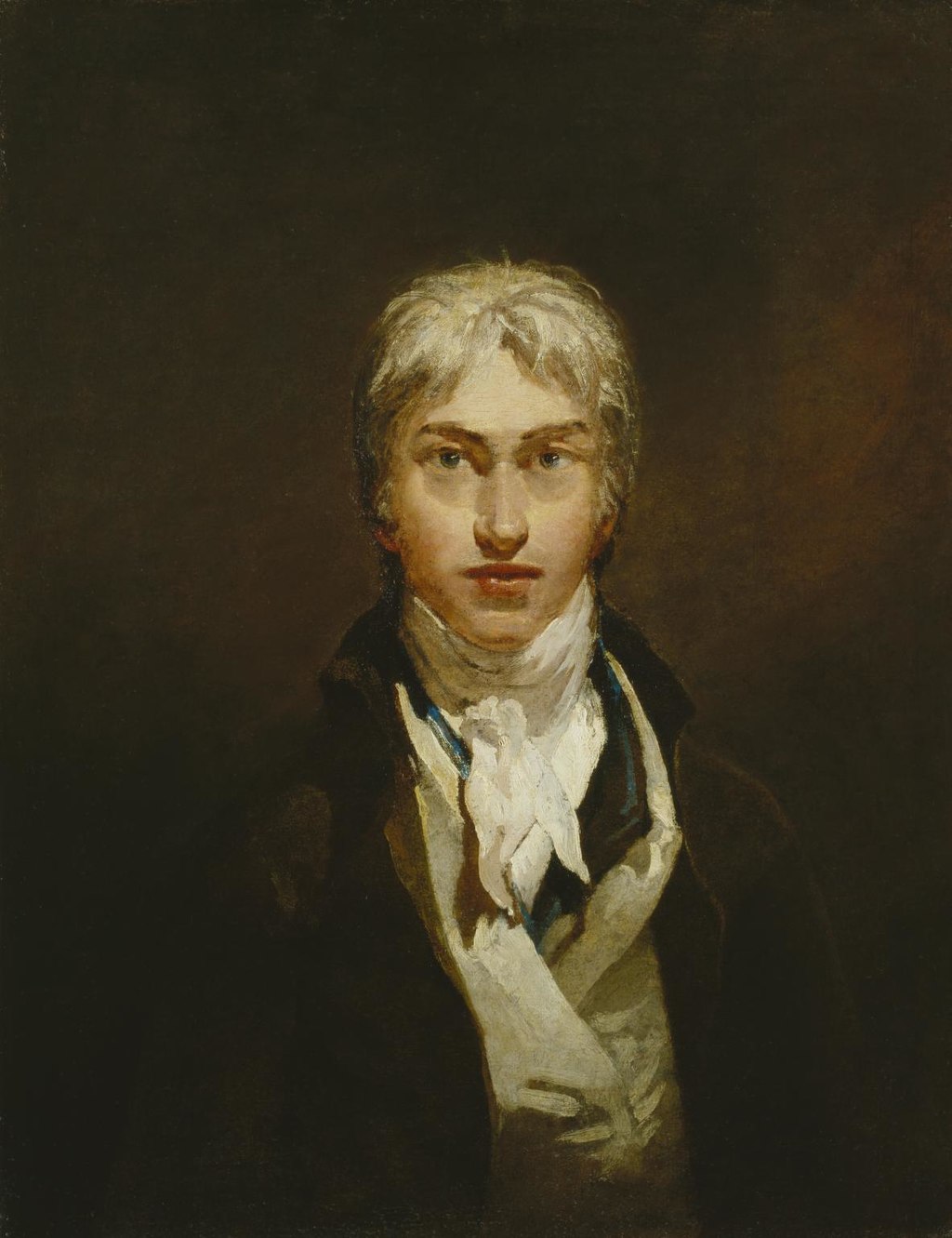
Turner – Self Portrait  1799

Turner’s confidence never wavered as an artist.  It is seen in his idealized self portrait in his twenties.  He looks out on the world as a young man that will be an oracle not a passive recorder of the world around him.    A classic portrait technique of its time, turner manages to imbue the dash and confidence of youth in the manner of a much earlier portrait, Albrecht Durer’s confident 1494 gaze directly at the viewer, suggesting the talent ready to emerge and take on the larger world.

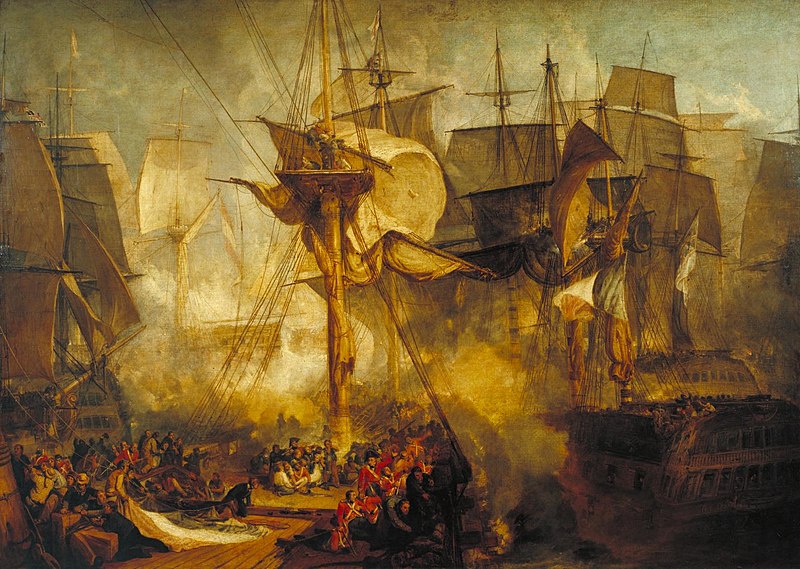
Turner – Battle of Trafalgar  1806

In the first decade of the 19th century, Turner’s ascension to prominence mirrored Britain’s own.  Europe was under titanic siege on land with the indomitable armies of Napoleon, but on the ocean, Britain showed the rest of the world the Napoleon was not omnipotent.  At Trafalgar in 1805, the British fleet led by Lord Nelson crushed the larger French fleet in a massive sea battle that ended any hopes of Napoleon subduing Britain in the manner he had the rest of the continent.  Instead it elevated Nelson to iconic status, and inspired Turner to reimagine the historic sea painting.  Turner’s Trafalgar reenacts the battle’s series of events in a simultaneous projection, increasing the sense of tension, chaos, smoke and opacity that suggests a very intimate reconstruction, despite the painting’s immense 8 by 12 foot scope.  The colors have begun to ‘turnerize’ with the sky pewters and ambers coexisting with the dark sea and isolated shafts of light.

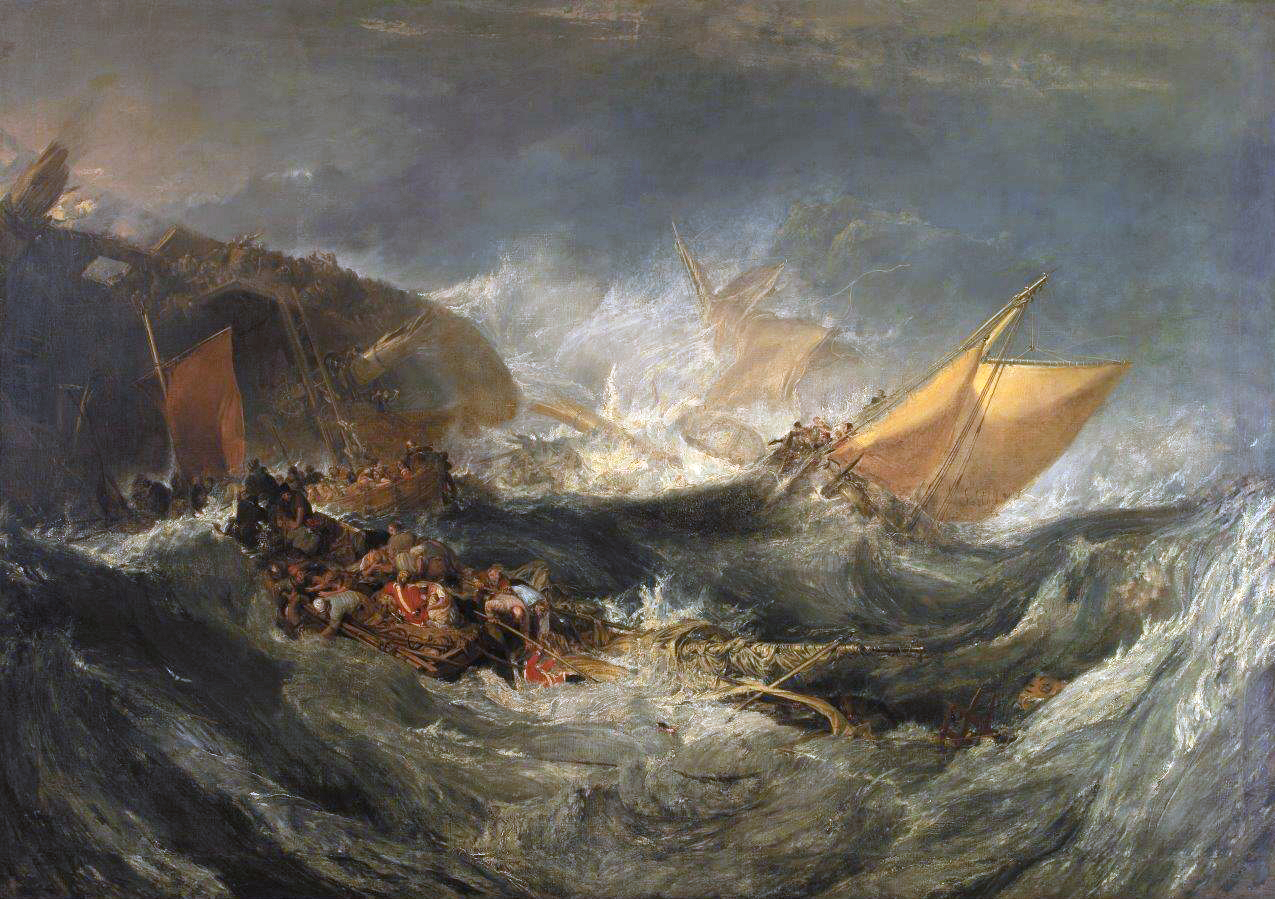
The destructive nature of the sea fit Turner’s view of the encroachment of industrialization on the restless impulse of nature to resist.  Sea and sky are progressively intermingling and the desperate calamity is highlighted centrally in a shaft of light massing the powerful waves, the broken ship and the desperate survivors clinging to life in a single maelstrom. Soon Turner’s vision progressively loosened itself of the need for specific detail, and he brought increased contrast between hazy contrasts and impressions of light and dense crimsons and onyx of both objects and sky.

Turner    The Shipwreck   1810

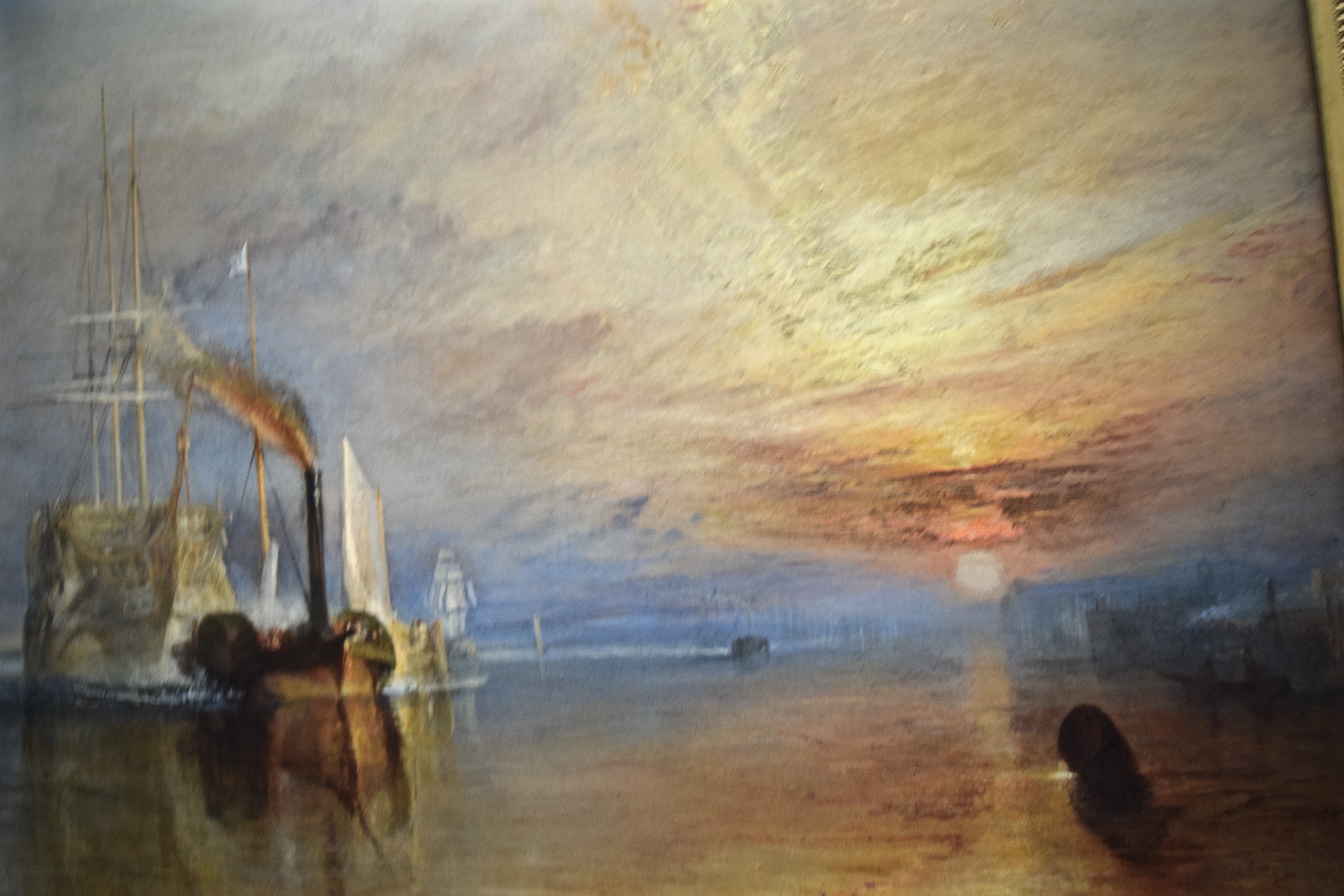
Turner   The Fighting Termeraire  1839

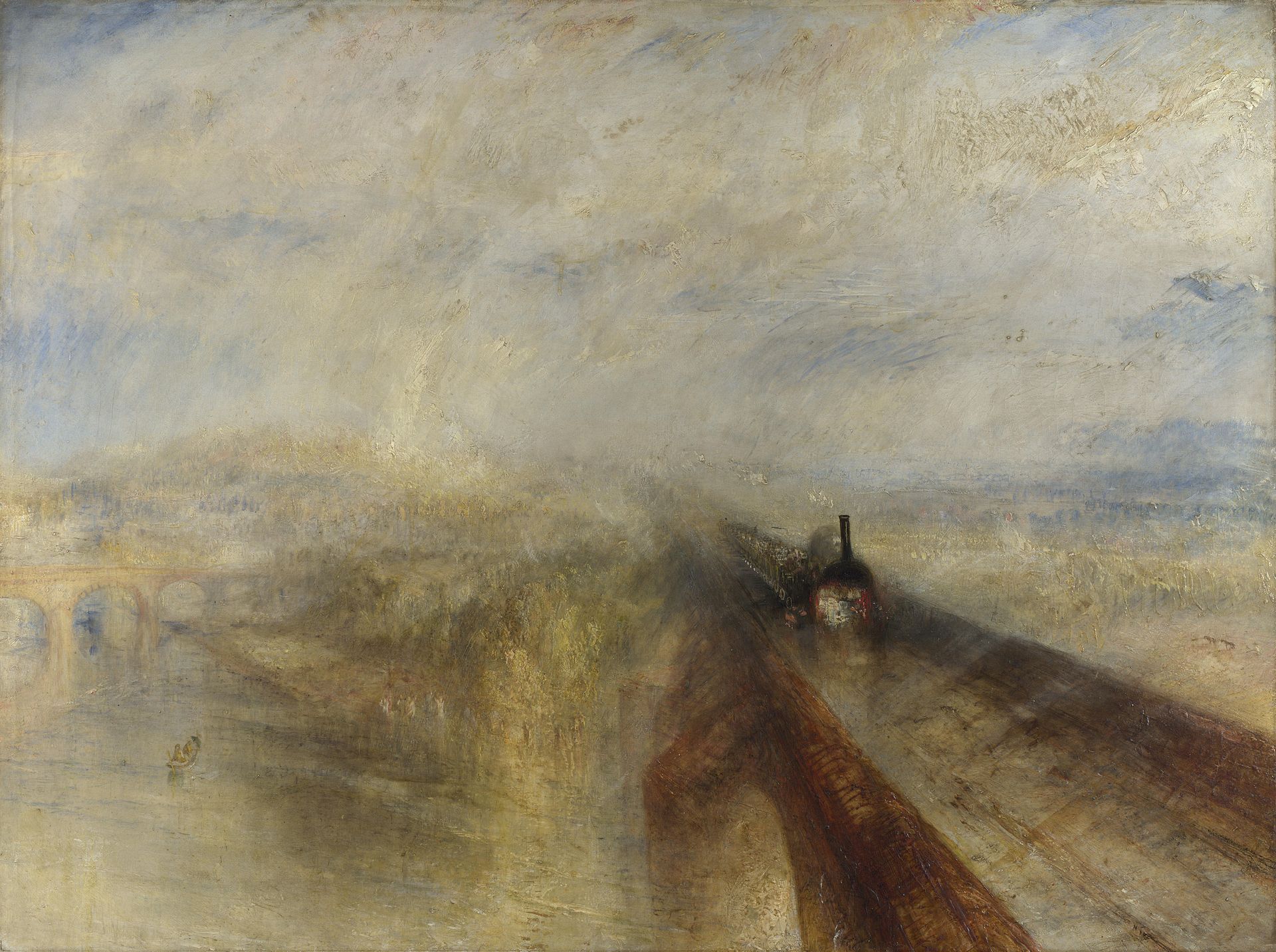
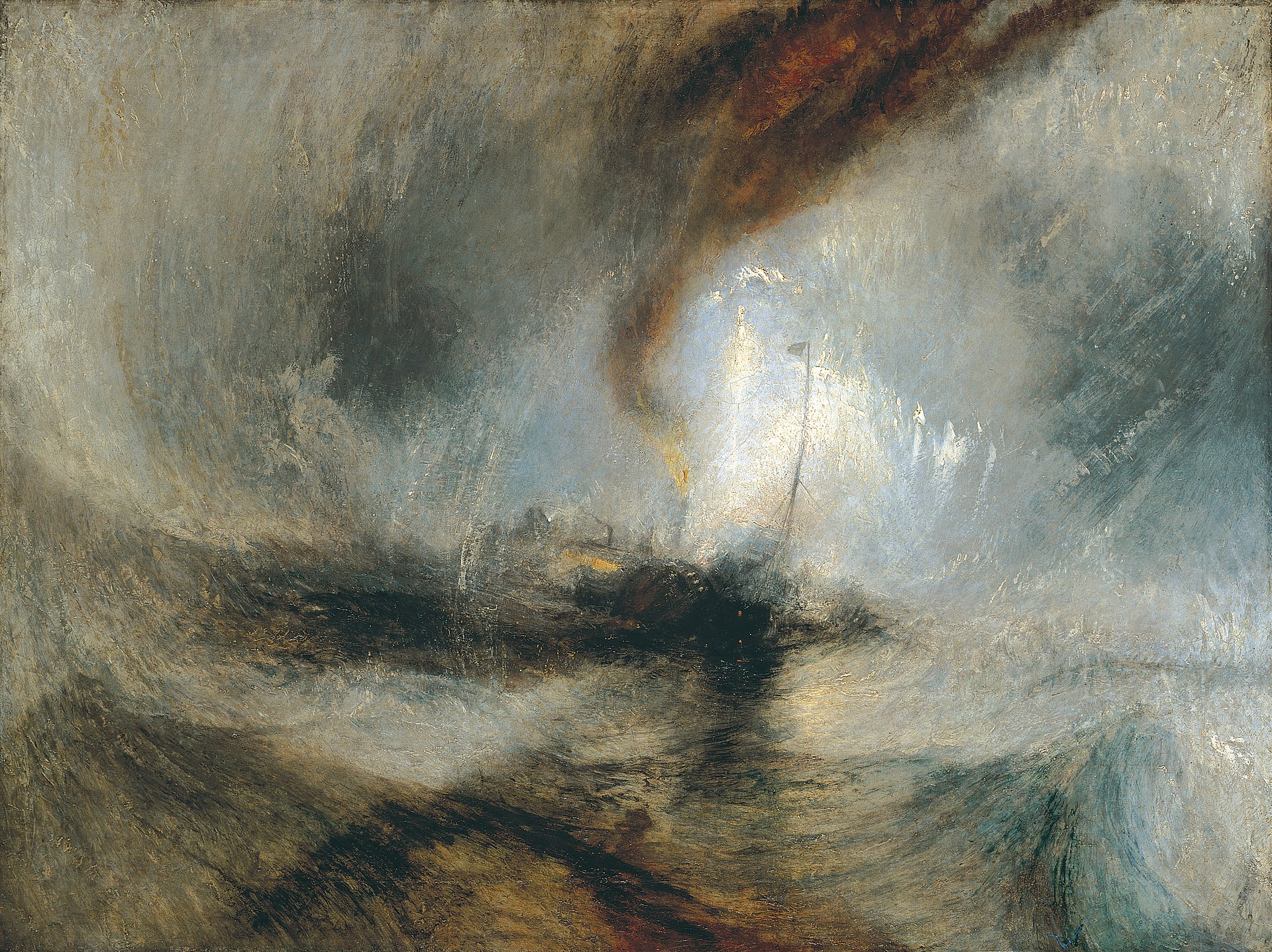
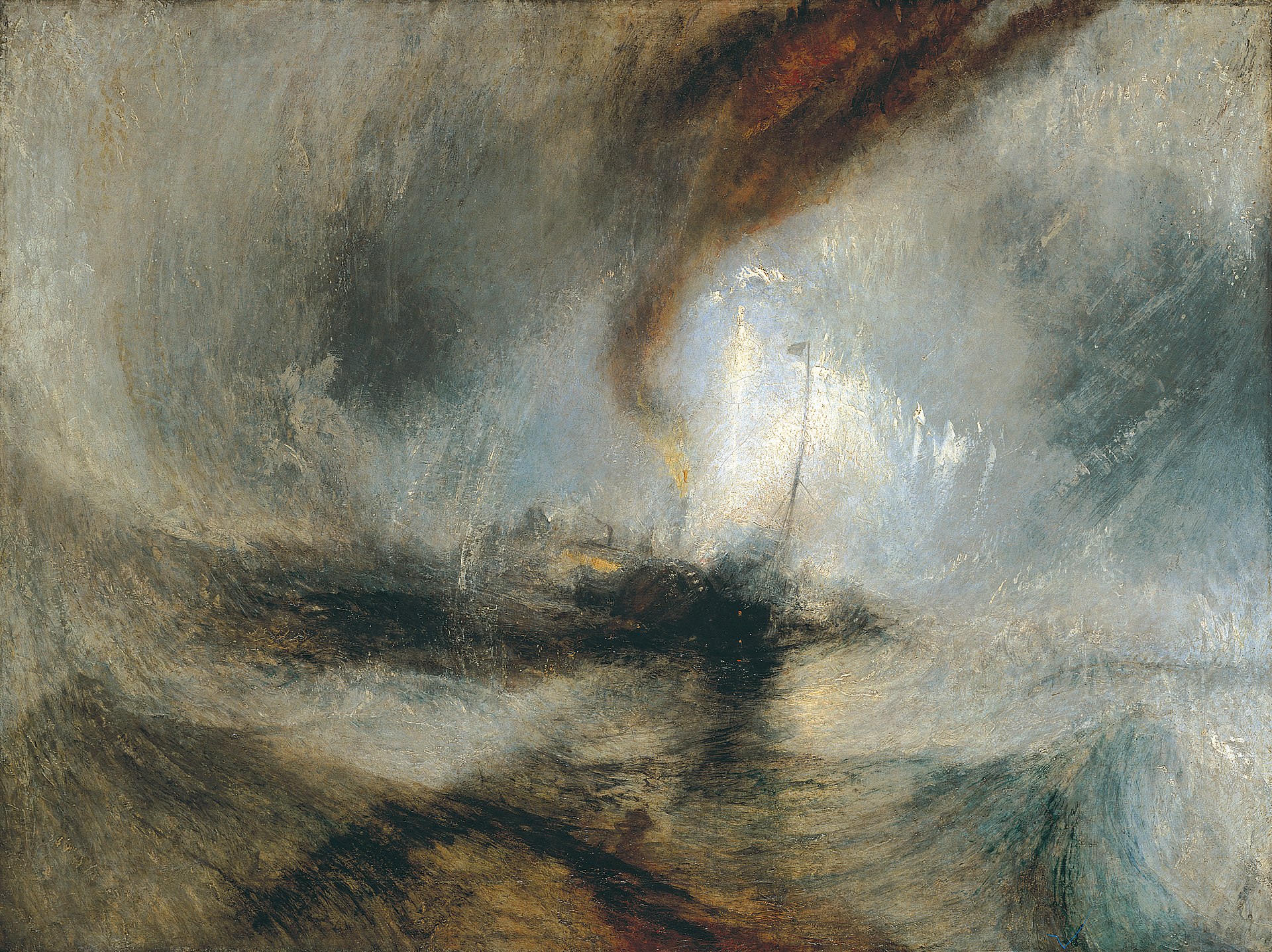
The final dissolution of form to the emotive quality of color and shade dominated the final projection of Turner’s art.  As the  art world  held to an academy of proportion, realism and comfort, Turner pushed completely off into the surreal, where edge, form and content are sublimated to the evoked emotion as expressed in color and light, presaging the twentieth century before the nineteenth was half over.  Paintings such as Rain Steam and Speed-the Great Western Railway and Snow Storm  are glassy sheens of color in which form is sublimated to the creative impulse of the artist to the point of near irredeemability.

Turner
Rain Steam and Speed –  Great Western Railway  1844
Turner   Snow Storm  1842

The over 2000 images that Turner created can not possibly be given justice in an essay of a few paragraphs and images.  Needless to say the importance of Turner is reflected in the need to see more and more of the work to try to gauge the artist’s creative journey as an unbounded romantic in a world of assimilation.  Turner, much like Beethoven is revered for what every succeeding artist thought they saw in his work, and the sense of having to answer to it artistically.  The bountiful diversity of artistic expression ever since owes much of its confident willingness to test boundaries on Turner’s willingness to leave the safe course  behind.

A trip to England for the art lover must leverage time for the Turner experience.  Perhaps, you will never see the world quite the same way again.

How Did We Get Here?

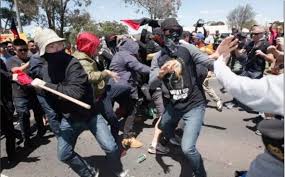
A respite from this blog for a few weeks to recharge my creative juices hasn’t made the world seem to be an any more enlightened place.  We are seeing across the world a progression in dissonance and downright strife when anything short of a passive acceptance of another’s world view is expressed.  Express free speech against the grain and you are banned from speaking in universities or physically harassed.  Reveal a thought or collection of thoughts on Twitter, Facebook, or You Tube that manages to offend others and risk erasure from the social medium.  If your thinking survives the initial onslaught, a phalanx of labeling invectives are hurled against you in an effort to humiliate you into silence.  Have a reputation for alternative views, and you risk violent harassment in public when you sit down to eat, or socialize with friends.

At a political level, socialist governments designed to redistribute wealth, horde it among a few elite, and can’t even distribute the most basic in sustenance.  Democracies are held hostage by parties that cling to power rather than solutions, and can’t marshall  even a tepid  response to the simplest challenges .  Dictators….well, they at least, dictate.  Overwhelmingly, regardless of foundation, all governments are progressively corroded by corruption and clogged up with incompetence.

And yet… the world has never had more globally available sustenance, opportunity, reduction of poverty, clean air and available water, health care, and general aversion to war to resolve conflict.

Maybe we have lost our collective minds.  Why must the  world that has positioned itself for the future so well,  submit to our need to bollux it all up so?

Loss of Civility 

It starts with our current inability to recognize that  the rules of civil discourse developed over thousands of years served a purpose.  Being considerate of others – provided the environment for a basic respect for their discourse, and your willingness to listen.  Think before you speak-implied an effort on your part to organize thoughts, reflect upon your past experiences and understandings, before assuming your view.  Agree to disagree – submitted a pact of understanding that ideas are always in flux, and you absorb from others and mature your own opinions.  Courses in civics, how various views are elucidated, how discourse is organized, how problems are solved in a civil society have lost favor with a modern tendency to consider one’s own views superior at face value to all others.  Civility is a foundational cornerstone to returning to a public discourse that converts our modern advantages into the building blocks of real progress.

Loss of Responsibility

The collective no longer expects the individual to hold up his end of the donkey.  The modern charge is for security, not responsibility.  The loss of freedom , the ability to effect one’s own life journey and outcome by accepting personal responsibility, is not mourned in the rush to level the playing field and reduce risk injected by individual choice. With the loss of responsibility has come the plague of incompetence.  Roads crumple, bridges collapse, and projects lapse because it is always someone else’s responsibility to confirm the decisions made.     Yet, the great advances of the last several  hundred years have come out of individuals take risk, taking owner ship  and pride in performance and competence,  and being incentivized for it.  It is the freedom to fail, that has lifted the great majority to succeed.  The gift of freedom, so casually tossed aside by those who are ignorant of its enormous power,  forms the way forward out of  the current malaise.

Loss of Morality

In a twentieth century where the world almost eliminated itself in horrific slaughter, morality died.  The recognition that a right and a wrong, a good and an evil, existed  required the combined will of all that was right and good. Creating  such supreme sacrifices to ultimately prevail exhausted the human capacity for objective morality. A religious world became an irreligious one, where residual religion retreated to relativism,  or in the case of Islam radicalized into death cult lunacy.  People have accepted progressively relativist arguments regarding abortion, spiraling crime rates, and sexual and drug promiscuity, ignoring the moral questions in favor of the relative — if it feels right, it must be right.

Loss of Truth

The concept of the narrative has strangled the search for the truth.  Narratives are nefarious memes to enforce behaviors and squash the skeptic.  ‘Human caused Global Warming’ declared man as the dominant actor in the 3.5 billion year history of earthly climate change, not because the world had not been warmer or colder before man, but that humans were uniquely flawed and could only ‘save’ themselves by surrendering their modern mobility and trillions of dollars to a global elite that would redistribute it to “appropriate climate friendly” causes.  Facts have butted up against the hysteria, presenting a much more measured reality as to the complexity  of climate, but that hasn’t stopped the increased righteousness of those convinced by the narrative.   Decades of victimization designed to elevate the narrative of a genetically controlled otherness, whether race, color, or sex, has led to the narrative of intersectional oppression – literally the cumulative victimization obstructing the oppressed from succeeding in a world where the “fix” is in, needing the ‘oppressor’ to stand aside.  The facts of poverty, education gaps,  the incongruity of continued vast safety nets helping the ‘oppressed’ the least have no place in displacing the narrative of oppressed and oppressor. On and On.

We Got Here, Now What?

Can society restore civil, responsible, moral, truthful conditions of discourse?  The progressive anarchy would suggest we may need to return to a dark place to be shaken back to the classic foundations of a productive engaged society.  In a somewhat bizarre turn of events, a politician flawed in his crudity and venality may have applied a slight break to the runaway train.  His unwillingness to allow the narrative to dominate, his determination to provide conditions for opportunity and reward to individuals, may prove to provide more corrective than all the think tanks seminars passively pontificating about how the world should be, if only people would see the light.  This crass man responding instinctually is upsetting the apple cart and waking us up a little.  Now, if he can only somehow recover his long lost civility gene, when one is called for.

Probably too much to hope.