People We Should Know #9 – Daniel Hannan

     Since the 1950’s, when  Great Britain, beset with the crushing debt and physical exhaustion of having fought two massive wars in twenty years, voluntarily gave up the mantle as a a world leader, the country has been in a steady decline in creativity and influence internationally. This is a natural consequence of the progression of an inward looking population that has become more concerned with personal security than industriousness.  This process  has certainly been accelerated by the willingness of the United States, a country Great Britain shared common foundations with, to accept the mantle of military and economic superpower that was once Great Britain’s.   The country that helped to create legal process,  educational capacities, the industrial revolution, scientific progress with Newtonian physics, the discovery of the atom and penicillin, has spent the last fifty years concentrating on the balance of a nations resources and its comfort.

     This is not to say that Great Britain has given up on one very special attribute that is uniquely British, the special skill of articulate debate.  The British educational system continues to produce informed thinkers who are not afraid to express their opinion in a fashion of structured argument, with the bombast left for others.  Daniel Hannan is a rising star of this school of debate, and a Person We Should Know.  Born in Lima, Peru to an English family, but educated through British bastions of Marborough College and Oxford, his diverse exposure to the world has led him to be both multi-lingual in English, French, and Spanish, and thoroughly aware of the various structures of government and social policy that define the western experience of the twentieth century, and equally comfortable with the intellect and rapid response required of the tradition of British debate.  At the young age of 39, he has already served his southeast English district in British Parliament for a decade and as a conservative representative in the European Parliament since 2009.  He is a modern interlocutor, using the internet as a podium for intellectual outreach and discussion. He holds strongly principled belief in the damaging role bureaucracy plays in societal progress and economic development, and has been a strong opponent of European integration and socialist instincts.  He has been especially forceful in his arguments for privatizing reform of the sacred cow of the National Health Service in the United Kingdom, which he blames for low survival rates in cancer and stroke treatments, poor hospital conditions, and inexorable waiting lists for procedures.  He is a strong supporter of American leadership of the free world as the world  in his view continues to be threatened with forces of fascistic suppression of individual rights and opportunity, for so long held back only by American willingness to confront far flung dictators and  stand for free markets and individual rights.  He is seeing now, however, a progressive fatigue building in America to replace individual industriousness with collective security and a retrenchment from world leadership responsibilities similar to  what Great Britain went through a half century ago, and demands are attention.

     In an important book recently published,  The New Road To Serfdom: A Letter of Warning to America , Hannan decries the insidious creep of socialist tendencies in the American legislative process and outlines the learning lessons for American in mistakes British Parliament has already made with similar decision points and their effect on British life.  How apropo this book is in watching the current struggles in Wisconsin, New Jersey  and other states to corral forces that would drive the United States into the obligations of cradle to grave guarantees that have so corrupted the flexibility of European political processes to deal with new challenges.

     Whether in full agreement or not with British thought, Hannan is one of a growing set of modern debaters such as Paul Ryan, Boris Johnson,  and Chris Christie that bring their considerable intellect to bear in a strong cohesive argument for stopping western societal decline and self induced economic suicide.  The sad fact of modern debate is that conservative minds are progressively the deliverers of constructive and complex thought and so called liberals the defenders of reactionary chants, fact suppression, and name calling. Where is our modern John Kenneth Galbraith?  Certainly not hiding in Illinois…
The Landscape Artists of the American Ideal

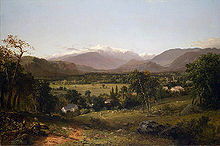
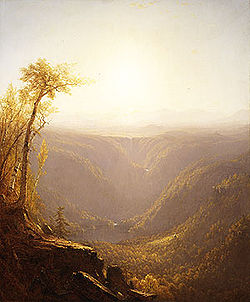
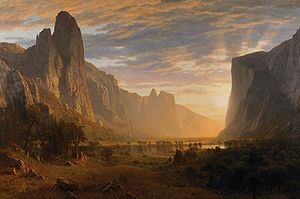
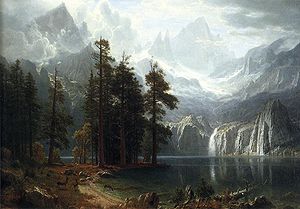
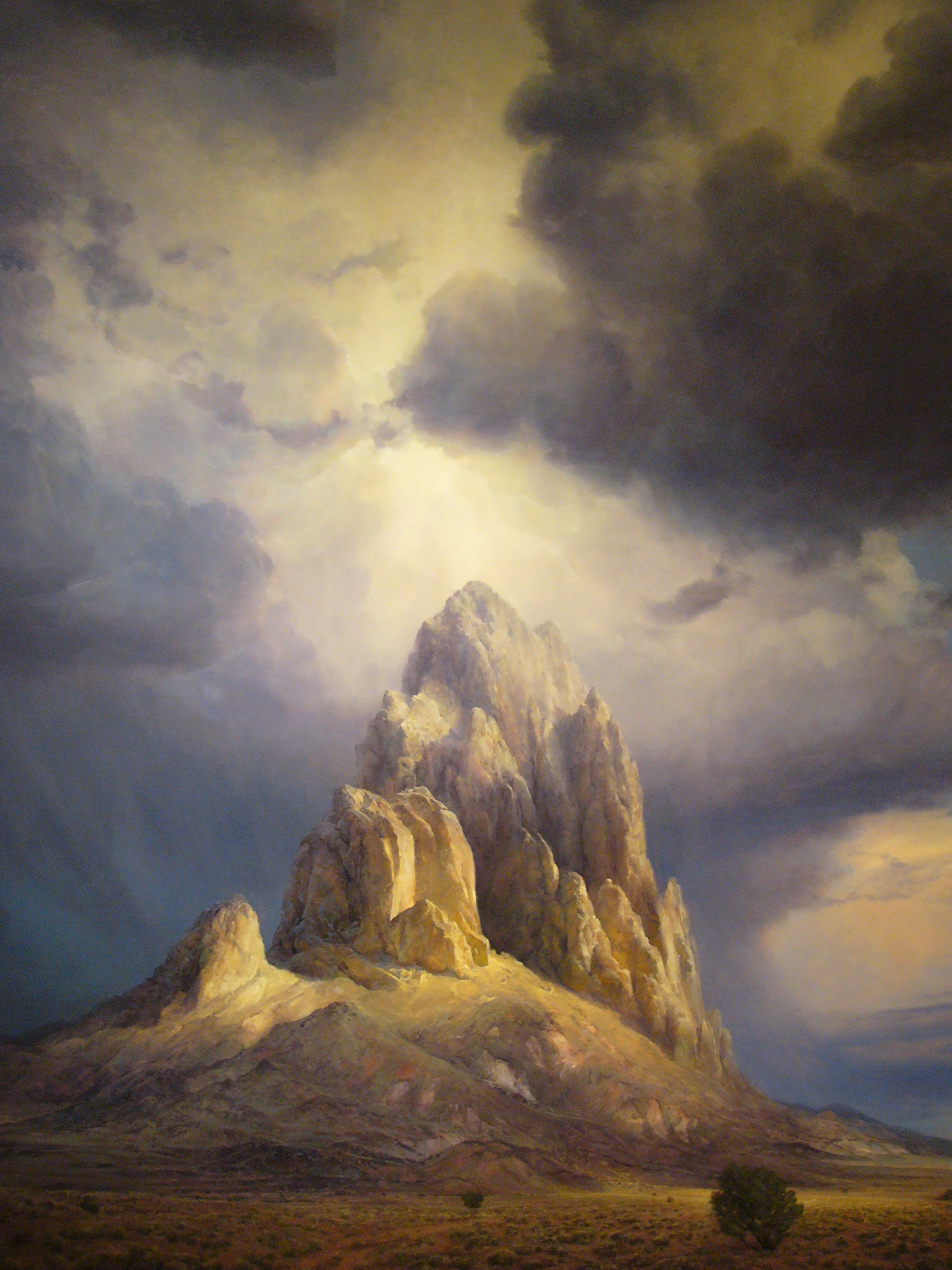
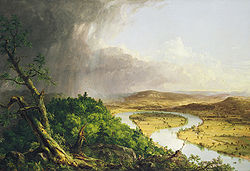
       The North American continent landmass has inspired from its first explorers onward a special spiritual awareness.  The explorers and early settlers, predominantly from lands crowded with civilization and restricted by their birth position found a overwhelming sense of a higher reality in the huge, untamed, and essentially uninhabited and unbounded country.  Even as the eastern seaboard began to gain a civility more associated with its older European ancestral home, a group of artists determined to evoke in their landscapes the enormity and beauty of the American wilderness before the contracting effects of a civilizing humanity.  They are known collectively as the Hudson River School artists, and have maintained an almost 200 year grip on the American public’s artistic appreciation of the land in which we live.

      The recognized founder of the group was Thomas Cole, who through his paintings of the lower Hudson River valley, began the separation of man’s influences from God’s in the scope and intimate details assigned to the landscape, rather than man’s action within that landscape. His pupil Frederic Edwin Church, influenced greatly by Cole and of superior talent, made the style prominent and valued, and he and his contemporaries John Kensett and Sanford Gifford created a subvein of landscape known as Luminism, where nature’s intense light took on sacred power and spiritual overtones, increasing the landscape’s monumental status and drama.  The zenith of the movement was 1855 to 1875, when Church and the great interpreter of the American West, Albert Bierstadt put on shows that brought something not seen before in American art culture, ticket sales, public buzz, and celebrity status.

esbit     The American populus has lived the double life of manifest destiny and regret for the loss of the unsullied nature of the land they conquered.   It is the eternal argument of progress, that which  is lost in the effort to bring progress and order, that was captured perfectly by the Hudson River artists.  It is at the heart of America’s notion of the the land’s romantic lure and its inseparable link to the sense of exceptionalism.  The measurable wonder that led to a unique American invention, the National Park, was a direct result of these artists, and influences the great American landscape interpreters, like Jacob Collins and Peter Nisbet, to this day. 


     The Hudson River School artists were not Nature’s illustrators, but rather God’s photographers, and they remain some of the best reasons to visit the premier American Museums.  They continue to illuminate the special pact of a land and its people, and keep this American experiment from getting too lost in what brings us comfort, and more appropriately focused on what brings us such wonder and thanks.

The Man In The Arena

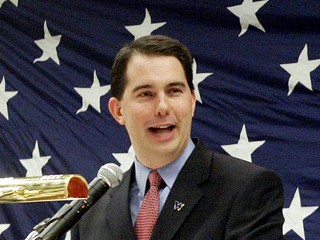
     In early November, 2010, the citizens of the state of Wisconsin elected the chief executive of Milwaukee County to the governorship of the state of Wisconsin on the basis of his reputation for fiscal discipline and firm resolve.   The state of Wisconsin, like most governments of the United States, including its federal one, had seen progressive growth in its entitlement obligations to the point of strangulation of every objective utilization of state resources for the public good for any other purpose.  The previous governor, facing similar budgetary obligations and fiscal pressures, unconstitutionally transferred funds from other critical areas of obligation, the state physician’s patient compensation fund and the transportation fund, and raised over two billion dollars in taxes in one of the most taxed states in the union, in order to avoid confronting the visible entitlement bomb in the budget. The previous elected legislative bodies conspiratorially kicked the building budget crisis to future governments to address.   The election of November, additionally converting both the Wisconsin state legislative Assembly and Senate to Republican despite a traditionally liberal electorate, showed the publics’ determination to have the government fundamentally transformed back to a fiscally conscious and publicly responsive entity.   It was no accident of fate that they put Scott Walker in the governor’s chair to direct the process.

     Scott Walker has been the anti-politician politician for most of his public life.  He has on multiple occasions now been the politician elected to clean up other people’s messes.  In one of the more liberal counties in the United States, Milwaukee County he managed as a conservative to be elected and overwhelmingly re-elected based on his pecular adult habit of performing in office exactly as he said he would.  In a county wounded by a spectacular pension heist propagated upon the tax payers by the county’s elected officials, securing pension obligations that made hundreds of pension millionaires, Walker, obligated by law to support the promises, assured that no further tax increases would go to prop up the poison pension pill locked in by the previous executive.   He cleaned up the mess to the tune of eight consecutive balanced county budgets without increases in the tax levy, cut his own salary while demanding sacrifices by other public employees, reduced and privatized the county workforce where feasible, and achieved it all with a mercilessly confrontational democrat common council that sought every opportunity to undermine his efforts.   The anti-politician politician calmly held his ground, maintained his principles, and did not break his pact with the voting public.

     Now the stage is the larger state governmental process but the in-dwelling hypocrites are the same and the task very similar for Walker.  The sense of entitlement by state employees to the public treasure is if anything magnified and their willingness to scuttle any attempt to change the bias equations that have served them so well for so long a matter of holy war.  The democratic process to produce a budget has ground to a halt as democrat senators have fled their responsibilities in governance and their residence in the state in order to prevent a quorum that would allow budget debate and passage.  The public unions have brought thousands of angry demonstrators to the capital day after day to obstruct and intimidate the legislators and governor.  They have called Walker a “hitler”, a “stalin”, compared him to apes, raised death threats and other violent invectives, screamed and chanted, and accused him of governing differently than he campaigned.

     Throughout it all, Walker has been serene and resolute.  He has asked for debate within the rules of the legislature. He has asked for democratic process.  Above all he has asked for seriousness in both facts and solutions.  He has broken no campaign promises because he is not about promises but rather principles of democracy’s actions.  The government represents all the people.  The government does not exist to profit its own.   The government exists to create equality of opportunity, not to guarantee it.  The government is graded by and responsible to, its electorate.  The government is not about special interests, but rather maintanence of standards.  The government exists to assure the protection of individual rights not collective security.  The principles ride herd on him , and he does not concern himself with immediate pulse of the day in making his decisions.

     He is exactly what people thought they were voting for when they realized no one else was going to willing to potentially fall on the career sword in order to find long term fiscal sanity. Scott Walker is one of those special people.  He is the Man in the Arena.

It is not the critic who counts; not the man who points out how the strong man stumbles, or where the doer of deeds could have done them better. The credit belongs to the man who is actually in the arena, whose face is marred by dust and sweat and blood; who strives valiantly; who errs, who comes short again and again, because there is no effort without error and shortcoming; but who does actually strive to do the deeds; who knows great enthusiasms, the great devotions; who spends himself in a worthy cause; who at the best knows in the end the triumph of high achievement, and who at the worst, if he fails, at least fails while daring greatly, so that his place shall never be with those cold and timid souls who neither know victory nor defeat.

                Theodore Roosevelt    “Citizenship in a Republic”   June 1910

The Virginian

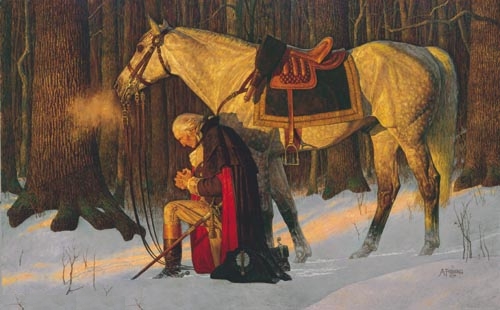
     In our more cynical, superficial age we find it hard to imagine the set of circumstances that would lead a man to risk all that he had, and give up the greater portion of his life, to an idea.   279 years ago today, such a man was born in the colony of Virginia, and his indomitable life quest almost single-handedly made possible the American Experiment.  There was no expectation in early life of his sacrificial nature, borne to a prominent Virginia family,  and he could have settled in to a life of plantation farming and land acquisition that was his family’s mantra.  Something restless and animal was part of his makeup , however, and his early journeys into the wilderness to survey land created a unique need not seen in other family members.  This man, George Washington, was tuned into a special stereophonic muse that was characterized both by the Age of Enlightenment and the Age of Possibility.  His forays into the vast American continent began to coalesce for him that this particular land was special, and the capacity of each individual man special, within it.  He began to seek positions that would both make possible the maximization of who he was, and steadily, the risks he would need to face to achieve fulfillment.

     The young adult Washington showed a warrior instinct.  He was named the military leader of an attachment that was to derive the position of the competing French in the Ohio country coveted by both the British and French superpowers, and managed in a short time time get himself involved in both a massacre of French soldiers near present day Pittsburgh, and later a complementary catastrophic massacre of British soldiers in the ill fated Braddock expedition to eject the French.  The sequence of events showed Washington to be aggressive, impetuous, and in a trait glorified later in life, unconscionably brave and seemingly immune to battle chaos or bullets.  The controversies of these events left the British and the American politicians with different impressions of the Virginian Washington.  The British saw him as inferior to the British officer ideal with his Americanized instincts for cagey warfare over stand and shoot soldiering.  The Americans saw him as an example of individual creativity and persistence.  Both concepts were of Washington, but did not completely describe him, to those who later felt they knew how  the “true” Washington in battle would respond.

     A leap forward in time to 1775, and the continental congress is desirous of a leader that holds both warrior skills and revolutionary ideals in his make-up. There was frankly little “in-house” experience to chose from, but Washington recognized before anyone that the warrior leader would have to a special hybrid. He would need to be able to commune with the common man who would ultimately provide a volunteer force that would need to be willing to sacrifice and  die for abstract ideas, and would have to project a consistent warrior bearing and confidence that would assure all that taking on the most powerful military on earth and winning was not the ludicrous proposition it seemed.  He played these two roles to perfection, and retrospectively, was the unique persona for the impossible task.

     The revolutionary war years of 1775 to 1783 were epitomized by the crushing reality of the sacrifices necessary by men like Washington to achieve the miracle of independence.  The challenges were overwhelming.  He was required to fight the greatest military force in the world with a rag tag army of citizen soldiers with little military training and limited resources.  He was challenged  time and time again to rebuild this volunteer army as deferments ran out, or men simply gave up on the intolerable nature of it all.  He was expected to maintain a continental strategy with troops who were thinking that their home to defend was their own state and not necessarily the “foreign” state to which they were forced to defend.  He was forced to defend his actions in defeat after painful defeat against individual politicians who thought they knew better and refused to monetarily support the cause or mandate the troops.  He did this all continuously for eight years with a price on his head, away from his home, under atrocious conditions, and with the foreknowledge that defeat meant for him certain death and loss of all that he had.   He faced all these enormous obstacles – and he won.

     When it came time years later to select a chief executive that would form the initial government of the United States, the selection again turned to one man, the Virginian, Washington.  He was selected not for any impassioned rhetorical brilliance or acknowledged philosophical depth, but again, because he was the single individual every competing interest group felt they could trust.  He was selected for his acknowledged ownership of the American Ideal through the worst of times, and his willingness as a man, to give up power when it was his to take.  As the first President of these United States he set for all time the standard that the office, not the man, the Constitution, not the trappings, were the key ingredients of the American Experiment.

     On his birthday, at a time when mediocrity of character and lack of in-depth understanding of what makes this American Experiment work frequently desires to inhabit the office of President, our first president, the Virginian, stands forever, like a colossus.

Sic Semper Tyrannus?

     In December, 1989, with almost inconceivable suddenness, the dictator who had ruled Romania with an iron fist for 34 years, Nicolae Ceausescu, in the space of one week fell from emperor king to the wrong end of a firing squad. His was the last thugocracy government to collapse in the spectacular year of Revolution that was 1989. Despite the domino like collapse of other authoritarian governments in Eastern Europe that year, Ceausescu confidently left the country for a trip to Iran, not recognizing the match for revolution that was struck in the city of Timisoara on December 18th over the simple act of attempted eviction of a Hungarian priest by the government for “inciting” ethnic divisions. Quickly joined by Romanian students, a brutal effort to violently  crush the demonstrations had exactly the opposite effect and within only two days had spiraled out of the government’s control. Ceausescu returned to find on December 21st a country he couldn’t possibly recognize, in full revolt and to his shock completely unafraid of him. His meager efforts to rally government support collapsed in hours and he was forced to flee, only to be turned over by police to a thrown together military tribunal that declared him an enemy of the people and executed him on December 25th, 1989.  One week,  from complete control, to complete collapse.

     So it appears the latin phrase, Sic Semper Tyrannus, “thus always to Tyrants” has come to roost again in the year of Revolution  2011 in Libya.  Following a similar pattern to Romania, the spark of revolution appears to have been the relatively innocuous event of the government preventing people from inhabiting a long promised but unfinished housing development, but the flame was clearly fired from the spectacular revolutionary forces that are shaking northern Africa and the Middle East, with despots in Tunisia in January and Egypt in February rapidly driven from power, and the governments of Bahrain and Iran shaken by unrest.  Libya’s Ceausescu is Mu’ammar Quadaffi, a four decade dictator who has maintained rigid control over the oil rich country and has been a long standing supporter of radical Islamic groups and terrorists in other lands. In similar fashion to Ceausescu, Quadaffi seems to have completely misread recent events and his own vulnerable position, and by violently striking out against demonstrators, managed in a single week to explode his country and implode his dictatorial control.  Reports suggest that he has had to flee Libya to avoid his own capture and that his sons are struggling to hold a losing position in the capital of Tripoli. If true, the historical evidence that dictatorial control, no matter how imperial, is a mile wide and an inch deep, and only needs the right push to force collapse, must have the governments of Syria, North Korea, and Iran nervously scanning their horizons for similar signs of trouble.

     The year 2011 is proving to be a year of revolution on the epic level of  1989, but its outcome is considerably more murky in the advance of freedom.  The dark forces of a different kind of totalitarianism, those of islamofasciist extremism, lay in waiting like foxes at the hen house, to these newly freed countries with little complementary institutional structure for individual rights.  The Eastern European countries of 1989 succeeded at getting the tender sprouts of freedom to flower, but initially, it was quite unclear what would come out of the foment at that time.  The difference was the example of a United States and Europe that was comfortable in the promotion of democracy for the sake of the formation of republican government and positively intervened to  help determine the outcome.  A much more unsure United States and Europe exists today, and it is unclear if an determined leadership is available that is able to recognize the opportunity for the promotion of individual human rights for the Arab world, and assure that the fragile flame for this beleaguered part of the world is not rapidly extinguished.

     President Obama could take heed from a President that now appears visionary in his understanding of the forces of freedom at work in the Mid-East and beyond:


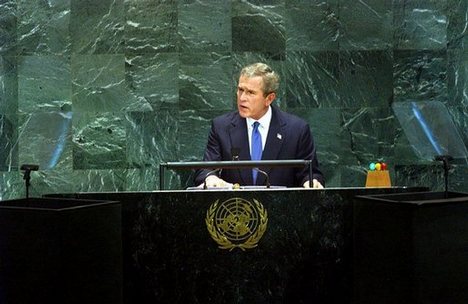
George W. Bush  United Nations Speech September 21, 2004

“For too long, many nations, including my own, tolerated, even excused oppression in the Middle East in the name of stability.  Oppression became common, but stability never arrived.  We must take a different approach. We must help the reformers of the Middle East as they work for freedom, and strive to build a community of peaceful ,democratic nations.”

” The advance of liberty is the path to both a safer and better world”

“The desire for freedom resides in every human heart. And that desire can not be contained forever by prison walls, or martial laws, or secret police. Over time, and across the world, freedom will find a way.”

“We know that dictators are quick to choose aggression, while free nations strive to resolve differences in peace. We know that oppressive governments support terror, while free governments fight the terror in their midst. We know that free people embrace progress and life, instead of becoming recruits for murderous ideologies”

Enter The Fixer

     We have become so numb to the inability of governments to address in adult and disciplined fashion the significant issues of our time that when such discipline is revealed, its harshness is initially tart as pickle juice. Thus the response of thousands of public employees to the adult requests of the governor of Wisconsin, Scott Walker, to pension and health care benefit adjustments he deems necessary to begin to deal with the state’s future busting 3.6 billion dollar budget deficit and billions more in unfunded mandates. Unlike the United States government, which can continue to pretend that balancing a budget is a task for future generations, most states are obligated by their constitutions to pay as they go. This sensible proposition of assuring sufficient funds available for the public expenditure was in the not too distant past considered a sacred trust of legislatures. Theirs was an emotional attachment to considering an additional tax to pay for an additional good, but at least it was pertinent to the consideration of the entire taxpaying public weighing the expense of a potential good to benefit that public. No more. The last few decades have resulted in a severe tipping of the scales with public unions requiring the taxpayer to progressively assure the public employee’s personal well being and comfort at the expense of any consideration of the public good. This achievement, through the weapon of “collective bargaining”, has resulted in the incestuous relationships of the public unions, fed by tax dollars, financially supporting the re-election of representatives who allow them to progressively feed, in a never ending progression.

     Collective bargaining, the process by which unions negotiate with their employer for hours, wages, work safety, and benefits, requires a set of assumptions, checks and balances for each to negotiate in good faith. The first is the assumption that the union is representing the best interests of the workers and the second that the employer is concerned with the availability of a productive work force to achieve profit and growth.
In the private sector, the checks in power to each comes in the realization that the union risks the members jobs if it undermines too significantly the company’s ability to make a profit, the company understanding that its primary capacity to make money comes from an adequately compensated work force that will be productive. Collective bargaining in the public sector distorts all aspects of this careful balance. The public sector employee and government both rely not on profit motive but rather a third financier, the taxpayer, to passively provide the funds for both. The public union can ask the taxpayer to continue to pony up more and more because there is no defined profit capacity. The available funds are simply limited to that which the government is willing to collect, and the power of the government to increase its power and reach, thereby increasing the number of public employees, is limited only by its ability to remain in power. The result is the impossible arrangement that allows public unions to invest in maintaining governments that, thankful for the support and ability to stay in power, progressively kick their fiduciary responsibilities to the public down the road. President Franklin Delano Roosevelt, a strong proponent of union rights, saw the infeasibility of the public union relationship with government as did the last socialist mayor of a major city in America, mayor Frank Zeidler of Milwaukee, who in 1969, warned “that the rise of public unions put a competing power in charge of public business next to elected officials.”

     Enter the Fixer. With the tsunami election of 2010, the voters of Wisconsin, a predominantly liberal state, rebelled against its impending financial doom, by electing a governor and legislature empowered with the singular mandate to restore the appropriate balance between the elected government and its people. The fixer comes in the form of Governor Walker, who in eight years as Milwaukee County Executive, managed to maneuver one of the state’s most liberal counties to the land of balanced budgets without tax increases. Despite getting called every name in the book, he persevered against entrenched interests time and time again by sticking to the overriding principle that his ultimate responsibility was to the taxpayer that paid the bills assure appropriate government, not to the beneficiary who demanded its inappropriateness. Elevated to the chief executive position in the state, he has brought with forcefulness to bear this overriding principle, and the hornet’s nest of entrenched interests has again been kicked over, on a much larger stage. If the interests that seek to derail Walker’s compact with his mandate, they will find him an immovable object. His separation of the public union from its oppressive hold on the levers of governmental funds and function, by removing its right to impel all public employees to fund the union and separating the collective bargaining rights for wages and pensions from job safety and grievance, is the most aggressive challenge to unions’ stranglehold on government decision making in decades. Walker has correctly identified the a lawmaker freed from the pressure of union tactics, regardless of party, may be more willing to review expenditures with a more objective eye. With objectivity, comes freedom of thought, and with freedom of thought, just maybe preservation of the republic form of government. IF Governor Walker pulls that off, he indeed will be the Fixer we have been waiting for.

Ramparts Hiatus

To all my fellow guardians of the ramparts, a brief hiatus is in order for the captain of the guard. I will be computer free for a few days, brewing up some new thoughts and sharpening my attention for the days ahead. Please take the time to peruse past favorites and stay in touch. Ramparts of Civilization will be back soon with all new adventures that make this world so damn interesting….see you soon!

Who’s Next – Maybe Turkey?

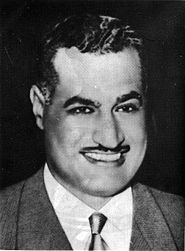
     The events in Egypt continue to evolve at a breathtaking pace.  The most recent news is the dissolution of the puppet parliament and the government’s associated agencies with the role of comptroller in the hand’s of Egypt’ military.  The military insists it is positioning itself to moderate a transition to representative government with elections to occur in September.  History as always allows for lessons to reflect upon.  The Egyptian military overthrew the monarchist government in  1952 with a council of officers led by Gamal Abdel Nasser, in a so called “Association of Free Officers” dedicating themselves to be “guardians of the people’s interests“, named a  President, General Muhammed Najuib, with backing from disparate groups such as the Muslim Brotherhood and the Egyptian Communist Party.  Sound familiar?  In a short time, however,  the council reformed itself into the Egyptian Revolutionary Command Council, tensions rose between the civilian government and the Council , and Nasser in January of 1953, declared a one party state, with progressive attainment of the machinery of power until after the Suez conflict in 1956, he assumed direct control.  He did not abdicate his power, promoting a belligerent form of pan-Arab nationalism until his death in 1970.  His fellow officer and long time confidant, Anwar Sadat, took over, and following Sadat’s assassination in 1981, was succeeded by Hosni Mubarak.  Egypt’s current “guardians’, the Egyptian military,  own a direct ancestral connection to this history. 

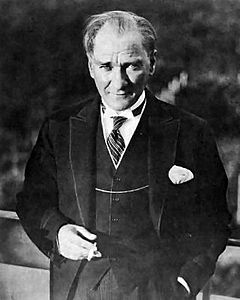
      The position of the military as a force of the people in Arab lands are perhaps linked to the only time it seems to have at least attempted to participate in institutionalising an Islamic country’s attempt at democracy.  The Turkish hero of World War I, Mustafa Kemal Pasha, who successfully resisted the British at Gallipoli in one of the British Empire’s most painful defeats, additionally resisted the victorious allies’ attempts to subjugate post war Turkey.  He refused to accepted a divided stump of a country proposed, declared himself Kemal Ataturk, “father of the Turks”, and successfully fought a small war of independence, resulting in the formation of the modern Turkey we know. Through his entire reign, he sought to modernize Turkey along secular, democratic lines, assuring the Turkish Republic would not dissolve in fractional tribal chaos that plague so many lands of the former Ottoman Empire.  Though he was a strong proponent of western democracy, he always saw the Turkish military as the ultimate protectors of the republic against unstable interests and felt no qualms about occasionally “righting the ship of state” with military oversight and intervention when needed.

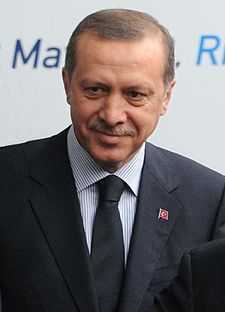
     The past few years in Turkey have seen the creeping expansion of an Islamist government in Turkey led by democratically elected Prime Minister Recep Erdogan, and the military has been slowly but progressively marginalized.  Erdogan has worked tirelessly to remove secular generals from the army and replace them with those who have less issue with an islamist shade to Turkish society and law, similar to the progressive role of the Revolutionary Guard in Iran removing the secular voices of the Iranian army in the early 1980’s.  Ataturk would have been appalled and would have “cleansed” the government of this tendency toward religious governance, believing it anathema to a modern society. European governments have been vehement in their warnings to the Turkish military to remove any desire on the military’s part to “control” events, further emboldening Erdogan.  Now it appears that the cauldron that has simmering beneath the surface in Turkey, driven by the recent events in Egypt are about to boil over.  Erdogan has determined to take the final step in emasculating the military’s independence by essentially accusing them of treason and plottage of an overthrow of Turkey’s government, and seeking the arrest of many officers.  This unreported event may prove to be a more dangerous and unstable event than anything happening in Egypt, and bears very close watching.  The current American government’s stunning ineptitude regarding Egypt, has absolutely no room for error in Turkey, a NATO ally astride the gates of Europe. 

     Like the mythical box of Pandora, the lid has been removed to a multi-century suppression of Middle Eastern forces that will play out in a way we can only guess. It is hard to know if there is another Mustafa Kemal Ataturk out there.  One thing is for sure, The Obama Administration is ill equipped to recognize such a leader, and sadly unwilling to be principled enough to be a steady force for good, in a unstable time crying out for American leadership. 

     Fasten your seatbelts. Its going to be a very, very bumpy night.

The Great One

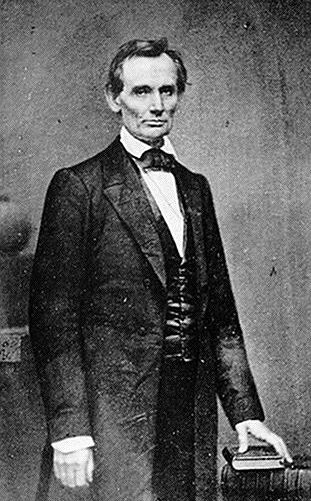
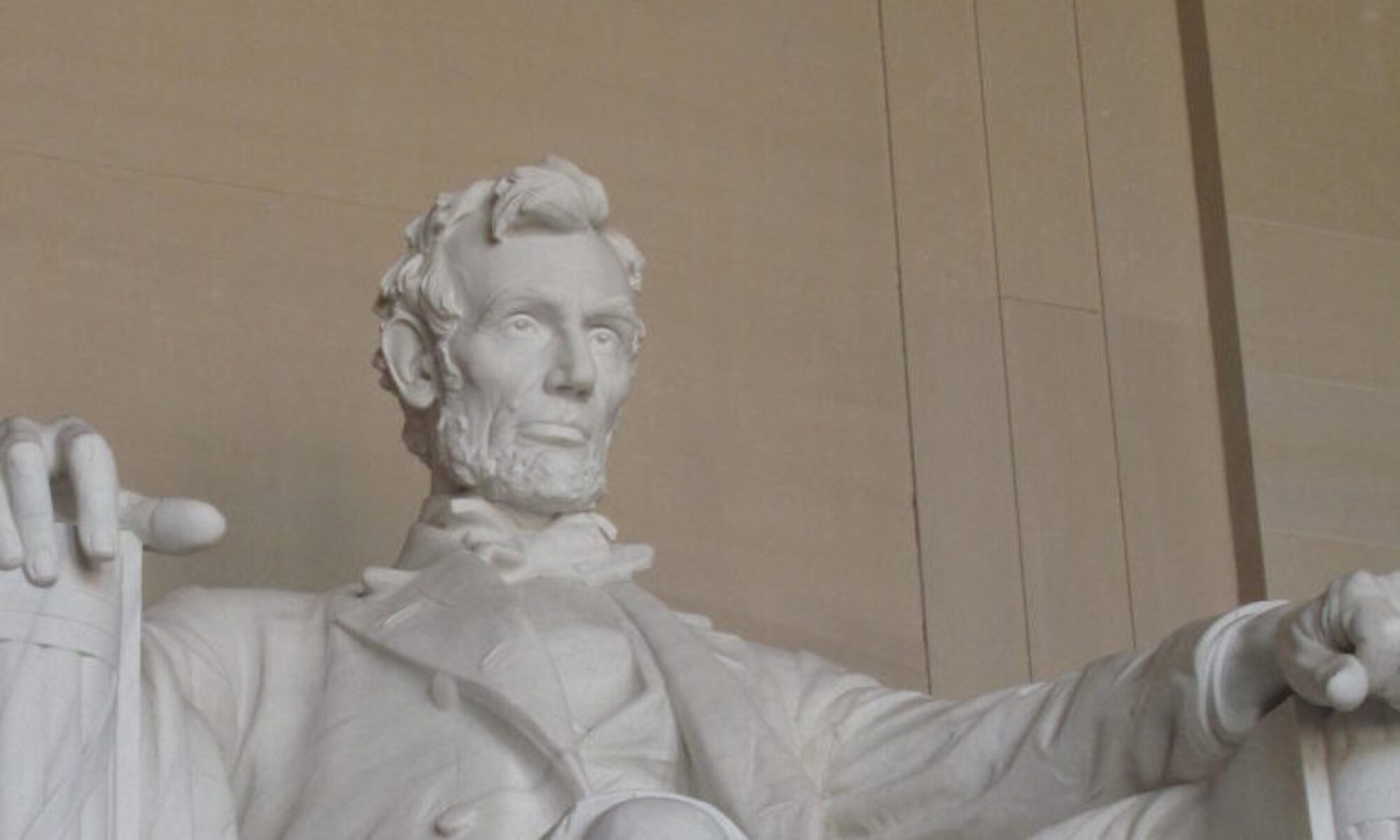
     February 12, 1809, 202 years ago, lost in the wild frontier of Kentucky in a log cabin placed at the side of a creek called Nolan, outside the settlement of Hogdenville, a miracle of history occurred. An illiterate tenant farmer named Thomas Lincoln and his wife Nancy Hanks brought into the world an epic soul. From such humble roots, one of the great thinkers and unquestionably one of the world’s most gifted leaders came into being to a nearly untouched natural world. He was Abraham Lincoln, and in his relatively brief life of 56 years shook the very foundations of his nation and changed it forever.

     It is the ultimate test of nature versus nurture when one examines the life production of Abraham Lincoln. He certainly had no significant identifiable schooling, and his upbringing provided nearly no stimulants for learning beyond the skills needed to survive in a very rough and occasionally brutal wilderness. His step-mother Sarah Johnson, coming into the family after the untimely death of Lincoln’s mother at age 11, found a melancholic and wild boy, but inured in him an uncommon devotion due to her unstinting love for him.  Though illiterate herself, she saw in him something nobody else saw, and pushed him to learn to read and write. In the Indiana wilderness the family moved to, Lincoln proved a voracious self taught student in writing skills, grammar, and the few books available to him. The entire scope of his training was frankly his will to learn, and the interpretations of his learning all his own. From wilderness wild cat to eventual local learned man, the philosophic world view devised by Lincoln was entirely unique and his own creation.

     David Herbert Donald’s Lincoln biography is in my mind the most passionately human biography of Lincoln and a must read for any who wishes to understand Lincoln the man who became Lincoln the colossal historical figure. The specific chapters reflecting the years of Lincoln as a young circuit lawyer in Illinois are essentially perfectly written. Lincoln was a mental sponge, forgetting no personal interaction, no lesson to be learned, no overarching theme to the simplest disputes and events. He built on his friendships, his experiences, and his battles to develop an uncommon awareness of the unique qualities of the American Experience and the vital role of the common man in framing it. With no apparent template for a guide, he created a strong and complex capacity to understand, and importantly, elucidate that understanding to others, in clear and precise language. It was a skill that was natural, his own, and absolutely, genius.

     Lincoln wrote and spoke on so many topics of importance to his time that an entire career studying the many moments of brilliance have consumed academicians since his life ended.  The more amazing reality is how often he spoke in a way that evoked universal themes that crossed multiple generations that speak to us today.  The speeches written by Lincoln resonate for our time; the House Divided speech, the Lincoln Douglas debates, the first and second Inaugurals, and the jewel in the crown, the Gettysburg Address.  He was additionally at his greatest in the simple letter responses to friends, and the letters of consolation to the war’s bereaved, showing each his ability to understand their prism of understanding, their own special role and their personal sorrow.   This President in saintly fashion absorbed every arrow, every pain, every loss, every need as his own, and it showed stunningly in his rapid aging in photos over the five year period of the Civil War.  The mind , though, did not age, and his brilliance revealed in the final weeks of his life showed eternal strength of character and a bottomless desire to take on monstrous social complexities and provide the leadership to solve them.
    

Everyone’s favorite Lincoln is their special Lincoln – Lincoln the Western Railsplitter, Lincoln the Writer, Lincoln the Philosopher, Lincoln the War Leader, Lincoln the Speech Maker.  Any one of these Lincoln’s would be worthy of a birthday treatise.  Lincoln the Miracle Man is my favorite today – the perfect Product from nothing, out of nothing, through the strength of his own will and the freedom offered by his society to have an equal chance as any other, to excel, and flourish at a miracle level, to the benefit of us all.  He is the man, who at his First Inaugural, looking into the dark chasm of the impending cataclysm of the Civil War, forgave us our sinful stubbornness and projected the way  to our eventual salvation by relying on our inherent goodness and the saving grace of our humanity:

” I am loth to close. We are not enemies, but friends.  We must not be enemies….The mystic chords of memory, stretching from every battlefield, and patriot grave, to every living heart and headstone, all over this broad land, will yet swell  the chorus of the Union, when again touched, as surely they will be, by the better angels of our nature.”

Freedom and the Internet

     Who is Wael Ghonim? Whether the name is familiar or not, Wael Ghonim is the new Egyptian face of the freedom uprising in Egypt and the human symbol of the power of the Internet. Ghonim, a marketing manager for the Internet giant Google, managed to become the focus for the dispersal of information and tactics for Egypt’s restive population. It was conceptually his arrest that led to the final crushing pressure for President Mubarak, leader of Egypt for over thirty years, to succumb and abdicate his presidency on Thursday. The real power of freedom however was not an individual but rather the instantaneous availability of the latest unfiltered information made available by the Internet, that surprised and overwhelmed the Egyptian autocracy, and resisted its determined efforts to shut it down. The power of the Internet continues to grow to the point where “secrets” held by government are increasingly vulnerable, and the very existence of dictator’s capacity to control information, and therefore their populations, increasingly suspect. The iron fisted rulers of Syria, Iran, Saudi Arabia, Cuba, and China have certainly taken notice and are alarmed for their own governments’ vulnerability.

     The ability to disperse information out of the control of governments to influence events is not a new phenomena. The presence of so many talented printers in America at the time of the American Revolution made possible rapid distribution of revolutionary concepts for digestion by the populous and their progressive weaving into the fabric of the body politic. The availability of telegraph made intercontinental development possible in the United States by achieving the simultaneous awareness of people thousands of miles apart, linking their common reaction to events in a coordinated fashion. There has not been, however, until now, truly simultaneous global linking that is offered by the Internet, and it is now the stalwart protector of free expression, for both good and ill, to all nations on earth, regardless of their ruler’s opinion as to what is “best” for their people. Whether the information is searched, linked, video shared, tweeted, or facebooked, the overwhelming access offered to real time events has changed us forever.

     As a free society, we are in no position to drop our guard against those in authority who are threatened and seek to “control” this phenomena. The Internet since infancy has been maintained by the United States to the advantage of its development and to the horror of those world wide and even within the U.S. border who believe better “control” is in order. They seek to “tax” the Internet and thereby achieve control of the commerce, “police” the Internet and determine what is or is not politically correct, and “regulate” the Internet to assure governmental control over who would have access and to what extent.

     Whatever your political or philosophical persuasion, however you feel about the potentially “dark” use of the Internet to invade privacy, lovers of freedom must be unequivocal in the Internet’s defence from the “good intentions” of legislators. The beauty of the powerful, and stunningly non-violent upheavals in Eastern Europe, Lebanon, Tunisia, and now Egypt, over the past decades are the direct gift of the free flow of ideas and the exposure for all to see of the empty and reactionary delusions of authoritarian governments. The greater control over the access of information and the greater the likelihood of the Tienanmen Square and Tehran massacres that are buried in shadow.

     Freedom calls for illumination and we all gain from the brightness of its light. As Dylan Thomas so aptly put, Rage, rage against the dying of the Light. God bless the Internet and its power to project the human Voice.