Seeking, and Facing, the Truth

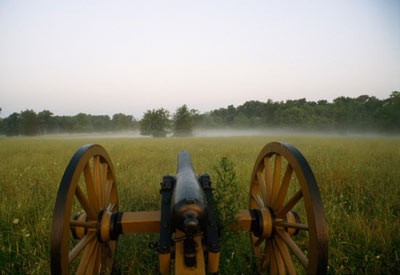
The field at Gettysburg

The next four days, July 1st through the 4th, are the jewels of American history.  In Philadelphia in 1776, representatives of the thirteen American colonies were meeting to debate and approve a declaration of ‘self evident truths’ that would forever sever their dependent relationship with their mother country.  At the junction of major turnpikes that entered like spokes of the wheel centered at the little town of Gettysburg, Pennsylvania in 1863, two massive armies would be drawn into cataclysm to determine if the declaration of those truths would continue as a singular expression.  Fireworks and parades will remind us of the events, but it takes greater meditation to absorb the greater connection to our current lives, and we are often want to do so.  It is hard to imagine in this time of malleable and ignoble commitment to truth, that there was a time when truth was felt to be so important to the quality of a person’s existence, that people were willing to fight, and as necessary, die for the principle of it.  Yet, this country of ours is almost unique for the purified expression of all our economies of effort on the idea of principle rather than power as our fundamental reason for being.

The foundation of what is truth is not a historical constant.  The truths that the men of Philadelphia, and later, Gettysburg were fighting to define were more humanistic than the stark clarity of Aristotle:

To say of what is that it is not, or of what is not that it is, is false, while to say of what is that it is, and of what is not that it is not, is true

This is the clarity of the perfect, absolute truth and requires only its discovery, not its interpretation.  The rationalization of truth by later philosophers accepted the presence of a divine truth, but recognized man’s interpretive intellect and saw what was knowable could be achieved by reason.  For Saint Thomas Aquinas, this was a divinely inspired capacity of man to use intellect to identify the existence and essence of things:

Truth is the conformity of the intellect to the things

By the time of the Enlightenment that would shape the thoughts of the writers of the Declaration of Independence, truth was an equally balanced reality of both experience and reason.  As expressed by Immanuel Kant, experience was purely subjective without being vetted by pure reason, and reason without experience would lead only to theoretical illusions.
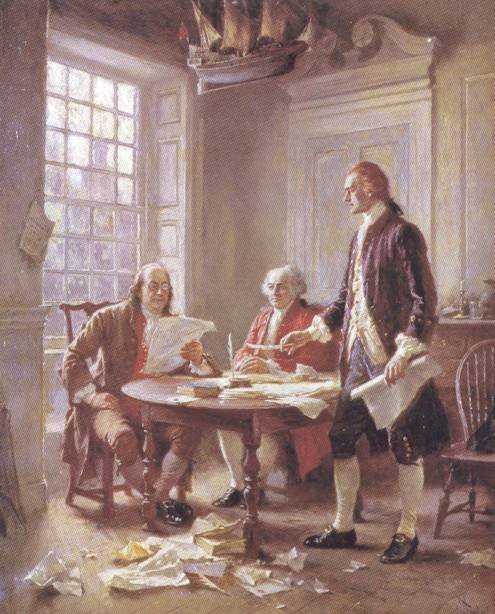
Franklin, Adams and Jefferson writing the Declaration of Independence 1776

The men of Philadelphia were fully aware that their determination to sever ties with Great Britain amounted to more than a desire to go their own way.  The ability to stir men to take up arms and potentially sacrifice themselves for a cause would have to be based on more than who owned the land mass called America, but rather in the age of Enlightenment, who better owned the truth:

We hold these Truths to be self evident, that all men are created equal, that they are endowed by their Creator with certain Unalienable Rights, that among these are Life, Liberty, and the Pursuit of Happiness

That an individual could perceive his own truth, the direction of his life, and ultimately determine his own fate accepted the superior position of each person to both experience and rationalize their experience to a moral end, without subservience to some outside force.  It was no longer the province of kings to be infallible, but rather within the capacity of each individual man, experiencing the natural laws laid out by a Supreme Being, and rationalizing his best path within those laws, that would form the moral force of the new nation.

How would objective definition be inferred on the last two truths, as subjective and experiential,  as liberty and the pursuit of happiness?  The armies that faced each other at Gettysburg on July 1st both firmly believed in the declarative truths of Jefferson but were willing to fight and die for their evolved interpretation.  The 20th century philosopher, Erich Fromm, recognized the historical nature of truth, based on the revealed truth available to the rational observer at any one time:

“the history of thought is the history of an ever-increasing approximation to the truth. Scientific knowledge is not absolute but optimal; it contains the optimum of truth attainable in a given historical period

To the forces of the north, the truths of the declaration were born out of the self evident nature of the process of truth, that all men were created equal.  To have the republic exist in an atmosphere that blasphemed the foundational truth, where some men were held by other men as slaves, corrupted this truth, and threatened its self evidence.  For the forces of the South, liberty and pursuit of happiness demanded each individual rationalize the interpretation of optimal truth, and not once again, have some distant outside power determine the direction and pace of their understanding. Laws that warped the ultimate  individual pursuit of truth, were as such artificial, and could be nullified.  Each saw themselves as upholding the truths expressed 80 years before, and were willing to impel the other side to accept their version, at the potential cost of ultimate  individual sacrifice.  Across the fields of Gettysburg would be decided who owned the truth of the Founders.

Over the next four days, the nation will crescendo to the celebration of the fourth day as the culmination of the unique moment of expression known as the American experiment.  It was perhaps a necessary historical prism, that the declaration of one generation of Americans would be tested in such an extreme test of blood by another generation of Americans, and settled in the very same state, on the very same day on the calendar.  It is the unfortunate ignorance of our time, that so many our current celebrators will have absolutely no understanding of the reasons for the celebration, or the events that occurred in Gettysburg that were its ultimate test.

Our current truths have now devolved to pure experience, and rationality has been demoted to the dustbin.  Current thought has no precedence and needs no evidence.  It is a child only of feelings and impulses.  We see the truth as settled, because we want it to be so.  We warp equality to force equality.  We desire equality of outcome, not of opportunity.  We see our science as existing to reinforce our ideals, not helping to define them.  We live in a darker age where are willing to have a government exist as our superior arbiter in matters of ultimate truth, determining the elements of our health, the accepted norms of our education, even the means of our energy, the morality of our entrepreneurship,  and the notion of our family.  We are left to argue only our wants and are needs, not our aspirations and our challenges.

Within the next four days, a moment to remind ourselves about who we are, and how we came to be,  offers an opportunity to retrench from our current waywardness.  Celebrations are wonderful, but hollow without context. When you see the flag waving in celebration, look at the stars and stripes as reflections of the journey for truth this country was founded upon, and  the constant struggle required to participate in such a journey.  The men of Philadelphia in 1776 embarked upon a revolution, the men of Gettysburg fought to ennoble it.  In these days of loose and corrupted values, we may need a another revolution, a revolution of truth, to secure the past sacrifices.

In a time of universal deceit, telling the truth is a revolutionary act

George Orwell
 

World Policeman No More

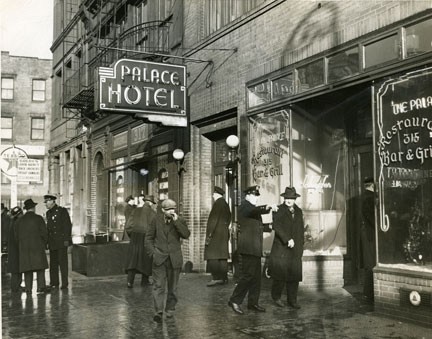
New York policemen on the Beat 1940s -  vintagephoto.com
New York policemen on the Beat 1940s – vintagephoto.com

The world is coming to the steady recognition that the forces that secured a peaceful resolution of the intense 20th century battle between totalitarianism and democracy are unraveled.  The key ingredient, and the accompanying heavy burden of responsibility, was founded on the concept of a “world policeman” to secure trading routes, work to resolve local strains, achieve regional alliances, and as necessary impel cooperation to maintain security.   In the first four decades it was the role of Great Britain, and with the cataclysm of the second world war, progressively the role of the United States in the next six decades, to take on the mantle, economic and military responsibility, and moral persuasion that produced the eventual triumph of democratic ideals over totalitarian unity. The device of “world policeman” so effectively maintained a will and clarity over the decades  that historian Francis Fukuyama declared in 1989 to have seen the “end of History”with the world settling on the victorious governmental form of political and economic liberalism known as western democracy as a final form of governance.

The world of today bears little resemblance to the post historical world declared by Fukuyama.  The role of world adjudicator and stabilizer appears to have achieved a progressive moral insecurity and spiritual and financial exhaustion in those two countries that accepted the burden.  Neither Great Britain or its successor the United States has the desire any longer  to be the forward defender of free people and free ideals,  and the world is noting the vacuum created.  The result is a return to local passions potentially creating a kindle for international violence that will make the world yearn back to the days when there was someone “in charge”.  It turns out that history abhors a vacuum and the number of unstable forces willing to fill the vacuum is growing exponentially.

President Obama took the opportunity of the world stage with his speech in Berlin to declare the end of a different history than we all remember.  The President, whose philosophy of “lead from behind” has defined his five years as President, sought to frame the current world as the triumph of such thinking.  The greatest threat to world security for this president, nuclear arms and global warming.  The means of achieving security against such threats? Peace with justice.

Peace with justice means pursuing the security of a world without nuclear weapons — no matter how distant that dream may be.  And so, as President, I’ve strengthened our efforts to stop the spread of nuclear weapons, and reduced the number and role of America’s nuclear weapons.  Because of the New START Treaty, we’re on track to cut American and Russian deployed nuclear warheads to their lowest levels since the 1950s.

The proliferation of nuclear weapons to aggressive totalitarian states like North Korea and Iran is therefore to be solved by the reduction of nuclear weaponry by the United States.  This policeman will unilaterally disarm, to show those who would arm themselves the moral futility of their aggressive nature.  That’s likely to work.  The president could not even bring himself to  acknowledge the stated goals of both North Korea and Iran to be nuclear weapon powers.

At the same time, we’ll work with our NATO allies to seek bold reductions in U.S. and Russian tactical weapons in Europe.  And we can forge a new international framework for peaceful nuclear power, and reject the nuclear weaponization that North Korea and Iran may be seeking.

North Korea has already tested atomic weapons, shown its desire to achieve an intercontinental missile capacity, and threatened its neighbors with nuclear destruction.  Iran has declared its goal the annihilation of the state of Israel.  Beyond the unilateral disarmament far afield from either threat and the moral rejection he states above, how will he achieve the stability and suppression of proliferation declared by such rogue states?  Thankfully by “hosting a summit in 2016 to secure nuclear materials“.

After such logic, it becomes increasingly difficult to rally behind this leadership for the even bigger threat to world peace with justice – global warming.

Peace with justice means refusing to condemn our children to a harsher, less hospitable planet.  The effort to slow climate change requires bold action.  And on this, Germany and
Europe have led.

With a global middle class consuming more energy every day, this must now be an effort of all nations, not just some.  For the grim alternative affects all nations — more severe storms, more famine and floods, new waves of refugees, coastlines that vanish, oceans that rise.  This is the future we must avert.  This is the global threat of our time.  And for the sake of future generations, our generation must move toward a global compact to confront a changing climate before it is too late.  That is our job.  That is our task.  We have to get to work.

The storms we need to defend ourselves against to propel humanity forward turn out not to be storms of terroristic violence, nuclear proliferation,  religious fundamentalism, governmental attacks on liberty, and dangerously unstable regimes, but rather…thunder storms and the floods they cause.  This President who has declared himself the most scientifically directed in history continues to talk about a science that is in outcomes free fall, with no identified warming in the 15 years that we were supposed to be overwhelmed by biblical calamities from man’s desire to drive his car and heat his house.  Science’s need to hypothesize is understood, but the need to test the validity of such hypotheses has been sacrificed to the political ideal, when it has been progressively shown that no validity exists.  The lack of validity would be sad, if it weren’t so economically and socially destructive to true human progress.

To this President, our current threats can be summarized as springing out of our own flaws and shortcomings as a people:

We may no longer live in fear of global annihilation, but so long as nuclear weapons exist, we are not truly safe.   We may strike blows against terrorist networks, but if we ignore the instability and intolerance that fuels extremism, our own freedom will eventually be endangered.  We may enjoy a standard of living that is the envy of the world, but so long as hundreds of millions endure the agony of an empty stomach or the anguish of unemployment, we’re not truly prosperous.

The summary translation might look as follows:  People don’t kill people. Guns kill people. Get rid of our guns (nuclear armaments), and we can finally feel safe.  It is our forcing our ideals of freedom on others and intolerance for their nihilistic, anarchistic tendencies that fuels terrorist’s extremism, not their desire to reek havoc on an ordered civil society.  Our standard of living that has brought spectacular development for the world and fed it for the greater part of a century, is tool of suppression and hunger.

The logic boggles the mind.

The argument that world policeman is an unenviable, potentially corruptible, and likely long term intolerable burden is an appropriate  discussion for a society to undertake, as long as the alternative to such stabilizing forces is understood.  The policeman that walks the beat rarely must inject himself forcibly when the neighborhood understands that he stands for lawful behavior and will protect the citizenry if necessary.  Its becoming clear to the neighborhood thugs that no one is in charge, and the risks of some real spasms of violence are growing by the day.  Syria, at one time a local revolt against a tyrant, is now becoming the fault line for two massive antagonistic religious philosophies with jihad as their common  logical expression of moral certitude.  China, sensing the American withdrawal, now looks to enforce a new East Asian Co-Prosperity Sphere with Chinese naval dominance to put previous ancient enemies of Vietnam and Japan in their place.  Europe decays from within with a loss of identity from reduced birthrates and societal suicide  through social spending at the expense of any residual effort to support their own defense, or cultural clarity.

And America?  The world’s policeman shackles its own economy, mortgages its own future through profligate spending, increases its governmental spying and suppression of its own citizens, destroys its foundational compact with its citizens through porous borders and arbitrary enforcement of law, and pretends that the world would be better place if we weren’t in it.

The world could turn out to be a very scary place in a few years, with the devils on the ascendant, no one left to call for help.

Vercingetorix and Drunken Wolves

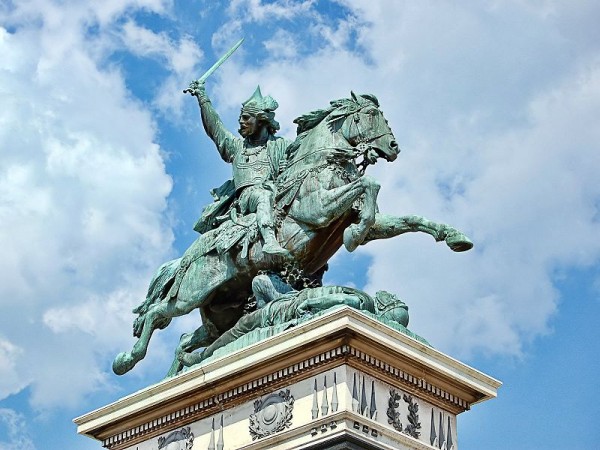
VERCINGETORIX wikipediaIn no other part of the world does a mix of history, romantic legend, factors of geology, and a curious genetic quality for maximizing quality of life come together as it does in France.  Though fitted with spectacular alpine peaks and thousands of kilometers of picturesque seascape, it is the center core of less spectacular landscape that carries the real mystique.  The temperate part of the planet is full of nondescript rolling hills and rock outcroppings, but leave it to the French to create from a querky ridge of metamorphic limestone known as the Cote de ‘Or, a wonderful tapestry of heroes, stories, legends and magnificent wines that make the region of the Bourgogne famous the world over.  The tapestry is of Roman proconsuls and barbarian kings, the bones of pilgrimage and Benedictine monks, engineers and future French presidents, even rampaging wolves, and they all have their story, but perhaps it can be simplified in saying at a base level they all came for the grapes.  Those special grapes of Pinot and Chardonnay that reach their zenith on the limestone bluffs beyond the towns of Chablis, Chambertin, Beaune, and Nuits St Georges make for some of the greatest wine in the world, and bring us to look in wonder at the characters that were drawn by their allure.

The first recorded burgundian wine interloper happened to write an excellent travelogue of his experiences, and from which we draw our first acknowledgement of the region.  Our author was none other than Gaius Julius Caesar, who in his epic Commentaries on the Gallic Wars introduces us to our first local hero, Vercingetorix, leader of the local tribes of Gaul.  The Gaul of Roman times was already known for its wine crop when Caesar decided to make his mark in history(and expand his bank account) by subduing the tribes of Gaul.  Vercingetorix was more noble than barbarian, but for the haunty Romans, apparently a man much in need of subjugation. Vercingetorix as heroes go was not exactly a humane figure, but rather crafty and violent Celtic leader of the Avernii tribe that fought Caesar to a draw on several occasions before meeting his final defeat at Alesia just outside the modern burgundian town of Alise Sainte-Reine,  in 52 BC .  There was no doubt much burgundian wine consumed by Caesar and his legions as the brought the captured Vercingetorix back to Rome for public humiliation, imprisonment, and in due time, death by strangulation.  To the locals of Burgundy who still see themselves as Aedui, the original inhabitants of the Cote de ‘Or, Vercingetorix is the triumphant hero of the region, and perhaps the first historical French resistor.

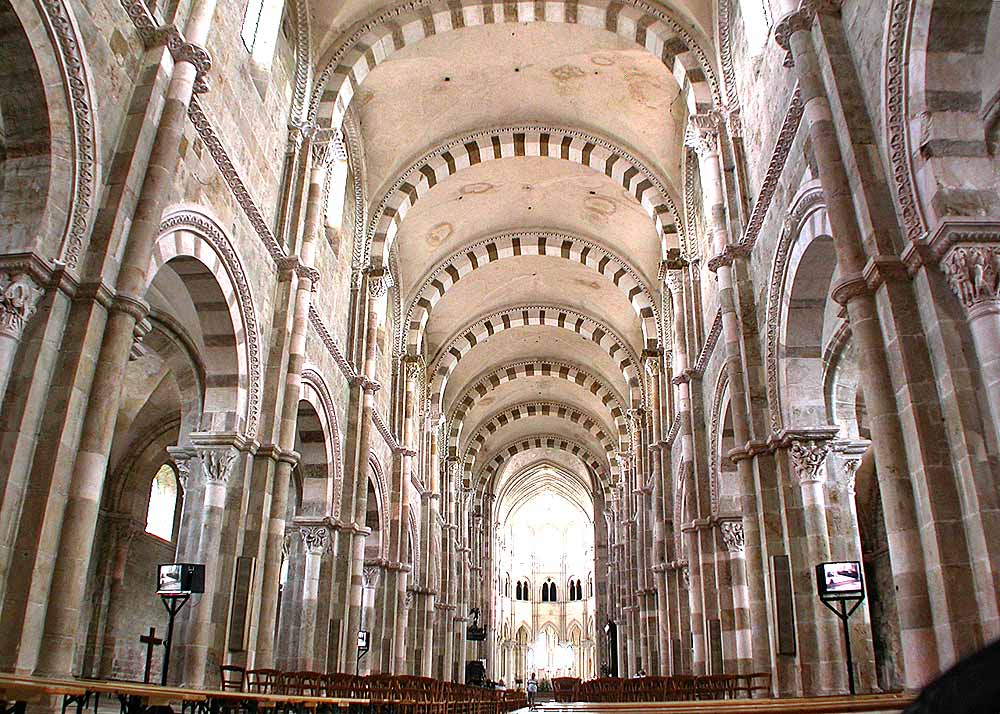
The Romans having finally successfully subdued the Celts, converted the celtic lands into the Roman Provence of Gaulus Lungdenesis, and contributed to the agricultural development of the wine crop with high demand for drink, excellent ramrod straight roads like the Via Agrippa for transport of goods, and relative peace.  Nothing lasts forever and that was certainly true of Pax Romana.  Half a century later and it was the “barbarians” that returned the favor on Rome, sacking it, it making wine once again a local product.   It was left to the successor to Roman empire building, the administration of the Christian church, to bring the area back to prominence as a nursery for leaders.  the Benedictines founded one of their great abbeys in Vezelay, and wine is a tonic for all great meditation.  VEZELAY ABBEY BASILICAThe town became a mecca for pilgrims who sought to begin their great pilgrimage on the way of Saint James, and to get close to the bones of Mary Magdelene herself, said to be housed as relics in the cathedral at Vezelay.  The fact that this was only one of several churches holding the so called remains of Mary, required Pope Stephan IX in 1058 to declare the Vezelay relics as the genuine article, making the little town in Burgundy a center for visitors from all over Europe.  The popularity made the local dukes very rich and very powerful, and the Dukes of Burgundy, ruling from Dijon, became important rivals of the House of Valois for the French throne, stopped only by their lack of fecundity leaving the Duchy without an heir, absorbed in the fifteenth century into the greater kingdom of France. The house of Valois had their Bordeaux and Loire valley wines but nothing quite like the chardonnay and pinot of the Burgundians, thus completing the greatness of the French Kingdom.

As Paris progressively became the center of French power and prestige, the homeland of Vercingetorix concentrated on exploiting the the encarpment of limestone but still occasionally contributed to French civilization with great engineers like Gustave Eiffel, Dominique Denon, developer of the Louvre Museum, and Francois Mitterand, mayor of Chateau Chinon (Ville) , parttime Vichi collaborator and French resistor, and later, President of France.  Well, maybe I should have stopped with Denon, as Mitterand was not a Burgundy native and definitely not Aedui.

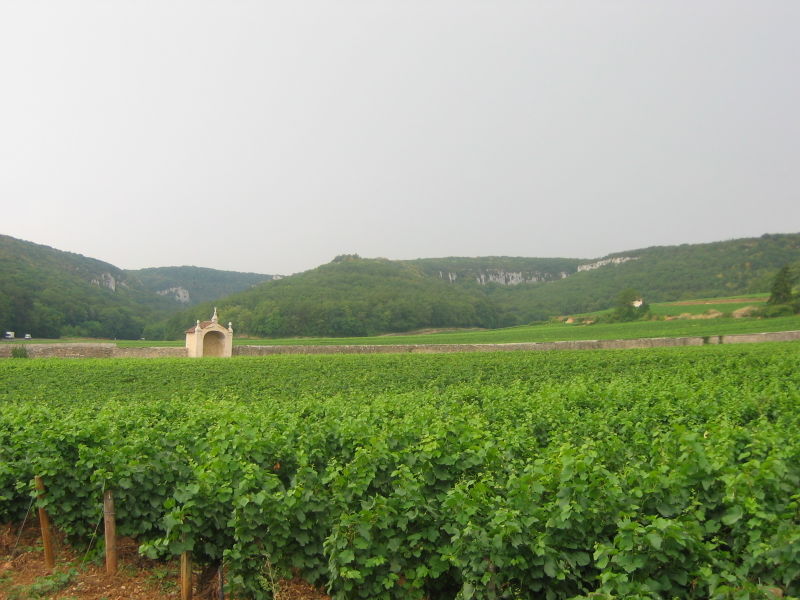
800px-Vineyards_Combe_Lavaux Gevrey Chambertin

The nineteenth and twentieth centuries saw the little towns of Burgundy take full advantage of the unique terrior and create some world famous vintages of their special grapes, bringing the Pinot Noir of Gevrey Chambertin and Nuits St Georges and the Chablis of Les Preuses and Blanchot, and the Chardonnays of Montrachet to the pinnacle of world prominence and wine excellence.  I had the occasion to drink a young 2009 Gevrey Chambertin last night, full of flavor to the point of being slightly tart, but already showing the finesse known for burgundy Pinot Noir.  It set off the lamb chop rosemary sweetness perfectly and made me go home and order some more as well as a few Nuits St Georges for my more economical nights of relaxation.

And so with all the history we’ve reviewed, where do the drunken wolves come in?  Well, World War II legend has it that the war made the towns and chateaus of Burgundy  so devoid of people that food was scarce and the wine crops undefended, resulting in hungry wolves from the countryside forests seeking any food they could find feasting on the fermenting grapes, and sauntered into the towns drunk . Laying around burgundian  towns drunk without a care in the world, they met their maker, as the horrified town residents found their presence, drunk and docile as they were, unacceptable.  To this day, one can understand, that there is little sympathy and consolation for those who would drink and travel, regardless of the context.  Loving the Gevrey Chambertin as I did, and wolfishly devouring the bottle, I made sure to have someone else drive me home, so as not to meet the fate of those poor drunken wolves, and miss out the next time I experienced the greatness of the wines of Burgundy.

Crusade Against the Darkness

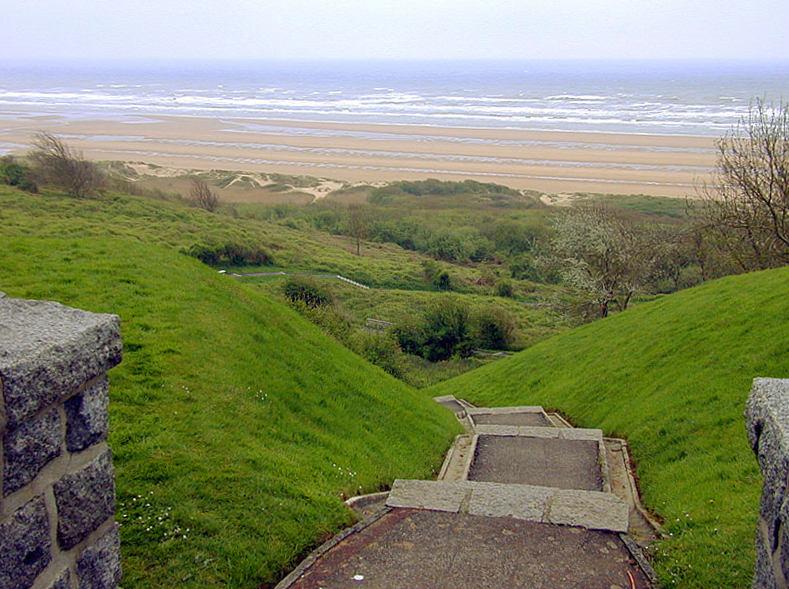
OmahaBeachFromNormandyCemeteryTo watch the gentle waves timelessly crest against the quiet beach sands, it must seem to be all about inevitability.  From our venue, we see a open serenity, with a path through the cove of the cliff leading to the beach below and it seems inevitable, that like the rising tide we would leave the beach to the environs within through this peaceful cove, up this quiet cliff.  Like the countless beaches the world over, the endless communication of the sea to the land takes place every day all day in peaceful solitary.  As it was. As it is. As it ever will be.

The serene beauty only becomes haunting and and laced with trepidation if we look down from our visage and recognize the beach is French, located in the Provence of Normandy, and has held an attached moniker for almost seventy years- as the beach known as Omaha.

This week marked the 69th anniversary of the moment when powerful forces of light and darkness clashed at this very spot and determined that inevitability would be defined by the winner and suffered by the loser, at the cost of great death and destructive violence. The cove leading up from the beach would be littered with bodies of men who were pushing up against the scythe of Death himself, against the will and lives of men who were determined to throw them back into the sea.  For someone 20 years old today, the drive up this path would have been led by men who were the father to their grandfather if they somehow survived the dash up the cliff, so long ago are the events of that day. So long ago that it seems inevitable to believe, that the forces of freedom and individual liberty were overwhelming, and that victory was assured over the forces of evil.  So long ago, that we see newsreels and read books regarding that day and see it as if in a movie or a fairytale, with snapshots of action that seem out of an ancient silent time, almost dramaless in its quiet inevitability.  First the scenes of the soldiers in preparation, then the boats slowly unloading, a few soldiers traversing the beach, a few dropping silently, quiet puffs of smoke, then cheering French crowds.  It all seems inevitable, a good action story, with a happy ending.

For the generation alive actually lived it, they know there was nothing inevitable about the ending.  For 5 years the entire world had been sucked into the blistering vortex of a battle between two diametrically opposed visions of humanity.  A totalitarian behemoth held most of Europe and the cliffs of Omaha beach, driven by dual passions of powerful efficiency and bottomless hatred, under the assumption that an ordered world ruled by an all powerful state and a superior race, was the pinnacle of human advancement.  Attempting to gain a foothold on the continent was a messy alliance of diversified races and religions, bonded only by their sense that a society that celebrated individual liberty and personal freedom of action were the perfected outcome of 3000 years of civilizational development and adversity.

5 years of hellacious conflict was compressed into a moment in time at 630 am June 6th, 1944, as the first troops unloaded on the beaches at Omaha and four other beaches of the Normandy coast to attempt to settle the issue as to the superior societal version.  The Allied forces had coalesced for two years on the British Isles collecting in massive amounts the means of war, training hundreds of thousands of men, thousands of ships and planes and endless hours of planning to attempt the largest amphibious landing in the history of conflict.  The goal was to land 165,000 men securely on the French coast in 12 hours, cracking the “impenetrable” Atlantic Wall devised by Nazi soldiers and engineers.  Previous allied attempts to deliver sea, air, and land forces in a coordinated fashion against the German defenses had proved bloody and disastrous in the landings at Dieppe in 1942 and the beaches of Anzio in January 1944, with much smaller scale and complexity.  Failure of such a spectacular investment in men and material gambled in the landings at Normandy would likely have required years of retrenchment before another attempt, if ever.  A successful push of the landing force back into the sea would have likely allowed Nazi troops to reorient towards the east and likely stalemate Russian forces, probably securing the permanence of a Nazi Europe.

The story of such immense forces would be told in future celebration by the forces of good only because of the individual will of every soldier that stormed the beach that morning.  In particular at Omaha Beach, there was every reason to give in to defeat.  Three hours into the landing thousands of soldiers lay dead on the beach and the waters behind, with the few survivors clinging to a breakwall under a withering hail of shrapnel, and the American commander Bradley contemplating abandoning the beach.  So broken was the plan, that the impetus that allowed the surviving beach officers to drive their men forward, was the appeal that the chances of dying were less attempting a charge up the cliffs under fire then they were huddled behind a wall of bodies on the beach.  Better to be a moving duck, then a sitting duck. One by one, men decided they were dead anyway, and decided to push up the coves against the machine gun and mortar fire.  One by one, the coves were taken, then the hills then the cliff and finally the pillboxes and machine gun nests.  The allied deaths on Omaha were so appalling that for years after, the official toll was reported by authorities as 2500, so as not to devastate the public knowledge of the butcher’s bill.  It seems the truth, that over 5000 casualties incurred on the beach on that one morning at Omaha, had to wait until sons of the fighting fathers were grandfathers themselves.

Somehow, what had never been successfully done before, in much smaller and less complex fashion, succeeded that day at Normandy, and changed the world on its axis.  It turned out that it was not the clash of civilizational will that Hitler was counting on that won the day.  It was something he could never have contemplated, the role a free man feels he plays in making his own destiny.  The soldier that Hitler was counting on, the American soldier softened by easy society and lacking in discipline who would prove weak under the stress of fire, existed only in his fantasy.  The reason that the cliffs were taken that day is perhaps personified in the story of one man, Private Hal Baumgarten, who determined to fight his own war against Hitler. Baumgarten, a Jewish college student at New York University, volunteered for infantry, when he saw how poorly Jews were treated in Hitler’s Germany.  Knowing the consequences of a Jewish soldier potentially being captured by Germans, American military authorities recommended that Jews not put their religion on their dogtags.  Baumgarten decided not only to list Jewish as his religion on his dogtags, but to have a large Star of David placed on the front and back of his army  field jacket beneath the words The Bronx New York, because he wanted ‘the bastards to know exactly who they were shooting at and who was coming to get them’. A single man defending his free will proved sufficient to crack an impenetrable wall of collective obedience.

We are coming to the end of those who personal remembrances of how awful it was, how uncertain it was, and how close it came to extinguishing liberty’s light forever.  The current populations of free societies now willingly give up their freedom and personal privacy without a whimper, and could not conceive of what D-Day soldier felt as he left the landing craft. Our personal Atlantic Wall of hard earned freedoms are proving as porous as the supposed impenetrable wall constructed by the Germans so long ago.  Our own government has declared war on those who would articulate the value system of our Constitution and proselytize it to others less aware.  In honor of  Private Baumgarten, we should “wear” the Constitution and the acquired freedoms he and others sacrificed so much to preserve on our sleeves, and make sure the bastards know exactly who they are shooting at, and who’s coming to get them.