Who Knew? – The American Oil Revolution

The Ghost of Fuel Prices Past

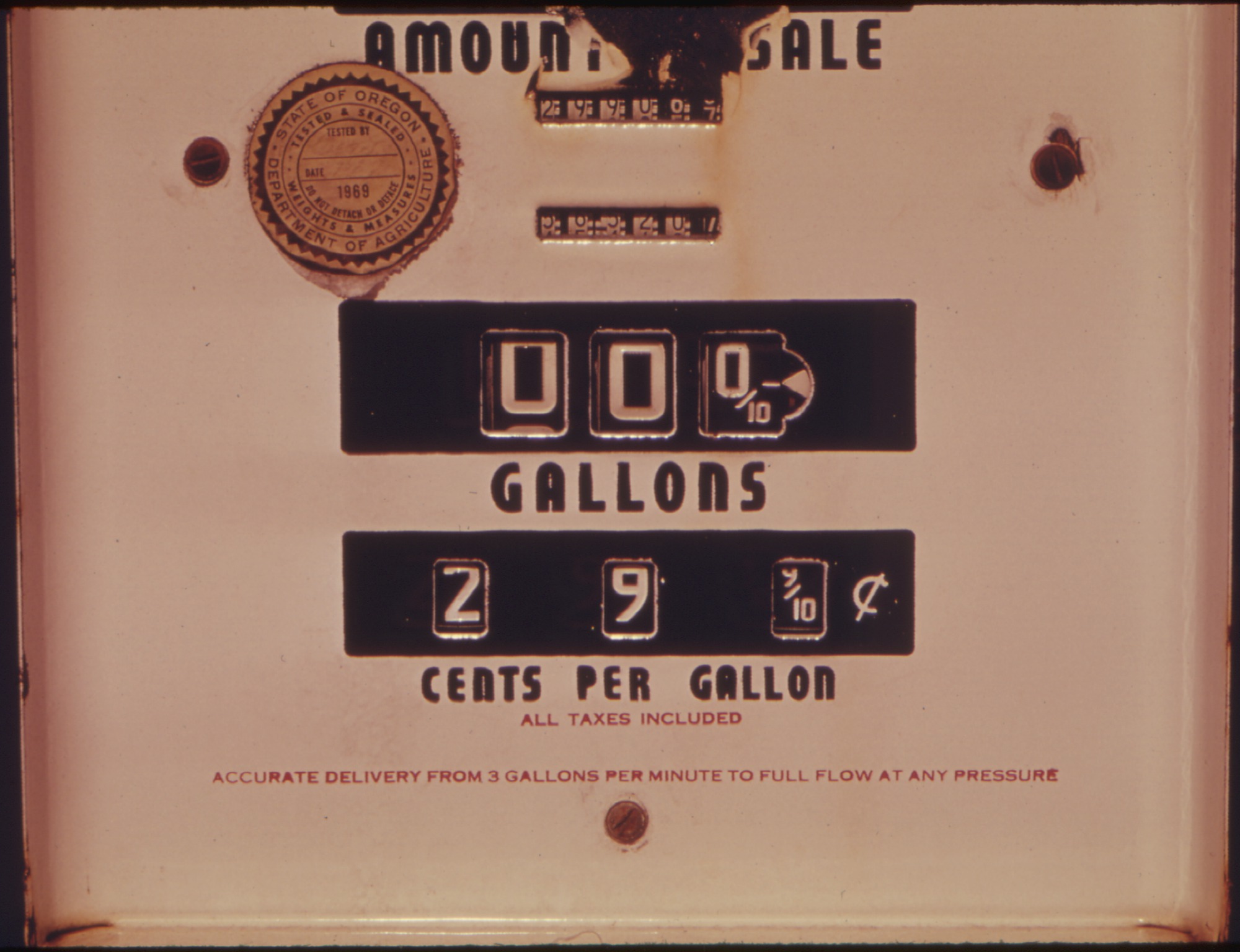
In all the stories assumed to be the Christmas miracle story of 2014, the story no one predicted was the resurrection of the American economy on the muscular shoulders of the American oil industry.  On the gas pump above frozen in time like a faded photograph are the gasoline prices when America was the number one producer of oil for the world, before the OPEC oil embargo, the piling on of taxes on the energy sector, the mythic concept of Peak Oil and the fading of carbon as an available source of fuel and energy, and the concern about global warming converted to “climate change” (with the unexpected lack of global warming) and the rising CO2 emissions.  A colossus of current events, however,  are driving down energy prices to the point where, inflation adjusted, we may see prices comparable to the ancient levels, with the resultant spectacular boost it will provide the economy through inexpensive available energy and to the individual in freedom of transport.

In the millionth example as to how progress in society is best achieved through the power of individual initiative and creativity and not plodding government bureaucracies, the American Oil Revolution is a prime case study. Left to the nanny state mentalities of the modern government agencies, no revolution would have come about.  Since 1990, on the basis of the dogma of carbon energy as the enemy, western governments have progressively looked to stamp out oil and coal initiatives because of the propped up science “connecting” global warming as an anthropomorphic  phenomena and rising CO2 emissions as the world became progressively developed.  The Kyoto accord looked to remove carbon as the fuel for economic expansion in the first world economies, allowing the developing world to “catch up” and to create a veneer of ‘sin’ associated with man’s progress as individuals.  This argument was buttressed by the concept of Peak Oil – the world’s supply of oil was finite, and as we had found all there was to find, the inevitably  scarcer oil resource had to be adjusted for by “good” technologies yet to be invented and aggressively put in place of oil. As expected, technologies artificially propped up by governments before their technical time, like wind and solar, created associated boondoggles, enormous waste of investment, lots of dead birds, and essentially no bump in net energy (energy creation/energy expended = net energy). As oil was yesterday’s fuel, the American government willfully restricted access to known oil resources on public lands, to assure the narrative and reorder societal behavior.

Leave it to those Texans to save us once again from ourselves.  On private lands, experimentation on so-called inaccessible oil locked in rocks began in the 1990s and took off in the first decade of the 21st century in the form of fracking – the process of pressure injecting sand and water  to create channels of oil flow in oil tied up in eons of rock.  As the government struggled to contain the action on private lands, the progressive success of the process spread to areas of the country long considered dead to energy production – North Dakota and Pennsylvania with the stunning result that not only could the oil be captured safely and economically but in quantities that soon put the Peak Oil argument to shame. Hundreds of millions of years of organic detris preferentially distributed in the continental expanse of North America at levels only conjectured about became accessible, and the miracle was on.
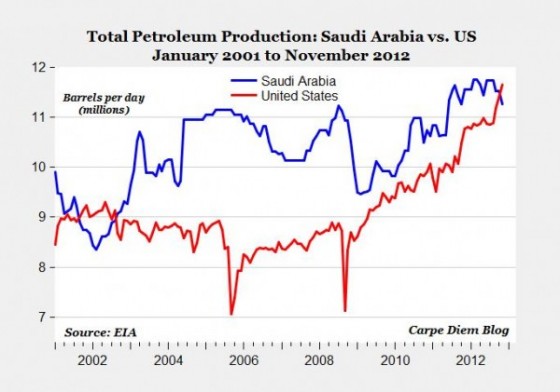
The American Oil Revolution

And so the miracle of the United States surpassing once again Saudi Arabia as the number one producer of crude oil in the world.  The effects of such a stunning turnaround are yet to be fully evolved.  The initial downstream effect has been a glut of oil and natural gas that has created a dramatic downward pressure in oil prices. WTI Crude Oil per barrel was $54.73 per barrel on December 27, 2014. On September 6th, 2013 it was 108.12. This 50% reduction in the price of crude oil has been resulted in the fracturing of the continuity of OPEC, the brazen effort by Saudi Arabia to maintain production highs to try to “starve” the American oil producers who require a higher oil extraction price, and the secondary effect on the dictators in Venezuela, Russia, and Iran that have funded their extremism and revanchist expansionist policies on a steady high oil price.  The benefit to the energy consumer, the individual in prices at the gas pump and the producer of goods and services in the reduction in energy outlay, is profound.  The benefit in removing oil as a weapon used against western society is equally profound.

And yet, the lingering issue of carbon emissions and the resultant CO2 effects on potentially precipitating climate change.  What good could possibly come from the entrepreneurial efforts of independent thinking Texas oil men when the world’s climate is at stake? The answer? — never doubt the creative intellect of the individual free to solve problems without an overbearing tiller of an oppressive bureaucratic regime.  The next coming miracle may be EOR-Enhanced Oil Recovery.  It turns out those Texans have not only resorted to fracking, but for decades have been thinking about the so-called exhausted wells they already own.  The traditional drilling process extracts only about 30-40% of an oil field’s available oil before it is “exhausted” by the lack of pressure to retrieve the residual 60% of the oil left behind.  It has always been cheaper to simply find another oil field to drill.  The estimated 100 billion barrels of oil remaining in US wells after exhaustion of the well has been waiting for technology to deliver a solution.  As fracking was to shale rock, EOR is to exhausted wells.  The process of extracting the retained oil may be best solved by the utilization of — wait for it –  CO2.  That’s right, the “evil” gas CO2 created by man’s energy demands particularly by coal burning plants may be the savior of attaining oil from exhausted wells.  CO2, in a liquified state, injected under pressure proves to be a unique solvent freeing retained oil for well to once again produce.
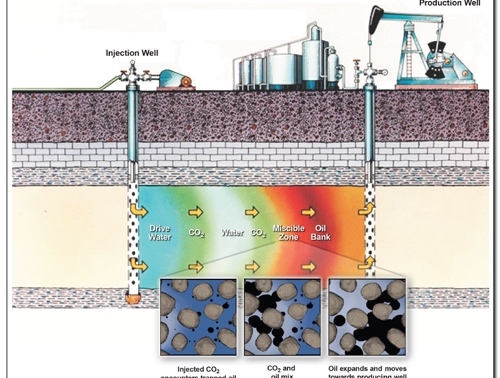
co2_eor


Samuel Thernstrom in the Weekly Standard describes in a must read article a process where the billions of tons CO2 emissions created by coal burning plants could be captured and sold to the oil industry for EOR extraction, thus increasing available oil and reducing CO2 emissions into the atmosphere by injecting them back into the ground where they came from  in a perfect dance of environmental and energy policy.

All proves possible again when you rely on the instincts and genius of the individual seeking to advance the world he or she lives in.

I don’t know if the amazing revolution in energy back to attainable carbon will be the final answer to continuing the process of achieving a more civilized and kinder world to more and more of the world’s population. I do know however,  time and time again, the answer will be found in the fertile mind of an individual who, released from the oppressive weight of a government that thinks it knows the future, will bring the future to us all.
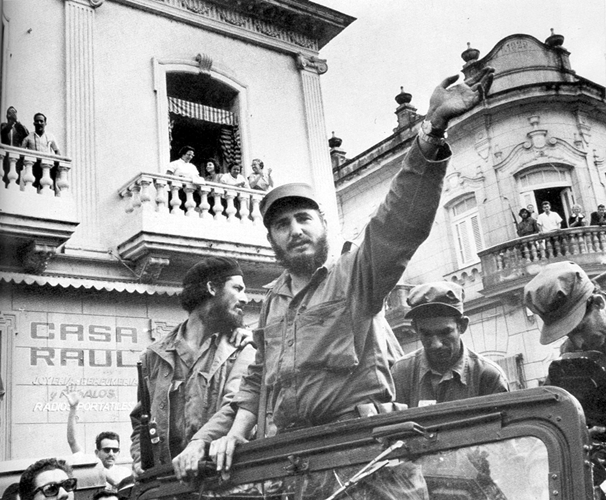
Freedom Loses Again

Fidel Castro and Che Guevara

Civilization is the progress toward a society of privacy. The savage’s whole existence is public, ruled by the laws of his tribe. Civilization is the process of setting man free from men.
                                                                           Ayn Rand

What is freedom?  Why did the United States for over 23o years declare the elevation  of one’s individual capacity to determine his destiny without oppressive interference of others the primary definition?  What is lost when the essential force for individual freedom sees itself as flawed for not recognizing another country’s capacity to set its on destiny regardless of personal freedom?  What does it mean to the inhabitants of this country and those that exist under different definitions?

We are about to find out.

President Obama this past week overturned the settled philosophy of the 8 prior American Presidents regarding relations with the nation of Cuba by releasing three Cuban spies imprisoned for felonies such as murder and acknowledging the process for achieving formal relations with the government of Cuba.  Having recognized in 1961 of the true political leanings of the young ‘revolutionary’ Fidel Castro, the United States attempted  to overthrow Castro in the Bay of Pigs fiasco. Castro retaliated by his willingness to bring the world to the brink of nuclear destruction in the October 1962 Missile Crisis  instigated by young Castro accepting nuclear weapons from Russia aimed at the United States. The successive American governments have applied the concept of containment with variable success to the aggressive tactics of the Castro government, blockading it from formal trade, and encouraging the cuban exile population to work progressively toward the liberation of the island from the Castro regime.  The fifty subsequent years have been essentially a cold war between Cuba and the United States, with Cuba progressively trading economic support from the Soviet Union to maintain its marxist totalitarian grip on the Cuba economy and people, and its  willingness to act as a military proxy for Soviet communist regime in the 1970s and 1980s in places as diverse as Nicaragua, Granada, and Angola.

From 1959 onward, tens of thousands of Cuban refugees have attempted to escape the totalitarian government, risking life and limb on rickety boats to try and secure a meaningful existence in the United States, the passage to freedom a tempting mere 90 nautical miles away from the American coast. Many have made it. Many more have been drowned, eaten by sharks, sunk by Cuban gunboats, and turned around by American Coast Guard vessels.

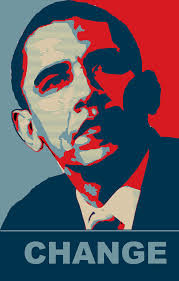
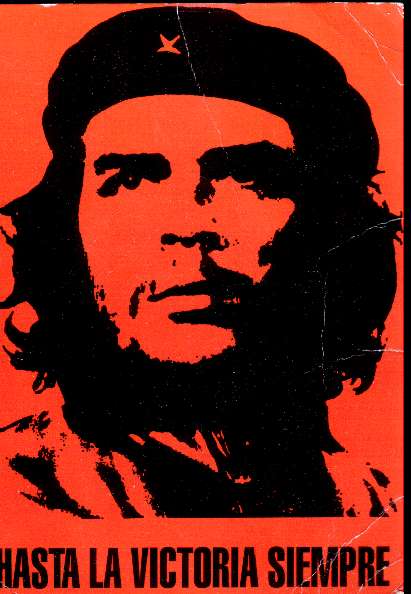
What were they escaping? To the liberal Washington elites and Hollywood celebrities they were leaving a utopian paradise of free health care and societal equality, ruled by a leader in Castro charismatic in his affect, perpetually revolutionary in his appearance in military fatigues, and ultimately concerned only for his Cuban people being able to steer their own course without the oppressive domination of a whorish American capitalist caste.  The level of cultural coolness and forever youngness was even secured on t-shirts and posters immortalizing the great leader Castro, and his right hand revolutionary, Che Guevara, the enthusiastic judge and executioner for revolutionary firing squads that purified Cuba from dissidents who didn’t recognizing the righteousness of the revolution.  It is the personification of this idolatry that propelled the current President to the office of Presidency and the subsequent comfort with the ideals of the winds of change fomented by the  Cuban revolutionaries.

Che_Guevara1 images

If the process of attempting to secure individual freedom for the Cuban people over 53 years of consistent foreign policy through containment proved to achieving no identifiable changes in the Cuban government’s relationship with its people what possible risk is involved in accepting the Cuban revolution at face value, and recognizing it as the legitimate aspiration of an entire people? What could be possibly at stake in similar efforts to restore relationships with similar minded governments currently hostile in position against the United States such as North Korea, Iran, and Venezuela?

Maybe one could ask men such as Rafael Ibarra Roque, imprisoned since 1994 by the Cuban government without trial for ‘sabotage against the regime” for speaking out against things he had seen as a Cuban soldier and citizen through a nonviolent group he formed called Frank Pais effecting to restore democracy to Cuba.  One could ask Human Rights Watch, which has documented a systemic oppression resulting in thousands of executions, arrests without trial, formation of forced labor camps (UMAP’s), suppression of independent media and opposition political movements,  government drug cartels, and prostitution. One could ask the Cuban exiles in Miami who labored for decades to restore the most basic of personal freedoms in Cuba for the family members they left behind.

And now it is gone, as the citadel of personal freedom and institutional democracy determines that respectful relationships with such tyrants will serve both countries better over the long run.  We are left with the question with each of these over-turnings of our own principles what is lost in ourselves as we deny the fundamental importance of such principles?  Will a President who cares more how we look to others than how we act among ourselves lead us to our own loss of freedoms?  That depends obviously as to what it means to be free and our willingness to prevent those who would sell such hard earned freedoms for the veneer of acceptance recognizes once gone, they wont be easily if ever brought back.

Freedom is never more than one generation away from extinction. We didn’t pass it to our children in the bloodstream. It must be fought for, protected, and handed on for them to do the same.
                                                                           Ronald Reagan

Perhaps the freedom we lose, will be forever Cuba’s gain.  Raul Castro, Cuba’s current leader and brother of Fidel thinks not.  He is looking to the economic support of the Cuban Revolution, to cement its gains and prevent any change in the relationships with its people.  Perhaps it will change Cuba’s belligerency.  Then again, it was just last year that Cuba attempted to gain tactical missiles from North Korea to position against the United States, learning nothing in the intervening 50 years since the Cuban Missile Crisis.

Cuba is not looking for change, but it will be hoping for change in the United States. As probably will Iran and Venezuela. It turns out when it comes to slowly dissolving the light of freedom, the Man of Hope and Change was ultimately the Man of totalitarians’ Hope , and our Change.


Shackleton’s Magnificent Failure


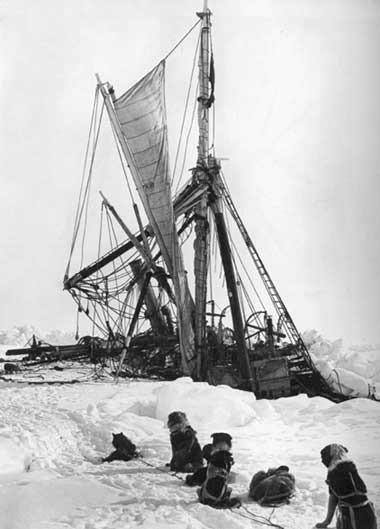
Shackleton's Endurance succumbs to the ice
Shackleton’s Endurance succumbs to the ice

One hundred years ago this week, the explorer Ernest Shackleton and his crew aboard the schooner Endurance left the port of the Grytviken whaling station on South Georgia Island in the South Atlantic to the continent of Antartica.  The goal was a never before achieved transcontinental traverse across one of the remotest places on earth.  It would be their last touch with civilization for the next one and half years, and it would be an utter failure. The extent of the failure, and the spectacular story of survival, courage, leadership and outright moxie required to bring the participants back to civilization is the basis of one of the most uplifting stories of human achievement and one hundred years later, remains a riveting example of meeting your own flaws and mortality head on and overcoming to inspire us all.

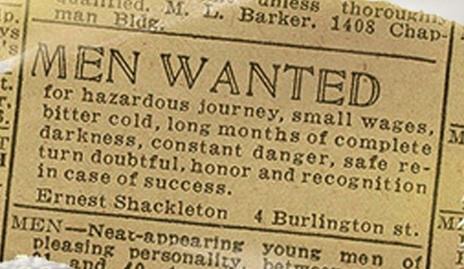
One has to put into the perspective the age that men were living in, and that it was the age of men.  Ernest Shackleton was a man of his age. He sought to test himself and others to expand the limits of what was known and did not terribly worry about the consequences or risks of such traits.  He had participated in a previous Antarctic expeditions including one with the famous explorer Robert Scott who later lost his life in the return voyage from achieving the South Pole,  in a mission that Shackleton had planned to be his own.  Having had to except the reality that the glory of first to the pole rested in the hands of the Norwegian explorer Roald Amundsen, who beat Scott to the pole by three weeks, Shackleton wanted to establish a British success that would be of import, the transcontinental voyage that would require more spectacular planning and logistics, in keeping with his sense of being a man of the Empire.   He did it in the old empire sense of understatement, not asking for public support but rather going to a few rich brokers with similar sense of empire to fund the expected costs of such a complex expedition, approaching 5 million in today’s dollars.  For crew, he called on a few loyal men of extraordinary talents who had served with him previously, and for other parts of the crew, a simple understated call to adventure advertisement in the local paper.

The Endurance Expedition advertisement

The genius of Shackleton’s leadership did not present with the planning of the voyage.  Limited by the primitive communication of the day, the difficult logistics relied on the almost perfect and thereby implausible timing of events and cooperative weather that very soon showed the flaws in Shackleton’s expeditionary capabilities.  The Endurance sailed across the Weddell Sea to the Ronne Ice Shelf in sight of continental land but hampered by a progressively treacherous current pushed ice pack which eventually locked the ship in from the open sea on February 14th, 1915.  Tremendous efforts by the crew to free the Endurance from the ice proved fruitless, and Shackleton realized the boat would have to wait out the ferocious Antarctic winter in the ice, hopefully to be freed by the next spring and summer’s melt off.

He had been locked in the ice before on the Scott expedition , but had been able to free himself, so he assumed with patience the same could occur for the Endurance.  He was wrong, horribly wrong, and by the intense winter of June through August the pack progressively thickened and began to put massive pressures on the boat’s structure.  By September, the boat was in dire straights, crushed against massive heaving flows of millions of tons of ice, and the inevitable occurred on October 27,1915 – the ship was abandoned and slowing sinking began.

And so really begins the story out of utter failure.  The depths of imagination and courage needed to survive are beautifully  told in Alfred Lansing’s book the Endurance , and can not be done justice in a few paragraphs in this blog. What Shackleton showed in the face of crisis is the basis for this blog, however, and the key moments are forever inspirational.  What does one do in the face of complete collapse and frank threat to your leadership? Shackleton’s decision was to show even greater leadership.  He announced to the crew that the purpose of the expedition was now fully to achieve the survival of the participants and he was confident through shared sacrifice this could be accomplished.  A score of men alone with limited food and poor survival gear floating on an ice flow over a hundred miles from land and a thousand miles from civilization seemed an impossible task and the men felt it, but Shackleton never let them see that he felt it.  He would lead them to safety.  The road to safety was the open sea, and therefore the three rescue boats on the Endurance would have to be the means of escape.  Men would have to physically drag them over ice flows and knee deep snow over uncountable miles until free water was seen.  Day after day the harsh realities were documented by the mission photographer, Frank Hurley, who brought visual confirmation to the incredible facts of the escape effort. Through maps and reckoning, the distance to shelter was felt to be three hundred miles-the highest speed of cross ice transit was seven miles a day.  It became eventually clear the men’s incredible effort would come for nought unless luck would intervene, and luck came in the form of fracturing of the ice pack on April 9th, and Shackleton’s decision to man the ice boats and attempt to make Elephant Island, the last outpost of Antarctica before the open sea, and certain death. Five days in the ocean led them to a landing on Elephant Island and land.

Land was a generous term as the island was essentially inhospitable and the weather still atrocious.  Shackleton had gotten them this far, and announced that the majority of the crew could take refuge, and he, Shackleton, would take the 22 foot rescue boat across the open Weddell Sea to civilization and help.

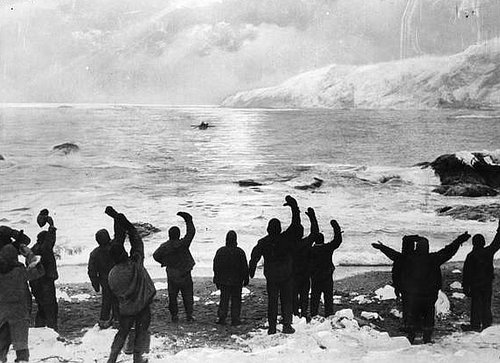
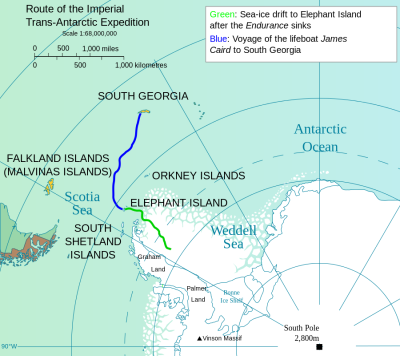
That would be 800 miles across what was uniformly known as some of the worst sailing sea in the world in a 22 foot boat to hopefully reach South Georgia Island and civilization – the equivalent of being a cork in the ocean that actually found itself back into its original bottle.  To Shackleton however, it was doable, and as he had gotten them into this mess, he would do whatever was necessary to get them out.  On April 24, 1916, Shackleton launched the James Caird with his chief navigator,  Frank Worsley who had only a chronometer and dead reckoning  to guide him across the difficult ocean, and four sailors.  The twenty or so crewmen of the Endurance who stayed behind on Elephant Island, waved him goodbye, and assumed that they were waving goodbye to their commander, and their own hopes for survival.

The Elephant Island survivors wave goodbye to the Shackleton and the James Caird crew on April 24, 2016.
The Elephant Island survivors wave goodbye to the Shackleton and the James Caird crew on April 24, 1916.

England by the spring of 1916 had been in brutal war for a year and a half, and having heard nothing from Shackleton and the Endurance crew, assumed them dead.  The forlorn men on Elephant Island knew they were as good as dead as no one knew they were there but Shackleton, and he was attempting the impossible.   For Shackleton, the impossible was only present through the release of death from responsibility, and as such, still, alive, he trudged across the Weddell Sea in his little boat through impossibly rough seas approaching thirty feet, gales that would have sunk a boat hundreds of feet larger, and nothing to prevent him from floating to death into the vast Atlantic Ocean other than the indefensible luck of successfully navigating to little South Georgia Island.

After 800 miles of vicious open sea, in a navigating achievement that no modern sailor with the most sophisticated gear would want to attempt, the James Caird reached  South Georgia Island  on May 10th, 1916.James_Caird_en.svg

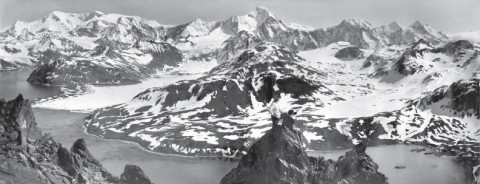
The exhausted men of the James Caird found themselves on the opposite side of the island from the small whaling station and rescue.  All that stood in the way were mountain peaks thousands of feet high covered with treacherous ice and glaciers.

South Georgia Island mountain range conquered by Shackleton

The men had soggy woolen clothes and a few ropes.  As if the travail across the sea was not challenge enough, the men tackled the climbs with desperation, finding themselves finally within site of the station but separated by a sheer three thousand foot drop. No residual strength was present so they took one last chance, improvised a rope sleigh and through themselves off.  Minutes later, whaling station inhabitants looked up to see four other worldly bedraggled men impossibly appearing from the impenetrable mountain side.

One of the four was Ernest Shackleton.

Shackleton fulfilled his promise to his men, eventually achieving a successful rescue mission to Elephant Island,  and his stranded men, on August 30th,1916.  The shock and joy that the impossible rescue had been achieved was for the men alone.  Upon returning to England, the men found a nation distracted and immersed in war, and the immensity of their survival achievement took years to absorb.  This was a generation of service, not plaudits, however, and most went on to serve in World War I, some dying in battle, after cheating death in Antarctica.

Ernest Shackleton remained somewhat of a celebrity, and even somewhat of an explorer, dying of a heart attack in 1921, in all places, South Georgia Island intent upon leading yet another expedition to the icy continent. It took several generations to fully absorb what he accomplished in failure, progressively appreciated as the technology improved and recognized what he had accomplished.  What he had done was be the best kind of leader, a leader that does everything he can to share in the sacrifice and find a way out of chaos, in a way that the men and women being led are willing to be led, no matter what the consequences.  Shackleton took responsibility, showed his followers that you try until you die, and you use what you have to succeed at whatever odds and challenges,  Through meeting a challenge no matter how harsh the consequence, the capacity to succeed revolves around the willingness to risk failure, and be content, with the idea you tried your very,very best.


“It is not the critic who counts; not the man who points out how the strong man stumbles, or where the doer of deeds could have done them better. The credit belongs to the man who is actually in the arena, whose face is marred by dust and sweat and blood; who strives valiantly; who errs, who comes short again and again, because there is no effort without error and shortcoming; but who does actually strive to do the deeds; who knows great enthusiasms, the great devotions; who spends himself in a worthy cause; who at the best knows in the end the triumph of high achievement, and who at the worst, if he fails, at least fails while daring greatly, so that his place shall never be with those cold and timid souls who neither know victory nor defeat.”
― Theodore Roosevelt