The Death of Resignation

Wallowing in the Mud - and Liking It
Wallowing in the Mud – and Liking It

We are ten days away from an epically unpleasant choice for the presidency of the United States between two candidates who show genetically ingrained layers of sleaze in their makeup heretofore not seen.  The virtue of entering a polling booth, completing by decisive vote an extended period of consideration as to who can best effect a positive future for the nation, a privilege not universally held in this world still populated with tyrants, is truly absent to us this year.  Instead, we will have to wallow in the mire adherent to both candidates covering our own virtue with shame, or opt out, and passively accept the decision of those who wallow better.  Do we select the candidate who has lived a  life bereft of principles, of shady deals, broken contracts, meandering ethics and political loyalties, history of cheating and uncouth,abusive behavior? Or do we select the candidate who has epitomized self-aggrandizement, character assassination, decades of corruptive behavior, and very likely criminal behavior that placed at risk the nation’s very security through their malfeasance?  Worse, is this election a simple house of mirrors and both candidates reflect the same essential person?

The seeds of this disaster of democracy were planted over many years and have many contributors.  We lost our compass as a society when the binding force of holding common virtues gave way to an undisciplined meme of the immature, to do your own thing and accept no consequence, and was subsequently elevated to the status of ultimate virtue for the society as a whole. Individual rights, once celebrated as protecting one’s intellectual capability of changing their own life tract and protecting individual expression against the tyranny of the rulers,  became the compromise of giving up the right of individual beliefs for the right of being anti-societal and forcing society to accept.  Some bargain there.  Life in this set of “freedoms” is one of constant hypocrisies – demanding unique freedoms and demanding others reduce their understanding of virtue to bend to your own.  This gashing of virtues has led to candidates stating they are best positioned to restore virtues because they have lived lives of literally ignoring every one of them and have paid no penalty.

The concept of “cleaning house” by voting in the ‘outsider’ attracts many voters this year in the theory that burning down all foundations is the best tact to severing our connection with this path we have been on.  Given the alternative, it is easy to see the attraction to this option.  The hard truth is of course the outsider has always lived as an insider, showing no identified introspection that would suggest he has any remorse for his life inside the bubble, or would govern any differently.  In fact, at times he has shown dark behaviors of personal threat and intimidation towards those that disagree and quiet passiveness in those supporters who hold racist or violent beliefs, that border on a very dangerous fascist core.

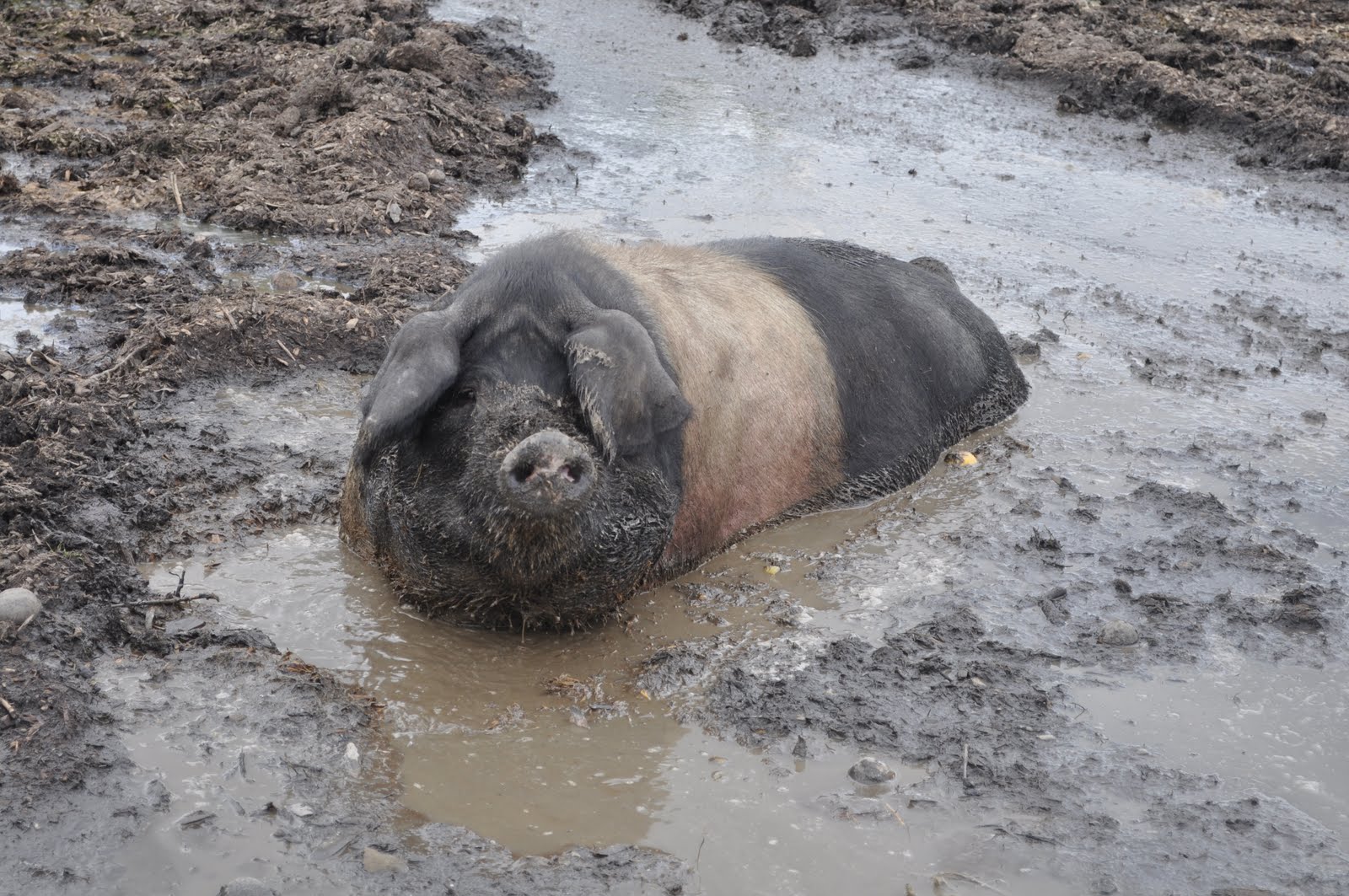
The alternative candidate has shown her core to be the intertwining of power and greed that is  even more dangerous.  Decades of using levers of power to create personal wealth has destroyed her capacity to separate out the nation’s best interests from her own family.  Recent Wikileaks emails suggest the personal aggrandizement of the Clintons through their foundation has already succeeded 60 million, with more millions yet mandated, for favors that have stunk for decades as “pay for play”.   As they used to say – you can put lipstick on a pig….   The result as is typical for those who would hang around the slop for some reflected glory or profit, they are increasingly covered in the mud themselves, whatever their original virtues.

The self corrective mechanisms once in place to identify and root out such people have long since been broken.  The Department of Justice progressively functions as the long arm of intimidation and coverup of those who benefit from the status quo.  The FBI has twisted itself into knots to avoid doing due diligence, providing immunity to the most culpable, and injecting itself into interpretation of the law rather than obtaining the dispassionate elements of facts that would allow judgement to be considered in an objective setting.  The tools for maintaining the independence of our virtues used to be housed in individual’s personal value system fortified by the shared virtues we all respected.  In positions of power, the weapon of choice was resignation for both the virtuous and the culpable.  On Saturday, June 20th, 1973, President Nixon, in an effort to maintain executive privilege in a matter of potential criminality demanded his Attorney General Elliot Richardson to fire the Watergate independent special prosecutor, Archibald Cox, who had subpoenaed Nixon’s personal secretly recorded tapes of Oval Office conversations.  Believing the demand to be extra-constitutional, Richardson resigned.  Nixon then demanded the deputy attorney general  William Ruckelshaus to fire Cox. Ruckelshaus on identical principles, resigned.  Nixon was forced to go to the Solicitor General Robert Bork and name him acting Attorney General who finally complied.

The acts of personal virtue in the face of enormous pressure inevitably had their profound effects.  Within eight weeks, Nixon himself was forced to resign under the weight of proposed articles of impeachment reinforced by his behavior.  Robert Bork, one of the truly brilliant minds of constitutional law, destined for a career culmination on the Supreme Court was forever tainted by his subservience to the executive at the risk of his personal virtues, and was turned down by the US Senate for the Supreme Court in 1987, a Senate that had not forgotten or forgiven.

The tradition of resignation for principle has left our country’s political class and our society as a whole.  When the Attorney General of the United States sees massive flaunting of the laws that protect our nation’s security, does she demand an independent and cleansing investigation that upholds the rule of law?  No – she rapidly secures immunity for those most culpable to protect the executive against any exposure of the slovenliness that may well have reached the Oval Office.  No resignation for those who left their principles long ago. Does the FBI director who recognizes the extent of involvement demand the concept of equal protection and enforcement under the rule of law, or resign as a matter of personal integrity and respect for that virtue?  No – he tries to ride the razor’s edge of acceptance and survival.  Does the Chief Justice of the United States when facing the objective extra-constitutional nature of a law in its coercion upon all citizens to purchase a governmentally mandated product, stand up for the principles of his life long advocation, or resign in the aftermath?  No-he subverts the law in front of him to call the mandate a tax, when no one, pro or con to the law which will affect society permanently has argued, to protect his ‘reputation’ as non-interventionalist.

Ten days from now, we will face the most odious choice in years in the election booth.  We are in this position, both Democrat and Republican, because we have wallowed in the mud with such people, and have gotten used to the dirt and the stench, to the point where it doesn’t effect us when we are covered in it.  Certainly as long as we don’t notice it affects us, all is forgiven.  We have sacrificed our personal virtue as a beacon of how to act, and how to expect others to act.  The result will cover us all, and not in glory.  Regardless, this is a democracy, and it relies on participation.  As someone recently said, vote your conscience, but vote you must.  However it turns out, the new America must demand a more rigid standard of virtue from the winner, or prepare to withdraw support from those who will not be virtuous.  We must ask of all who serve, and of ourselves, the willingness to balance the scales of virtue, or resign in their absence –  to let those in power know, their hollow core of corruption will no longer be tolerated.  We will need to show once and for all, they don’t own us, and they can’t buy our personal virtue.

See you on November 8th.
 

Ophelia’s Flowers

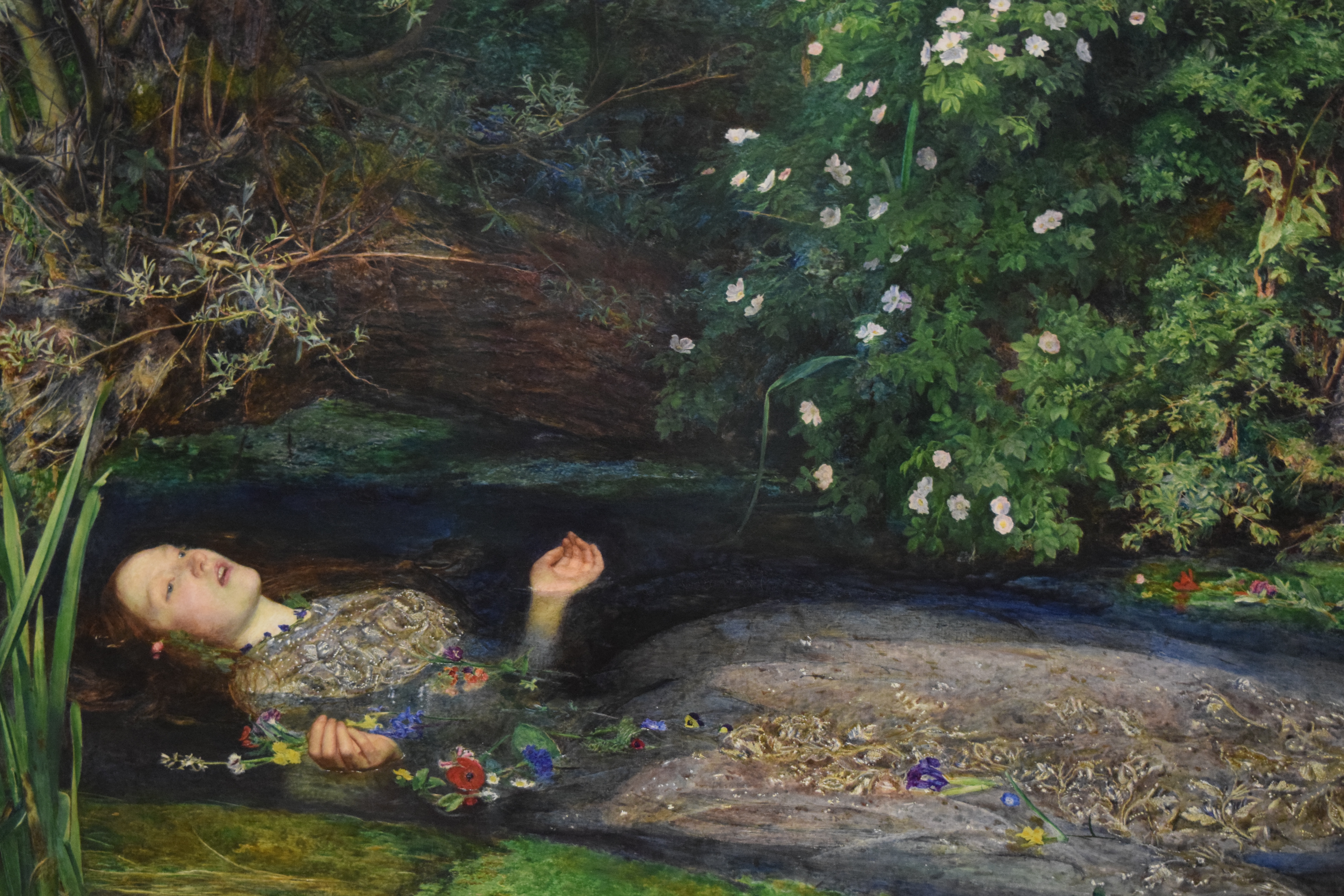
 Ophelia John Everett Millais 1851-2
Ophelia
John Everett Millais
1851-2

In a large rectangular room in the Tate Britain Museum, a modestly sized painting draws the eye among all others.  A beautiful young woman floats in a stream surrounded by a dense, fecund growth, drifting silently down a quiet stream, surrounded by  flowers of florid color and variety.  But this is not a scene of serenity. A  pall lights her features, her eyes see nothing but madness and impending death. Her hands are held in a pose of complete surrender, grasping but not feeling a bouquet of violets, nettles and daisies, which cascade into a floating pool of withered stems on her shimmering waterlogged gown.  She is Ophelia, Hamlet’s scorned love, driven to madness and suicide by the dark Prince of Denmark.  And Ophelia is the signature painting of John Everett Millais, that announced the arrival of a brotherhood of British artists known as the Pre-Raphaelites, heralding  a full blown romantic movement in 19th century art.

In 1848, a group of young artists determined to shake the art world through a conviction that art had become statuary, overblown, and disconnected from the natural aesthetic of the world of creation. The group  of seven – John Everett Millais,  Dante Gabriel Rossetti, William Rossetti, William Holman Hunt, Frederick Stephens, Thomas Woolner, and James Collinson – declared their disdain for the accumulated artifice of contemporary art, and harkened back to a time prior to the revolution of art propelled by Raphael and his acolytes.  For inspiration, they left the subject matter of fawning portraiture of royalty and idolatry, and defined a list they referred to as the “Immortals,” a disparate list of historical figures such as Jesus and King Arthur, diverse literary scions such as Shakespeare, Browning, Poe  and Shelley.  They set four basic rules for the Brotherhood of the Pre-Raphaelite.  1) To have genuine ideas to express 2) To study Nature attentively, so as to know how to express them 3) To hold sympathy with what was direct, serious and heartfelt in art prior to the Raphaelite school and, most importantly, 4) produce throughly good and beautiful paintings and statues.   The sentinel evocation was Millais’ masterpiece of Ophelia, and the art world was stunned and even disturbed with what they saw.  Prior romanticism was held privately between the pages of a book.  Ophelia pulled the viewer into a world of intense feelings of pathos, pity, the world of mental derangement, and an intimate voyeurism that left many uncomfortable.  In the age of Victoria, the public acknowledgement of baser human feelings and passions were not a socially acceptable norm.  The popularity of what propelled from the seven artists suggests however, that the contemporary norms veiled a simmering intensity that had found a vehicle for expression.

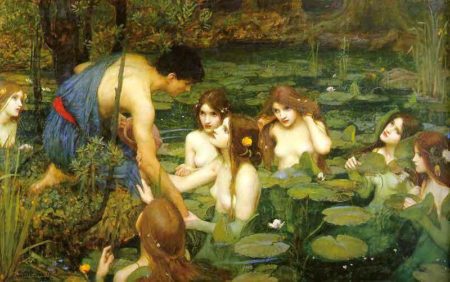
The pre-Raphaelites formally cooperated only until 1854, then broke apart into various art directions. The intense romanticism of the paintings inspired a whole school of art and literature focused on the simple aesthetic of beauty as found in both human form and nature.  In literature, the Aesthetic Movement emulated the artistic strokes through writers such as Oscar Wilde and stylized through physical crafts such as furniture and pottery, the so called “art for art’s sake” of the Arts and Crafts Movement. The painters Rossetti and Waterhouse expanded the art form into overarching portraiture of idealized human beauty that bordered on sensual in a time of contracted public emotional expressions.   John William Waterhouse’s  Hylas and the Nymphs extends the flower symbolism into the realm of the human sensual, with the pure water lily painted along side nymphs that symmetrically reflect the lily’s youthful beauty and purity,.  They are colorized by the artist as a reflection of the lily in human form, peerlessly white skin, languid lines, but with a hint of danger as they, like the lily, float above a dark murk and intend a dangerous attraction for Hylas, who is mesmerized by their ethereal beauty.  The flower allegory pulls the intense power of nature and its primordial instincts through the painting that prevent it from becoming a vehicle that could suggest leering without the balance.

Hylas and the Nymphs John William Waterhouse
Hylas and the Nymphs
John William Waterhouse

The focus on beauty as an artistic expression pushed into the twentieth century but became mired in excess and repetition that left the world ready for the bound away from realism through the light show of Impressionism and inevitably the distortion and evocativeness of the genius that was Picasso.  Beauty, like flowers in bloom , appropriately is transient and comes against the harsh realities of life.  Shakespeare’s masterpiece Hamlet, presented an anti-hero to the world and evoked the pitiful fragility of beauty and innocence through the brief but unstable vision of Ophelia.  John Everett Millais achieved the core of Shakespeare’s expression through his alliteration on canvas of Ophelia in a stirringly poetic and faithful representation of the tragedy of Ophelia, so masterfully evoked by Shakespeare through Queen Gertrude’s beautiful eulogistic soliloquy:

There is a willow that grows askant the brook,  that shows his (hoar) leaves in the glassy stream.                                                                There with fantastic garlands did she make                                       Of crowflowers, nettles, daisies, and long purples,                           That liberal shepards call a grosser name,  but our maids do “dead man fingers” call them.                                                                 There on the pendant boughs her coronet weeds Clam’ring to hang, an envious silver broke,                                                          When down her weedy trophies and herself fell in the sleeping brook.                                                                                                                  Her clothes spread wide, and mermaid like awhile they bore her up, which time she chanted snatches of old lauds,  as on incapable of her own distress.                                                                         Or like a creature native and endued unto that element.  But long it could not be till that her garments, heavy with their drink,   pulled the poor wretch from her melodious lay                   To muddy death.

There is a willow that grows askant the brook,   that shows his leaves in the glassy stream.   There with fantastic garlands did she make.  John Everett Millais captured the moment for  us all to glory in, the majesty and beauty of life, so fragile and so capable of madness and sorrow that comprise humanity.


One can see Ophelia and the many other masterpieces of the Pre-Raphaelites at the Tate Britain Museum.


Poor King George III

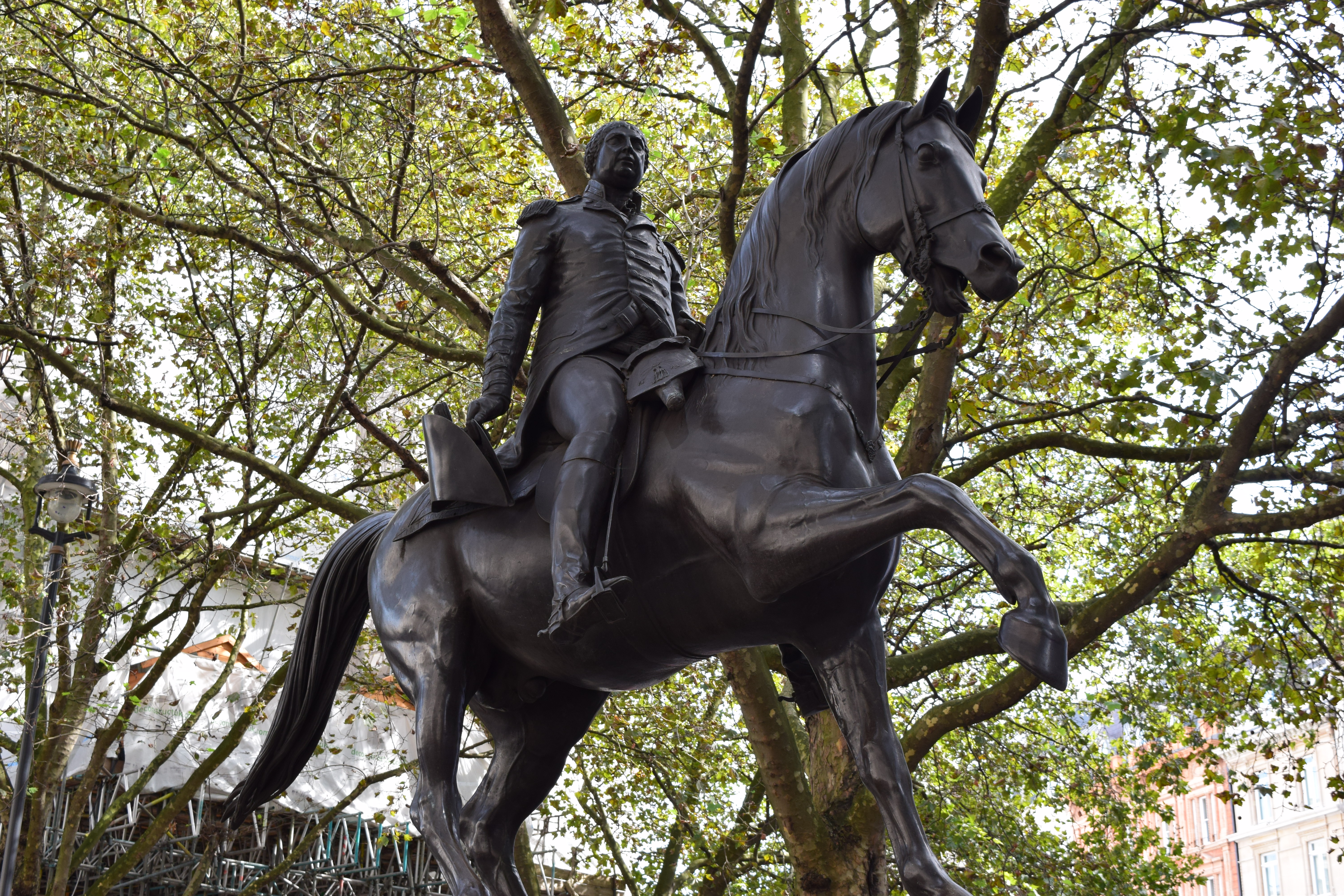
King George III of the United Kingdom of Great Britain and Ireland

I have had a long respite from the challenges of maintaining an interesting blog, spending a goodly portion of time traveling to London and the surrounding countryside, storing up wonderful memories and visuals I cant wait to share with you.  For an amateur historian like myself, the journey was a veritable feast.  A city and country chocked full of the magnificence of 2500 years of people, places, and events that form so many of the cornerstones of western thought and civilization.  But then, you knew that already.  I will do my best to resist a tired litany of the stops that you can get from any travel guide or commemorative. Sometimes, unassuming things you note on your travels have a more profound effect  upon you then the more illustrious sites.  And certainly can make for more interesting writing.

For instance, I was struck by this beautiful statue of King George III under a pleasant tree on the east end of Pall Mall, the thoroughfare extending along St James Park, from St. James Street projecting towards Trafalgar Square.  The statue, dedicated in 1836, sculpted by Matthew Coates Wyatt, is a magnificent equestrian statue showing a confident and intelligent sovereign aboard his powerful steed Adonis.   One can certainly not say that the statue’s location is not situated among the most prominent street addresses in London.  But as statues go, it is quite isolated from the nation’s most honored heroes, from Nelson soaring over Trafalgar Square to Prince George, Duke of Cambridge on Whitehall to the brooding Churchill gazing upon Parliament.  The Boulevard of Whitehall the perfect scale for pageantry and prestige. And George III?  Under a tree off of Pall Mall.

I’m sure I’m making too much of the statue’s location but it works into the psyche that the location is the subtle reference to this king having done something not associated with the other glamorous statuary subjects.  George III lost some serious empire.  And the nation memorialized the monarch in a respectful but not quite forgiving location.

George III ascended to the throne in 1760, and for the next 59 years served his nation with the longest reign of any male monarch in British history.  By the time of his death in 1820, George III had presided over an epic period of history with both spectacular triumphs and ignominious defeats that have few equals in that nation’s annals. A descendant of the Hanover line of kings that had ruled Great Britain from 1714 to rescue the country from the succession crisis that resulted from the end of the House of Stuart as a provider of sovereigns.  Despite being associated with German royalty, George III was a complete breath of fresh air when he first ascended the throne.  This king was the first of the Hanoverian line born in England, proud of his englishness in speech, and a true son of the Enlightenment.  He spoke multiple languages, was a religious and ethical man,  immersed himself in science and other scholarly pursuits, and ruled the country with an eye on transforming the island nation into the most modern and powerful of nations on earth.  Fortuitously in 1763, just three years into his reign, he stood astride a colossus that had just defeated its mortal enemy France in a world war, that resulted in England gaining a huge swath of the North American continent.  The fragile english colonies on the eastern seaboard of North America could now look over two thousand miles of common language, law and commerce without the competition of a hostile French periphery.  The new King could define himself as ruler of one of the great empires in human history.

Oh, to be King.

The problems started almost immediately with victory.  The huge debt incurred in achieving the massive military victory had to be paid, and the King was not so enlightened when it came to the relationship of sovereign to subject.  The Americans, who had gained security and spectacular opportunity with the expulsion of the French, were expected to help pay for their home country achieving such bounties for them.  It would take the form initially of the Stamp Acts, means of deriving revenue from the Americans to help pay for the war that all had benefited from.   Which takes us back to the Enlightenment, which brought new ideas from people like John Locke that influenced the American colonists to the point of confrontation with their king.  Taxation without representation, however imprecise in the actual actions of the British parliament and king, was an intolerable act to the colonists.  By 1775, the pressure cooker exploded into armed violence, and the king was faced with real insurrection.  Kings and insurrection don’t go over well, and George III was not about to allow such affronts to his absolute authority.

How serious was the King?  Ever so serious.  Great Britain, so recently involved in worldwide conflict and stretched financially, determined through the will of its King to raise the largest amphibious force to that time assembled, and move over 35,000 fully trained and armed troops across the ocean to crush the rebellious colonists and their ragtag army.  The idea that a set of colonies orders of magnitude larger than the homeland would be allowed to separate was absolute anathema.

Yet, in one of the truly amazing outcomes in history, the underdogs managed to beat their masters in an 8 year long struggle.  The King was forced to release through treaty millions of square miles of the North American continent so soon after previous triumph.  The humiliation so great, King George III was willing to abdicate as a testimonial to his acceptance of his role in the debacle.  That’s how you end up under a tree in an obscure corner of  a park.

But the saga and pathos of course don’t end there.  Under George III’s rule, the loss of portions of North America propelled a sequence of events that culminated in the overthrow of the monarchy in France, the very real danger of an invading republican army from France, and progressively the crisis propagated by the rise of a military genius dictator on the continent named Napoleon Bonaparte that threatened the very existence of the monarchy.  True to form, King George III once again marshaled his forces, and under the epic triumphant heroism of Horatio Nelson at Trafalgar and the Duke of Wellington at Waterloo, Great Britain reigned supreme.   Guess where their statues ended up.

Crushing Louis XV and gaining half a continent. Crushing Napoleon and gaining an empire.  One might see a good reason to place poor King George III more among the pantheon of national heroes.  But losing to Americans, that just proved undigestible.  King George III steadily buffeted against mental illness, and by the time of the triumph of Waterloo, was in no position to reorient  people’s opinions.

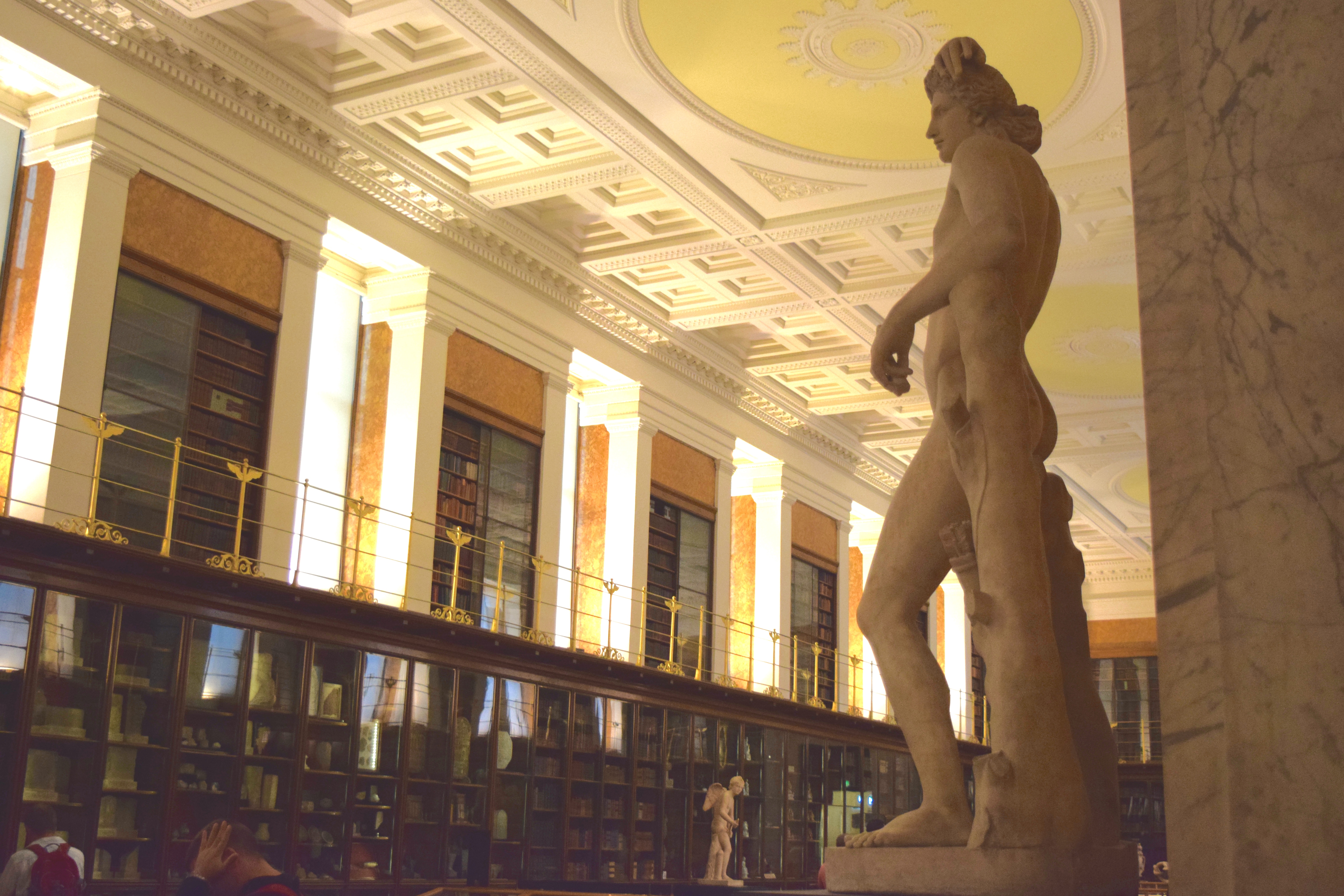
The record would suggest one of Britain’s more substantial monarchs, and the peerless gift he made to the nation of a library befitting of an enlightened world power is still seen today in the masterful library of King George III in the British museum.

dsc_0457

As an American, I am certainly glad that King George III was the rigid foil upon which a great nation was able to birth and overcome.  But a little bit sympathy and respect is in order to someone who on the basis of one loss has seen forever tainted his role in his nation’s  greatness.

I’m not saying move the statue, but maybe when you’re in a rush to see all the other paeans to winners, remember old George didn’t do so bad himself.


e