The Last Raider

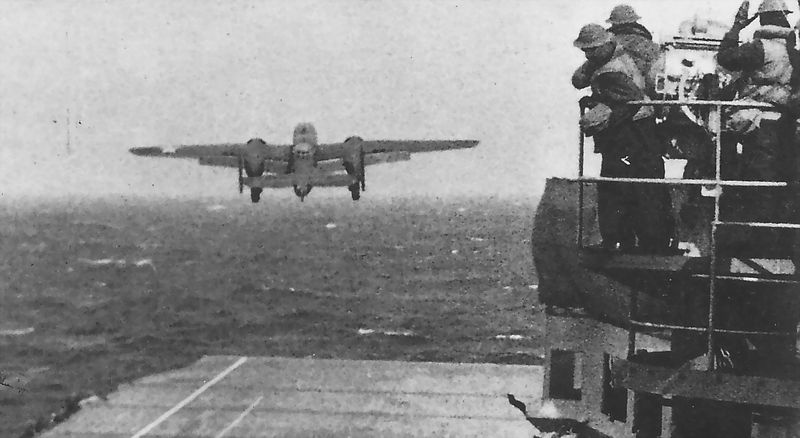
A Doolittle Raider Mitchell B-25B bomber leaves the deck of the USS Hornet April 18, 1942

In the lead plane, the fuselage visibly shook as two massive engines strained against the restraints, driving rpms sufficient to create the escape velocity needed to lift the fuel and munition laden bomber across and safely off the short 500 feet of flight deck available to them on the aircraft carrier USS Hornet.  In the co-pilot seat sat Richard Cole, a 27 year old Army Air Corps pilot picked by his squadron leader Lt. Colonel James Doolittle, who likely gave him a brief nod in the noisy cockpit as the time to accept history was upon them.  No real time for nerves.  15 bombers and 75 crewmen behind them, waiting restlessly for them to clear.  Waiting since December 7th, 1941, to show the Empire of Japan the United States was wrong country to pick a fight with.

After the catastrophic surprise attack on Pearl Harbor, the United States and allied powers were reeling from a well supplied and well trained imperial Japanese force trained in the most modern equipment and imbedded with the most ancient martial ardor. Ruthless and efficient, the Japanese spiraled into the South China Sea imperiling the Philippines, with a  tendril of American force clinging to Corregidor.  The strategic thinkers in Tokyo strove to convince the Americans and British that their destiny in resistance was in ignominious defeat, and they convinced themselves and their population that the battle would be fought on foreign lands away from the sacred homeland.

The Americans had their own psychology to worry about.  The greatest economic force in the world was well over a year away from adequate force projections against such a difficult foe, and it was not clear how long the American public would be able to tolerate defeat after defeat.  The goal after Pearl Harbor by American strategists was to eliminate the aura of Japanese invulnerability, and crack the fantasy of superior racial  will and capacity for sacrifice for the Emperor.  The Japanese had shocked the Americans with a complex and massive multi carrier strike across 3000 miles of ocean destroying a large part of the American navy at Pearl Harbor.  How could the Americans now with no functioning battleships, and 4 overstretched carriers possibly achieve a similar psychological blow?  The answer was divined By Lt. Colonel James Doolittle who almost immediately after Pearl Harbor envisioned a means of carrier projection that would strike the Japanese homeland itself and achieve an equally stunning psychological impact.  The crazy idea was not to risk the few carriers the Americans had in a suicidal mission involving fighters and dive bombers with short flight capability that would require the carriers to enter Japanese waters and almost certain overwhelming  defenses.  No, the crazy idea was to do something everyone thought essentially impossible, to use the carriers from longer distances and launch heavy bombers that would strike the mainland of Japan and have sufficient fuel capacity to continue to China, and land…. Crazy.

Doolittle, a test pilot and engineer, first proved on land he could take off on an extremely short runway on land then proved it on a carrier.  The mission would require bombers to fly as much as 2400 nautical miles to complete the mission, but nothing mattered if the fully armed planes could not even get off a flight deck.  With modifications, Doolittle had found his plane, the Mitchell B 25B midrange bomber, and in the three months since Pearl Harbor sufficiently modified it to achieve the concept of the mission.   President Roosevelt, willing to try anything to gain a foothold with the American public in a sea of bad news, approved the mission,  and the meticulous process of picking crews that were willing to try something never done before on a one way mission with no direct home of return was left to Doolittle.  80 men eventually formed Doolittle’s 17th bomber squadron, and on the second of April left the Alameda Naval Station loaded on the USS Hornet for the long trek across the Pacific.

The plan was to get sufficiently close to Japan to allow the fuel necessary to safely land in China, but on the morning of the 18th of April, the task force was spotted by a Japanese scout ship, and Doolittle and the Hornet captain, Mark Kitscher, determined to launch the bombers given the loss of the element of surprise, despite being a full 10 hours earlier and 170 nautical miles further out than planned.  The Hornet was turned into the wind.  Doolittle piloting the lead plane, and the 15 bombers behind Doolittle and Cole then accomplished the impossible in 40 minutes, all successfully launching a munitions laden bomber from a carrier flight deck, though none of them had ever done it before, or would do it again.  Flying low to evade detection, over six hours of nerve wrenched flying were required to reach the target,  Tokyo, but the insane nature of the attempt contributed to the Japanese complete surprise, and the bombers rose to 1500 feet  and managed to strike the heart of the Japanese empire, Tokyo with over 2000 pounds of incendiary  bombs each.  The physical damage was relatively minimal, but the psychological damage to the Japanese was immense.  It was clear that America had determined that the pain of war would be felt on the Japanese mainland from the war’s very start,  and an ominous hint of what was to come,  entered the Japanese psyche.

The brief glory of the successful raid rapidly turned to desperation for the flight crews as their realized the increased distance required to fly by the early launch had stolen their fuel reserves.  Some managed to reach the Chinese mainland into the hands of allied forces, but others had to ditch into the sea, and one crew was force to abandon their plane on Russian soil.  Of the original 80, 69 escaped capture or drowning, 3 were killed in action, and 3 others were eventually executed by vengeful Japanese forces.  Doolittle and Cole were among the 69 to return, and were among the pilots would fight again, and contribute to the eventual massive air destruction of the Axis powers.  Doolittle would receive the Medal of Honor and military immortality,  and Cole the Distinguished Flying Cross and the pride of a job well done.

Which brings us to Richard Cole, the co-pilot of Doolittle’s lead plane on the Tokyo raid, who stood at 101 years of age on April 18th 2017, the last survivor of the those heroic airmen who 75 years ago achieved the first blow against Japan in a mission so impossible no ever tried it again.  Every year after the war to celebrate their accomplishment, the men of the 17th bomber squadron would get together on the anniversary and toast their fallen comrades. A stand filled with upright goblets, upon which each goblet was etched with the name of a surviving raider, was placed in the room, and as time took crew members, each was toasted with cognac, and the goblets of the fallen were successively overturned.   With each decade the numbers of upright goblets grew fewer and fewer, and the group’s mortality was etched for all time when Doolittle’s goblet was turned over in a toast to their fallen leader in 1993.  By 2016, there were just two left, Cole and 94 year old David Thatcher, and on June 22, 2016, Richard Cole was the last man standing.  On April 18th, 2017, the final goblet remains upright, and it has become Richard Cole’s destiny, to be the Last Raider standing.

The men and women of the magnificent generation that braved all to save the world from a dark, soulless future are rapidly leaving us forever. They are now only faint memories in faded photographs, flickering newsreels, and history books.  But everything they were, they always will be,  as they faced true madness and through heroic sacrifice and personal will, gave us all one more chance at a better world.  To all the World War II veterans, from Richard Cole, to my own father, God Bless you and thank you from the bottom of my heart.

Oh, how you soared like eagles.

Oh, how you soared.
It Gets Syria-ous

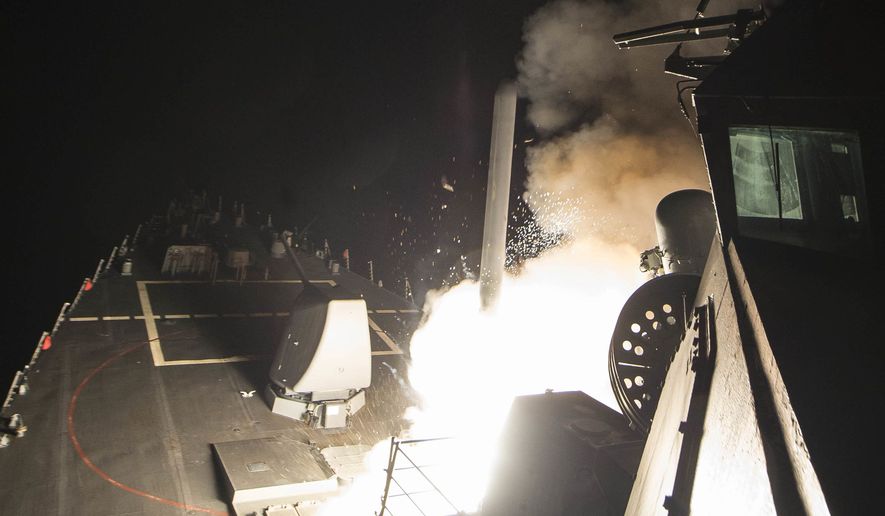
USS Ross fires tomahawk cruise missile towards Syria                                                      washingtontimes.com Robert S. Price/ U.S. Navy via AP


Its been fun and games for opponents and media deriding the inexperienced Trump administration’s floundering around as the new President has adjusted to the massive difference between being an outsider deriding leaders for their actions or inactions, and being the leader of the world’s most powerful nation and head of the world’s most demanding bureaucracy.  The President has been his own worst enemy becoming fixated and pitching conspiracy theories in a badminton match with opponents regarding Russian influence and spying, while simultaneously driving a premature health care process into a political muddy rut.  The difficulty of having a tradition of gut instinct for decision making rather than a carefully developed principled philosophy has made the President look disorganized and reactionary.  His opponents on either side of him, a position he created himself by suggesting he was the ultimate ‘outsider’, are circling like vultures over an assumed terminally injured animal.

This past week however the job suddenly got serious, and the President, under estimated every step of the way thus far, is showing himself to be tenacious if not a quick study.

The hardest skill to learn for any president is the ability to project themselves as commander in chief of an unbelievably powerful weapon, the US military, without committing the force into a role antithetical to its purpose.  It requires real dexterity and recognition of the levers and dangers of escalation, when the country’s vital interests are not directly at risk.  Do nothing, and the enemy sees only a paper tiger and a corrupted and dithering power.  The puny response of President Clinton in the face of Osama Bin Laden’s massive provocation with the embassy bombings and the attack on the USS Cole led to the Al Qaeda leader’s confidence that his movement could survive a 9/11 response.   Do too much and the Powell Doctrine of “you broke it, you own it” becomes an ominous trap for any President.  Iraq and Libya come to mind.

Syria has proved to be a Petri Dish for both modes of superpower involvement.  The Russians have inserted themselves in the center of the conflict, resulting in any failure of survival of the dictator Assad being a direct reflection upon their abilities, and being splattered with the casual brutality of the same dictator.  Assad, a survivor like his father, recognizes that for dictators who are clinging to power, no force vector is too horrible to retain that power.  Assad looks to chemical weapons (curiously presenting after Saddam Hussein’s stockpile disappeared) as the ultimate nondiscriminatory terror weapon of intimidation.  Having used them previously, Assad faced a President in Obama who drew a red line,against their use, putting his country’s very prestige and resolve on the line,  that in humiliating fashion a week later he withdrew and did nothing, fearing a quagmire he had no intention of risking.  The message was clear – Assad need only give Obama a superficial out, and the President would leave him alone.  A Potemkin village agreement to “remove” chemical weapons from Syria was promised by Assad.  Obama pretended he had solved the problem, to the extent that as recently as January of this year, his buffoonish National Security Advisor Susan Rice bragged about how Obama had achieved the elimination of such weapons from Syria.   Assad knew Obama would do nothing, and was willing to use them again, this time under the nose of a new president who as a private citizen disparaged President Bush for drawing red lines with Iraqi weapons of mass destruction.

Citizen Trump and President Trump may well not be the same person, and this week the world took notice.  The President showed real skills in this week when the game got serious. Consider the balancing act.  The irrational despot dictator of North Korea Kim Jong Un shot a ballistic missile off, threatening Japan and the United States with an impending ability to secure a nuclear warhead on a rocket that could reach either nation.  Trump had to respond, and sent advanced weaponry to South Korea including B-52’s, having his Secretary of State announce that the US policy of strategic patience regarding such belligerence from North Korea had ended.  But was that just typical empty bluster from the US?  Assad took the signal to test Trump himself with the horrid chemical attack on Khan Sheikhoun with Sarin gas, resulting in torturish deaths of scores of men women and children.  On Thursday Trump declared the action a crime against humanity, and responded promptly with a lethal measured fist full of ominous portent, blasting the airfield in Syria where the planes carrying the gas attack had based, while simultaneously meeting with the Chinese President regarding his seriousness confronting North Korea’s threat.  A powerful message reverberated throughout the world.  This President wasn’t blustering.  The North Koreans knew the Syrian bombs were symbolically pointed at them.  Assad’ s partner the Russians, realized their hegemony in Syria was at an end.  Assad reacted but knew his partners the Russians were going to not be happy with further escalation.   The Chinese, who have supported the increasingly deranged Kim dynasty in North Korea for the buffer it achieves against having a successful capitalist democracy being established on their border, took note that Trump would not use empty rhetoric, should the Chinese want to test him in either North Korea or the South China Sea.  The Syrians realized the next event would potentially end the dictator’s residual chance to stay in power.  The Iranians from a distance realized the next provocative act in the Straights of Hormuz against US ships may not be passively accepted.  The allies of the US appreciated the superpower had awakened from its lethargy.

Now that’s Exhibit#1  how you play the serious game.

The media hoped to control narrative to paint Trump as unhinged and somehow responsible for the refugee disaster in Syria, but the clarity of Trump’s approach resonated in profound ways that flummoxed the reflexive liberal media that always assume their superficial view of the world and the negativity regarding the U.S.’s role in it is shared by everybody.

The mess on the foreign stage that has been left to this President is going only get more serious, but at least, the world has been made aware, there’s a new sheriff in town.  The sound you are hearing from many parts of the world, is a quiet sigh of relief.

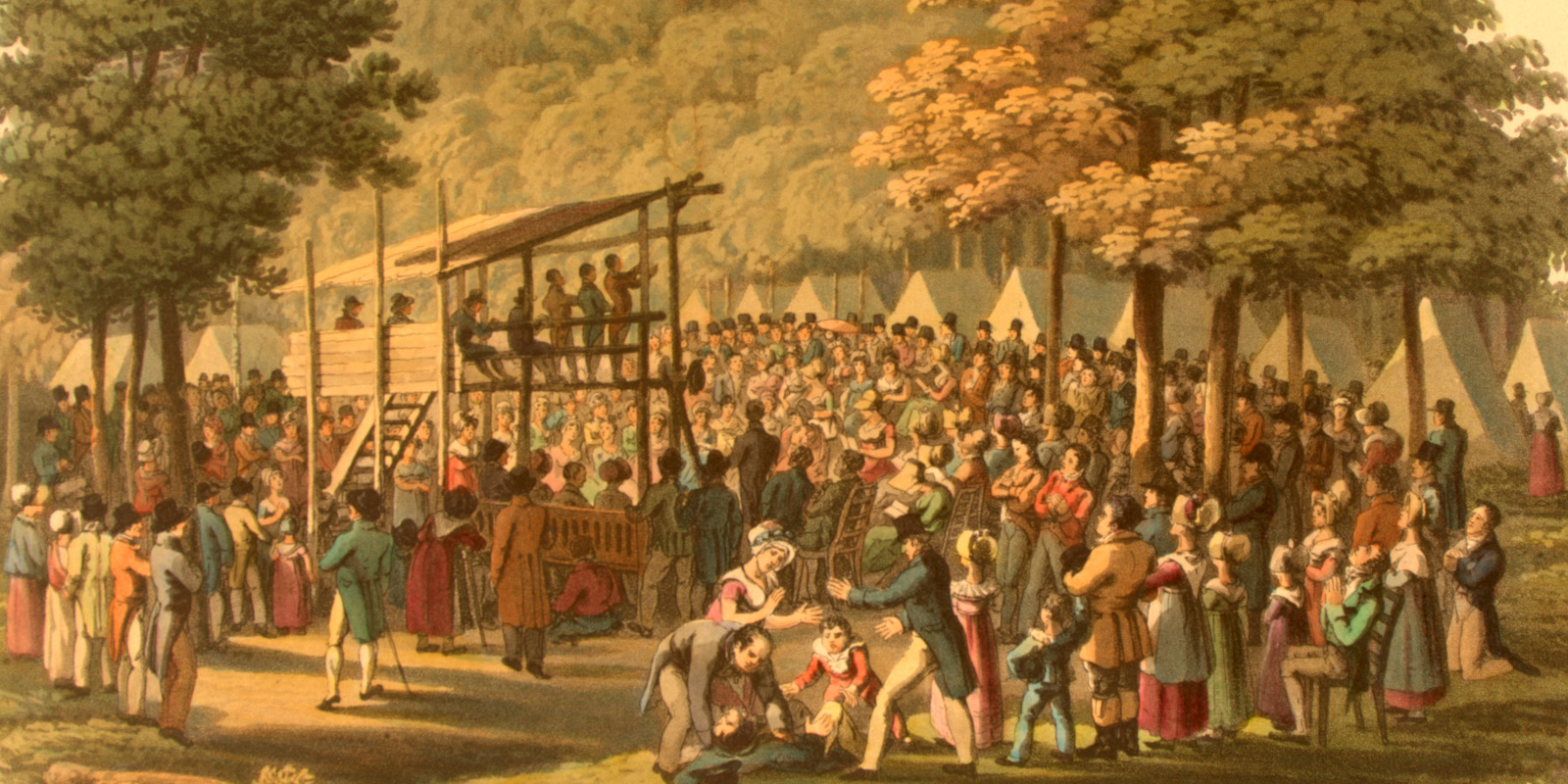
Yearning for the next Great Awakening

Methodist Camp Meeting  1819


The Christian world is anticipating the most important days on the calendar.  From Palm Sunday,celebrating the triumphal entry of Jesus into Jerusalem, through the events leading to the Last Supper, the solemnity of Good Friday reflecting the Passion of Christ culminating in the crucifixion, and the subsequent Resurrection on Easter Sunday,  the believer reflects upon the immense events in reflection towards their own life in faith.  The hunger for meaning in life, once served to overwhelm any situational material deficits or abject circumstance.  We in the West, however, live in an ever more post Christian world, where belief systems and faith are considered archaic vestiges of an earlier age, when science and progress were not available to rationalize one’s life and provide a secure safety net.  The post Christian world makes a virtuous life obsolete, and the countries of Europe now celebrate a world without boundary or differentiating belief system.

America in many ways, however, was uniquely formed on the foundational rocks of  such religious belief.  The desire to find a land unfettered by preconceived notions of rule and open to individual expression of religion was the original driving force of the fragile colonial settlements and their eventual diverse belief systems.  The land was so large that close proximity with an alternative belief system was dealt with simply by moving to another part of the wilderness, then, taking root.  The founding of the country as a country driven to achieve independence and freedom through revolution was an outgrowth of this intense view that Providence had led the immigrants as pilgrims to a chosen place, where they would build their “city on a hill”.   Each man built himself a kingdom of faith and virtue, and looked to his leaders to preserve his right to do so.

This tendency towards individual spirituality set the new America apart from the trends of the larger western world.  Obviously influenced by the great movements in Europe of scientific method, rational thought, and humanism,  the founders nevertheless imbued their new constitution with the very first article of its constitution assuring no interference or bias of the state with religion, to vaccinate the new country against the orthodoxy of an overbearing state apparatus.    Europe, however, caught on the same wave of the Enlightenment, had no individually driven core faith  to suppress its inevitable excess.  The French Revolution surged into post belief rationalism, its Declaration of the Rights of Man devolving into a Reign of State Terror, destroying elements of faith as shackles of orthodoxy, establishing the State as the new authority, the Citizen as its soldier, and even the old calendar eliminated for its reference to a belief system antithetical to the regime.  A year Zero was proclaimed, with its implication of a force greater than the human intellect, and the negation of all past belief systems.   A post Christian world was thus born in Europe and the rattled concept of faith has been under attack ever since.  Over time the churches have emptied.  Anti-individual movements such as communism and its less threatening but equally demanding cousin globalism have installed their new religions, the war on values and virtuous behavior, the elevation of Nature as a God in Climate Change, and the denigration of any path that does not achieve equality of outcome.

Each time America looked into the world of a post Christian Europe, it resolved to restore itself.  These cleansing movements, known as the Great Awakenings, are laid out beautifully in Paul Johnson’s epic one volume history A History of the American People .  The most significant renewals, occurring in the first and last portions of the nineteenth century, were  reactions to the progressive oppression of “science” and “progress” on the concept of individual belief.   Common people spontaneously gathered to hear and experience the word and power of faith and virtue in an ever more secular and faithless modern world.   As a larger civilized post christian world threw off the restraints of virtue, Americans restored it time and time again as a core foundation of who they were, and what they wanted to be.  Through the epic battles to expunge slavery and achieve civil rights, the mantle of a greater belief system then practical reality drove a continuous improvement process.  Virtue as cleansing faith stoked the painful purifications, the central core of American spirituality was emoted in Julia Ward Howe’s Battle Hymn of the Republic:

In the beauty of the lilies Christ was born across the sea,
With a glory in His bosom that transfigures you and me.
As He died to make men holy, let us die to make men free
While God is marching on.

The Great Awakenings occurred spontaneously and from below, requiring no organized  religion to drive the yearning for a life restored to fullness through faith.  Our current time, so fully immersed in the material wants and needs of generations never before so free from want and need, has left us vulnerable to those who still hold value in a belief system, no matter how tainted the belief system is with violence and prejudice.  The Islamist looks with disdain upon the lack of core belief of the west, with empty cathedrals, absent morals, paucity of virtues,  and lack of willingness to defend their civilization.  The migrant Islamists wall themselves off from such rudderless lives and demand the dispassionate state support them,  while they await the inevitable collapse of the cratered society that no longer respects itself.

With the strange events of the past year in Western society, perhaps a Great Awakening is again beginning to form and a sense of individual dignity and purpose will surface.  A society that can not define a greater good, can not survive a progressive bad.  To believe in something more than oneself, and to see one’s self as redeemable, is the essence of the Easter miracle.  It requires no regulation or doctrine for guidance, only faith in the message of redemption in a virtuous life.  As the philosopher C.S. Lewis proclaimed:

I believe in Christianity as I believe that the sun has risen:        not only because I see it, but because by it I see everything else.

Happy Easter.