
Now is the Winter of Our Discontent

Trump, Clinton and the decline of a nation             abcnews.go.com
Trump, Clinton and the decline of a nation
abcnews.go.com

At the opening of William Shakespeare’s peerless study of malevolence, Richard III, the protagonist initiates his soliloquy with the seven words that focus the entire play –  Now is the winter of our discontent. To Richard the seeming stability enjoyed by the elites is about  to see the havoc of the discontented, from unpredictable and opaque directions, until the world experiences the reordering that will upturn the status quo. In more down to earth terms, the whole miserable truth is, that the joke is on them.

Such is our current season of discontent.  The polls suggest that the position of chief executive of the most powerful country on earth may come down to a choice between a bombastic clown and a truth-addled crook.  In Great Britain, there is a groundswell in the Labour Party to select as leader, Jeremy Corbyn, a man who would make Karl Marx blush regarding his proletariat uber-sympathies.  In France, the leading candidate for the Presidency of France is forced to evict her father from his own party for saying out loud the prejudices upon which the party was founded.

The discontent crosses philosophies and principles.  The unifying force is the discontent itself.  Legions of people who feel their particular issues have been stomped in the dust by the elites who set the rules that the rest must live by, and the elites blithely ignore.  To the discontented, it is refreshing for a Donald Trump to admit what they always suspected – that patronage is purchased, and the entire governing body is in on it.   He does what they wish they could do, act out,  and call people out, without recriminations.  The rule of law has crumbled behind the ever shifting sands of lawyerisms, so why not suggest extra-legislative means harshly correcting the inequities?  For the discontented, Trump doesn’t have core beliefs, just the cojones to do something to restore their voice.

Trump is pitted against Clinton, the poster child of name calling and victimhood.  She stands for the nihilist principle – Let me do what I want, and you get to do what you want.  She might be the first candidate in history to whom the candidate who presumptively will run against her, proudly admits to having previously bought her patronage. Yet even Clinton stands vulnerable to attacks from even farther out on the anarchist fringe from a progressively popular Bernie Sanders, who wants to take the ‘us versus them’ to a celestial level.  The toxic stew stands to drowned out any deliberative debate as to the country’s problems, as the emotional discontent gains further traction.

The discontent in Great Britain threatens the status quo, with competing nationalisms driving progressive unprincipled extremism, from the ‘throw the rascals out until it looks like England again’  mentality of UKIP, to the ‘drain the capitalists of their money and power’ invectives of Corbyn the rest of the Labour party seems helpless to thwart.  Tony Blair stands aghast at the unleashing of Corbynmania but seems clueless as to how his peculiar brand of elitism helped to create the monster.  The European Union, and by proxy the dominant German backers, cling to their bureaucratic dictums that demand the obedience of all under its puritan reach, yet are progressively alarmed at the increasingly nationalistic populations that thumb their nose and suggest that if they are to be ruled by a bastard elite, better a bastard elite they recognize and to which they can relate .

The discontent surges not knowing necessarily what it wants, only sure it doesn’t want the status quo.  Why have a constitution if no one follows it?  Why follow the rules if the elite tell you that those that don’t follow the rules, will receive an equal if not greater piece of the pie?  We are deep into our winter of discontent, and the former balancing forces of a stable society maybe unable to restore the accepted order, or the predictable outcomes.  For Richard III, when the tidal forces he unshackled came back upon him, he temporarily sought refuge from the progressive calamity, willing to give up “A horse, a horse! My kingdom for a horse!”  When Catesby urges him to withdraw from battle, achieve the steed, and therefore safety he requested, Richard III knows his destiny is the calamity he has unleashed, responding, “Slave, I have set my life upon the cast, and I will stand the hazard of a die!”  

It is the mystery of our time to see whether our current protagonists will have Richard’s courage to see their role in stoking the darker shades of our nature, to destiny’s fitting conclusion.
 

Felix Mendelssohn and the Romantic Age

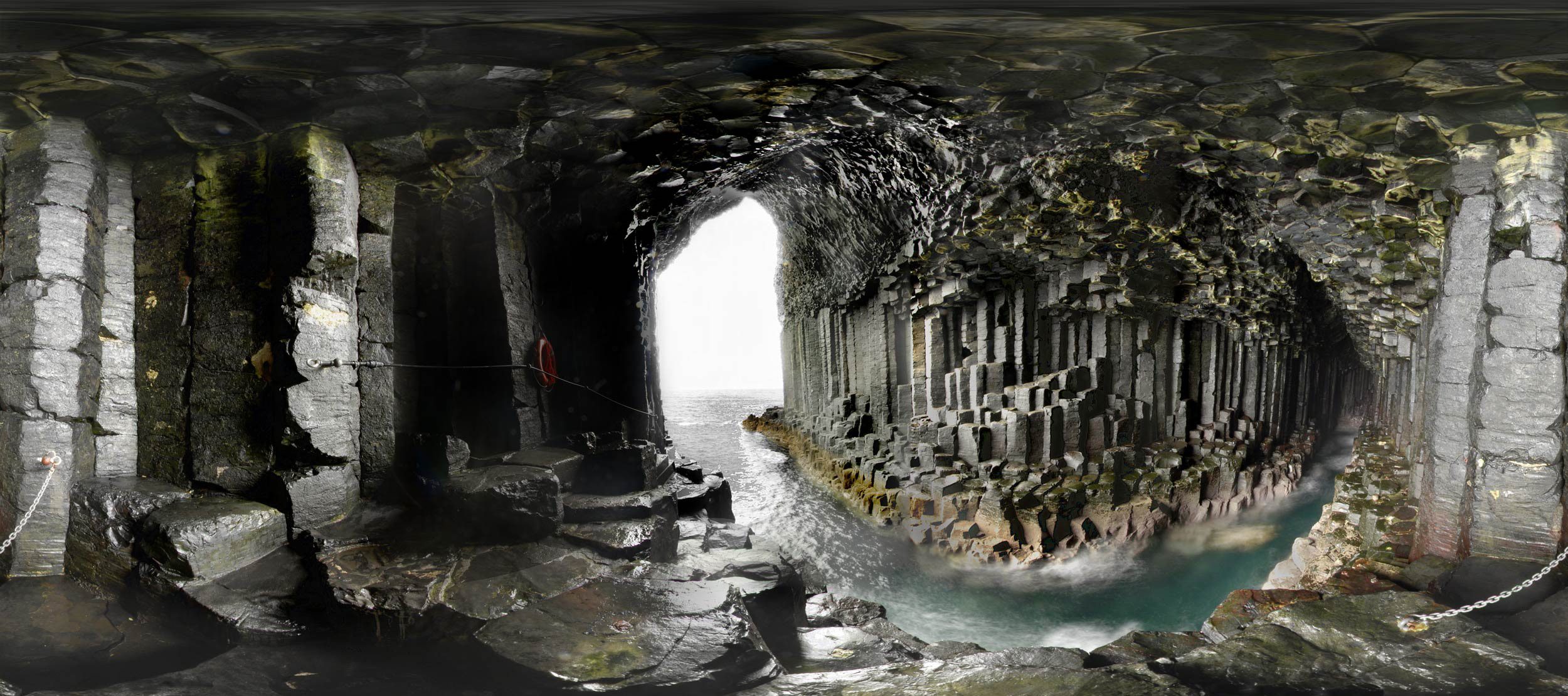
Fingals Cave, Staffa, Inner Hebrides   Scotland
Fingals Cave, Staffa, Inner Hebrides Scotland

At the western edge of the island land masses that form the Hebrides off the coast of Scotland, stands a little tuft of volcanic elevation known as  Staffa.  Barely a quarter mile in area, the southern most tip of this uninhabited island faces the huge expanse of the Atlantic with a peculiar formation  of crevice, cave, and stone referred to as Fingals Cave.  Despite its natural isolation, it has been reknowned for as long as there has been humanity on the islands known as Albion for the strange cathedral like natural formation of its prismatic hexagonal basalt columns formed by the slow cooling masses of sea lava that pushed out of the sea and were  reoriented by intermittent flooding of the lava flows by the great ocean.  Natural formations such as Fingals Cave  have taken on supernatural characteristics to those who are open to its coalescence of sights and sounds that seem to have been directed by an unseen hand into something beyond the sum of its parts.  At a certain time of day, in a certain light, the very rational explanation of the natural formation in the shadows and mists is progressively lost to the mysterious otherworldly sensual experience of that which is beyond explanation.

It is in that place, that an entire cultural line of creative thought we now refer to as the Romantic Age propelled out of the rationality of the Enlightenment of the seventeenth century.  Enlightenment, with man as rational thinker, and God as Engineer, saw the world as ordered and explainable, limited only by the means available to understand it.  At the turn of the 18th century and for fifty years following, a reaction to this ordered universe developed in the cultural world that connected the internal world of unspoken thoughts and dreams to the great unknown of the supernatural, and sought expressions in their writing, art, and music. The writings of Shelley, Wordsworth, Lord Byron, Robert Burns and William Blake, the paintings of Goya and Friedrich, and the music of Mendelssohn and Schumann, Liszt, Chopin, and Berlioz provided a reaction and withdrawal from the very real turmoil of the marshal and nationalist Romanticist impulses optimized by the French Revolution and Napoleonic Wars.

Though a multicultural movement seen in every western society of the time, the greatest amount of definition came from the german remnant of the Holy Roman Empire, through its philosophers Harmann, Goethe and Schiller.  The German expression of “Sturm and Drang”, literally Storm and Drive, referred to sublimation of the rationalist to the internal turmoil of both individualism and emotion.  The natural world took on progressive attraction and awe, as it tended to stimulate unique emotions, and provided escape from the brutal realities of the development of state militaries and the darker effects upon people of the mass scale of the Industrial Revolution.

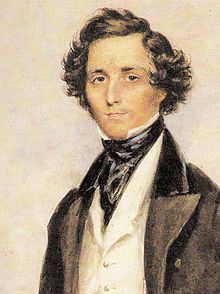
Felix Mendelssohn is the somewhat under-appreciated musical master of his time. Typical for his age, he accomplished a prodigious amount in the very short life span so common before the Age of Medicine.  Born in 1809 in Hamburg of a prominent intellectual Jewish family, he suffered under the rigid anti-semitism of european culture.Raised in a secular home, he was eventually converted to Christianity, but insufficiently Christian for most of european society, and insufficiently Jewish for his own understanding of his people and ancestry.   Although his family with its Christian conversion took the name Bartholdy, Mendelssohn  never fully dropped his ancestral name, and his courageous juxtaposition defined his relationships for the rest of his life.  This inner turmoil provided an exceptional platform for Harmann’s Sturm and Drang, and the undeniable genius that was Mendelssohn proved a fortress of this movement’s expression over his short 38 years on earth. From the 17th century’s end to the atomic age, genius was the province of birth, not formed through scholastic preparation. This particular form of genius was celebrated for its polyglot capabilities in language, music, and art, and Mendelssohn was from childhood recognized for the depth of his intellect and the prodigy level of his talents. Like Mozart, he was born a musical prodigy, by age 17 already considered at the highest order of pianist performers and composers, completing his seminal overture to the Midsummer Night’s Dream by age 16, and the aforementioned ode to Fingals Cave by 21. The Symphonies poured out in his twenties and the great Violin Concerto in E Minor by age 33. The music was sonic, pictorial, and nativist, connecting to the internal but never losing its relationship with the classical roots from which it sprung.

Felix Mendelssohn Bartholdy  1809-1847
Felix Mendelssohn Bartholdy 1809-1847


It was Mendelssohn’s unwillingness to sever his connections with the ancestry of musical expression the offended the more radical romantic dreamers like Liszt and Berlioz, and Mendelssohn’s pride in his jewish roots that even more offended the german racialist Wagner, who worked to demean Mendelssohn’s reputation where he could.  Mendelssohn created a very personal dream world that celebrated nature and individual but painted with a cool light that seemed too rational for the more disordered and exhibitionist world that a performer like Liszt inhabited.  Mendelssohn’ s universe foreshadowed more than later cool impressionism of Debussy and Matisse than the dense emotionalism of Mahler and Van Gogh.  Mendelssohn  also was selfless in almost single handedly bringing back to light the genius that was Johann Sebastian Bach, almost completely buried in the past, as well as the more present works of Schubert and Schumann to prominence.  It was Wagner’s racialist hatred, perhaps additionally fueled by Mendelssohn’s apparent earlier indifference to the youthful Wagner’s composing efforts, that nearly buried Mendelssohn’s musical memory.  In Nazi Germany, Mendelssohn’s works were banned as reactionary and his influence scrubbed, but the universal connection felt by his audience and particularly the performers  who admired the seamless perfection that was his Violin Concerto would not let his musical expression die.  To the horror of the racialists, Mendelssohn’s very germaness overwhelmed their ignorant theories, and his sublime work combined with his rescue of former German cultural greatness makes him one of the titans of Germany’s significant cultural gift to humanity.

In today’s world, where our current homage is to the twin temples of Settled Science and Athletics, it is nice to harken back to the creative geniuses that saw pleasure and awe in the unsettled and mysterious nature of life, and celebrated its obtuse and otherworldly side.  We don’t have to travel to Staffa and linger in the cathedral like cove that is Fingals Cave to feel our connection with the grandeur that is God’s Creation and our soul’s connection to it.  We only need to close our eyes and let a genius from another age take us there and make us one with it.

Vice President Biden Gets It

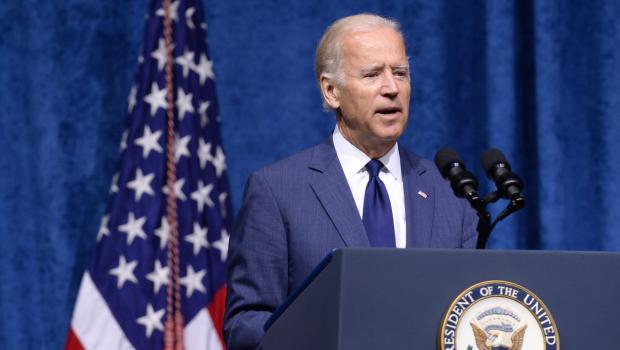
Vice President Joseph Biden  at Chattanooga memorial services for slain soldiers Jason Davis/Getty Images
Vice President Joseph Biden at Chattanooga memorial services for slain soldiers
Jason Davis/Getty Images

President Obama has been firm with concept that America’s heavy footprint in the Middle East is partially responsible for stoking the intense violence of the region and that our withdrawal will reduce the nidus for the conflict.  He has been adament that the descriptiion of the violence as a premeditated goal of a radicalized Islam is our contribution to the seeds of that violence, and has no place in American thinking.  His view has led to the conceptualization of the Major Hassan as “workplace violence”, the Tsarnaev Boston bombing as “lone wolf” actions, and the recent Chattanooga recruiting station attack as a problem of “mental illness”.

Specific to the Chattanooga attack of July 16th, 2015, five unarmed military personnel were murdered by a Palestinian American named Mohammed Youssef Abdulazeez, whose parents left the middle east in 1996, and accepted American citizenship, but never left their fundamental Islamist beliefs behind.   Abdulazeez, pummeled by a life of drug abuse, poor personal discipline costing him stable employment, and consumed by the internal rage of arab youth felt denied their position as the superior race, attained an AK 47 automatic assault rifle and unloaded 100 rounds into people who could not defend themselves, until he was  put down by police fire.

On August 15th, 2015, the military finally secured a combined service for the five servicemen and their families, a month past the point where the rest of the country has already put the event behind them and moved on to other things.  In a country anxious to avert its eyes to the growing threat of radicalized Islam, assisted by the Averter in Chief, the individual loss of soldiers does not take hold.  After all, the country lives through assaults every week in its major cities as part of routine urban violence and does nothing but salute the occasional thug that determined to strike back against the police.  The shared sacrifice idealization of a soldier defending their country no longer secures an emotional response among a population where the great majority of the population no longer serves, or knows someone who has.

The Vice President of this country is thankfully different, and eloquently expressed what is rarely expressed anymore by those in power.  Vice President Biden has reason to connect with loss of loved ones; in 1972 he lost his daughter and wife in a car accident in which his two sons, Beau and Hunter were seriously injured.  This summer he lost his son Beau, Delaware’s attorney general, to brain cancer.  Beau, the Biden hope for the future, a major in the Army Reserve who served in Iraq, and assumed next governor of Delaware, was taken from the Vice President with a vicious cancer  that has clearly and deeply affected the Vice President’s views on life, sacrifice, and loss.  There is likely no loss as personal as a child to a parent, and places Biden in direct sympathy with those military families who must face their overwhelming loss in silence from a country that prefers not to know.

Vice Presidents do funerals, and perform eulogies.  But there was something very special about the eulogy Vice President Biden gave yesterday.  Something so heartfelt and direct, only someone who has lost, could understand.  With his eulogy, Biden showed great clarity in what it means to serve and defend the ramparts, what it means to sacrifice, and what it means to be an American.  Sometimes the most unpredictable events elevate a person and make them worthy of our attention.  In an election season where the presumptive republican front runner clowns his way through policy discussion, and the presumptive democratic front runner has shown herself to be laden with corruption and indiscipline, Vice President Biden may have just set himself apart, and shown the world that there is still a place for someone who gets it.

Watch the speech in its entirety, and you will get it, too.

Averting a Train Wreck

Donald Trump at the republican presidential debate

On Thursday evening, August 6th,2015, an estimated 24 million Americans tuned in to watch the national broadcast of a debate of republican presidential aspirants. With such an audience, the standard was set for the highest rated non sports related telecast in cable network history.  I’m fairly confident this huge audience didn’t tune in to see Rand Paul articulate libertarianism, judge what Megyn Kelly was wearing, or query whether Jeb Bush would respond to the name Jeb Bush.  No, the great majority tuned in, I believe, to be potential witnesses to a real time train wreck.  On June 16th, the Donald Trump train left the station with his announcement that he was running for the Presidency, and has been teetering on the rails ever since.  A nation’s audience reveled in the chance he just might in front of everybody swerve completely off the rails and self destruct.

Donald Trump is the triumphant example of the progressive superficial vacuousness that has overcome the nation’s political discourse.  The Trump agenda for the country is essentially bluster.  Were it not for bluster, he would have no program at all.  But to Trump, what ails the country is not the lack of formative ideas to solve the nation’s challenges, it is the lack of politicians  being willing to lay it on the line, and tell it like it is.  Or at least tell it as Trump think it is to be told.   He sees the world not in layers of complex historical trends, intellectual assessments, and strategic insights, only as groups of winners and losers.  If you win you are “wonderful”.  If you fail, you are “terrible” and a “loser”.  In 1987, Donald Trump burst upon the national consciousness authoring a best seller called “Art of the Deal”, in which he relayed his recipe for success.  Among its breakthrough concepts, Think Big and Get the Word Out.  As Trump tells it, ” I like to think big. If you going to be thinking anything, you might as well think big.”  The Donald starred in his own television show in which he identified “losers” and “fired” them.  He states he would bringing this cutting edge management style to the executive branch of the nation’s government.

Is it feasible that 25% of the nation’s voting public, as currently reflected in the polls, sees Trump’s  political core thought as innovative and worthy of the nation’s highest office?  I suspect not, but there has been a progressive tendency to look for leaders that elicit emotional reaction, rather than measured thought.  Its seen in the tendency to want to look to elect the “first” of something – the “first African American”, the “first Woman”, the “first Other”.   Leaders that stoke victimization seem more caring about individual problems and concerns, rather than promoting challenging processes that might actually solve them.  Politicians also seek to identify the “villains” – the “Rich”, the “Gun Owner”, or the “Christian zealot”.  Trump nestles into the psyche of the average voter that is not entirely willing to investigate why problems exist, but fairly certain they are being at least impersonally screwed by the establishment.  Since Trump sees himself as never being duped, he aligns himself with the voters, who see him as protecting them against unseen forces.

As he is the deliverer of emotional retorts, Trump is under no pressure to secure is the logic or the consistency of his statements.  He has been able to make outrageous and contradictory statements,  because to him, the outrage is not his lack of facts, it is everyone else’s lack of outrage.  As Kevin Williamson in National Review articulates:

Asked to provide evidence for his daft conspiracy theory that our illegal-immigration crisis is a result of the Mexican government’s intentionally flooding the United States with platoons of rapists, Trump’s answer was, essentially, “I heard it from a guy.” Challenged on his support for a Canadian-style single-payer health-care system, Trump described the system of his dreams in one word: “better.” As though nobody had ever thought: “What we need is better policies instead of worse policies.” Trump’s mind is so full of Trump that there isn’t any room for ideas, or even basic knowledge.

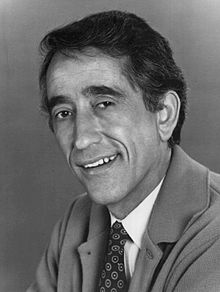
Logic like that used to be recognized in American politics as a form of satire.  Pat Paulson, a sketch comedian on the Smothers Brothers television show ran for the Presidency in 1968 and five times thereafter on the Straight Talking American Government(STAG) party

Pat Paulsen, Presidential candidate 1968,1972,1980,1988,1992,1996

platform, with the healthy comedic cynicism of an observer of body politics’ inherent hypocrisies.  Paulsen, freely willing to be a flip  flopper and double talker regarding  his policy statements, when caught in his incoherence, always responded with the catch phrase “picky, picky, picky!”  His presidential campaign slogan was “I upped my standards, now, up yours!”  Paulsen always secured a certain protest vote, but everybody knew he was in on the joke.


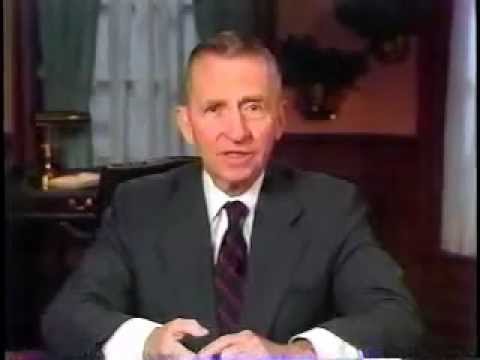
In 1992, H Ross Perot, a Texas businessman with a particular hatred for the sitting President George Herbert Walker Bush, set himself as a Trumpian candidate,  and his form of satire was certainly less funny and somewhat more ominous in its success.  He was quoted as saying obtuse policy statements such as, “ If someone as blessed as I am not willing to clean out the barn, who will?”  and  “If you can’t stand a little sacrifice and you can’t  stand a trip across the desert with limited water, we’re never going to straighten this country out.”  Whatever potential policies Perot felt such remarks would evolve into, he never let on, but he translated it into 19% of the national vote in 1992, and although he didn’t win a single state’s electoral vote, Perot managed to take down a sitting President and give us Bill Clinton.

H Ross Perot Presidential candidate 1992
H Ross Perot
Presidential candidate 1992


Perot’s success set the stage for the current “businessman savior” Trump, who feels his supposed dominance  in the business world would translate into the more arcane and compromise filled world of politics.  Of course such talents never need to show their skill level running for any lower office – the Chief Executive office of the country is fundamentally just big enough for their egos.

The 2016 republican field was felt to be one of the most talented in recent history, with multiple vetted and articulate candidates with willingness to confront one of the more challenging political environments in years.  Into this maelstrom comes the distortion of Trump, who looks to steal the energy and attention of the moment to pump his own ego and potentially upset the applecart.  Trump, the runaway train, threatens to take his circus “Independent” and achieve the same notoriety that propelled Perot, and likely bring another Clinton into the office.  It would suit Trump fine as he believes the office holders are meant to be “managed” for favors, and their policies consumer items for purchase.  It certainly wouldn’t phase him as to which party would be in power, as power comes from the Art of the Deal.   Is the country so gone that it can no longer participate in a real battle of ideas and help mold its destiny?  My gut sense is that the country has had its flirtation with the superficial (see current administration) and will trade it for some serious adults, not the theater of the absurd.  If so, Trump’s train will soon be passenger-less, and its conductor once again reduced to running beauty pageants, wrestling events, and roulette wheels.  I suspect after a period of time in the klieg lights, that will suit the conductor of the crazy train just fine.

The Lion in Winter

WOODROW
WOODROW

This week was one of the more difficult weeks in my life.  My great companion of thirteen years, my dog Woodrow, succumbed to a nasty cancer of his spleen, that like a thief in the night, stole without warning our living bond.  Clinically the event was perpetrated as the result of a spontaneous rupture of a malignant hemangiosarcoma, but it presented as internal bleeding,spontaneous deterioration, and the acute need to make a rapid and very,very painful decision.  Like the warrior king he always was, Woodrow fought the vicious foe tenaciously for several hours.  He would not let his warrior heart give in…

I had to do it for him, to end his suffering.  The battle lost, the warrior king was at rest for the ages. His best companion’s deep suffering continues.

Above is the king at the height of his powers. An exotic mix of Golden Retriever and Chow, he carried the dual personality characteristics of beauty and beast.  Rescued in his youth from a kill shelter in Idaho, he maintained always the frontier spirit of the West in his soul.  He was a throwback. Self sufficient. A hunter. A loner.  He liked being outside in the elements when other wussified dogs of the suburbs to which  his rescue delivered him headed in doors at the first weather.  He would go on vision quests, long walks which irritated the neighbors and brought him in a precarious love hate relationship with the local constabulary. He did not suffer fools, neither dogs nor humans.  If a stray coyote sought to take over the territory, Woodrow made sure there would be none of that.

He brought an intense bond with his owners in that it was easy to see there was nothing to own, only life to share.  He did not whine, and he took care of his own wounds – the occasional untoward moments in life. A missing canine.  Facial scars from raccoons. The stiff gait of many a battle.

He also let you know he was your wing man.  Always by your side. He deeply enjoyed human contact, and showed real gratefulness for the comfortable life he ended up achieving through rescue, released from the wild, difficult, unknown world of his youth and the harrowing experience of the shelter.

He was strong and beautiful, but as life does to us all, he was slowly and insidiously drawn  down by the ravages of age.  The hips stiffened, and the massive shoulder muscles weakened.  He no longer could run, and progressively getting up and down became a daily challenge.  He had become the Lion in Winter.  In his last year, he would still guard his territory from the porch, surveying his domain from his padded bed – weakened, but still not suffering fools such as the UPS man.  The body began to deteriorate before the final insult, but the warrior heart remained strong and the deep eyes always burned with the fires of the ancient eternal soul within.

The night of nights came for Woodrow, as it must inevitably for all of us.  The stark rupture from the bonds of life to the vagaries of death is the essential moment that reminds us of the precious gift that is life.  In this same week, we are confronted with our modern culture’s confusion with the gift.  We note society’s faux outrage with a hunter’s kill of a somewhat domesticated lion in the country of Zimbabwe that dominates people’s emotions internationally.  The people of Zimbabwe are confused as to the intensity of the emotion of people for a lion they did not know, in a country where lions kill people every year, and other animals every day. In the same week, we are exposed to moral emptiness of a bureaucratic  human extermination process run by Planned Parenthood, exposed by video to be actively selling late term aborted fetus body parts for profit, taking care not to damage the “crop”.  The latest video identifies the horrifying reality that in some cases, the execution is not fast enough, and the fetus escapes the womb fully formed and viable – what used to be universally recognized as a human baby.  No matter. The baby is “harvested” anyway.  Society, unable any longer to sustain a soul, unable to understand the life creation process stands mute.  As the Nazi monster physician Joseph Mengele ominously and presciently was quoted,

” The more we do to you, the less you seem to believe we are doing it.”

We have progressively lost our wonder of the miracle of creation, God sent, with natural order of things a struggle to be mastered and the awesome beauty and diversity of life to be celebrated. To live in a world where humans become divisible consumer products and animals strange objects of worship demeans the entire constellation of the sacred gift of life.  The universe has balanced it all, the joy and tragedy, struggle and triumph, wonder and loss that makes the idea of living on a fulfilling one.  We can only hope to be worthy of the miracle and live a life totally respectful of it.


Norse legend suggests that for Woodrow , as one of God’s creatures, his time on Earth done, a lush meadow awaits him between this world and the next, where he can be young and strong again, body  restored to its majesty.  There he can wait, until one day he notes a familiar scent, lifts his eyes forward, and leaves the pack behind. And comes running to me, joy thus restored and the universe now healed… and from that point, together,  we cross the rainbow bridge, to our shared eternal destiny.

Were it to be that the universe indeed worked that way, that would be all right with me.