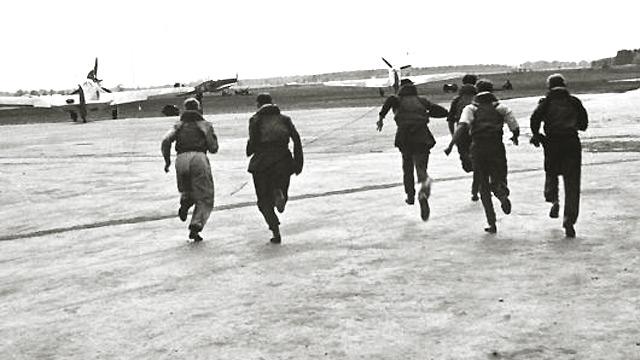
The Battle of Britain

RAF pilots sprint to their planes to attempt to intercept incoming German air attack squadrons in the Battle of Britain 1940

“What General Weygand has called The Battle of France is over. The battle of Britain is about to begin. Upon this battle depends the survival of Christian civilization  Upon it depends our own British life and the long continuity of our institutions and our Empire. The whole fury and might of the enemy must very soon be turned on us. Hitler knows that he will have to break us in this island or lose the war. If we can stand up to him, all Europe may be free and the life of the world may move forward into broad, sunlit uplands. But if we fail, then the whole world, including the United States, including all that we have known and cared for, will sink into the abyss of a new Dark Age made more sinister, and perhaps more protracted, by the lights of a perverted science. Let us therefore brace ourselves to our duties, and so bear ourselves that, if the British Empire and its Commonwealth last for a thousand years, men will still say, ‘This was their finest hour'”

                                        Winston Churchill  June 18, 1940

75 years ago this month, in a September 17th meeting with his military staff, Adolf Hitler, the dictator of Germany and the conqueror of continental Europe, heard the disparaging news that his air forces were not going to be able to sustain mounting losses and still hope to support a cross channel invasion of Great Britain.  Three days later, unbeknownst to the British, who had months of horrific losses ahead of them in nighttime bombing later referred to as the Blitz, Hitler effectively suspended the initiation of the cross channel invasion, Operation Sea Lion, and in doing so, changed the outcome of history.  The battle of which Churchill so eloquently spoke of  just three short months before, had turned back the greatest war machine ever known through the savvy, will, and courage of perhaps the fewest people one could imagine. 75 years later, it looks like no less a miracle, and ever more important, as we are currently called to summon our will again to combat a marauding evil.

When Churchill spoke to the House of Commons in June 1940, he saw a world where his Britain was the last remaining obstacle to securing Hitler’s stunning successful conquest of the European land mass and the subjugation of the cultures that had determined western civilization for the past five hundred years. The challenge looked immense, if not hopeless, to most, including members of his inner circle.  The United States, Churchill’s hoped for ally that might turn the tide, had no inclination to get involved in a trans ocean struggle and was nowhere near ready to do so, if it had so inclined.   The United States Ambassador Joseph Kennedy saw in the British a dying empire with no hope of  stopping Hitler, and recommended no American support.  The Germans as recently as May had gone through the French million man army in a mere six weeks, and the British had narrowly escaped with the remnants of their forces at Dunkirk in a hastily produced withdrawal that was a victory only in avoiding  disastrous capture or destruction of the entire British expeditionary army. The Soviet Union has earlier made its own pact with Hitler and swept into eastern Poland and Finland, to secure its own land grab, giving Hitler the ability to focus full attention on Britain.

Full attention meant the world’s largest war machine pointed at the nation that had just had it handed to it over the preceding 6 months in Norway, and then France. The only hope lay in the difficulties of achieving a cross channel invasion.  This had not been successfully achieved (without invitation) since 1066, when William the Conqueror defeated Harold at the Battle of Hastings, and William had not had to worry about battleships or airplanes during the crossing.  The Germans initiated the preamble to Sea Lion in July, 1940 , with a massive daily air attack to destroy Britain’s capacity for defense, with the plan’s logic the destruction of the British Royal Air Force, and with it, the last chance to fend off a cross channel invasion fleet.  And so history was joined to the destinies of individual pilots, the German contingent looking to attack, the British looking to eliminate, in a deadly battle of attrition that bound one to exhaust the fighting capacity of the other.  Planes as machinery were difficult to replace, but pilots – able pilots were irreplaceable.  The destiny of a several hundred thousand man invasion force  therefore lay in the hands of several thousand trained pilots on each side, capable of the skills and experience required to marshall the  maneuvers of a modern aircraft.  Each day a massive bombing force from the continent looked to destroy British will, and each time a group of intrepid fighter pilots in Hurricanes and Spitfires looked to drive the Germans into the sea.
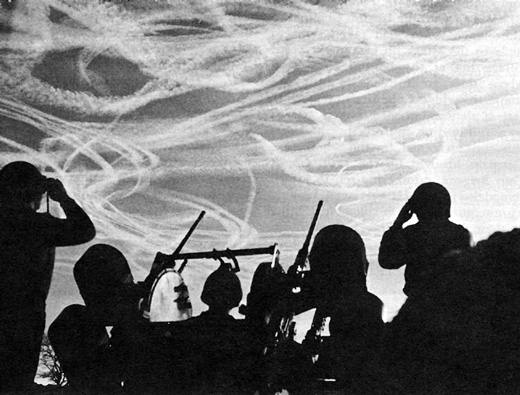
A British Anti-Aircraft Gunnery views contrails of battling aircraft over Britain


The battle was every bit about individual courage, but it was also about revolutionary tactics.  The Germans were late to the understanding of the significance of radar and a sophisticated forward spotting network. The British airmen did not have the ability to be everywhere, but sophisticated tracking allowed the concept of force magnification by getting fighters from far afield to the appropriate intercept point with uncanny accuracy. The Germans had somewhat more powerful aircraft in straight line speed, but poor fuel capacity to the extent that for the escort fighters, only about ten minutes of dog fight capacity was present before the fighters had to turn to home across the channel, leaving the bombers exposed. The german bombers were instructed to destroy the airfields and planes initially, a task that proved difficult given the ferocity of the resistance and the accuracy of bombing at the time,  That left British industrial capacity for the most part untouched, allowing the capable replacement of the air machinery above loss rate.  Eventually, the German losses mounted and the raids turned to night bombing of civilian areas, bringing horrific casualties on the ground in the tens of thousands.
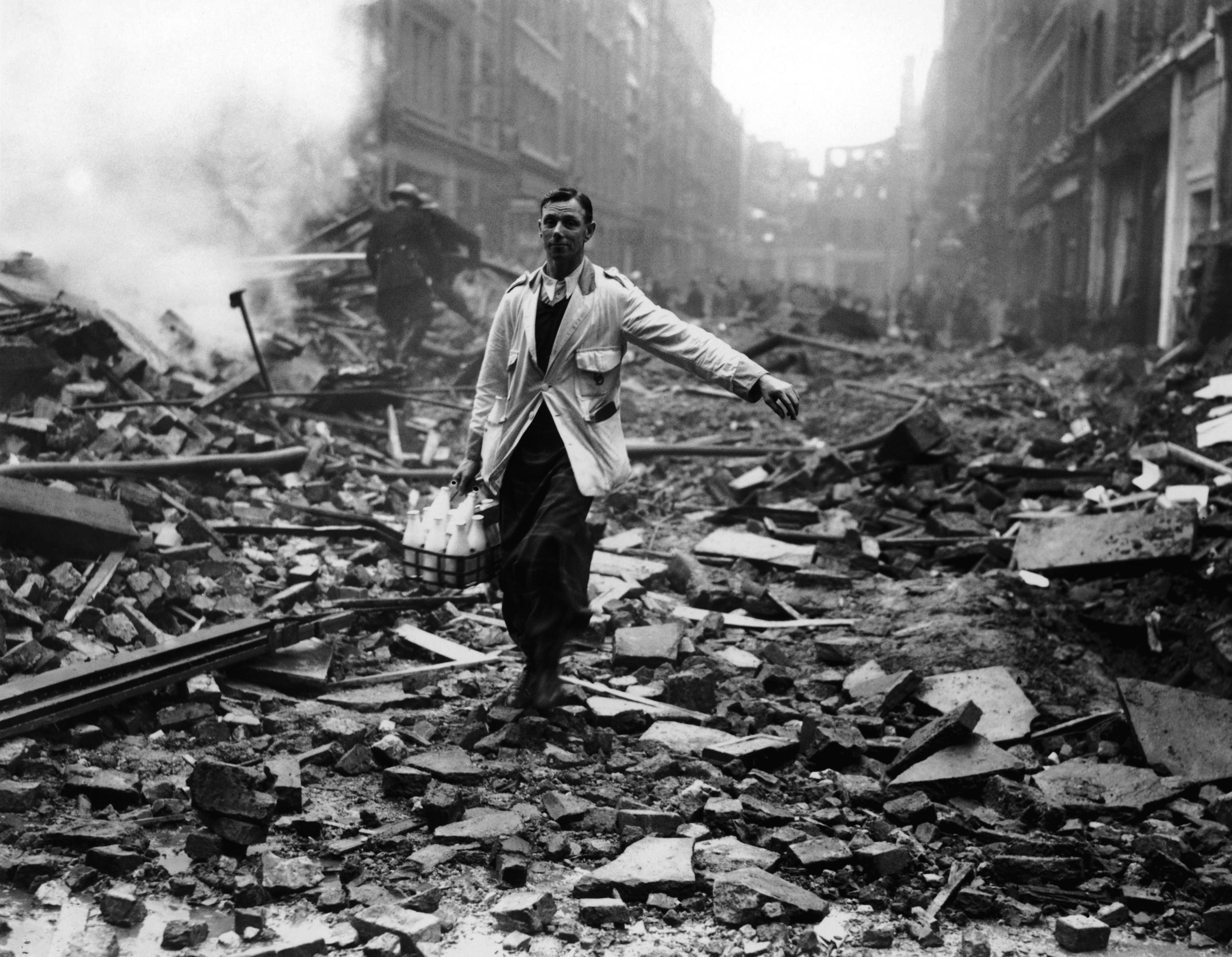
Milkman Fred Morley delivers milk in London despite the devastation of German bombing raids

By mid-October, though the ferocity of the bombing was nowhere near done and the Blitz continued until May 1941, when Hitler re-directed his assets east toward Russia, The idea of a successful cross channel invasion was scrapped by the Germans.  The Battle of Britain had resulted in the loss of over 1600 German piloted aircraft, compared to 1400 RAF.  More importantly, it removed the word inevitable to describe the German war machine and proved a democratic people could develop the powerful martial instincts necessary to combat a remorseless leviathan.  As Churchill was to say in words that have become immortal regarding the Battle of Britain participants : “Never in the field of human conflict was so much owed by so many to so few.”  In a war that may have resulted in as much as 25 million military deaths, the sacrifice of less than two thousand airmen may have changed the entire course of the war, and history itself.

75 years is such a time period, that the few that lived through the moment are in no position to teach the current generation of the necessity at times to defend one’s civilization.  No invasion took place of the British Isles, because a determined population believed their view of civilization was worth fighting for, no matter what the odds, and potentially at total cost. Surrender of a way of life and tradition of respect for others was thought less worthy than the loss of one’s life for the chance of preserving such principles.  Mr. Morley, the milkman in the photo above, saw the surrounding devastation as an obstacle to overcome in his call to preserve a civilized society, not a sign that self preservation was called for. Delivering milk to people who needed it, is what was done in a civilized society, and to stop, would to suggest the barbarians had won. And that, was unthinkable.  Civilization once again proved itself to be a bottom-up phenomena, barbarism top down.  The shadows of such distant history show us today that our civilization’s decline will occur only if we as individuals stop caring about our role in civility.  The island of Britain, all alone, against indescribable odds, showed what one could do, if civilization was your cause.  We again to look to Churchill whose words resonate for those of us who see the immensity of the task ahead of us in a time where surrender is all around us – ” You must just KBO!”

Keep Buggering On.
 

Boehner and the Tea Party Insurrection

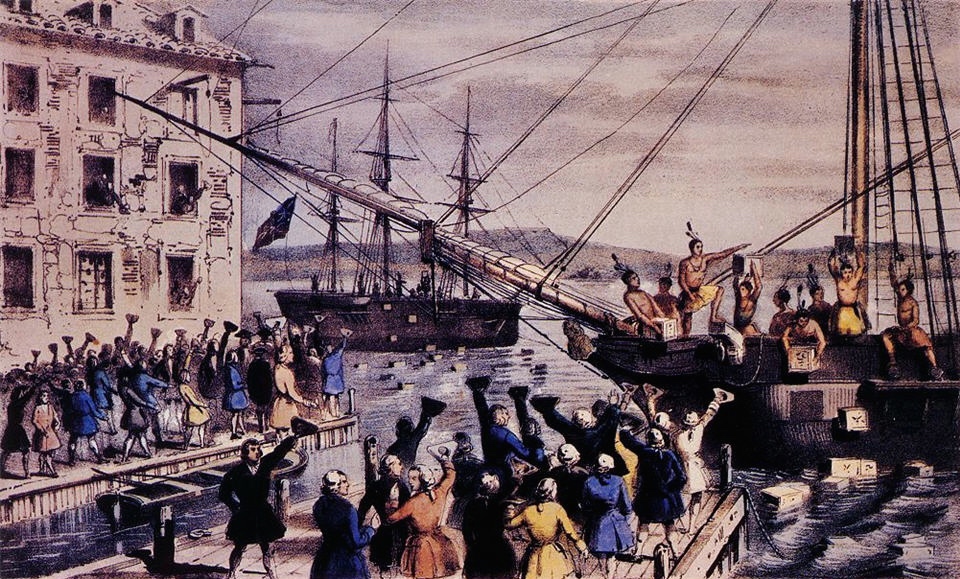
Boston Tea Party illustration by Currier
Boston Tea Party
illustration by Currier

Speaker of the House, John Boehner, third in line to the Presidency of the United States, was felled by a procedural dispute.  The dispute unfortunately for him was with a group of congressmen and women he could no longer ignore, or avoid. Maligned and derided, miscast as at best doofuses or at worst racists, the tea party insurrection has quietly gone about its business, and is now progressively shaking the very core of what represents the conservative political movement in this country,   The tea party movement, now just over   six years old, has managed to help win first the House majority for Republicans in 2010, then the Senate majority in 2014, elect political stars such as Mike Lee, Marco Rubio, Rand Paul, and  Ted Cruz,  take down House Majority Leader Eric Cantor, and now, Speaker of the House Boehner.  Not bad for doofuses.

Who are these ‘doofuses’ and what do these ‘doofuses’ want?  The establishment politicians, enamored with their supposedly invincible incumbent status, gold plate retirement plans, and propensity to support the version of democracy that functions as a one party state, the government party, are asking the question much as the British establishment did at the original tea party in Boston Harbor in December, 1773.  It was hard to project in 1773 how such an obscure rebellious act would result in the revolutionary tumult only a few years later. Such is the obscure origin of the current tea party insurrection.  Smoldering for years, as Washington grew progressively larger and larger and more and more tone deaf, the ignition spark occurred when a little known financial reporter for CNBC, Rick Santelli, went on a spontaneous rant on the floor of the Chicago Board of Trade, on February 19, 2009. Santelli railed  against the new Obama Administration that was willing to spend billions of stimulus money to secure mortgages that had been given out by many banks to individuals who had no assets to pay for them.  Santelli spoke up for the average person who plays by the rules, takes appropriate risk, and has no one look out for them when fate determines a bad outcome.  Santelli felt something profound had just been broken, the equal opportunity that was at the heart of the American Dream.  Little did he know what his four minutes of rant would start:

Within weeks “tea Party” movements broke out across the country, and a slow steady wild fire began.  Initially formed as Tea “Taxed Enough Already” Party, the movement began to develop unappreciated depth, impressive patience, and significant political acumen.  Early missteps with unprepared candidates such as Christine O’Donnell and Todd Akin were learned from, and the skill and winning ways of the candidates began to take hold.  Scott Brown winning the Senate seat previously ‘owned’ by Teddy Kennedy in deep Blue state Massachusetts,  Scott Walker achieving and then retaining the governorship of Wisconsin despite a furious and vicious effort to defeat him in three elections over four years, and Eric Cantor’s stunning loss to unknown David Brat showed a disciplined and committed movement.  Further earthquakes prior to Boehner  began to show themselves in the summer Presidential process, with establishment favorites Jeb Bush and Hillary Clinton loosing traction despite enormous money advantages, and a ‘throw the bums out and make America great again’ demagogue named Trump storming to the top of the polls. The concept of Trump is closely tied to the poor selections of O’Donnell and Akin but can be seen as the temporary weapon the modern movement is using to evidence its displeasure with the status quo and warn everyone what is coming.

Which brings us back to Boehner.  The final straw had nothing to do with taxes per se.  It had everything to do with leadership mistaking their positions are not related to their experience with process, but rather, their grasp of principle.  Boehner committed the ultimate sin in suggesting that an electoral success of 2014 putting Republicans in the position of leadership of both legislative houses, would lead to clear actions thwart the runaway train that is the constitution subverting Obama administration.  Rather than show backbone and take stands that would make clear distinctions of philosophy between republicans and Democrats, the two houses sheepishly folded time and time again, as the President ignored laws and made laws that were never legislated with Obamacare, outsmarted Boehner and McConnell in avoiding any vote on the disastrous Iran agreement that would have at least made all parties responsible for their actions, and finally crumbled into silence on any action on defunding Planned Parenthood’s development as a fetus factory for profit.

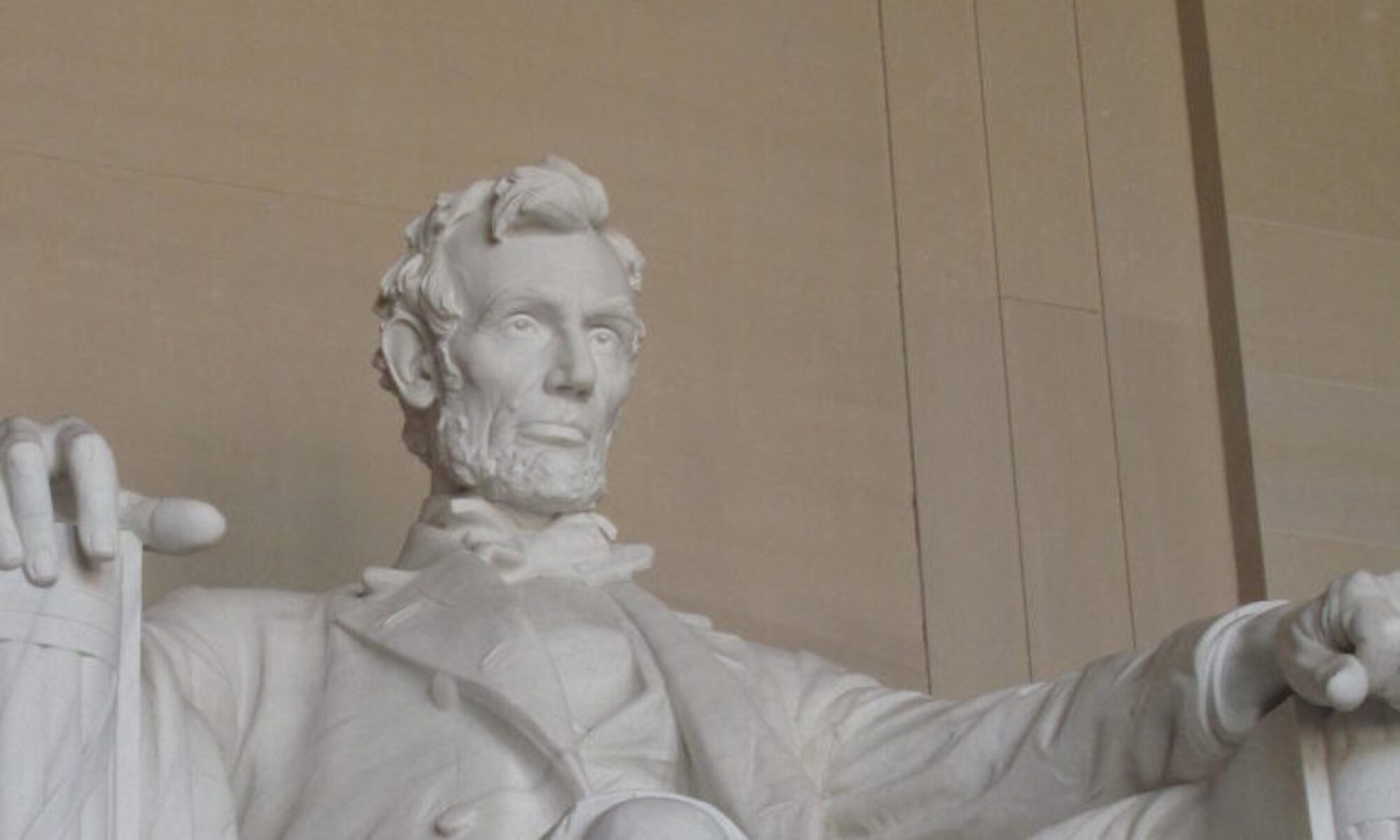
The phony tears that are those of Boehner’s supporters suggest that there was little he could do with the numbers in the President’s favor.  For Tea Party proponents, the excuses rang hollow.  They had labored mightily to give Boehner his majority and hence his Speakership.  They saw him much like General McClellan in the Civil War, blaming his lack of action on the forever excuse of not having enough troops or provisions.  Lincoln, much like the tea party finally exhausted by the excuses, was willing to take a chance and absorb some heavy punishments on a considerably non-establishment figure, General Ulysses Grant.  He stated, ” I can’t spare this man- he fights”.  The tea party was not looking for Boehner to win in order to fight, it was looking for him to fight to win.

The tea party has grown into a principled social movement that demands that America return to rules of behavior, limited governmental size, reducing repression on personal freedom, equal opportunity, fiscal sanity, and firm defense of its exceptionalism.  In six short years, it has grown beyond insurrection, into something that is beginning to look like revolution.  Revolutions are unpredictable, but sometimes are necessary to re-orient a lost compass.  One thing is for certain, and John Boehner knows it now if he didn’t before.  The tea party is not the provence of a few raving reporters and political outcasts.  It’s a political movement that’s rocking the world.


Media Democracy

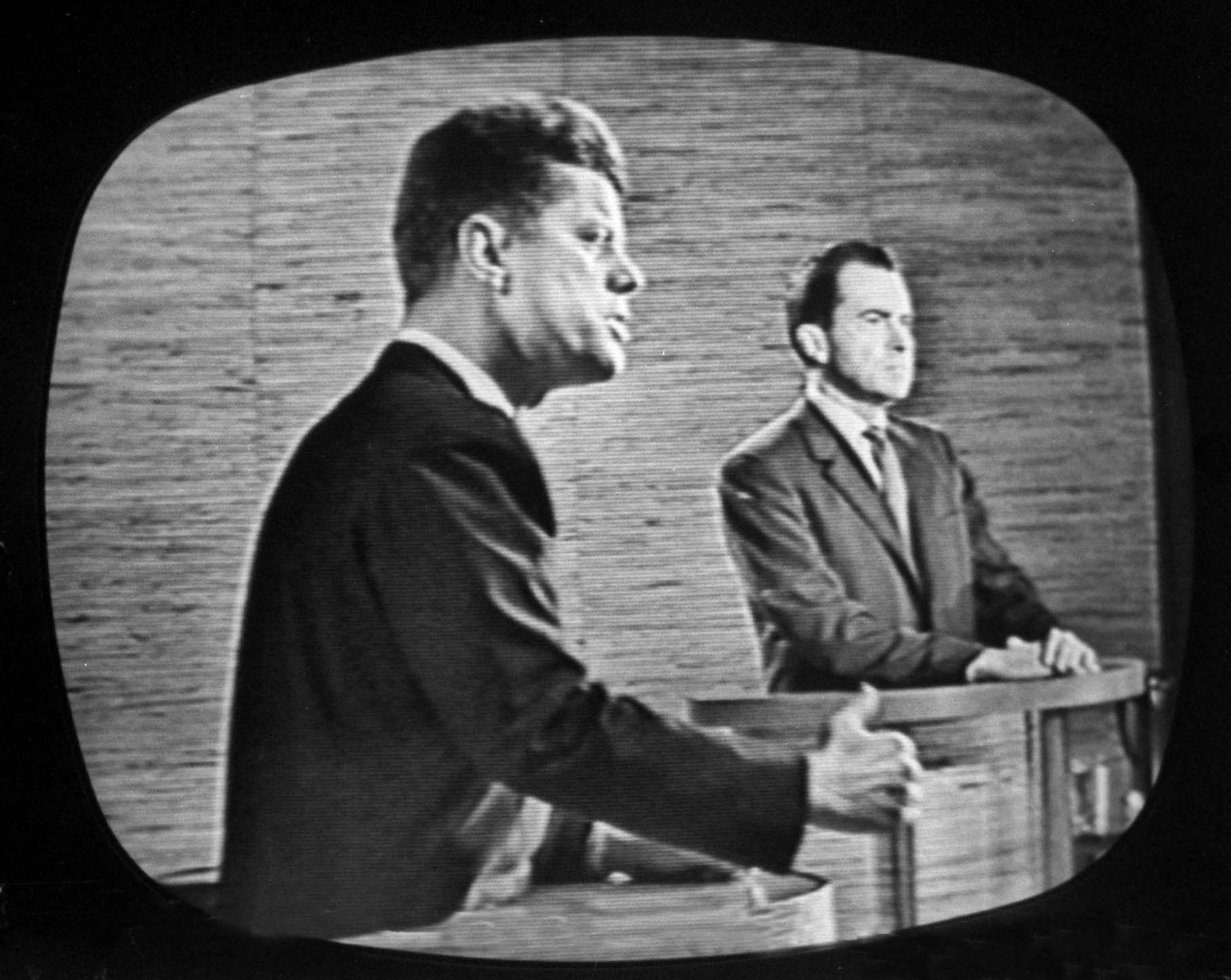
John Kennedy/ Richard Nixon Presidential Debate October 7th, 1960
John Kennedy/ Richard Nixon Presidential Debate
October 7th, 1960

Television was barely a decade old in being available to a substantial cross section of the American public, when it vaulted to the role of ‘decider’ in the nation’s democratic process.  On the night of October 7th, 1960, two politicians vetted their philosophies in front of a large shared real time audience, and television was there to frame for all time our memory of it.  The U.S. Senator from Massachusetts, John Kennedy was seen by viewers as young but capable, prepared, tanned, energetic, and the promising future; the sitting U.S. Vice President Richard Nixon old, cautious, pale, and the establishment past.  The image television perpetrated of Kennedy as clear “winner” was out of keeping with the relative realities of the debate itself.  Heard by millions more Americans on the radio, it was Nixon, not Kennedy, that was felt to project a more measured, prepared,  and in-depth performance.  At 47, Nixon was barely three years older then the ‘young’ Kennedy and had shared with Kennedy the generation’s defining life experience of World War II combat service.  Unbeknownst to most everybody, it was Kennedy, not Nixon, who was sickly and medicated, only still recovering from an Addisonian crisis several years previously.  It was Kennedy, not Nixon, who declared a nonsensical ‘missile gap’ existed between the Soviet Union’s capabilities and that of the United States, ignoring that fact that the US had a several hundreds times more nuclear delivery capacity, but clearly designed to reinforce the vision of the shock of Sputnik in the uninformed audience’s mind.

Kennedy, following the debate, secured public perception as ‘up to’ the job of President with his projection on TV that night, and defeated Nixon in one of the closer elections in US history.  Television, as the new media, found in its discovery of Kennedy’s on screen projection, the definition of ‘telegenic’, and was happy to promote the Camelot myth of a young vibrant President and his family as the new definition of leader.  Camelot sold a lot of television sets.

In the 55 years since that debate, television has ruled supreme as the venue for definition of a politician, and has guarded that role ruthlessly.  Television was adversarial to Lyndon Johnson and particularly Nixon, despite their political success, as they projected poorly on television, and prominently in Nixon’s case, saw the media as the enemy in defining their public perception. The media wanted Reagan to fail, painting him as dangerous and a dullard, but television could not undercut his telegenic presence, that masterfully projected calm, dignity, and humanness.

As television moved into its middle ages as a media force, it has rallied to the need to re-instill the Kennedy magic, first through Bill Clinton, and in a tour de-force, Barrack Obama.   Clinton, who nearly put every viewer into a coma with his 1988 droning, overwrought Democratic National Convention speech, finally achieved telegenic Valhalla wagging his finger at the camera, denying sexcapades in the White House and inventing the political television reality show. Obama preened in front of Greek columns and claimed olympian talents of controlling sea levels and ending division on the strength of his world diversified telegenic projection, echoing Kennedy but with a fraction of the political grasp or respect for process.  Television needed to balloon these two in particular because the threat of the internet to be even more real time and defining than television, was slowly becoming a reality and threat to the force that television played  in defining our discourse.

Unfortunately for television,, the emerging media, the social media through the internet, has loosened television’s tight grip on the narrative.  Progressively,  the internet has screwed severely with the narrative television has been built to project.  The Internet has broken down multiple fortifications television had built around its star child Obama as the global unifier and the smartest man on the planet.  Television media groups were stunned when it positioned Donald Trump for collapse by projecting his most stupid, offensive comments and discovered the more he did it, the more the Internet liked what it heard.  Trump has thus far proved immune to television defining of him, because he has turned out to be the hybrid, fully cognizant of the reality show deterioration of television and the synthesis of the visual with the immediate and emotional qualities of the Internet.

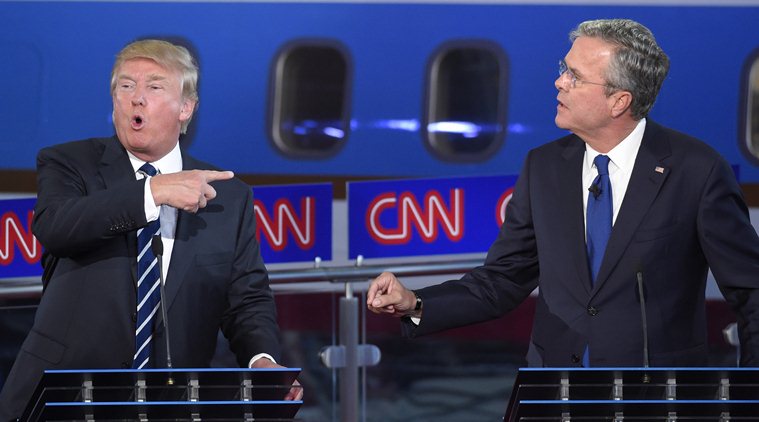
The latest debate of Republican candidates shows television trying to respond to its slipping position as the primary media vehicle to define this nation’s direction.  A large group of diversified, intelligent, and capable conservatives is not exactly what television has in mind when it sees itself as owner and pathfinder for the nation’s consensus.  The debate was designed by CNN to be part reality show and part circus side show.

Republican presidential candidates, former Florida Gov. Jeb Bush, right, and Donald Trump both speak during the CNN Republican presidential debate at the Ronald Reagan Presidential Library and Museum on Wednesday, Sept. 16, 2015, in Simi Valley, Calif. (AP Photo/Mark J. Terrill)
CNN sponsored Republican Presidential Debate – AP photo

The idea was to develop a bunch of mudslinging matches that would show the nation  the pettiness and vacuousness of the Republican field, and distract from the emerging disaster that is Hillary and her effect on  the virtuous party, the Democrats.  Fox was stunned when 24 million Americans tuned in to see the first debate, and CNN wanted to magnify the Trump celebrity factor to make the irrelevant cable network seem relevant again.  More than 20 million Americans tuned in to see this second debate.  CNN treated them to questions like, ‘Mr Trump says you’re ugly, what do think of him’, ‘Mr. Bush speaks Spanish, shouldn’t he speak English?’ , and ‘ Mr. Paul, Mr. Trump says you don’t belong on this stage, because you only poll at 1%, how do you feel about that?”‘ – among other questions, in this most dangerous and serious of times.  Despite CNN’s best attempts, surprisingly and progressively though,  an actual debate broke out in the second half, and this bright field of candidates began to find its legs and maneuver into serious discussion, directed at the internet generation, more directed, and personal, and deliberative. Stream of consciousness born for Internet discussion started to develop that television struggles with – What do living fetus organ harvests say about our nation’s character? What are the consequences of citizenship?  How does the nation achieve personal highways to  success for the most people?  What are our mechanisms for dealing with a dangerous world?  Progressively, no one missed the visual references as to who is the prettiest, shortest, meanest, or tanned. The celebrity Trump was mollified, quiet, and progressively a non-participant.

Television is in danger of being marginalized into the corner of an internet screen feed, competing with the huge diversity of opinion drivers available. The concept of the nation huddling around the television in the living room is becoming a dated concept in the same way that the newspaper delivered to the door once connected our thoughts. Something that may be quite profound is beginning to project with the lack of message control that once dominated our thoughts through the visual media.  It may turn out that the huge audiences are continuing to tune in to the debates, are doing so not so much to watch as to organize their own thoughts.  The debate the other night, so designed to define our way of thinking, may have initiated our journey back to a more town  hall vetting of ideas, shorter on visual magnetism and longer on the victory of ideas.  Whatever comes after television, an internet nourished democracy built on ideas, not personalities, may not be the worst thing  The Trump personality comet may actually come to represent nadir of visual consensus, fundamentally mis-interpreted.  It may actually be speaking to the final divorce with forced consensus based on visual manipulation.  The Trump factor may be saying, we will form our own opinion, thank you.  And now we will start looking to the pathfinders that can articulate the ideas that we form.  That kind of media democracy might finally put us back on the path to salvation.

War and Peace

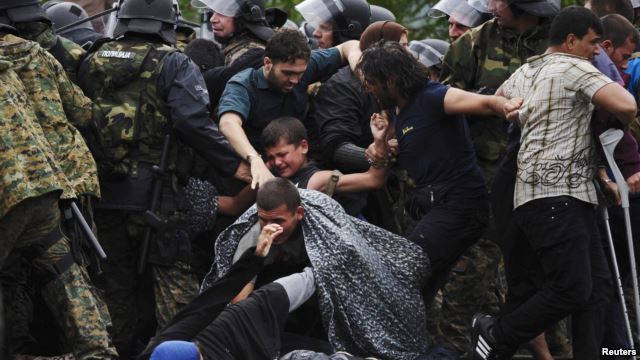
Syrian War refugees struggle to gain access to Europe    greekreporter.com
Syrian War refugees struggle to gain access to Europe               /greekreporter.com

In between golfing expeditions on his recent extended summer vacation, the President of the United States must have at various times noted the recent news of the day.  There was of course that irritating Hillary Clinton struggling to explain how she had determined to house the nation’s secrets on an unguarded server for her own benefit, as a matter of preference. Then there was that silly Donald Trump ranting about something or the other.  Most importantly, it appeared the various golf outings had managed to secure the Iran deal with his democrat politicos, making it possible for a non treaty, with provisions no one has seen, and inspections no one intends to uphold,  secure the jihadist radicals as the secure rulers of an Iran emerging as world power for the next President to deal with.  That last bit of news, now that was a good one.

Lining up the putt on the 18th green of the Cape Cod golf course, perhaps the President briefly gazed upon the vast ocean that separated his country from the continents beyond, and thought, how wonderful a time of peace can be.  After all, he had ended two wars in Iraq and Afghanistan, pulled American influence completely out of the Middle East, and punctured the quant and old fashioned American resolve to try to always do the right thing, no matter how difficult or potentially risky the situation.  That martial, imperial impulse that had dominated American foreign policy since the beginning of World War II had finally met its overdue demise under the disciplined, steady direction of  this smartest of all presidents.  Now, finally, some real Peace.  And the opportunity to spend the Peace Dividend on more pressing needs.

Unfortunately, it turns out, it is our Peace, their War. Despite the determination to remove the warmonger USA from inciting the locals in the Middle East, warmongering has continued at an accelerated pace.  An increasingly nasty war contagion is filing the void created by the American withdrawal, and the damage is cataclysmic.  Michael Ledeen, a long standing Middle East observer, notes that increasingly larger players are taking sides and developing war strategies in the region that supposedly would have been pacified by removal of the American hegemonist, and are savagely feasting on the carcasses of Syria, Iraq, and Libya the Americans left behind.  The visible result is human misery on a massive scale, with millions of  refugees fleeing the horror most profoundly effecting Syria, and risking everything to come to the shores of a Europe that doesn’t want them.  The Arab nations, trained for decades on the ability to ignore Palestinian refugee plight, are comfortable with thrusting all the refugees toward the hated ottomans in Turkey and the colonialists in Europe, making sure none land in their own countries and mess with their oil monies.  The Russians, who have always been world players, seek to mold the war in a way that serves their interests, and are increasingly taking a direct role in the mad center of the tornado, Syria.  The greatest war strategists of all are Obama’s new partner, the Iranians, buying anti-ship missiles from the Russians for when it becomes time to clear American ships from the Persian Gulf, strategizing with the Russians to secure President Assad’s position in the Syrian holocaust, and reaping real casualties from the Saudi and United Arab Emirate troops in Yemen, testing their resolve and willingness to die for their oil princes.

War and Peace. Throughout history, the two expressions of human existence have always co-existed, each preventing the other through hard choices.  Peace is not the absence of war, but the prevention of it. Despite all the historical precedents, the President thought somehow by withdrawing the policing forces from a pacified Iraq, removing the leadership of Libya and defining no alternative, ignoring the progressive disaster of Syria as if it were a local affair, and releasing the restraints on a jihadist Iran, peace would ensue.  Instead he, and the U.S. leadership to come, will have War.  Europe, other than Great Britain, always willing to avert its eyes from responsibility and assume that the victory in the cold war was achieved by the attractions of passivist socialism, is now facing the reality of millions of entrants to their societies, and the urgent need to do something.  The something is unlikely to allow them to wait to be rescued once again by the U.S.  If Europe’s recent brief period of “peace” is to be extended, they may have to finally be willing to admit that the concept of Peace does not survive without constant, aggressive vigilance and defense.  The millions and millions of people caught in the middle, as always, will be the sentinel sacrifices, of the  dithering democracies.

The President, in his final year of office, probably has plans to enjoy the Peace dividend he has created, and get in some serious golf.  I suspect, that War, is going to turn out to be his very uncomfortable caddy.