Liberal Fascism Tests Its Reach – Who’s Watching?

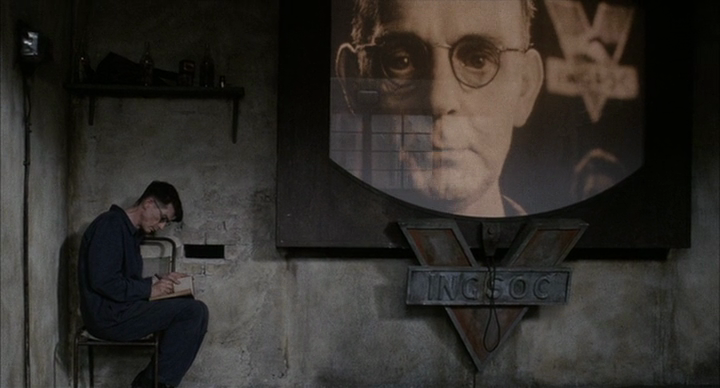
Big Brother Watching               1984
Big Brother Watching
1984

The state of Wisconsin is known for cheese, the Green Bay Packers, and a pleasantly schizophrenic penchant of voters that sees no conflict with simultaneously electing committed ideologues from both ends of the political spectrum.  What it hadn’t been associated with, until the election of Governor Scott Walker and the enormous battle over Act 10, the sequence of laws mandating political reforms in public unions, was the progressively darker side of American liberalism.  The ugly fascistic side of American liberal thought, however, was well ensconced in the tactics of those who sought to derail Governor Walker, and the techniques now being uncovered progressively bring to mind the mindset of the 1930s and the horrors predicted by Orwell in his brilliant tome of thought police, mass control, and crushing of independent thought, 1984.

This week a vivid tail of state sponsored terrorism was revealed in the unlikely location of Milwaukee, Wisconsin that will test our country’s fealty to the principles of personal liberty, privacy rights, and free speech codified in the Constitution and part of the fundamental fabric of the nation’s consciousness for over 200 years.

The synopsis of events revolve around the stakes for winners and losers in Wisconsin’s epic battle regarding the  power of public unions and their principal benefactors, the Democrat Party and the power of the individual citizen.  With Walker’s election in 2010 the public union stranglehold on the governmental budget was put at risk by Walker’s revolutionary attempt to de-couple the public unions from their source of power, the permanent tithe the unions were able to enforce on the state taxpayer. Surging the percentage of state workers through twenty years and securing for them an ever more unsupportable entitlement by progressively making a larger and larger proportion of the budget non-discrecanary, the unions were buttressed by their partners in the power grab, the Democrat Party.  Democrats saw an ever-growing dependent voter base and a seemingly inexhaustible cash flow from the state coffers to the unions and ultimately to the Party.  The marriage of inexhaustible resources to evermore ideologically pure politicians made for an axis of evil that only a revolutionary approach could stop.  The revolutionary was Walker, and no amount of recall elections, storming the capital, death threats, or hijacking of the legislature was proving capable of dislodging Walker or the elected legislature from achieving the de-couple.

In liberal fascism, however, there is no winning or losing on the ideas or the merits, there is only the eventual victory of ideology, and the fashioning of new state supported means of destroying Walker and his ideas with him took root.  The legal machine, first in the guise of liberal judge injunctions, and then more ominously, in the form of a John Doe investigation of Governor Walker’s staff when he was County Executive for Milwaukee, expanded beyond all bounds was a potential atomic weapon.   John Chisholm, the Democrat District Attorney for the county, exploited an archaic Wisconsin law fashioned to allow a secret review as to whether laws had been broken by government officials into a broad based multi-year siege on Walker.  Chisholm’s conflict of interest, his wife’s position with the very public union Walker’s law would effect, was single minded in his desire something, anything that would smear Walker and take him down.  The first John Doe investigation centered on the use of e-mail for political purposes from government computers, an investigation that if even handed would have taken down the majority of public officials in both parties.  When the conclusions of the initial investigation could not be tied to Walker in any meaningful way, the investigation did not end, but morphed into evermore expanded and brazen attacks on individuals whose only crime was they supported what Walker was doing.

David French in the National Review Online this week describes the harrowing, Constitution busting antics of Chisholm and his enforcement arm, sponsoring middle of the night police raids by armed officers breaking down doors, invading private property, and threatening individuals with the moxie mirroring the tactics of the Soviet Cheka or German Gestapo.  Chisholm has remained unapologetic and frankly thus far immune to any public outrage regarding the unwarranted trashing of people’s rights because they were members of conservative groups that supported Walker as their only “crime”.  Megyn Kelly of Fox interviewed French regarding the ugly truths exposed recently:

This is certainly no isolated example of the progressive reach into extra-constitutional territory by the liberal elites of this nation led by the facioso in chief.  Whether it is the weaponizing of the IRS to target conservative groups that could have proved a political competition for Obama, the ignoring of legislation that mandates immigration policy, or the harassing of the tea party, the extra-legal means of achieving ideology has spread from the executive on down to the local governments and universities.  We are now seeing the banning of conservative talk on campus, the harassing groups such as jews or christians, climate change deniers or fracking advocates, that may be antithetical to the goals 0f the ideology, and the neutering of the military’s role from defender of the country to enforcer of the political correctness that infects and strengthens the ideology.  With each day, the tenets of the obscure radical Alinsky, become the calling cards of the progressive elite that see their role to permamently transform, what they have been unable to change through reason and measured debate.

The Constitution remains the bulwark against the brazen tactics of these committed and righteous radicals.  The Supreme Court may potentially take up the cause of the Club for Growth supporters that were so abused.  This pattern of Constitution trampling has to be stopped in its tracks for the miserable miscreants it creates, and the intolerable actions they think they can get away with, because they believe nobody cares enough anymore. If it turns out that people have stopped caring, George Orwell may have known us better than we ever would have guessed, and this world will descend into a very,very dark place.
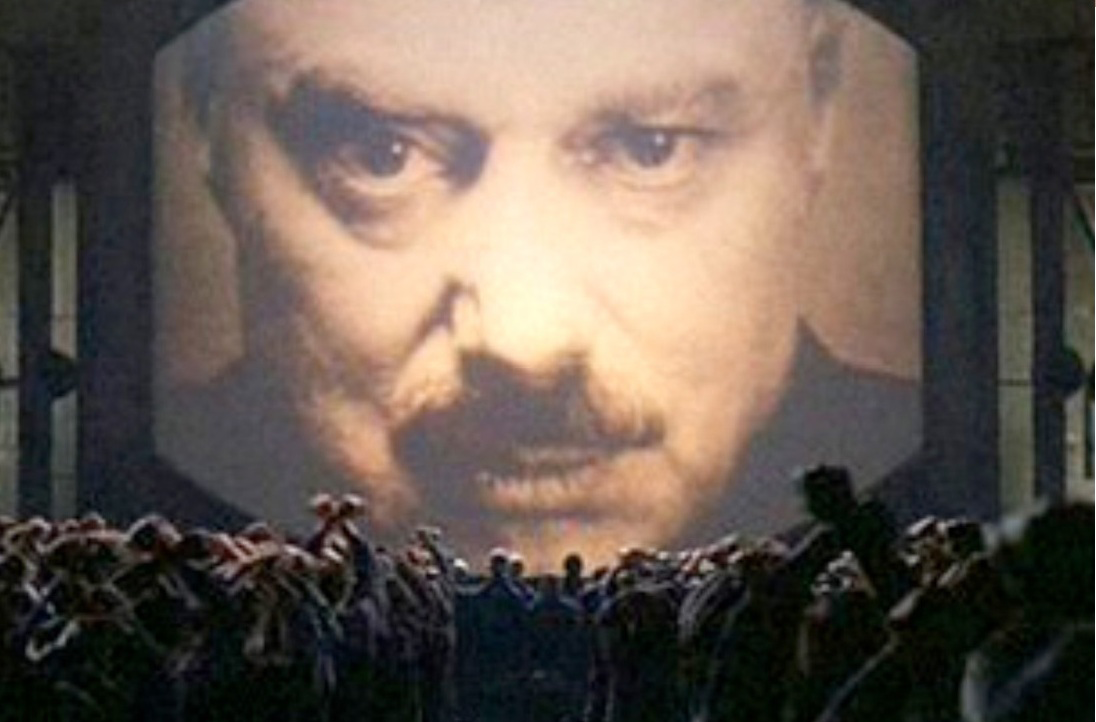
Big Brother is Watching                    1984
Big Brother is Watching
1984


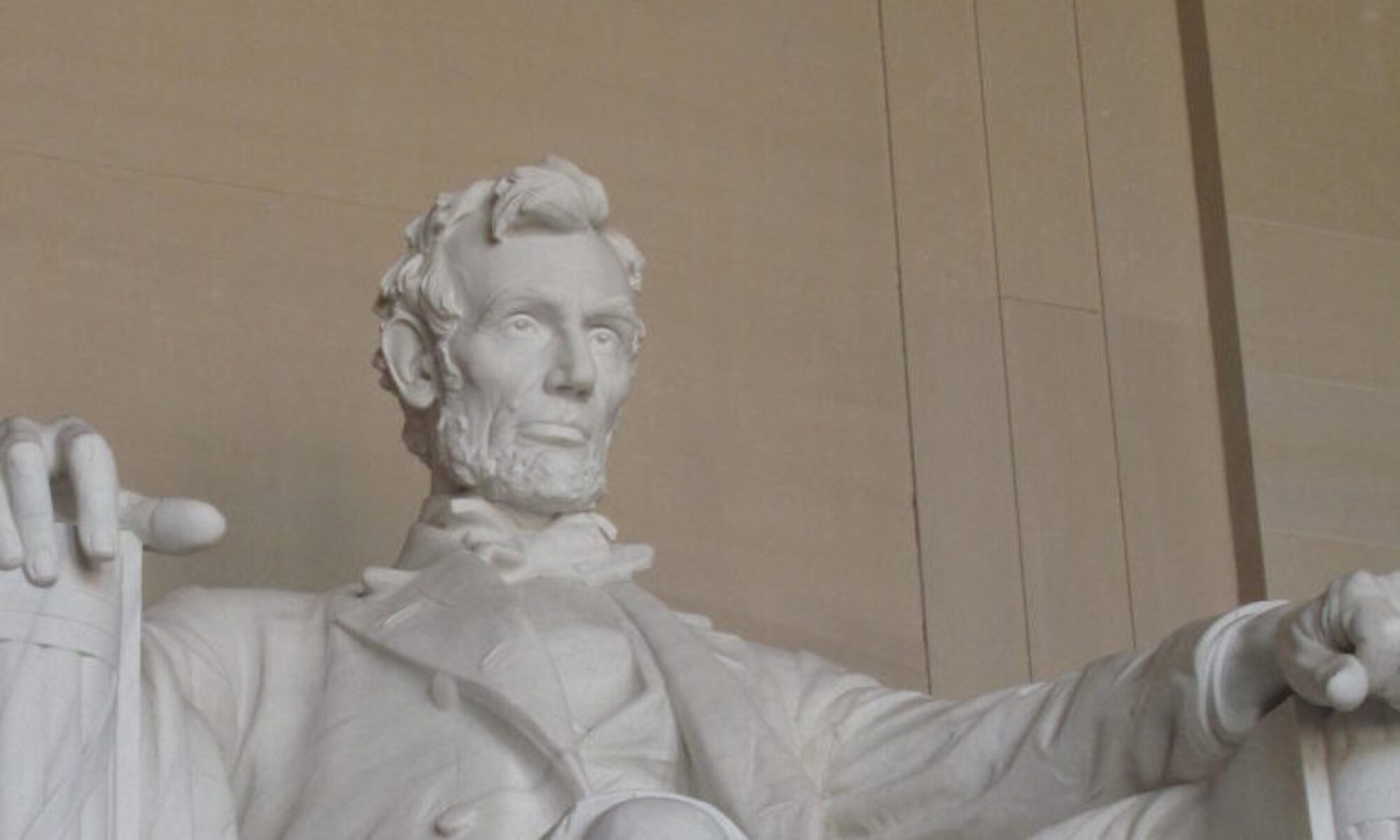
Now He Belongs to the Ages…

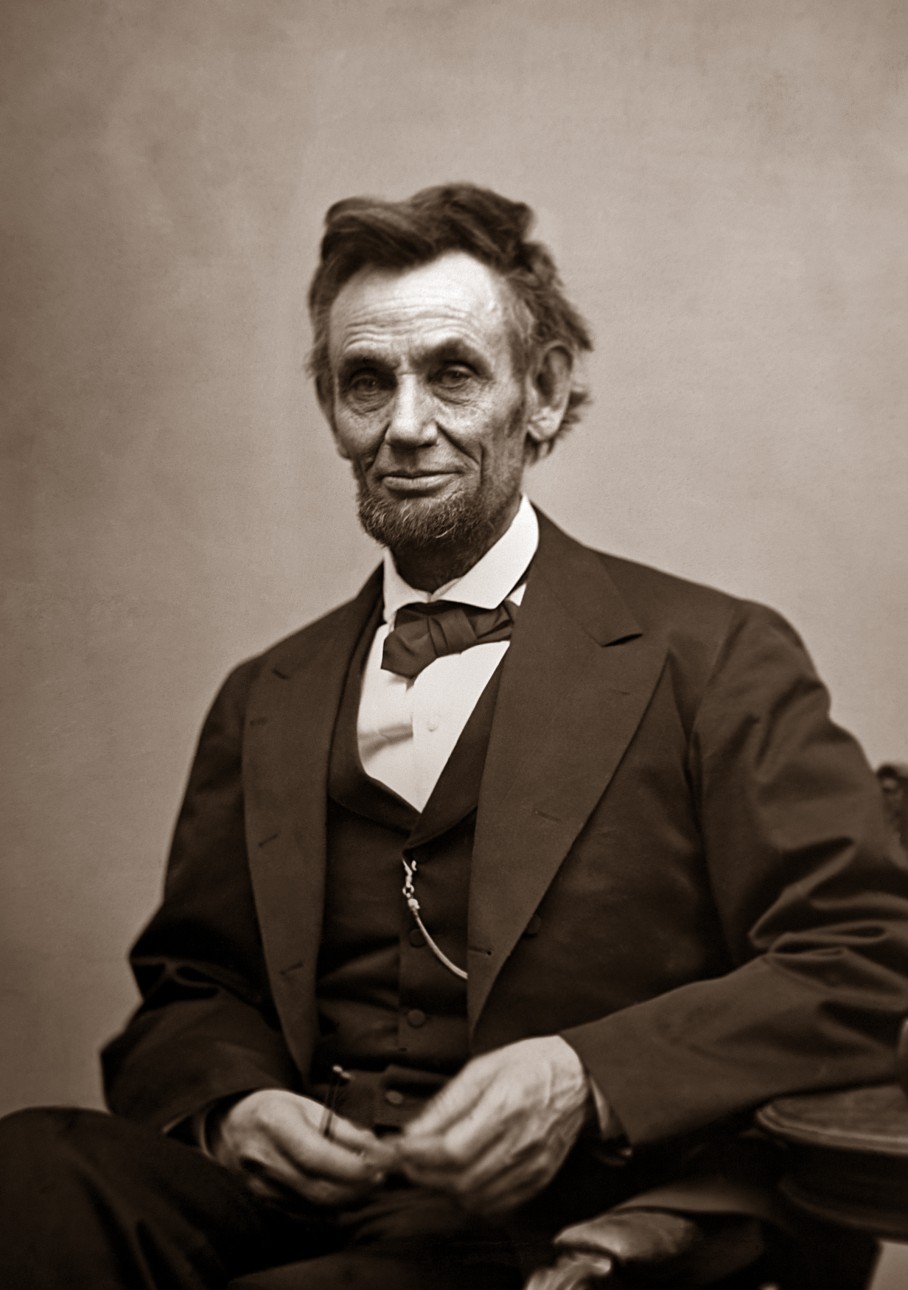
President Abraham Lincoln            March, 1865
President Abraham Lincoln
March, 1865

To reach beyond the mists of time and bring immediacy to the events that gripped a nation one hundred fifty years ago is an extremely difficult proposition. The war that cleaved across the breath of the American land mass and struck into the life blood of nearly every American family is at best a distant recollection and for most has little emotional relevance.  The modern society struggles to understand the passion and commitment individual Americans brought to the concepts of union, liberty, individual rights, and the relationship of a governed people to its government that so stirred the nation to the cataclysmic conflict.  From Sharpsburg, Maryland to Glorieta Pass, New Mexico, the remnants of titanic battle scattered among fields, cemeteries, memorials and roads the strategic value of which are known to few and passed by millions without a glint of recognition of what lies beneath the traveled path.

It has not always been so.  The intense emotions that built over 30 years and exploded in the war that cost over 600,000 lives and immense destruction were for decades an acute sensation in the hearts of both north and south.  The events at Appomattox that culminated in the surrender of the Army of Northern Virginia on April 9th, 1865 were documented in the previous Ramparts, but the final act of the tragedy that forever secured the sacristy of the conflict was the murder of the national leader five days later on April 14, 1865.  In a conflict that demanded the loss of so many, it was the almost Christ like death of Abraham Lincoln that seemed to stop the process of destruction forever in its tracks, as if a provision  for washing the sins away for a wayward people had been pre-ordained.  The stolen life of a single man seemed to bring a closure not possible through any other contemplated outcome.

On April 14th, 1865, the President of a United States that had fought an epic battle with itself for its very unity, was reported by many observers that day to be in an especially ebullient mood.  He participated in a productive cabinet meeting in which he laid out his determination to steer a magnanimous course for the nation’s reconstruction, and for the first time in many nights planned a strictly social outing that evening to attend a popular play currently playing at the Ford’s theater in Washington ,Our American Cousin.  He had invited his victorious general of the armies, U.S. Grant, to accompany the President and his wife, but due to a relative lack of comfort the two wives had for each other, Grant deferred.  The President looking forward to the life affirming experience of laughter after so many years of crushing responsibility and tragedy, determined to go anyway.

It was Lincoln’s fate that the leading actor of the playhouse, John Wilkes Booth, saw himself as an actor on a far greater stage than that of the local theater, and had for months determined to play a defining role in history.  The headmaster of a particularly bizarre gaggle of malcontents and miscreant Southern sympathizers,  Booth self-identified  as the avenger to reverse the fortunes of a conflict that the South had for months progressively pointed toward defeat.  With the South’s defeat assured with its army’s collapse at Appomattox, Booth somehow convinced himself that with an epic sacrifice, the tide would be reversed.  The cleansing act would be the decapitation of the Union leadership, with the violent deaths of the President, leading General, Vice President and Secretary of State to so shock the North that it would sue for peace and give the South the breathing room it needed.  The cockamamie plan required the simultaneous actions of multiple conspirators, but Booth gave himself the honor of removing the hated victorious President .

It was a sign of the innocence of the times that Booth and his fellow conspirators came as close as they did to accomplishing the calamitous plan.  As the President sat in the Presidential box at Ford’s to enjoy the play, Booth’s fellow conspirators fanned across Washington to remove the other stalwarts of government.  The conspirator Lewis Powell showed the most malevolent commitment, entering the house of the Secretary of State  William Seward, viciously attacking Seward’s son nearly killing him, then cascading up the stairs of the residence to enter the bedroom of the prostrate Seward, who had been severely injured in a recent carriage accident and was recovering.  Slashing with a knife, Powell nearly killed the Secretary of State before being incapacitated by the Secretary’s other sons and household servants.  The conspirator Atzerodt was positioned at the Willard Hotel, the residence of the Vice President of the United States, Andrew Johnson, but lost his nerve to attack and went off to get drunk, thus saving the Vice President for the honor of replacing the irreplaceable.

The penultimate act was left to Booth himself.  The President resided at the theater in a box accompanied by an army major, Henry Rathbone, Rathbone’s fiancé, and the President’s wife.  The President’s security detail was, stunningly given the emotions of the times, a single police officer, John Frederick Parker, who determined to be across the street at a tavern during the play’s intermission and never returned, leaving the President accessible to anyone who determined to enter the box.  Booth, as a celebrity, had no problem entering the Presidential box, and waited for an acknowledged line in the play that never failed to bring laughter across the house.  With the comedic line delivered, the President leaned back and with his last conscious act enjoyed a final moment of relaxed joy, as Booth positioned himself directly behind the president, placed a revolver against the President’s head – and fired.

A single bullet from close range entered President Lincoln’s brain from the left and lodged behind his right eye, and for all intent he joined the hundreds of thousands who passed in the war’s previous days and years, as the final sacrifice of a country’s death spasm.  The laughing crowd did not immediately interpret the muffled shot as apart from the play as the terminally wounded President slumped forward, then back, but the experienced Major Rathbone recognized the sound and scent of gunpowder and sprung into the assassin. Booth struck him with a knife and managed to free himself from Rathbone’s grasp, then leapt from the box only to catch his boot on the patriotic bunting and awkwardly fell the twelve feet to the stage , breaking his ankle.  The 1700 attendants to the nation’s first presidential assassination slowly grasped the reality, and turned their gaze to the box, then to Booth as he exclaimed an oath, eventually codified in legend as “sic semper tyrannis” – “thus always, to tyrants!”, though the actual words were heard differently be every shocked person close enough to hear them.  Booth ran off the stage and into history as devil incarnate, destroying any chance the nation had at a measured and wise reconciliation.

The unconscious President was brought across the street to the Peterson House, where military surgeons quickly determined the wound to be fatal.  So began the vigil of the President’s family, government leaders, and the nation, with President Lincoln drawing his last  breath at 7:22 am on April 15th, 1865.  As word spread of the events of the night and the President’s death, the stunned realization that the President who had somehow shepherded the country through four years of incalculable horror, had at the very moment of triumph and peace, been sacrificed at the altar of a sinful nation, progressively took hold.  Lincoln, in life, who had been viewed variably by the many touched by the conflict, began to assume in such a senseless death, a sanctification that seemed almost inevitable.  A man who had come from the simplest of roots, had grown to lead a people with an almost devine sense of the way forward when many around him felt lost.  The careful and gracefully beautiful language, the context of the words, the steady and careful hand of leadership, the bottomless well of humanity inherent in this man came to represent the whole of the goodness of those who endeavored to leave their homes and safety and risk all for the concept of a just cause.

The funereal journey seized the national consciousness, as did the furious manhunt for the conspirators.  The murderer Booth met his end 9 days later in a shootout at a Virginia barn; the other conspirators were hunted down and eventually met their fate at the end of a hangman’s noose. The vengeance though complete, seemed so unequal to the loss.

With the passing of the years, Lincoln’s stature has grown to where he is seen as the equal of the greatest of leaders in human history.  As Secretary Stanton preciently stated upon witnessing the moment of the great man’s death, “Now he belongs to the Ages..”  A man so much of his own time, Lincoln spoke of the potential of mankind as God’s vehicle for a better time, to be touched, as he so beautifully expressed, by the better angels of our nature. In our current day, where horrors once again abound, Lincoln’s profound humanity soars above his moment on earth, and truly belongs to our age every bit as all the others. In such ageless humanity, lies for us  the slightest glimmer of hope.

The Final Acts of a Calamity

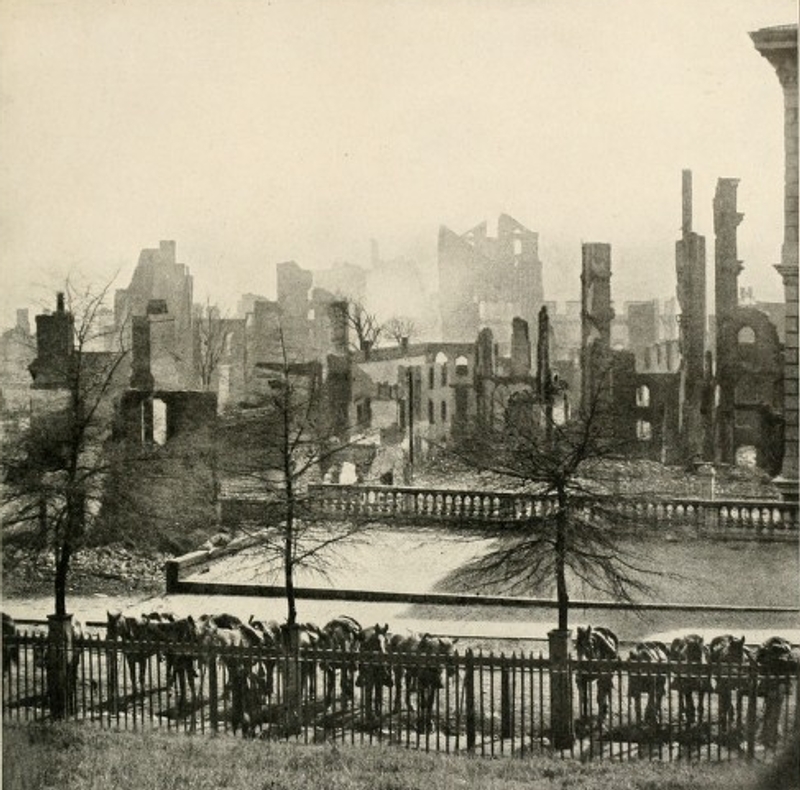
Post Battle Ruins of Richmond, Virginia April, 1965

War is cruelty. There is no use trying to reform it. The crueler it is, the sooner it will be over.
William Tecumseh Sherman


April 2015 is the 150th anniversary of the denouement of the American Civil War, the calamity that defined the nation and whose tendrils still refine the consciousness of its people. As history recedes as an area of interest for the average American, the fundamental and inexorable causes leading to the war and the intensity and sacrifice of millions of people to the concept of a cause seems a trite and faded memory of a long ago time.  The America that saw ideals as concepts to be defended with life as necessary doesn’t seem real to the current generation, who see the nation as a means of dispensing resources, and not a standard to uphold.  To the American of 1861-1865, however, ideals were very real things and were equally real to the farmer from Wisconsin, the plantation owner from Mississippi, the news editor from New York, or the slave laborer in Alabama. For each the ideals were different, but the stakes in losing, total.How to persuade someone to whom losing is not an option, that they have indeed lost, is the centerpiece of any calamitous conflict, and the story of the last 14 days of the civil war are as eventful as any before.

Ramparts has addressed the unique circumstances of the final day of surrender of General Lee’s Army of Northern Virginia before, but of equal historical interest is the final acts that led to the concluding day.  As we enter the story 150 years later, a cursory reminder of the tactics leading to the final chapter is appropriate for perspective.  Although the Civil War may on the surface seem archaic for its fixed set-piece battles and agonal use of men as expendable targets of attrition, the tactics by both sides following the elevation of General Grant to supreme commander of the Union forces following the victories of July , 1863 at Vicksburg and Gettysburg were extremely modern and innovative.  For the Union north, with superior resources and population, the plan outlined by Grant to President Lincoln was continental in scope and consistent with the modern concept that the morale and comfort of the population supporting the enemy army was the true target to weaken and destroy the army.  Grant’s comprehensive plan was for General Meade’s Army of the Potomac to find, pin down and decimate Lee’s Army of Virginia while the Army groups of Sherman, Braggs, and Butler were to wreak havoc in the South’s interior, destroying communications, railways, and supplies, bringing the war to the doorstep of the population of the South,  and carving up the residual Confederate armies into more and more isolated and digestible units.  General Lee’s plans were equally modern.  Lee sought to maintain superior ground, interior lines of communication, and bleed the opponent white to such an extent that the never ending war would be too expensive for the northern population to tolerate any longer.

The initial experiences of 1864 suggested Lee would be right as Grant was aggressively drawn in to bloodbath after blood bath in Northern Virginia from the Wilderness to Spotsylvania to Cold Harbor and finally into a miserable trench warfare at Petersburg on the outskirts of Richmond, Virginia, the Confederate capital.  In the first thirty days of the Overland campaign, Grant stunningly lost over 54,000 men and was perceived as a ‘butcher’ in the northern press. But the the Army of Northern Virginia was now pinned down, and the rest of Grant’s plan began to play out, with Sherman eventually laying devastation to the deep south through Atlanta, through Georgia to the coast at Savannah, then brutally through the Carolinas.  By the end of March, 1865, it was Lee who was reactive and  desperate for materials and men, and Grant who was reinforced and aggressive.

Yet, the conflict was fought by men to whom death was preferable to loss of ideal, and despite the staggering differences by this time in both men and material, the end was not one of timid collapse but rather one of a contest of inch by bitter inch.  It is often inconceivable to imagine the ability to fight tenaciously when all odds are against you and surrender would allow self preservation, but the sense of hopelessness seems to somehow instill tenacity beyond all sense.  A weakened southern army remained a bunch of badgers led by a lion, and Grant still sought the means to somehow crack the will of the committed.

After nine months of battles and siege at Petersburg, the Southern trench lines had finally been stretched to the point of cracking, and Grant determined that if a  crack were to be developed, a tsunami would follow.  Lee felt the pressure first and attempted a breakout on Grant’s right at Fort Steadman on March 25th,1865, with initial success in puncturing the edge of the northern line only to be crushed by a furious Union counterattack.  The southern forces retreated to their trenches but severe damage had been done to Southern infantry strength with over 4000 casualties and no means of reinforcing.  Grant seized

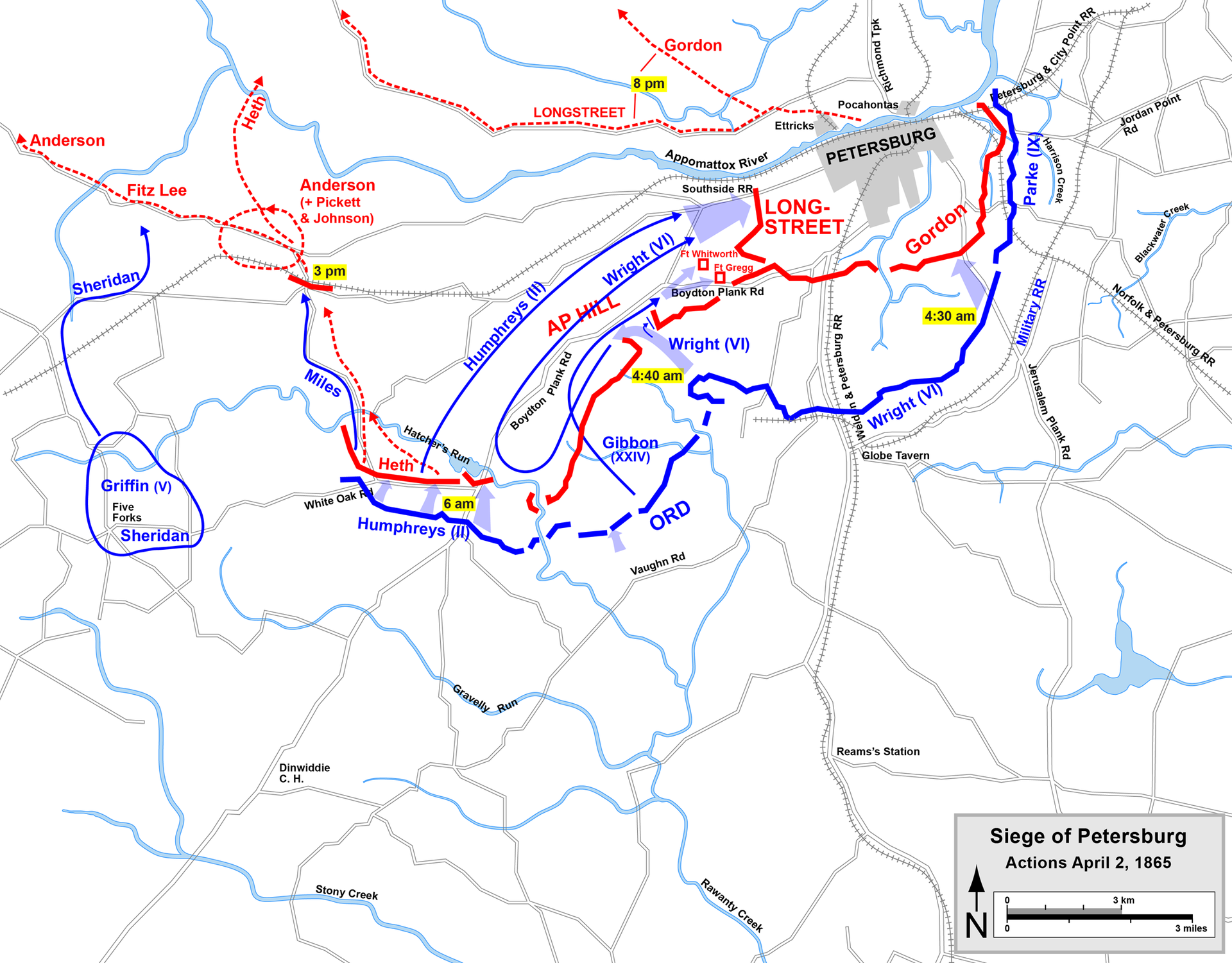
The envelopment of Petersburg April 1-2, 1865

the opportunity and on March 29, a crack was finally developed in the impenetrable southern defenses and Grant’s VIth Corp lanced inward and forced the South to contract and support. General Sheridan’s Cavalry force, by this time as feared as any the South had developed swung around the union left to attempt the severing of Lee’s supply lifeline at Five Forks on April 1st, 1865, and the result was catastrophic for the South with envelopment of over 8000 troops of general Pickett and collapse of Lee’s right flank. On April 2nd, Grant found the final crack on the right and the crack became a deluge as two Union Army Corps poured through the decimated defenses.  Lee found himself now surrounded on three sides and had to evacuate the trenches of Petersburg and the Confederate capital city of Richmond.

The Army of Northern Virginia was now on the run, and unlike every other time in the war with similar circumstance, such as McClellan after Antietam and Meade after Gettysburg, Grant recognized the opportunity for a final kill and performed a perfect pursuit and destruction.  Lee had one chance remaining, to achieve supply support at Appomattox and attempt to rejoin the Southern Army of the Carolinas, now fighting off Sherman’s crushing attacks.

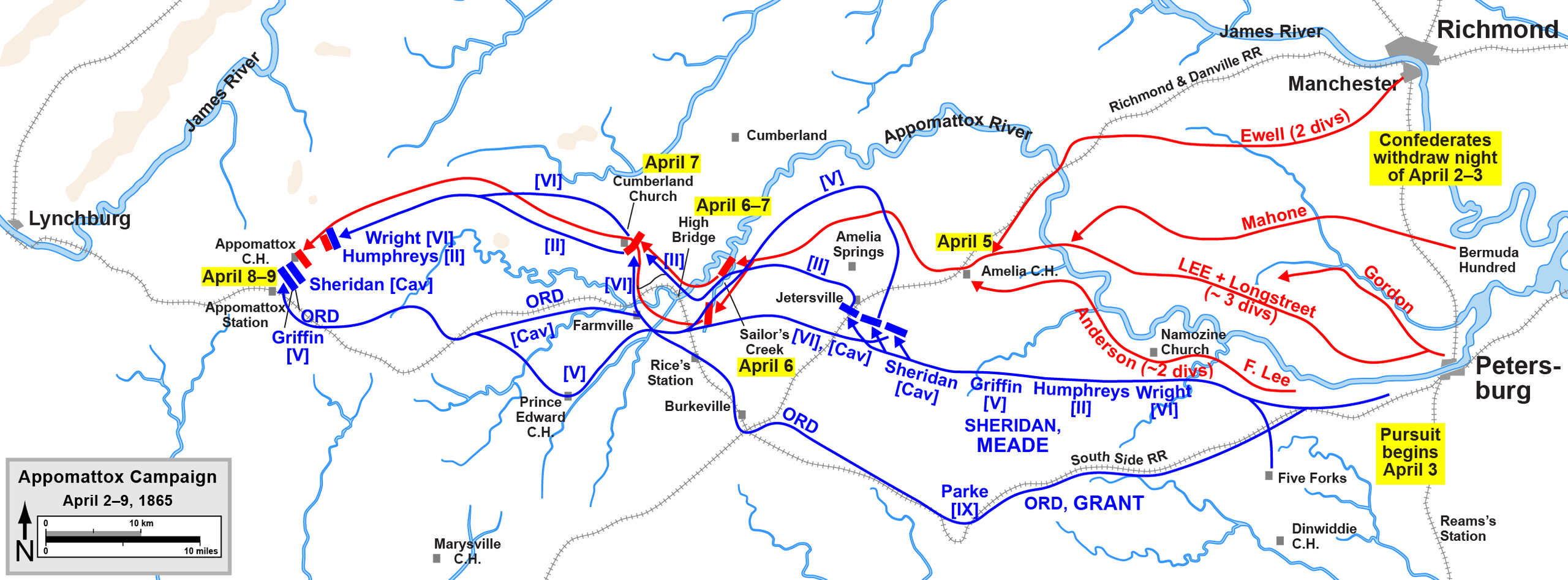
The Final Acts at Appomattox  April 4th-9th, 1865
The Final Acts at Appomattox April 4th-9th, 1865

Grant assumed the role of anaconda and pursued, pinned, and cut off fragments of Lee’s support until the envelopment was total on April 9th, 1865 and Lee was forced to acknowledge he was the fox surrounded by hounds, and the end was inevitable.  To assume that such considerations led men to becoming self-preserving is to deny that the final 14 day struggle took over ten thousand lives, with neither army letting up an ounce.  For both sides, the end justified the sacrifice, and the overwhelming superiority of the Union capacities assured that inexorable force would win out over any desperate heroism.  This was a time of heroes however, who drew their own conclusions and inspiration from loyalty to their cause, and fought tooth and nail to the very end.

We are left with the famous stillness at Appomattox, where the overwhelming recognition of finality struck both sides simultaneously.  Lee, to whom losing was anathema, and Grant, who saw winning completely the only means to peace, found a way to achieve the peaceful stillness that allowed a reconciliation thought impossible only hours before.  One hundred and fifty years later, the victory stands tall as the means of preserving the original principles of the nation, that all men are created equal, and that individuals can have a full say in their destiny.  The price that both sides paid to achieve such laudable ideals is incalculable in the extent of the calamity or the effect on the families.  It was cruel, but it was necessary and it was purifying, though it took decades to fully wash out the stains.

On this 150th anniversary, we could use a reminder as to the closure we achieved as Americans, and what it required to achieve it.  In today’s superficial understanding by most as to the benefits of this great nation, a moment of stillness is in order.