Paying Attention

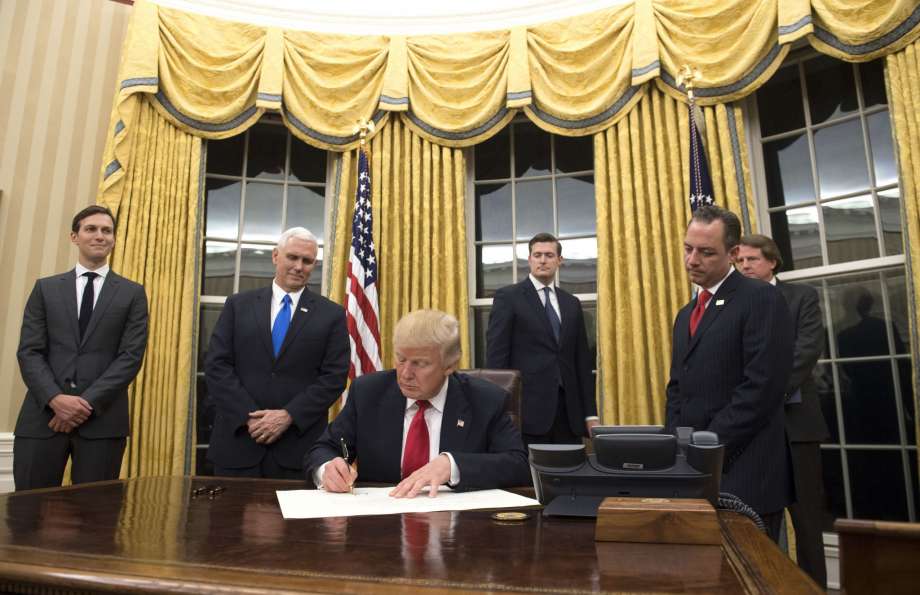
President Trump signs executive order in Oval Office – photo /Houston Chronicle

One of my best friends has a life story the new President of the United States has been adamant we should be on guard against.  Born in Mexico, early in life my friend had to cross the border in what might be charitably described  as less than documented.  Now legally and successfully a permanent resident, he has become Americanized as well, and is studying the underpinnings of American civics as he is seeking to be a citizen of the United States. At the very moment he is about to secure the rights of citizenship, he is faced with a leader dually elected who would prefer he not have gotten here the way he did.  Needless to say he’s not exactly thrilled about a President Trump.  Yet the very requirement of familiarity with the nation’s foundational documents as part of the his pathway to attain citizenship has brought him to a significantly more prescient understanding regarding the recent elevation of Trump compared to many Americans. The civic  lesson of this election he states, is that “in a successful democracy, a citizen must be a participant and better pay attention.”

Pay attention indeed.

The smug assumption that Mr.Trump had during the campaign promoted raw ideas simply to stir sufficient emotional response necessary to win, and would, upon gaining the job, revert to the usual model of backtracking on promises to gain “acceptance” of the establishment, has been obliterated in one week.  Executive orders to reverse Obamacare? Check. Extreme vetting of immigrants from the unstable Middle East?  Check.  Forge ahead with “building the wall”?  Check. Restore the “special relationship” with Great Britain? Check. Withdraw from the Trans Pacific Partnership? Check.  Restore the approval of the Keystone and Dakota Pipelines? Check. Prepare to restore the conservative majority on the nation’s Supreme Court?

Checkmate.

If you were not paying attention, you are paying attention now.  Like the antimatter superhero from the alternative universe, President Trump, using the exact same tactics of his predecessor Obama,  has slashed deep gashes into the supposed fundamental transformation the previous chief executive crowed about.  The bureaucrats of the EU in Brussels, the President of Mexico, the stunned establishment media, and the angry victimhood clingers that make up the majority of the Democrat Party are all on their heels, and are surely paying attention now.  It seems to be that the ‘conviction-less’ candidate assumed by establishment observers, has more convictions then you can shake a stick at.

The larger question is not whether President Trump learned from his successor’s success in using the executive order to effect change, but rather whether he learned from Obama’s failure in his willful discarding of  the democratic institutions of the country, and the compromise necessary in a democracy to turn transient executive actions into permanent law.  Obama achieved only one legislative triumph, the Accountable Care Act of 2010, which rose out of the legislature through sleight of hand and a complete lack of engagement of the opposition,  then never again returned to the concept of enacting laws for fear he would have to negotiate his vision of the world with representatives of the deplorable caste.  President Trump will have to face the exact same challenges if he is determined to see his vision come to full fruition, and there will have to be compromises galore. There is no indication yet that the ‘fun’ of being President and simply declaring actions, will be set aside for the gritty sweat and tough hours of negotiations and compromises with others necessary to effect real change. We shall see.

The beauty of this version of democracy, as Ramparts has trumpeted since its inception, is the ingenious set of checks and balances envisioned by the founders, that prevents any one power group or transient notion from being immune to the influences and adjustments required by all  other competing opinions.  James Madison described this in Federalist #10:

“…the smaller the number of individuals composing a majority, and the smaller the compass within which they are placed, the more easily will they concert and execute their plans of oppression. Extend the sphere, and you take in a greater variety of parties and interests; you make it less probable that a majority of the whole will have a common motive to invade the rights of other citizens[.]” (No. 10)

We have lost the appreciation of this careful structure as citizens.  The ever growing government that sought to determine through regulation every facet of our lives and represent a singular “truth”, managed to sever the average person’s conviction that they could effect change in their own lives, and they grew increasingly detached from holding the monster bureaucracy accountable.  Like a thunderclap from an approaching storm, the November election of Trump asserted the original framers intentions are not yet dead, and Trump’s first week has restore the sense that elections do matter after all.

The key issue that will determine the future of representative democracy in the limited government ideal put forth by our founders, is not whether the new president will govern from the middle.  He is under no obligation to do so.  No, the key will be if this president will allow the middle to govern, in the way this whole magnificent experiment of freedom was built to function.  A President Trump who achieves his election mandate through the prism of careful democratic vetting and review, will have restored this country back on to the stable footing of personal freedom and civic responsibility  that is the envy of every other land.

Like him or not, we are all paying attention again.  On that alone, President Trump has succeeded beyond anyone’s expectations.
 

inconsequential

The Obama Presidency
2008-2016
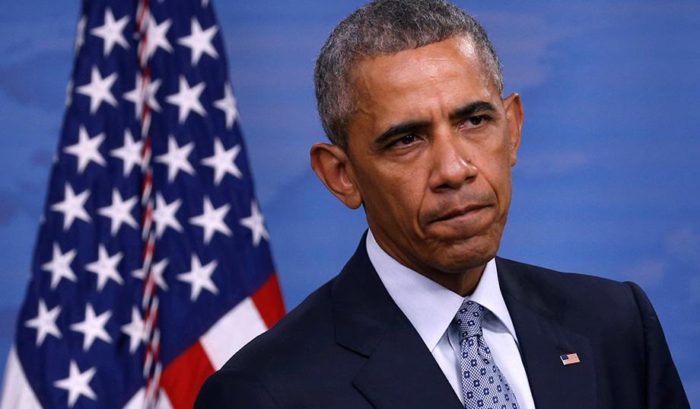
photo — national review

Every election of a new President of the United States brings a quirky American tradition to the forefront — the need to rate or rank the President about to leave office against his predecessors in some hastily assessed scale of accomplishment and gravitas.  The academicians and faux historians love doing it, because it implies they themselves alone have sufficient stature and authority to summarily adjudicate recent history and immediately weigh it against distant history.  Additionally, they can make sure their version of success or failure, their definition of consequential, will set the standard by which their favorites are judged. The current President Obama, as he prepares to leave office, is already being rated “highly,” as if they would possibly let objective insight get in the way of their feelings for the man of hope and change.

History of course is its own best guide, as distance and events begin to provide better perspective to the actions and inactions of the President, that determine if the country and the world were left a better place and important arcs of history were affected downstream.

President Obama is doing his utmost to try to self define his Presidency as transcendent, because that was standard he set for himself at the moment of his election in 2008.

Transcendent Presidents are few, as their capabilities and depth of awareness of the forces of history, and the collective and progressive openness of the people to their message must additionally be transcendent.   President Obama’s message, for good or ill, was transcendent, the transformation of the United States as a world leader and defendant of individual freedom, into a more passive collaborator in globalist ideas, and a country that needed constant and consuming racial and societal reflection at home to achieve a society “worthy” of its out of proportion bounty.  This was a President that wanted to be transcendent, consequential, and to the elites that righteously demand a world they alone can admire, he was the perfect talent for the job of societal transcendence.

Some Presidents have left quietly and allowed others to reflect on their time in office, others have suggested their own sense in a few chosen words, the challenges of their time and their hope for the country.  President Obama felt the need to restate his place in history through an hour long, rambling speech that tried to stay ahead of the sickening feeling in his political gut, that the country did not see his consequentialness consistent with his own opinion.  If you have been told over and over again by the fawning elite and your own ego, that you are the unique answer to the nation’s yearnings, it is, I’m sure, a very uncomfortable feeling to see the country rapidly averting its eyes to your vision.

Hope and change in the end did not feel consequential to the country’s needs and yearnings, and in many ways the fall from grace has been stark and total.  In the period of the President’s ‘transcendent’ leadership, the party reflecting his views has gone from a position of dominance, to the loss of majority in the state legislatures, governorships, house of representatives, senate, the presidency, and soon, supreme court.   The President’s personal charm did not translate into an aura of leadership that anyone was willing to follow.  He achieved essentially one legislative victory, the Accountable Care Act, that took on his persona and became extricably linked as Obamacare, a veneer of “progress” in healthcare that rapidly collapsed under the weight of its poor depth of structure and lack of alignment with the average person’s needs.  Its overwhelming inconsequentiality will be forever defined by the law being overturned literally as its namesake is replaced.  This inconsequential President, unwilling to seek consensus with others on so consequential a concept as overhaul of the nation’s health delivery system, will be consigned to leave office with his singular achievement leaving the stage alongside him.

President Obama, elected as the literal answer to the prayers of millions who believed in Martin Luther King’s dream of a society based not on the color of one’s skin but the content of one’s character, had an incredible opportunity to bring this message to final transcendence.  Maybe more than any other President, his unique characteristics offered the ultimate bully pulpit to cement a new racially advanced society, to the benefit of all.  It was most disappointingly in this arena, where his talents and leadership proved  most difficient and ham handed.  The eight years of Obama showed a steady deterioration in inter-race relations, with ‘victories’ claimed through the championing of victimhood and political correctness, and the profound indifference to urban violence, police relationships, and cycles of family demise and neighborhood opportunity.  The final twin daggers to the President’s tone deaf, failed recognition of his own role to educate and to lead were both stark, and frustratingly familiar to previous events.  The first was the awful reverse racist event of four black youths torturing a mentally disabled white youth and proudly broadcasting it on Facebook, and the President unable to articulate any principle of race that would speak to the universal concepts of civilized decency and respect whatever the direction of racial ignorance.  The second was the President removing the protection of Cubans escaping the totalitarian, oppressive government of Cuba and requiring return to Cuba of those without appropriate documents.  This move is a fit  of pique to hamstring the next administration, and  to support a legacy event of restoring relations with communist Cuba. The ruling pretends to support legitimate immigration processes, when for eight years administration has allowed porous borders and sanctuary cities to shield many individuals who sought to do America and its citizens great harm, yet treat them as equals of Cuba’s oppressed and desperate escapees.

Finally, Obama’s  foreign policy of retrenchment from a perceived American expansionism left the country far more vulnerable, and the world infinitely more unstable.  A radical transformation of the nation’s focus from international human adversaries, to an attempted quixotic war on the world’s core temperature, left America and the world  progressively detached from the President’s effort to be a transcendent world leader.  The superficiality of the vision without the hard work of philosophical development and the backbone to assure adversary respect led leaders to ignore “redlines” and “sanctions” when they realized Obama’s reaction would be inconsequential, his attention easily diverted to personal rather than national goals.  Pathetic attempts to use his supposed personal and rhetorical gifts to re-direct Russia, mollify the Muslim world, and influence elections in Britain and Israel collapsed upon the emptiness of his leadership.  The unfortunate result for all the planet is that the country that must lead for a stable world to exist, has been led by the most inconsequential of leaders on the foreign stage.  It is not clear if the wake of such inconsequence will be the darker consequence of upheaval, but history would suggest the outcomes of such failures are determined in the eventual collapse of rational actions by aggressor nations.

The many other examples, the regulatory waterboarding of American enterprise, the weakening of the military, the enormous deficit spending and ballooning of debt assure the need for consequential actions of subsequent Presidents to address the distracted dithering of the current one.  Consequential Presidents set in to place forces that assure decades of shared purpose regardless of politics due to the overwhelming reality of the positive impact of those consequential decisions on society.  There are no examples of consequential leaders where the very lack of their presence on the stage led to a rapid and complete overhaul of everything they had directed, and a society satisfied to see it happen. For consequential presidents, the historical consensus can often turn to epic recognition.  For this President for whom so much was felt possible, it looks like his inconsequence will result in the legacy of  –  15 minutes of fame.


A Good Bye to Good Morning

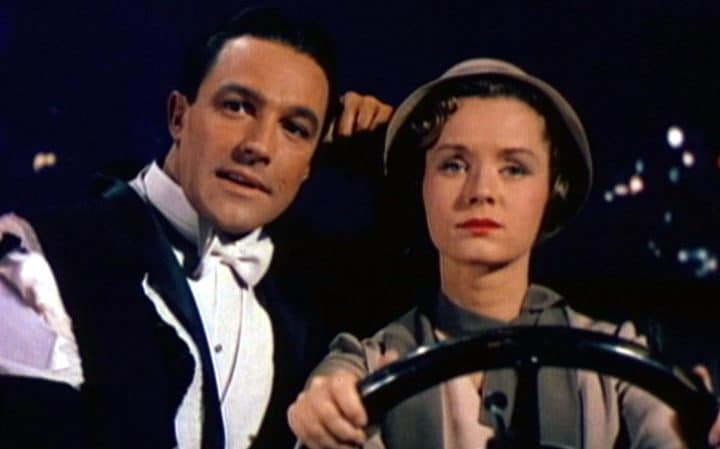
Debbie Reynolds and Gene Kelly – “Singing in the Rain” 1952

2017 is upon us, and it will be a year of some momentously momentous moments requiring serious introspection that will likely fill the Ramparts blog with much of interest to the defenders of civilization.  For those of you who like that sort of thing, stay tuned – we love you checking in.   Ramparts can not say goodbye to 2016, however, without a brief and wistful homage to the memory of Debbie Reynolds, who passed away a mere day after her own daughter Carrie Fischer died of the sequelae of a cardiac arrest.

Ms. Reynolds death was not the tragic part, nor its proximity to her daughter’s death –  certainly sad, but not tragedy. Debbie Reynolds lived a long, eventful and fulfilling life, and though any passing is sad, it is not the pinnacle reason for homage.  It is with Debbie Reynolds passing that a particularly glorious form of American culture, the golden age of the movie musical, passes into memory as well.  Debbie Reynolds, at the very initiation of her adult life, managed somehow to find herself participating in a central role on what has become one of the enduring classics of the American Musical, 1952’s “Singing in the Rain”.   The stars that connected us to the great American Songbook through song and dance, in a larger than life projection on the movie screen from 1930 to 1960 – Astaire, Kelly, O’Connor, Sinatra, Crosby, Mary Martin, and …briefly, Debbie Reynolds-  are now all gone. The very unique cinematic expression of American can do spirit, essential goodness, vitality and optimism that these musicals projected, is seemingly old and jaded to our modern society.  Debbie Reynolds was perhaps the last living link to that different America, that looked up on the silver screen, saw themselves, and felt nothing but good vibes.

Singing in the Rain sits at the pinnacle of the American musical not because of a brilliant story line, perfect lyrics, original songs, or magical acting.  It was actually a story laid upon a series of songs by composer Arthur Freed that had seen performance in other musicals.  The basic plot was a Hollywood inside joke.  With the advent of talkies in Hollywood, it was discovered, not every star actor or actress – could talk.  At least not in a compelling way that made those watching believe in the illusion projected on the screen.  Gary Lockwood, played by Gene Kelly, is a silent movie star, who realizes that the time of long stares into the screen are over, and he will have to change, or say good bye to his career.  He is unfortunately saddled with his silent screen leading lady, Lina Lamont, played by Jean Hagan, who as it turns out, has the voice of a parakeet crossed with a New York cabbie.  The audience that loves Lockwood and Lamont are not going to buy anyone being romantic on the screen with the dialogue sounding like an argument at a fish market.  And so, as you might imagine in typical Hollywood fashion, Gene Kelly is rescued from the brink of star disaster from a complete unknown everygirl, played by 19 year old Debbie Reynolds.

It turns out 19 year old Debbie Reynolds was exactly who she played, a very young effervescent all American spirit who came from absolutely nowhere to hold her own with two of the greatest dancer showman in history, Donald O’Connor and Gene Kelly.  She was real live nobody, with a story you couldn’t make up, if you tried to make it up.  She was born and raised in El Paso Texas into the poorest of circumstances, to a ditch digger father and a mother who did other people’s laundry to make ends meet.  Poor but decent and virtuous, straight out of Horatio Alger, Debbie moved with her family to try their luck in paradise –  California.  She was fortuitously plucked out of obscurity in a local beauty contest when she, still in high school,  won the title of Ms. Burbank, and was “discovered” by talent scouts from Warner Brothers and MGM, who were looking for an everyday girl who might be able to emote that special American perkiness.  No kidding.  That’s really how it happened.

A year and a half later, she was selected by the MGM studio to bring that “perky” American  can do spirit to the screen and was positioned to work with Donald O’Connor and Gene Kelly, two huge stars and professional dancer/performers.  The problem was Debbie Reynolds, all of 19 years old, was not trained to sing or dance. Gene Kelly, a workaholic perfectionist,  one of cinema’s biggest stars having performed in Pal Joey, On the Town, and his oscar winning performance in American in Paris, was not amused.  He was the director of the movie and not at all comfortable with the studio forcing this young girl with no training onto his movie set, much less plunking her in the lead role.  He was very severe toward her, and looked to break her down and get her to leave.  But that wouldn’t be a very good end to our story, would it?  It turns out that a more sympathetic soul, Fred Astaire, who remembered people had been harsh to him when he started, saw something in Debbie Reynolds and helped her learn the complicated routines, persuading Kelly to give her a second chance. And with that, a better Hollywood ending to our story.

The trained up 19 year old Debbie Reynolds – not the most beautiful or graceful girl in movies- but with a special, unique, and magical ‘perky American’ screen presence that made those talent scouts look like geniuses — helped Donald O’Connor and Gene Kelly pull off maybe the best 4 minutes  in cinematic musical history.  Singing in the Rain will always be remembered for Gene Kelly’s magnetic solo performance on the streets performing the title number in a downpour, but the central ensemble brilliance of the American musical is encapsulated in Debbie Reynolds star turn with the two men in “Good Morning”.

Debbie Reynolds was a star of stars thereafter, but like so many who found early perfection, never quite did anything so wonderful and so perfect, again.  Then again, the American movie musical, though it didn’t know it at the time, was coming into its waning moments, under the audiences’ inevitable turn toward the smaller screen of television for its entertainment.

Debbie Reynolds’s death closes the book on a long ago time, but the composition of her American story, from humble roots to the heights of personal accomplishment, based on her on energy, willingness to work, and concentration and confidence on her individual talents to see her through the difficult times, is a story we could certainly benefit from today. Good Bye Debbie Reynolds.  Thanks for reminding us, we can do great things when we believe in ourselves and don’t dwell on our circumstances.  Maybe our Good Morning may yet be in our future, if we remember how just good it can feel — to live out a dream.