
People We Should Know #28 – Augustin Hadelich

Augustin Hadelich
Augustin Hadelich

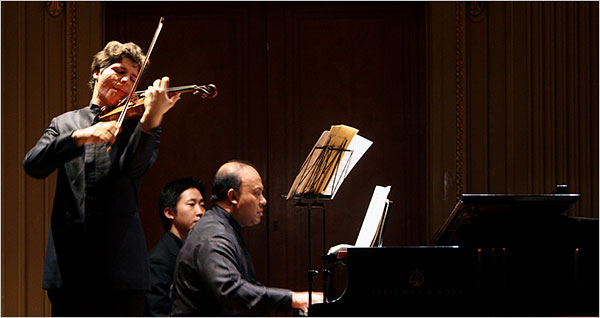
Every once in a while, you see something that transports you so much you start to think maybe there is still hope for us homo sapiens.  Everything you thought you knew about hard work, preparation, capability and profound comprehension are shown by someone to exist at a higher plane than you ever thought possible.  That was my concert experience recently watching and listening to Augustin Hadelich perform Beethoven’s D major Violin Concerto with the Milwaukee Symphony Orchestra.  One of those generational talents, Hadelich at a very young age appears to have grasped the dual oracles that are provence of only the greatest of performers, pyrotechnics and poetry, and welded them into an artistic whole.  We are consumed with the apparent demise of glorious, elevated expressions that seem to have faded from western civilization after a 500 year renaissance, and then someone like Augustin Hadelich comes by, and you realize we are going to go forward for a few years more.  That is why Augustin Hadelich is Ramparts People We Should Know #28.

Augustin Hadelich is an immigrant American citizen,  born and raised in Tuscan Italy by German parents.  It may well be that the cultural life forces that are Italy and Germany have infused themselves into a perfect concoction.  Sunny Italy with its romance and poetic view of the beauty of life.  Earnest Germany with its craftsman precision and its teutonic discipline.  Born in 1984, raised on a farm in northern Italy, Augustin showed prodigy talent in a musical family, but it took a catastrophic accident to bookmark a whole new level of genius.  At the age of 15, Hadelich was horribly burned over two thirds of his body, and for almost two years had to give up playing the violin, too painful to contemplate the difficult physical nature of the instrument. Like a Phoenix from the ashes, however, at 17, a completely new artist emerged, and a new direction as well.  Hadelich was accepted to Juillard, the citadel of budding performers, in New York, and trained under acclaimed teacher Joseph Smirnoff.  It was at Juillard that Hadelich credits finding his musical voice in the multiple chamber music opportunities that taught him how to play with an intimate tone, and once married to his prodigious physical gifts, his career has been thereafter on a rocket to stardom.  He won the 2006 Indianaopolis International Competition Gold Medal, the Avery Fisher Prize, and other major perfomance awards. He has already performed with all the leading orchestras in the world.  And when an adjective is looked for to describe his play versus the many other technically skilled artists now perfoming, it is one word -masterly.Augustin Hadelich is a true master in the classic sense of the word.  He can play everything, and he can play everything better than most.

Beethoven created his violin concerto for masters that did not yet exist. the first performance in 1806 of the concerto was not well received.  It was not understood by audiences that were not prepared to have the violin dominate  a piece the way that the piano was achieving at the time.  Beethoven, this most masculine of composers, briefly found himself in unusual territory of doubting his work.  Concerned that such a piece might be too big for the performers, he hastily transposed the concerto instead for piano, but that was even less successful.  It would take 40 years, for the great performers of the 19th century like Paginini and Joachum, to elevate the violin into a performance level like the piano in the minds of audiences, and with such talents, the Beethoven concerto began to soar, and never again was thought of in any way other than the zenith of performance concertos.

The D Major concerto carries the performer through the orchestral composition like no other, defining the melody, then framing it over, through and under the orchestra, emerging at times, like the most intimate of string quartets, singing like a celestial chime above, than at other times pulling the orchestra along with macho warmth and fullness. It  holds for the performer a restrained kind of fiendish difficulty, until the performer is exposed in the cadenza, the famous finale of the first movement, and reminds all of the enormous capacity of the violin instrument, and the technical skill of the performer. Some performers can play lyrically, some can show pyrotechnical brilliance, and some can emote great discipline, but Hadelich can do it all, and do it so effortlessly, that you wonder if this is what the greats in the golden age of classical music sounded like – the Joachims, the Krieslers, the Heifetzes.  Hadelich shines most at the upper range of the violin, that fiendish region at the top of the finger board with the sonic vibrations of notes differ minisculely, and the spaces between them for the fingers to function, even smaller.  The best players in the world can sound harsh and thin in this rarefied play area, toneless and cold. Not for Augustin – the quiet high passages ring like celestial chimes, with the purest of tones at the most pianissamo of play.  He is playing in the music of the other world, and inviting us to briefly to bask in its glory.

We don’t always recognize the Great Masters, but they are still among us. Taking life, and coloring it like a prism, sounding it like the oceans, describing it as one would the angels.  Augustin Hadelich is already a Great Master, and Ramparts People We should Know #28.  Behold – the Music of the Spheres.
The Obama Doctrine

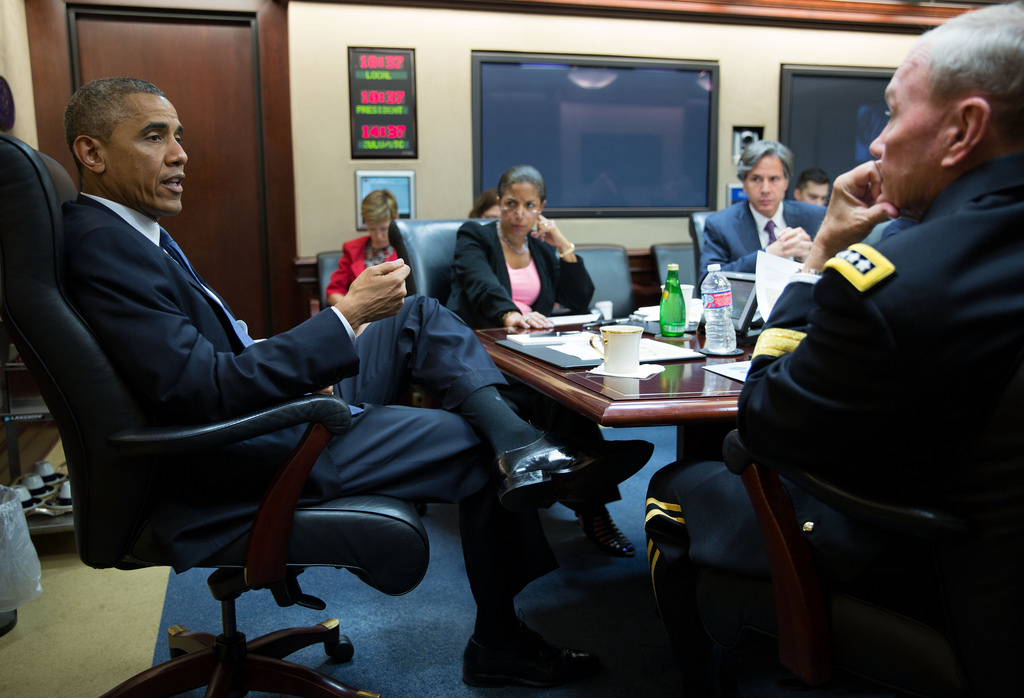
President Obama meets with his National Security Council

The world has become an exceedingly dangerous and unstable place in the seven years that President Barrack Obama has been the steward of American foreign policy.  Certainly some realities as an outgrowth of September 11th, 2001 and the radicalism of Islam subsequent to the Iranian Revolution of 1979 were unpleasant gifts the previous administrations bequeathed to this president, but a substantial number of metastases of instability, chaos, and dramatic violence have sprouted from multiple directions in response to his decisions.  As much as he has been comfortable of blaming every untoward response to American interests as a reaction to President Bush’s aggressive foreign policy, the pattern of Obama as more than just “anti-Bush” is beginning to project as a premeditated decision process, what used to be referred to as a policy philosophy, or a “doctrine”.

Presidents in the modern period have structured their foreign policies behind attempts at consistent interpretations and responses to world events, known as doctrines.  The Truman Doctrine, in response to a post war Soviet Union bent on expanding its rigid grip on eastern Europe and Asia, defined a policy of containment as outlined by George Kennan, that became the benchmark of American foreign policy for the next forty years.  The Carter Doctrine, reacting to the Russian invasion of Afghanistan and the Iranian Revolution, declared that any effort by foreign powers to attempt to usurp the status quo of the Persian Gulf would be considered in direct conflict with America’s vital national interests and would be met militarily.  The Reagan Doctrine declared the goal of American policy toward the Soviet Union was no longer containment, but rather a comprehensive effort to “roll back” the global influence of the Soviet Union – or as Reagan so presciently described it, “we win, they lose”.  The George W Bush Doctrine grew out of the catastrophe of 9/11 and became a multi-pronged strategy essentially defined as, if necessary,  preemptively attacking enemies of the United States at their root, to prevent the fight being brought to America’s shores.

These doctrines, some successful, some not so successful, at least defined a consistent and articulated  national policy process and understanding of a national interest. But what of the current president?  Is there a discernible American interest in Obama’s seemingly haphazard declarations?

Niall Ferguson, a Professor of History at Harvard and a senior fellow of the Hoover Institute at Stanford, has editorialized on what he believes is the “Real Obama Doctrine”.  A must read, the editorial reflects what one of America’s most astute intellectuals sees as the essential pattern of the “patternless” and seemingly contradictory Obama actions.  Sadly, he concludes all these colossal ‘mis-steps’ are on purpose:

“But what that meant in practice was not entirely clear. Precipitate withdrawal of all U.S. forces from Iraq, but a time-limited surge in Afghanistan. A “reset” with Russia, but seeming indifference to Europe. A “pivot” to Asia, but mixed signals to China. And then, in response to the revolutions in Tunisia, Egypt, Syria and Libya, complete confusion, the nadir of which was the September 2013 redline fiasco regarding the Assad regime’s use of chemical weapons in Syria and Mr. Obama’s declaration that “America is not the global policeman”–..

An approximation of an Obama strategy was revealed in April last year, at the end of a presidential trip to Asia, when White House aides told reporters that the Obama doctrine was “Don’t do stupid sh–.””

Dr. Ferguson sees the Obama Doctrine as much more than threat avoidance.   He now believes the President is driving  a forced re-set of America’s position in the world and a particular desire to create a new balance of power, most particularly in the Middle East.  The Doctrine as Dr. Ferguson sees it is directed by the pre-conceptions of the president himself, with almost no significant intellectual counterweight in the administration in the skill set of policy development.  The president has surrounded himself progressively with fellow lawyers who are predominantly concerned with the process of negotiation rather than reflecting a world view.   That leaves President Obama himself to refine the rationale and his strong opinion of his own intellectual prowess leaves little room for the discussion  alternative scenarios.

The result – has been nothing short of disastrous.  A resurgent Al Qaeda after Obama declared it dead and a even more murderous cousin ISIS after Obama disdained it as “junior varsity”. A catastrophic collapse of nation states in Iraq, Syria, Libya, and Yemen. A ruthless Russia that has forced itself back into the position of power broker in the middle East after 50 years as irrelevant and the United States as the definitive arbiter, and has brazenly absorbed the Crimea and thumbed its nose at NATO and the US in creating a proxy war in Ukraine. A China that is aggressively threatening to turn the world’s busiest sea traffic lanes into an internal Chinese sea. And perhaps, most stunningly, the President agreed to a massive infusion of cash and capability into the world’s most aggressive supporter of terrorism, Iran, which has declared its intent to ignore all the supposed agreement Obama crowed about negotiating with it, including ballistic missile and nuclear weapon development.  And ominously, repeated its stated goal to wipe Israel off the face of the earth.

The Obama  Doctrine is succeeding beyond even the President’s projections in re-setting America’s position in the world, and the result is calamitous.  For  a President that planned to “stop” America’s addiction to “ceaseless wars”, the doctrine is looking like it will make 2016, the last year of the Obama presidency, at risk for real non-stop global conflict.

It turns out that thinking you are the smartest guy in the room, might just make you the dumbest man on the planet.