“No man is above the law, and no man is below it ; nor do we ask any man’s permission when we require him to obey it. Obedience to the law is demanded as a right; not asked as a favor.” Theodore Roosevelt 1903
” I, Eric Holder, do solemnly swear to support and defend the Constitution of the United States against all enemies, foreign and domestic; that I will bear faith and allegiance to the same; that I take this obligation without any mental reservation or purpose of evasion; and that I will well and faithfully discharge the duties of the office on which I am about to enter. So help me God.” Oath taken by Eric Holder, Attorney General of the United States February 3rd, 2009
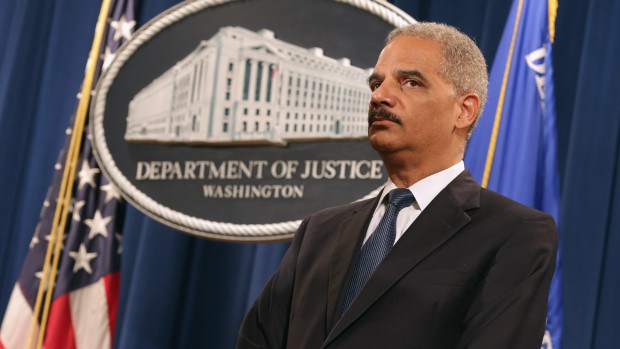
On Thursday of this past week, President Obama accepted the resignation of Eric Holder as Attorney General of the United States. So ended the controversial 6 year term of the country’s chief law enforcement officer, who spent as much time ignoring the country’s fundamental structure of law as enforcing it. To those who see activism as the highest calling, he is seen as a hero; to those who would seek equal justice under the law and respect for its unprejudiced adjudication, he is an abomination. What Eric Holder is not, is insignificant. Holder managed to infuse political activism so intensely into the Department of Justice that it may prove impossible to ever return it to its calling of enforcing the law that has been given it. The rule of law, and the protection it provides a free society, may be irreparably harmed.
What is the rule of law that has previously been considered the mandate of a free people? The definition has certainly been deliberated, and there is no single answer. The concept of law obviously requires a standard people find fundamentally just to their lives. Is a law for instance that serves to enforce servitude, physical pain, or premeditated inequity a law that deserves enforcement without pause? The laws of sharia, Krystalnacht, Stalinist Russia, and Jim Crow America come to mind. Martin Luther King, speaking of the logic behind civil disobedience, suggested in a free society, there is often the need to define the equity of a law by the willful breaking of it:
” I submit that an individual that breaks a law that his conscience tells him is unjust, and who willingly accepts the penalty of imprisonment in order to arouse the conscience of the community over its injustice, is in reality expressing the highest respect for law.” Martin Luther King 1963
The American Bar Association through its World Justice Project attempted to secure a universal meaning to the concept of rule of law that could merge the concept globally across societies:
1) A system of self government in which all persons, including the government, are accountable under the law
2) A system based on fair, publicized, broadly understood and stable laws
3) A fair, robust, and accessible legal process in which rights and responsibilities based in law are equally enforced.
4) Diverse, competent, and independent lawyers and judges
The overriding message is that the rule of law is not so much the law itself but its accountability and its equality of enforcement. Throughout Holder’s tenure as Attorney General, he proceeded to abrogate these two tenets that regardless of his personal views, he had a responsibility to uphold. The selective prejudicial enforcement or premeditated neglect of laws rather than the hard work of convincing a people of their apparent inequity and improving them was part of the innate hubris of this Attorney General. There were several profoundly disturbing events in his tenure that stand out in sharp contrast. Particularly remarkable was the dominance of race outrage as an alternative to the concept of civil rights. The civil right of every individual regardless of race, the centerpiece of assurance for the elimination of racial discrimination, was converted time and time again to perceived racial abuse, one directional toward alleged white on black injustice. The elevation of the Trayvon Martin and Ferguson, Missouri incidents by the Department of justice threatened to intimidate the equal protection under the law for all concerned, making a mockery of the concept of true civil rights. While propagandizing the idea of white on black violence, Holder ignored multiple other minority group injustices, the most profound of which was black on black violence, devastating community after community with little attention or concern.
The laws of immigration, designed to protect the country’s borders, and secure the concept of citizenship regardless of race, were habitually ignored by Holder and the administration, turning the process of achieving citizenship by accepting and respecting a nation’s laws, into somehow a racial injustice to those who would ignore the requirements of citizenship.
Holder became the first Attorney General in the history of the country to be found in contempt of congress, for obfuscating in the process of examination of the Fast and Furious scandal. The Fast and Furious program, in which the government deliberately ignored its own laws regarding the sale of certain armaments, participating in gun trafficking with criminals , in an effort to create a perceived environment of law breaking that would allow increased restrictions on the second amendment. The result was the deaths of untold numbers of Mexicans and several Americans for which the government remains, protected by Holder, unaccountable.
Holder continued the pattern of selective civil rights enforcement, with his department involved in the incredibly questionable investigation of reporter’s personal information without cause in an effort to identify the sources of “leaks” in the administration, and has put no effort in the policing of the administration’s own IRS that sought to use its powers to inhibit individuals participating in free speech the administration saw as counter to their aims.
Civil rights activism delivered with a point of view is of course the inherent right of every citizen but the adjudication of every citizen’s civil rights is the calling of a Department that calls itself Justice. For Eric Holder to have accepted the position with no intention of equally enforcing the laws that assure rights of all citizens while elevating beyond law the perceived injustices of a few, is a person to whom civil rights have no meaning. This country, that through the strength of its constitution and bill of rights achieved hard fought victories for the rights of all men, was diminished by his time in government. The damage done is incalculable to the real mission of equality and equal opportunity for all.
In a free society, justice blind to prejudice, firm to the law of equal accountability of the meek and the powerful, is the link that secures the future of a civilization. Those of us who consider this a foundational value, won’t miss Eric Holder.