
Why Don’t We Care About Facts Anymore?

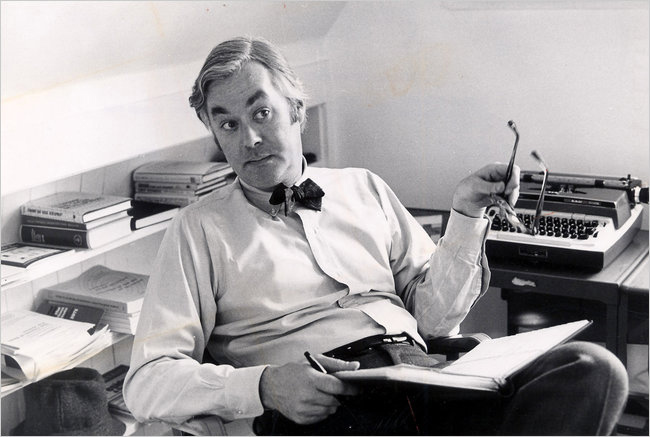
Daniel Patrick Moynihan


“Everyone is entitled to his own opinion, but not his own facts.”

Daniel Patrick Moynihan

The latest Harris polls have come out this past week regarding the state of the country’s confidence regarding the nation’s management and future and they are grim. Powerline reviews these polls in anticipation to the President’s State of the Union address and finds that Americans by an almost continuous ratio of three out of every four citizens feel the direction as to managing the large challenges of this country, whether the environment, economy, education, health care, jobs, or foreign policy, is poor.  The conclusion is that this is one of the most comprehensively pessimistic index of American confidence ever.  What contributes to such pessimism and drives the most self correcting government mechanism ever developed to drive a Lamborghini of countries off the cliff?

I think it is as John Adams once said – “Facts are stubborn things.”

The country has spent the past fifty years of its history increasingly turning philosophically to the measuring stick of Values rather than Facts to guide its direction. Values and what they say about us are infinitely more comforting then dealing with the harsh realities of facts.  Values declare an ideal world as it should be and define a truth that does not require a carefully constructed argument based on facts.  It is an unpleasant sensation to recognize that people should respond and how they react in reality to facts are dissonant.  The very liberal but factually enlightened Daniel Patrick Moynihan discovered this almost fifty years ago when he made the mistake of critically assessing  the social effect of government’s war on poverty on a specific group, the nation’s African American poor.  As a disciple of Lyndon Johnson, Moynihan was determined to find the government’s aggressive effort to wrench the nation’s poor out of poverty successful,  but found instead dangerously opposite trends in the reaction of the population to the “help”.  The positive values in the civil rights movement overlaid with  the timing of the war on poverty were assumed to create an environment of opportunity and safety net that would improve the situation for the average urban poor – but Moynihan was finding disturbingly opposite trends.  The crux of the issue seemed to be the fact that illegitimacy and single parent families were exploding in what had been a population that had lagged but at least paralleled the rest of the nation’s population in terms of economic progress and family stability.

This wasn’t a liberal versus conservative argument.  Certainly Moynihan as a staunch liberal wasn’t rejecting the concept of the nation providing a strong hand in helping its nation’s poor or overturning hard won civil rights.  He was instead pointing to facts and the need to understand them in guiding policy.  What he and other factualists were not prepared for was the spectacular blow back from value biased proponents that vilified the report, not for its logic, but for its argumentative ‘illegitimacy’.  In the values world, the facts suggested an effort to “blame the victim”, and imply a racially tinged “promiscuity” to the urban poor that was opposite of Moynihan’s argument.  Although many bright individuals saw similar trends to Moynihan’s observations, the corrective actions that might have helped generations of poor were stamped out by the a progressively entrenched group of powerbrokers that felt they ‘owned’ the values argument, and that being non-judgmental regardless of outcome was the appropriate judgment.

What neither Moynihan or much of the nation recognized at the time was this values movement, philosophically being non-judgmental about fact and result meant being progressive and politically correct, would overwhelm all the naturally corrective capacities of adjusting to facts.

Fifty years later, and trillions of dollars of right minded non-judgmental expenditure has left us with gaping holes in urban poor education, family stability, economic capacity, and confidence in the future.  No set of facts are up to withstanding the blizzard of invectives regarding victimhood, accepting any socially dissonant behavior,  or continuing to explode the budgets of failing programs designed to “help”.

This willful ignorance and war against facts and their basis to constructively correct actions is the foundational cause of this nation’s pessimism.

The values movement has metastasized in many elements of policy discourse, particularly the economic ones, as significant money is to be made from arguing victimhood. The enormous redirection of funds to “modify behavior” in order to “save the world from global warming” continues despite the overwhelming evidence that the so called “settled science” of anthropomorphically induced  global warming has collapsed.  The pouring of trillions into “stimulus” projects when  economic fundamentals suggest the opposite effect to economic growth incentives is created.  The crash of health care stability against the desire to make it more fair or equitable, rather than better.  The value of democratizing populations that hunger for stability rather than unencumbered elections before any other societal stabilizers are in place.  The throwing away of thousands of years of educational concepts on formative development for the desire for each individual to be allowed to ‘ seek their own place’ in what they are educated on, with its resultant disastrous effect on cultural literacy.

And on and on and on.

Facts are stubborn things. Human behavior follows fairly recognized paths that our social engineering efforts often helplessly thrash against.  The country is growing increasingly pessimistic because it can’t discern a way out of this mess; it can’t see that good intentions unencumbered by factual adjustment lead only to further deterioration.   We are trying to be good by trying to do good, with the opposite effect resulting and contributing to our fatigue. The cure would be in accepting facts to lead to improving the conditions that would lead to progress against society’s ills, rather than projecting value judgements that perpetuate their very existence.   The cure would be in listening to voices that discern the balance between values and facts necessary to begin to build some confidence back into the system, and trust the correcting capacities of the system as it was designed, not as we wish to manipulate it.  As Senator Moynihan presciently stated so many years ago, no one owns the facts.
The Lion Sleeps Tonight

ARIEL SHARON
ARIEL SHARON

Cincinnatus was a farmer. In 458 B.C., as he was plowing his field, a representative of the Roman Senate travelled to the farm, and described the crisis facing the Roman nation in a fight to the death with neighboring tribes the Aequi and the Sabines.  He told Cincinnatus that the Senate had determined to vote him dictator and give him all powers necessary to save Rome from the invaders.  The farmer Cincinnatus became the patriot general Cincinnatus and accepted the charge, eventually leading Rome to a crushing defeat of its adversaries.  With the roman world at his feet, he then did what was unheard of for a warrior general with absolute power.  He gave up the power voluntarily and absolutely, and returned to his farm.  He served the country that he loved, then returned to the farm that he loved.  He never confused himself as to who he was, or what was asked of him.

Israel’s farmer general died today, on his farm, and like Cincinnatus , never confused his role as a savior general with his role as a citizen of the country he loved.  In various roles, he helped lead Israel from its inception in 1948, through almost every conflict the nation faced over 50 years and returned to his farm until asked again to lead.  Ariel Sharon had been in a coma since 2006, but according to his family, decided his time to leave the mortal coil was now. Sharon as through his life, determined his own timetable for action.

And lead he did, to the often stunning unpredicted results as interpreted by those that would be his eternal foes.  Sharon was as he put it, a simple farmer, but as a military and political leader he was anything but simple.  In the field of battle, he was a implacable foe of the enemy, strategic and innovative in action, and single minded in his determination to defeat those before him. In politics, he often brought his strategic vision into actions that flummoxed his opponents who could not appreciate the clarity of his singular focus, the permanent existence of a viable Israeli state.  His strategic realism, saw each battle political or military, as a battle of survival, in which the outcome was to be contributory to the permanent existence of the state.  All else was merely charade, he didn’t play charades.  His foes despised him because there was no way to defeat him, and his friends struggled with him because he had already determined his victories before his actions.  He gave voice to the adage that he achieved results, and left it to others to devise a theory to explain it.

From Israel’s formative battles for independence in 1948, to his spectacular victories against more powerful Egyptian tank forces in the Sinai in 1973, Sharon was a brilliant leader of troops and recognized tactical genius.  Such heroes are enormous targets for critique, and Sharon’s aggressiveness was felt intolerable by some who felt Israel’s best position against its foes was an compromising co-existence.  Sharon understood the concept of enemy and studied his enemies.  He saw no conversion of Arab nationalism or Palestinian desires to seek the obliteration of the state of Israel, so he accepted all issues as to their positive or negative impact on Israel’s ongoing existence.  He never made any assumption that he could trust others to protect Israel’s fundamental interests, and did not seek the trust or respect of his foes.  To world liberalism and to Israel’s peace lobby, he demonstrated his intolerable flaws in 1982, when he did not hide behind excuses of a massacre of Palestinian refugees that occurred in Lebanon under his watch in 1982 during the Israeli invasion of southern Lebanon to rout out increasing dangerous and aggressive Palestinian cells.  As defense minister, Sharon sought the elimination of Palestinian forces from southern Lebanon and allowed the blisteringly vengeful forces at work in Lebanon to work toward that goal.  In a country torn by competing forces of Christian Lebanese, Sunni and Shia, Druise militia, and a huge dose of Palestinian interlopers, Sharon permitted the Christian Phalangist forces to enter Palestinian refugee camps, to identify Palestinian fighters, and to the Maronite Phalangists, all Palestinians were usurpers to Lebanese territory.  A massacre at the Sabra and Shatila camps ensued, and although the actual history of the raids are a confusing morass of Lebanonese versus Palestinian versus Syrian atrocities, the world blame fell directly on the shoulders of Sharon.

He was forced to resign, and returned to his farm in disgrace.  And so he remained in the political wilderness, until the Palestinian Intifadas of the turn of the century brought Sharon’s version of realism rather than idealism back into vogue.  Despite Israeli efforts for ten years to reach a negotiated accommodation with the Palestinians, The Palestinian leader Arafat found that 96% territorial concessions by Israel were insufficient to the 100% he felt appropriate, and turned the West Bank into a war zone. He achieved the deaths of hundreds of Palestinians and returned terror as a weapon to his negotiating technique.

Sharon as always was unaffected by enemies acting in expected ways.  As leader of Likud and eventually the hybrid political party, Kadima, he became Israel’s eleventh Prime Minister despite his controversial background, and proceeded to turn the concepts of peace upside down.  Seeing the Gaza strip militarily indefensible by Israel and meaningless strategically. he unilaterally pulled Israel out and left it to the Palestinians, stunning the world that always assumed he would see all of Israel’s military gains as inviolate.  To that end he dismantled and moved Israeli settlements in Gaza, considered politically impossible, but achieved by Sharon in short order.  Negotiating with Palestinian leader Abbas, following the death of Arafat, he determined that decisions henceforth regarding territory would be singularly based on Israel’s strategic defensive interests, and was on his way to a comprehensive  process for permanence when he was suddenly silenced by a stroke in 2006.   He remained in a silent coma until his passing today.

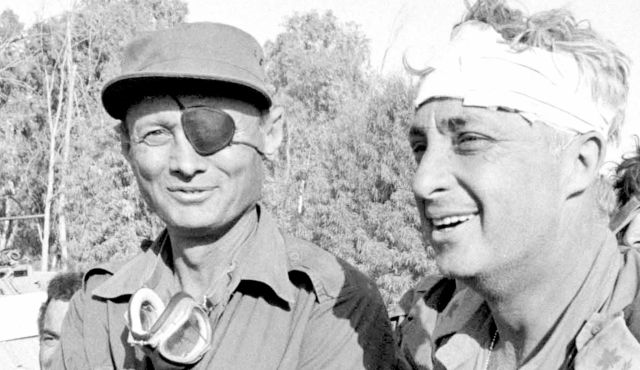
There is no telling as to what might have been the sequence of events with a Sharon in power for the first decade of this century.  It is clear that his enemies are happy to see him gone, as he was unbeatable, and tireless in their destruction.  It is also clear his country and neighbors lost the pathfinder that envisioned a  way out of the blind idealisms and dysfunctional radicalisms that haunt the region today.  Today the lion finally sleeps, and the world has lost one of its great leaders.  Somewhere, as in the picture that leads this blog, Sharon and Moshe Dayan are again sharing the tactics that allowed the survival of Israel against overwhelming odds.  The farmer of the Negev desert would remind Dayan, that even in the desert, unyielding will and visionary thinking can make for a bountiful harvest.