The Last Shuttle


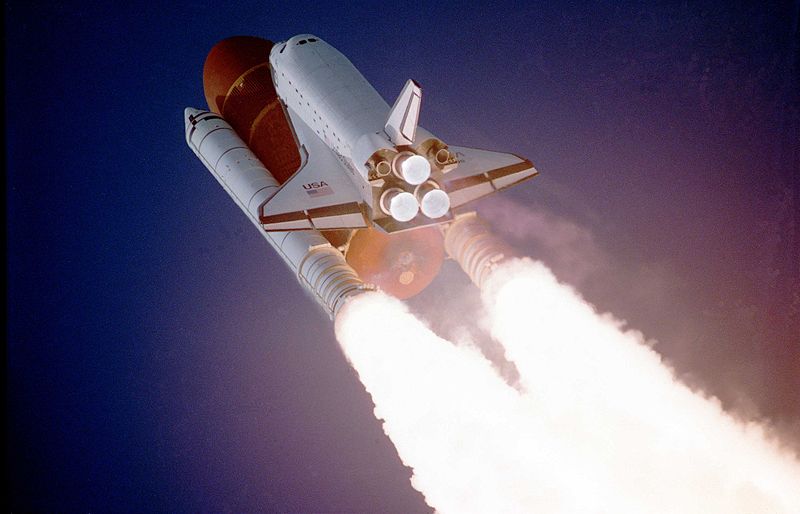
      The last planned American space shuttle flight took of from Cape Canaveral yesterday, and with it a fifty year history of continuous effort to achieve and maintain an American manned presence in space. The Space Shuttle program was initiated on April 12th, 1981 and over the next thirty years achieved 135 flights with some significant firsts and some catastrophic failures. Initially positioned as a cheap reusable vehicle for easy space access and material transport, the shuttle proved to be a highly complicated and relatively risky means of space transport. Projecting an original 10 million dollar per flight relative cost and flights as often as once per week, the shuttle program ballooned to costing almost one hundred times as much per flight and was anything but simple to rapidly return to orbit. The catastrophic shuttle failures of 1986 Challenger and 2003 Columbia flights resulting in 14 astronaut deaths and significant delays each time in restoring the program was certainly a major contributor to the waning desire to utilize a complicated glider system for manned flight, but equally as devastating was the progressive loss of identifiable mission value.

     Confined to low earth orbit, the shuttle became an expensive way to deliver a limited number of satellites into space and provide taxi service for the International Space Station, a craft with its own ridiculously expensive albatross of questionable mission value. Spectacular space walks such as the Hubble Telescope rescue missions provided only temporary boosts in interest in the investment required to keep the shuttle viable as the means by which to maintain a permanent space presence..  After thirty years and billions upon billions of dollars in shuttle mission expenditure, the realization of “been there, done that”  with no visible contribution to further space progress has become the epitaph of the space shuttle program.

     NASA’s original plans to retire the shuttle program were predicated on initiating a new vehicle for space exploration, the Orion, but with budgetary issues so dominating the national conversation the program has been scrapped. the best we can hope for is to obtain rented rides on the Russian Soyuz craft until private American efforts such as those being attempted by SpaceX and other companies supplant what has been a national commitment to space and its exploration.  A leader since the beginning in space exploration, America will now take a back seat not only to Russia, but also emerging manned space powers such as China and India.  It is a very unpleasant sign of the times that America must look to others to show the national consensus necessary to do great space engineering, and a poor indicator of this country’s priorities and self confidence.  We seem a long was away from the time when America relished to be in the arena of challenge, sacrifice, and can-do spirit.

We Hold These Truths to be Self-Evident…

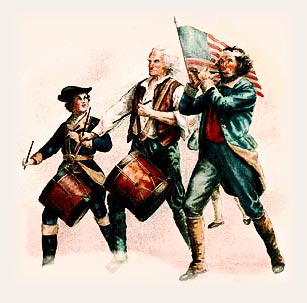
     The power of words to move the intransigent, the timid, the pessimistic, and the doubting never reached a higher plane than in the second sentence of a declaration of a people to a king put forth on July 4th, 1776.

We hold these truths to be self-evident, that all men are created equal, that they are endowed by their creator with certain unalienable rights, that among these are Life, Liberty, and the Pursuit of Happiness.

      A revolution had already been underway for the better part of a year when  the leaders of thirteen colonies assembled in a Continental Congress in  Philadelphia to try to determine whether a common consensus could be achieved regarding the American colonies’ relations with Great Britain.  There was no natural consensus.  The New England colonies already under attack by British forces were radical in their intentions to sever all ties and declare nationhood. They were led by firebrands from Boston under the astute leadership of John Adams. The middle colonies of Delaware, Maryland, New York, and the all important Pennsylvania were against draconian steps and saw the actions of the British Parliament to be separate from their loyalty to the King.  The southern colonies varied from watchful waiting from South Carolina to aggressive individual declarations by colonies such as Virginia and North Carolina.  The size and scope of the colonies initially created barriers to a natural confederation and a single voice.

     The number of men prepared to step onto the world stage at this congress however was unparalleled in history. Natural leaders such as Washington and Lee, brilliant minds such as Adams and Jefferson, and sage figures such as Franklin, Livingston, Mason and  Morris.  The recognition of the unique historical nature of the questions they were asking themselves, and the need for unambiguous conclusions dominated every debate.  They impressively could see the enormous potential of a republic lead by common men on the unique stage of the American continent, to put in to practice what philosophers from Greece, Rome, and more recently from the Age of Enlightenment had dreamt about.  These were learned, successful, self made men who additionally recognized that taking on the greatest military power on earth was frought with great danger and personal risk.  As Benjamin Franklin so aptly put to the Congress,  ” Gentlemen, we must hang together, or certainly we shall all hang separately.”

     By mid- June 1776, efforts at conciliatory diplomacy with Great Britain were met with stiff rejection and dire threats from the King and Parliament, and it became apparent to all that a declared statement for history as to the rationale for a complete independence be defined.  It was left to a Committee of Five, formed of John Adams, Benjamin Franklin, Thomas Jefferson, Robert Livingston, and Roger Sherman to draft a declaration.  The actual writing fell to Jefferson, the editing to the others and a draft was available to the congress to debate on June 28th, 1776. The original draft was dramatically sculpted with 25% of the prose removed, including  anti-slavery text accusing the King of “creating” the calamity of slavery removed.  Jefferson was unhappy with the haphazard attack on his carefully crafted words, but the document’s incredible force was preserved in its first two immortal sentences.  The first declaring the natural law entailed in the reasonable conclusion of the need for a complete independence and severance of ties:

“When in the course of human events, it becomes necessary for one people to dissolve the political bands which have connected them with another, and to assume among the powers of earth, the separate and equal station to which the Laws of Nature and of Nature’s God entitle them, a decent respect to the opinions of mankind requires that they should declare the causes which impel them to the separation.”

      An extended list of grievences then set the foundation for the final paragraph that  stated the intention of thirteen disparate colonies to act as one a form a unique entity,  a unified country of free men self ruled:

  We, therefore, the Representatives of the united States of America, in General Congress, Assembled, appealing to the Supreme Judge of the world for the rectitude of our intentions, do, in the Name, and by Authority of the good People of these Colonies, solemnly publish and declare, That these United Colonies are, and of Right ought to be Free and Independent States; that they are Absolved from all Allegiance to the British Crown, and that all political connection between them and the State of Great Britain, is and ought to be totally dissolved; and that as Free and Independent States, they have full Power to levy War, conclude Peace, contract Alliances, establish Commerce, and to do all other Acts and Things which Independent States may of right do. And for the support of this Declaration, with a firm reliance on the protection of divine Providence, we mutually pledge to each other our Lives, our Fortunes and our sacred Honor.

     On July 2nd, the individual colonies were called to roll, and each finally declared its intentions – the initial no votes of South Carolina and Pennsylvania were reversed, Delaware converted its vote from abstention to in favor, andNew York abstained.  With 12 votes yeah and one abstention the declaration of independence was passed, and publicly presented on July4th, 1776.

     History was forever changed by the group of men who formulated and signed the Declaration of Independence.  The elements of the declaration became the foundation of freedom movements the world over, from the French revolution to the revolutions of South America, to the modern inflections in the movements in eastern Europe and the Arab Spring.  The strength lies in those words, All Men are Created Equal, and the recognition that the men who expressed it had no way of knowing if they would ever see its fruition.  It mattered enough to them, and ultimately to us, that regardless of trial or tribulation, the words speak an eternal truth.  Happy Birthday, America.


Happy Birthday, America!…and Ramparts of Civilization!

     July 4th is the 235th  birthday of that special experiment in liberty known as the United States of America. Kudos and Huzzahs to this great nation and all she stands for on this special day, of which more is to follow forthwith.  There is a more personal reason to celebrate for me , however, as this is the 1st anniversary of the birth of a small outpost defender of that freedom we hold dear, the first birthday of  Ramparts of Civilization

     Born on the 4th of July, 2010, as a unapologetic defender of the positive contributions and special characteristics that have defined western civilization development over the past 2600 years, Ramparts has tried to bring to light the special components of who we are , and the principles worth fighting for.  In a year of 190 essay posts, encompassing over 130,000 written words, we have tried to focus on the current, the controversial, the uplifting, the memorable, and the obscure.  I hope that if nothing else, Ramparts has allowed the reader a relatively painless and hopefully entertaining reminder of the interesting world around us, and a moment, however brief, of introspection.

      In the past year, Ramparts has reviewed artists such as Gerhartz, Homer, Renoir, and Michelangelo;  followed the harrowing and ultimately triumphant story of the Chilean miner rescue; delved into the flashpoints of battle such as Gettysburg, Battle of Britain, and Midway; returned to light such forgotten heroes  as Charles “the Hammer” Martel, Nikola Tesla, Norman Borlaug, and Christoffa Corumbo;  reminded us of the glories of musical genius found in Glenn Gould, Jacqueline Du’Pre, and Alica De Larrocha; asked us to look closer at civilization’s knights in Friedrich Hayek,  Abraham Lincoln, and Winston Churchill; raised to consciousness defenders of the ramparts such as Mark Steyn, Bernard Lewis, and Daniel Hannan; pounded the critical economic factors of the developing debt crisis slowly strangulating western civilization and noted its impact on the evolving political revolution; and revelled in the beautiful musical creativity of stars such as Sinatra, Richard Rogers, Irving Berlin, and Allison Kraus.  These stories and so many more fill the vast repository of moments and accomplishments that define the western ideal.

     So begins another year of Ramparts of Civilization.  It will I’m sure be an interesting journey;  how can it not?  To those who have come along so far, I hope to see you become more involved in the coming year with your comments, to help me better understand your own view, and what you have liked and not liked about the site.  To the new visitors, welcome aboard,  please enjoy reading and thinking, unsheathe your rhetorical swords, and help join, with your fellow defenders, at the  Ramparts of Civilization.  

Across the Open Field They Came

     It is just after three o’clock in the afternoon on July 3rd, 1863 just outside of the hamlet of Gettysburg, Pennsylvania.  You are a member of the the 71st Pennsylvania and note for the first time in over an hour that you can hear yourself think.  You have been burrowed like a badger into the ground just behind a low stone fence at the upper crest of an open field, protecting your eardrums and praying for your life as an onslaught of iron shot and killer shrapnel flew over your head, and exploded with deafening blasts behind you. You raise your head guardedly and stare through the smoke across an open field to a row of trees known as Seminary Ridge, and think you see the glint of a thousand sun splashed diamonds.  It is deadly quiet, and strangely beautiful, in the searing heat. The beauty is ephemeral as the reality sets in and the diamonds coalesce out of the trees into the mid-day light.  You realise the hell you have just lived through holds another painful interlude for you.  Your little corner of the fence is about to be the focal point of a nation’s apocalyptic schism,  in which one image of nationhood will sustain, and one will fail.  You are about to be target of Pickett’s Charge.

     On the other side of the open field just within the cover of the trees of Seminary Ridge, you are a member of the proud army of Virginia.  In woolen garments in a humidity swollen day near 90 degrees you have sweated in the brutal heat in motionless air for over two hours waiting for your time to cross the open field ahead.  You are the forward sword of a direct Virginia line from Lee to Longstreet to Pickett to Armistead to you, the heart of the confederate nation, the home of the great founders like Washington , Madison, and Jefferson, the homeland  stage of the great battles of the civil conflict, Virginia. You look across that open field and in the momentary quiet contemplate how anyone could think one could cross that open field and survive. But you are in the Army of Northern Virginia, and pride and honor come before death.  If they say you go…you go.  You are about to be the living apex of Pickett’s charge.

     The mid afternoon sun blazed across the open field on that day in 1863 as the soldier actors on a horrific stage played a heroic part in the climax of the epic three day struggle known as the battle of Gettysburg.  General Robert E. Lee, commander of the confederate forces had been in continuous attack mode as was his personality, on the Union Army’s right  flank through the town of Gettysburg and against Cemetery Hill, and on its left flank through the Peach Orchard and Little Round Top over the past two days. Now the force of the blow would come to the center,split the Union army, and end the conflict that had already taken so many lives.  General  Lee knew he had to live in a perfect world, as the Union forces had advantages in numbers of forces, armaments, economic power,  and victimhood on its side.  He had against such overwhelming considerations, his brave, loyal ,well trained army of winners.  Beyond the open field lay the stone fence; beyond the stone fence lay Washington DC and the end of the war.  In a perfect world, the flank attack by General Early’s forces on the Union right violently fulminating all morning was to distract and weaken the Union middle.  The stunning artillery barrage of Colonel Alexander’s over one hundred fifty cannon proceeding the charge for two hours of ceaseless explosion was to pummel the Union middle, and coordinated with the Pickett onslaught from the front, General Jeb Stuart’s cavalry was to fragment the backbone of the Union from behind with  a simultaneous attack from the rear.  In a perfect world, the 12000 troops of Longstreet’s army would cross the field, find a shattered and demoralized Union middle and crush now and for all time the Union army capacity and morale, and end the war.  In a perfect world, General Lee could see it all, and believed it could be.

     Out of the trees seen above into the hot mid day sun, 12000 troops paraded out into the open field to decide the destiny of all who believed in the ideal of freedom, as it was conceived by both sides in their own way.

     The perfect world ended with the first step into the sun and reality set in.  The battle will never be described better than in Shelby Foote’s “Stars In Their Courses“.  Like all epics that culminate around a single moment, the somewhat inappropriately named Pickett’s Charge, has the painful romance that belies its horror as always occurs when an unstoppable force meets an immovable object.  The 12000 found instead of an incapacitated  Union artillery and decimated infantry, a largely intact and devastatingly coordinated defensive response.  From the left flank came crushing fire from Hay’s Ohio troops collapsing in Pettigrew’s North Carolina  brigades, making it no farther than the fences lining Emmitsburg Road.  The Virginians wheeling to their left across the open 1000 yards of field toward the stone fence, faced first the exploding artillery shells, then the grape shot of Union cannon like a hail storm blistering 20 men at a time, torturing the survivors as they attempted to re-form their lines. As they crossed the field to first the road and then the stone fence, they came into the full force of infantry rifles and their merciless aim.  In the last one hundred yards the march finally became a charge, and briefly in what is known as the “high mark of the confederacy” Armistead’s men managed to scale the wall at the angle and briefly overwhelm the local union troops.  In a melee of fists, bayonets, screams, shots, and curses exhausted men fought for their version of free will and the world hung in the balance.  But only briefly.  Union reinforcements came crashing down on the confederate breech, there were no living southern reinforcements to take advantage, and the breech quickly closed.  The lifelong friends Union General Hancock and Confederate General Armistead were wounded, Armistead mortally.  The door to Washington so briefly open, closed violently on the survivors, and the southern high mark was no more.  Confederate retreat was total and to the taunting, revengeful Union cries of “Fredericksburg, Fredericksburg!”  General Lee seeing the retreat washing around him, rode up to Pickett to marshal his division and prepare for a Union counter attack.  Pickett was said to reply, ” General Lee, I have no division now.”
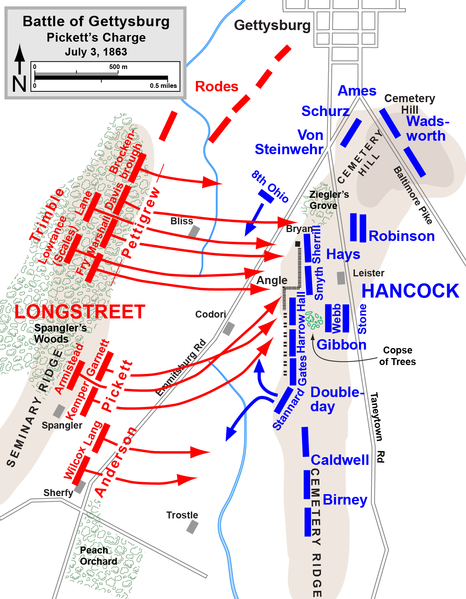
     If the words were spoken, they told a harrowing truth.  The confederate army of Pickett’s charge sustained over 50% casualties with an estimated 1200 deaths and over 4000 wounded, to the Union’s 1500 estimated casualties.  Longstreet’s army lost all 15 of his regimental commanders, including two Brigadier Generals and six Colonels. The horrendous butcher’s bill of the three day battle was over 50,000 casualties to the participating armies.   The effect on the south of having lost the battle at Gettysburg, coupled the next day with General Grant’s capture of an entire Confederate Army at Vicksburg ended any hope of the Confederate dream of nationhood.   General Lee, who asked for so much more coordination then the technology of the time was capable of giving, recognized what it meant and apologized to the retreating troops, crying out to all who would listen, ” It is all my fault.”

     Across that open field in that simmering day in July in 1863, men trusted their destiny to a loving God, who they hoped would understand their violence and forgive them. They gave willingly their families, their dreams, their far away homes, and their lives for conflicting versions of what it means to be free, and what is required to retain that free will.  It is not for us so distantly removed to judge their reasoning, but instead to stand back in awe, of the compelling force of a man’s need to determine his own free will, and fulfill his destiny on the altar of a principle.  The open field we cross is full of risk and torment, but takes place under the canopy of a forever open sky.