Duty Calls

     Every generation hopes for a leader that transcends the self absorption and indecisiveness that consumes the political discourse at various critical times in history to become a beacon of clarity and direction to the benefit of all. The founding of the nation, so fragile in birth, received a framework for all future leaders through the calm and steady George Washington. The country was consumed with insurmountable philosophic division in 1860, leading to Civil War, discovering a leader in Abraham Lincoln, who achieved the impossible task of translating the country’s original founding principles into a more modern version that restored unity when all thought it lost. The nation found in Theodore Roosevelt a unique vehicle for the country achieving a position as a world power while restoring the promise to the individual citizen of a fair shake in their own world. In its greatest test ever, buffeted by the twin catastrophes of great depression and apocalyptic war, the nation was steadily and safely led to the position of superpower by Franklin Roosevelt. Finally, out of a crisis of confidence in which many thought the nation’s best years behind it, Ronald Reagan restored a nation’s vitality and in each individual promise for a better tomorrow.

     Every generation hopes for such a leader, and this generation is no different. The current crisis is self created, with a burgeoning national debt progressively suffocating all flexibility for addressing the nation’s needs, and inevitably draining the nation’s life force. Like all previous crisis situations, the political landscape is filled with pretenders and charlatans, deniers and demagogues, mediocrity and downright mendacity. The simplistic contribution of a self absorbed population to its own ills in welcoming an entitlement Trojan horse into its own future, feeds the comfort of all the sunshine patriots who claim the crisis is overblown or simply addressed at a later time.

     The numbers are staggering – a 14.2 trillion dollar national debt, equal to the gross domestic product and expected to double within ten years, 4.6 trillion in US debt held by foreign countries, an indescribable 113.2 trillion dollars owed future generations in unfunded liabilities, and an estimated incurred debt per citizen of 51,000 dollars. Yet, the recent response of both congress and President was to pile on further debt and unfunded liabilities a a record level in complete disdain for the gathering storm.  No leaders here, and certainly false and fatuous hope and change.

     Like earlier times a leader has arisen from unassuming quarters, a back waters district in southeastern Wisconsin, and with no other calling than his profound desire to assure a nation worth inhabiting for his own small children. This leader, Paul Ryan, (Ramparts People We Should Know #4), has decided to put into action against all odds a means for this nation’s salvation. He has determined like all great leaders before him, that the position to lead is in front with clarity and courage. Like all great leaders he will face a storm of resistance and undercutting, and will be abandoned at times by his erstwhile friends, afraid of the heat. He will be impugned by the chief pretender, who adrift in a sea of his own inconsistencies and lacking in any semblance of original thinking, will see him as a threat and look to destroy him. Like all great leaders before him, I think Paul Ryan has realized that it is his time and his calling to bring America back from the brink. He has stated that his quest is not a personal one, but I foresee the willful force of history calling him to assume the mantle that he has to this point denied. Unfortunately for Paul Ryan and his desire to be an initiator but not the vehicle of change , he will soon find out, that he is the right one, at the right time.  Paul Ryan is about to realize his own truth….A Nation’s Duty Calls.
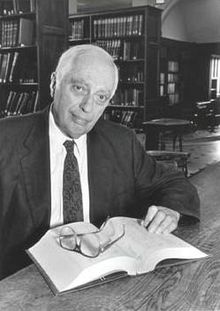
People We Should Know #12 – Bernard Lewis

     Since the uprising in Tunisia in November, 2010, the revolutionary fervor in the Muslim world has spread like wildfire through Egypt, Yemen, Bahrain, Libya, and now, Syria. It has caught the West unprepared despite an almost ten year education in the tumultuous strains in the Muslim world emanating from September 11, 2001, through Afghanistan and Iraq. The struggle in the West to respond with a rational and coordinated consensus has its roots in the modern tendency to consider political science over history as the intellectual tool best served to predict an actionable course and satisfactory outcome. Debate revolves around “freedom fighters” and “democracy” as if they had acknowledged similar definitions in the Muslim world to their political expression in the West. One historian has dominated the discussion regarding the ongoing upheaval in defense of historical rather than political interpretations. He is Bernard Lewis, Professor Emeritus at Princeton University and the foremost western scholar on medieval Islam. At 95 years of age, he continues to show prodigious energy and insight regarding the historical perspective of what is currently transpiring in the Middle East and Northern Africa. In an in-depth interview the Wall Street Journal has interviewed Dr. Lewis, and his insights remind us why he is one of Ramparts of Civilization’s People We Should Know.
     Bernard Lewis has been a major contributor to Western thought regarding Islam since the 1950’s. Fluent in twelve languages, he has had unique capacity to delve into Islamic and Ottoman era writings and archives since the time of Muhammad to put together a penetrating view of the Arab and Islamic relationships, psyche, and rationalizations. He has articulated strong opinions regarding the Armenian- Turkish conflict in 1915 and the subsequent massacre, the Israeli Palestinian conflict, and more recently, the rise of what he is credited as first describing as “Islamic Fundamentalism” in the late 1970’s originating in Iran and propagating across the Islamic world over the last 40 years. He was first to make the world aware of Ayatollah Khomeini’s fusion of religious doctrine and political fascism, and later, in 1998, warned the world regarding the then little known Osama Bin Laden’s writings for a means of returning the Islamic Caliphate to a new dominant position through the “ideology of jihadism” and his declaration of war on the United States.
     With his warnings resulting in sorrowful reality with the attack of 9/11, Dr. Lewis has been a frequent consultant to the United States government in an effort to provide clarity to the chaotic aftermath and a potential strategy for dealing with the direct threat radical Islam holds toward Western ideals and security. He is a proponent of firm responses that define western resolve, rather than weak appeasement, as he feels the Islamic psyche abhors signs of weakness as the product of an inferior people. He sees the current conflicts as progressions in what he terms the “clash of civilizations” between Christianity and Islam that began in the seventh century with Islam’s rapid rise and continues to this day.
     Specific to the current upheavals, he applauds the uprisings as a legitimate expression of a suppressed people, but cautions the West not to ‘take sides’ and insist on western versions of democracy and freedom as the means for restoring people’s legitimate rights in these countries. He believes republican expression can provide the rightful provision of people’s economic concerns, educational rights, liberal justice, and societal respect with democracy a mature outgrowthand endgame, rather than the tool of initiation of such rights.  He notes that fascist governments have achieved power through legitimate democratic processes when the societies were not sufficiently evolved and this is a obvious risk currently in the promotion of Hamas and Muslim Brotherhood as “democratic” parties.  He is most concerned with Iran’s fixation with the messianic story of the Twelfth Imam and Iran’s frequently stated goal to apocalyptic ally eliminate the state of Israel, with the device being atomic weaponry.  He notes that the concept of mutually assured destruction the prevented the ultimate cataclysm between the Soviet Union and the United States in the Cold War provides no element of deterrence to a society in which the achievement of death in a religiously inspired jihad is the purest means to achieve paradise. 

     We are in a significant historical period with far reaching consequences, and people like Bernard Lewis offer sage advice to the protection of the concepts of freedom, equality, and liberal thought that we hold so dear.  A significant part of the world is trying to find its means of expression of those concepts, and we should be very careful that we are constructive in our actions, or a dangerous darkness has the potential to descend upon us all.

People We Should Know #11 – Eva Cassidy

     Sometimes the brightest flames shine for the briefest time. Life is funny that way. A virtually unheard of songstress named Eva Cassidy has become one of the all time leaders in album sales for solo vocal musicians with essentially all the music sales occurring after she died at the incredibly unfair age of 33 years of age. Toiling in essentially complete obscurity in small clubs around Washington DC in the 1990’s, Eva produced a few recorded sets of music that represent our only available record of her brilliant versatility in the entire lexicon of song music, regardless of the genre. At a point where it looked like a wider public may finally recognize her talent, she took ill, and past from our view in a few short months. A solitary melanoma removed from her back three years prior, had metastasized and spread virulently and ruthlessly throughout, and the woman known as the Songbird was extinguished.

      Eva was borne and spent her entire brief life in the Washington DC area, but her song interpretation was innate and universal.  A talented self taught musician, she understood the instrument that was the human voice and brought out all its capacities.  She therefore showed an amazing range that included the ability to sing gospel, jazz, country, and popular music with equal skill, and an interpretative quality that made unique the most well known songs.  Her treatment of Harold Arlen’s “Somewhere Over The Rainbow” made her an ‘overnight’ sensation in England several years after her death,  and is achingly beautiful and respectful to the wistful melancholies of the music and Yip Harburg’s lyrics.   She could additionally ramp up her pace and swing in the best traditions of Ella Fitzgerald and Peggy Lee without mimicking them, as appreciated in songs like “Cheek To Cheek”.   She had a spot-on higher range that allowed her to drill notes in the way of the great gospel singers without sounding  harsh.  She was simply a magnificent musical vehicle for the Cosmic American Sound that had we had any more time to appreciate, may have put her in the pantheon of the short list of singers we turn to when we think of the great interpreters of that songbook.

     Eva Cassidy gave us a special gift , recording her concert at the night club Blues Alley in the Washington DC area  just a few months before her death in 1996.  Thankfully some video exists that helps us to appreciate the depth of her genius.  When we listen, we are not ready but are inevitably drawn, like a moth to the light, to the brillant comet trail that was Eva Cassidy’s art.