Imagine

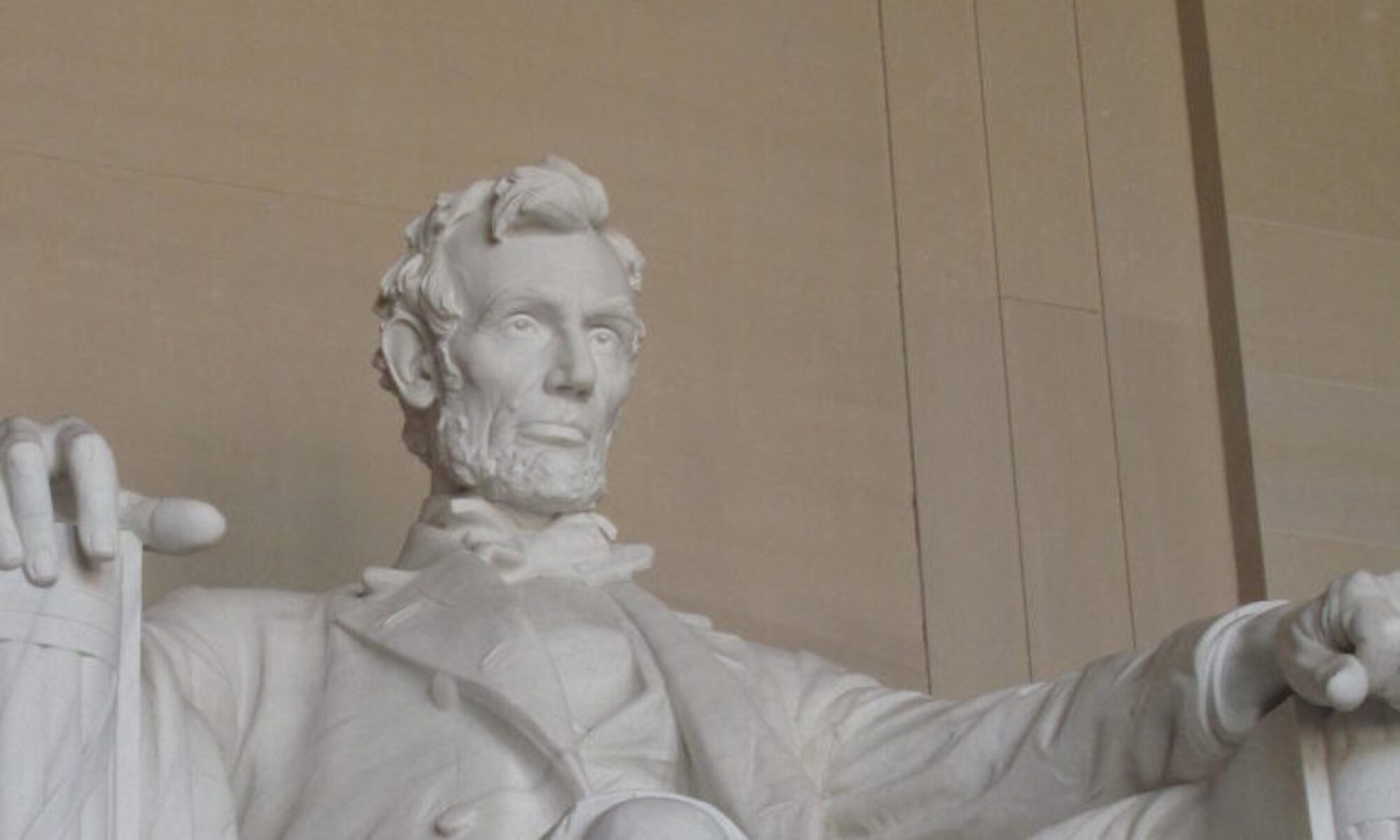
     This past week was the 30th anniversary of the murder of John Lennon, legendary member of the Beatles rock group, and an emblem of the fragmented value that comes with celebrity status in western society.  Lennon is an unfortunate member of a small group of public figures who were assassinated for the notoriety it would bring the assassin rather than any other identified specific cause or perceived societal effect.  On the night of December 8th, 1980, Lennon and his wife were returning to  their mid town West Central Park condominium from an outing, when they were approached by Mark David Chapman, who wordlessly shot Lennon four times in the back as he passed.  Chapman had stalked the entrance to the Dakota complex awaiting Lennon’s return, assured of Lennon’s presence as several hours before as Lennon had left the Dakota, Chapman had asked Lennon to autograph a Lennon album and Lennon had complied.   In the vein of Arthur Bremer’s attempted assassination of politician George Wallace in 1972, or later, John Hinckley, Jr’s. attempt on President Ronald Reagan in early 1981, the crime victim themselves bared very little impulse for the disturbed stalker assassin who simply reveled in their ability to achieve their own personal celebrity through their act.  Lennon was rushed to Roosevelt Hospital, but was unable to be re-susitated and died that night.  Chapman subsequently was arrested and convicted of murder, and has been in jail since his conviction.

     John Lennon was a difficult human being with multiple run-ins with family, friends, band mates and governments.  His status in western culture, however,  will always be secure due his exalted role as leader of the revolutionary musical force known as the Beatles, and his combative but spectacularly prodigious membership in the song writing duo of Lennon and McCartney.  The duo,with minimal formal training, produced a song catalogue that ranks with the great song writers and songwriter teams of the 20th century.  For the 5 year period from 1964 to 1969,  Lennon and McCartney changed forever the role of the musical group, who to that time had been performers rather than creators of original music; after their spectacular run no quality act could proceed to be seen as elite without producing original material.  Lennon was the stronger wordsmith who often corrected McCartney’s tendency toward saccharinelyrics and brought depth, wisdom and at times angst to the simplest expressions.  He was personally not a revolutionary but formulated a revolutionary style that created new sound motifs, visual poetry, and a competitive personality to always try to top the band’s last creative impulse with each successive effort.  By 1969, the pressure of continuous originality and brilliance exhausted all the members, but particularly Lennon, and he sought and succeeded to gain a way out of the group, and the madness.  Like all creative but unstable personalities, he continued to occasionally produce epic music thereafter, but missed the steadying influence of his musical partners.   It appeared at age 40, he was finally seeing the gentle stabilizing influences of adulthood when his life was cut short by Chapman’s bullets.

     We struggle in western society to accept celebrity as an indicator of achievement, rather than artificial status.  The reimbursement for creativity is often dis-proportunate, the public exposure, claustrophobic, and need to maintain status inevitably self-destructive.  Peculiar to the western societal model, is the desire of certain people to achieve the illumination of celebrity without the hard work and talent that often is required.  The effect is the disturbing glow that is cast on those who succeed at destroying a celebrated person, and through denying the society access to the individual’s further contributions, disturbingly cementing in their own influence on events in a memorable way.  Our continuing weakness for elevating people to impossible heights often contributes to their destruction.  The price of a free society unfortunately will always be the danger of free will to those in society who wish to effect their influence beyond their capacity, for the sheer thrill, and “fifteen minutes” of recognition.

     Whatever John Lennon was, or would have been, was focused on the night of December 8th, 1980, in the hands of an individual who cared about neither.
The Dawn Brings a Blood Red Sun

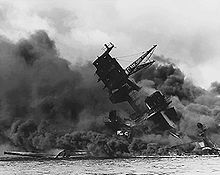
     December 7th, 1941, the date of the surprise attack of Imperial Naval Forces of Japan on the United States at Pearl Harbor, is now an unknowable memory for anyone under the age of medicare or social security. The resonance of the attack, however, continues to define every argument of preparedness for a democratic power, and its stunning effect on the transformation of the United States from isolation to a military colossus makes it one of the most studied events in its history. Sixty nine years ago, at 7:48 am, a beautiful, peaceful Sunday morning at the American naval base at Pearl Harbor, Hawaii was shattered by strafing gunfire and torpedoes released from a overwhelming wave of Japanese planes onto the moored battleships of the US Pacific fleet. The audacity of the attack was transcended by its brilliance in plan and execution. The head of the Japanese imperial Navy, Admiral Isoroku Yamamoto, determined months previously that the only hope of a Japanese long term victory in a climatic war with the United States would be determined by “decisive battle” strategies. A singular devastating attack on the United States capacity to extend across the Pacific Ocean would be the only way to achieve sufficient military parity with the United States to make a war unwinnable for the Americans. This would necessarily involve the destruction of the pacific fleet and base facilities in one mortal blow. No scenario not involving complete surprise would conceivably be successful and Yamamoto concluded the shock and rage of an unprovoked attack would only be mitigated by overwhelming success. In a time of relatively poor communication and logistics, Yamamoto managed to secretly transition a force of 6 attack carriers and 414 attack aircraft thousands of miles across the Pacific to the very limits of Japanese logistical capacity, initiate and coordinate two waves of combined air and sea attack, and successfully neutralize both American air and naval forces with catastrophic impact. America’s sea power lay in 8 massive battleships at dock, and meticulous planning assured an almost complete devastation.

     Almost simultaneously, the USS Oklahoma, California, Nevada, Utah, and West Virginia were struck by torpedo bombers, but the colossal destruction was saved for the USS Arizona, when a dive bomber penetrated the munitions hold with a bomb that created such an explosive force that the massive ship was lifted out of the water and split in half. Of the 402 American planes maintained at the army field complex 337 were destroyed or damaged beyond flight capacity. Multiple other ships, oil depots, barracks, repair facilities, harbor docks, and runways were destroyed. In 110 minutes of sustained attack, at a loss of 55 Japanese airmen and 9 submariners, Japanese forces inflicted 2,386 American deaths and the destruction of 18 American ships, including 5 battleships.

      There are no words to describe the cumulative impact of the attack on the American psyche. Propelled by incautious feelings of superiority of American military capacity and horrendous underestimation of rival Japanese ingenuity and military professionalism, the United States was overwhelmed by the sheer capacity of the Japanese to perform such a complex and precise attack. The thin luck that allowed American carriers to be at sea and avoid the fate of their battleship brethren did little to assuage the feeling of catastrophe and gloom. The expectation that the Japanese, already nine years at war on mainland China, would suddenly be able to extend their reach to the very shores of the United States shook the country to its core.

      President Franklin Roosevelt, as he was so apt to do, seized the moment to focus the disparate tones of shock and disbelief and focus them into righteous crusading anger. In his masterful speech following the attack, he sustained like a drumbeat the “surprise” nature of the attack and its inherent treachery, He focused the energy into quasi- religious fervor with an appeal to “righteous” might and ” inevitable” victory under the auspices of a chosen people assisted by their choosing God. No element of American society, including the most extreme isolationists like Charles Lindbergh, were capable of resisting the compelling nature of his articulate oratory.

      In a time of significant pride of nationhood, the United States converted itself from an army of less than 200, 000 in the space of 20 months to 16 million, became an arsenal of democracy, and in bitter fighting crushed the Japanese in less than four years. Yamamoto himself was sacrificed in an airborne assassination accomplished by US forces in 1943.  His vision of a victory based on the decisive character of the Pearl Harbor attack proved to be ephemeral and within 6 months, the United States managed to put Japan on the permanent defensive by sinking four of the six Japanese carriers involved in the Japanese force responsible for Pearl Harbor.  Pearl Harbor turned out to be a symbol of American resolve that until 9/11 represented the biggest loss of American lives on American soil  since the Civil War.  So long ago now, the direct memories are slowly being replaced by faded newsreel and archaic pictures.  The emotions are long gone and to most Americans grown up in a time of the Japan as one of America’s most intertwined allies and friends, almost impossible to contemplate.  We will always fall short in our ability to long maintain the learning lessons of history, and will always be at some risk to succumb and be dumbfounded by the unperceived rise of the blood red sun against the peaceful dawn.

     A documentary captures the intensity of destruction that allows us to feel a small part of that horrible morning so long ago:

Puccini and the American West

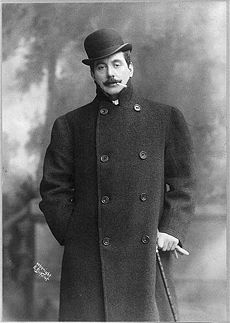
      The Metropolitan Opera of New York City is celebrating the 100th anniversary of the world premiere of Giacomo Puccini’s ode to the American West , La Fanciulla del West.  The opera was first performed by the Met in 1910 as a crowning showpiece of the Met’s then 20th year in existence with a first performance commissioned from the leading opera composer of the time.   Puccini was a fan of the perceived view of the American frontier promoted by Buffalo Bill and his Wild West Show, who had toured Europe with an fantasized version of the west identified by outlaws and cowboys, Indian “savages”, shoot’em ups, and fearless gun play.  He enjoyed setting opera in non-traditional settings that made for spectacular sets and no more fantastic backdrop for an opera existed than the American western frontier that had so captured the imagination of Europe at the turn of the century. 

      With the aggressive and physical presidency of Theodore Roosevelt, the world began seeing a new American power endowed with a unique free spirit culture that many in the tradition and hierarchy bound European society so envied.  Puccini on a trip to New York had seen  “Girl of the Golden West”, a play by American playwright David Belasco.  Belasco had been responsible for one Puccini’s earlier triumphs, Madame Butterfly, a story line regarding an American naval officer in Japan that had translated seamlessly into operatic structure.  Puccini saw the Girl of the Golden West in a similar vein.  He was intrigued and attracted to the “native” elements of American music form and composed motifs of American song, Indian chant, and western expanse into the musical score.   Exotic or not in locale, the opera libretto was in Italian and  followed the traditional Italian 19th century operatic success story.  Boy meets girl. Girl meets another boy.  Boys fight.  Girl expresses her love for boy. Boy expresses his love for girl. Boys fight. Boy turns out to be bad, but good. Girl defends him. Boy meets tragedy – or something along those lines.  The dramatic overtones of love, violence, life, and death made wonderful ingredients for Puccini’s masterful sense of drama and melody, and he possibly was the greatest serious composer of saccharine music.  The aria was the pinnacle weapon of Puccini’s popularity and no one was better at creating the dramatic star vehicle that would leave audience members humming the melodies as they left the theater.  That made opera stars very, very happy and they were rabid to associate themselves with Puccini’s melodies.  The premiere was no different and had the world’s greatest tenor Enrico Caruso in the lead tenor role of Dick Johnson. 

     Giacomo Puccini’s La Fanciulla del West is not his most aria glorifying but is one of his more inventive and serious musical scores and has plenty of beautiful “Puccini moments”.  Placido Domingo has managed to make the Johnson role his own and for twenty years was the signature performer.  Below is his performance in London in 1983 with Carol Neblett in the role of Minnie:


Cyber Warfare Is Here

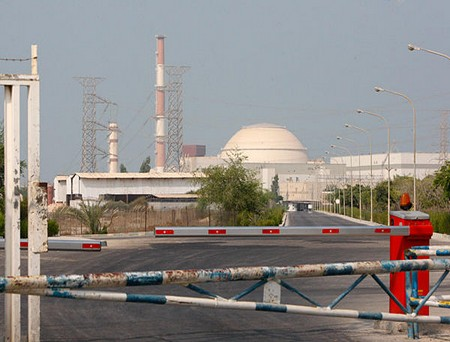
       There have been hints of the power of software assassins to wreak havoc with the world’s computer grid of the past twenty years. These have produced more hysteria than actual damage – the Love virus and the Y2K event, to name a few. Something new and more ominous has presented itself in Iran recently, and across the world software experts are in awe of its sophisticated and cyber-lethal capacity. The apparent spectacular damage it created to delay Iran’s nuclear ambitions has far exceeded the world’s tepid efforts at embargo and sanction.  What seemed to be a minor bump in the road may turn out to be a critical intervention that will allow a sufficient “breather” in the battle to prevent the theocratic and apocolyptic elements of the Iranian dictatorship from living out their anti-Zionist fantasies.  The cyber-weapon of note is known as STUXNET, and the world is just getting to realize the power and potential trouble such technology holds for what has become for all of us a basic staple of life, the computer.

      As the weeks extend from the cyber-attack on Iran’s nuclear enrichment facilities, the information regarding STUXNET becomes more cloak and dagger with every piece of evolving information.  A transfer of the virus was achieved into facilities with the highest security and no outside Internet access.  The virus was so sophisticated that it achieved the control of the critical centrifuges causing them to spin at high and damaging speeds without any monitor showing an aberrant function,  sufficient to damage the fragile and sophisticated machinery without anyone the wiser, the virus then hiding without a trace and waiting for new sites to proliferate and destroy. By the time Iranian scientists realized the damage, the ability to produce the enriched uranium required for atomic weaponry appears to have been significantly set back,  and may require Iran to again attempt to obtain the components of the centrifuges from countries who may no longer have the capacity or desire to give them access to the precision equipment .  

     The question as to who is capable of such sophisticated software capacity, and a recognition of the thousands of man-hours needed to produce such a sophisticated cyber weapon leads inevitably to nation states.  The Cold War was fought by stealth warriors on both sides, whose exploits were popularized in spy novels and Bond movies.  The ‘Bond spys’ were special warriors with special technology not available to the rest of us, designed to protect their nation’s interests and roust out evil plots with all of us being none the wiser in our daily existence.  The realities of STUXNET suggest intelligence agencies of the highest order.  The Iranians with their hatred and paranoia suspect Israel.  The incredible sophistication  of the weapon and its military nature could easily implicate the western intelligence services from the U.S., France, United Kingdom, or Russia.  The reality could be some combination of all of the above given the obvious interests all would have in seeing Iran not being successful in its nuclear ambitions.

     STUXNET has created a new reality and perhaps a new cold war weapon.  In the days of the cold war the fear was nuclear holocaust and we were all trained at school to seek shelter under our desks in case of attack, however ludicrous the level of protection that may have offered.  Now we will have to learn to hide from what is on our desks, as we note the capacity to turn off our communications, our power, our commerce, our lights, and our way of life may just have annouced its first ominous presence on earth.